Warren Buffett has compounded Berkshire Hathaway’s book value at roughly 20% annually for over five decades. His approach is not complicated, but it is disciplined. He buys wonderful businesses at fair prices, holds them for years, and lets compounding do the work.
The principles behind his method are well documented. Focus on businesses you understand. Look for durable competitive advantages. Evaluate management quality. Calculate intrinsic value based on owner earnings. Buy with a margin of safety. Think in decades, not quarters.
What many investors miss is that these principles are entirely actionable using free tools. You do not need a Bloomberg terminal or proprietary models. You need access to financial statements, the patience to study a business, and a framework that keeps you disciplined.
This guide walks through the best free tools for Buffett-style valuation and shows how to use them together.
The Buffett Valuation Framework
Before diving into tools, it helps to understand what you are trying to accomplish. Buffett’s process follows a clear sequence:
- Understand the business. Can you explain how the company makes money and what drives its profitability?
- Confirm a moat exists. Does the company earn consistently high returns on capital with stable margins?
- Evaluate management. Do executives allocate capital intelligently and own meaningful stakes?
- Calculate owner earnings. What cash flow could an owner extract without impairing the business?
- Estimate intrinsic value and demand a margin of safety. Is the current price low enough to protect against errors?
Each step requires specific data. The tools below provide everything you need to complete this analysis without spending a dollar.
TIKR: The Core Platform for Buffett-Style Analysis
TIKR is the most comprehensive free tool for fundamental investors. It aggregates financials, valuation metrics, analyst estimates, ownership data, and earnings transcripts for over 100,000 global stocks. Instead of pulling data from five different sources, you can complete most of your analysis in one place.
In a Buffett-style valuation, TIKR’s strength lies in connecting historical performance to forward expectations. You can view ten years of ROC, margins, and free cash flow to confirm a moat exists. You can review analyst estimates to inform your growth projections. You can check insider ownership to assess management alignment. And you can compare valuation multiples to historical averages to identify the margin of safety.
How to use it:
- Navigate to Financials > Ratios to review ROC, ROE, and margins over time
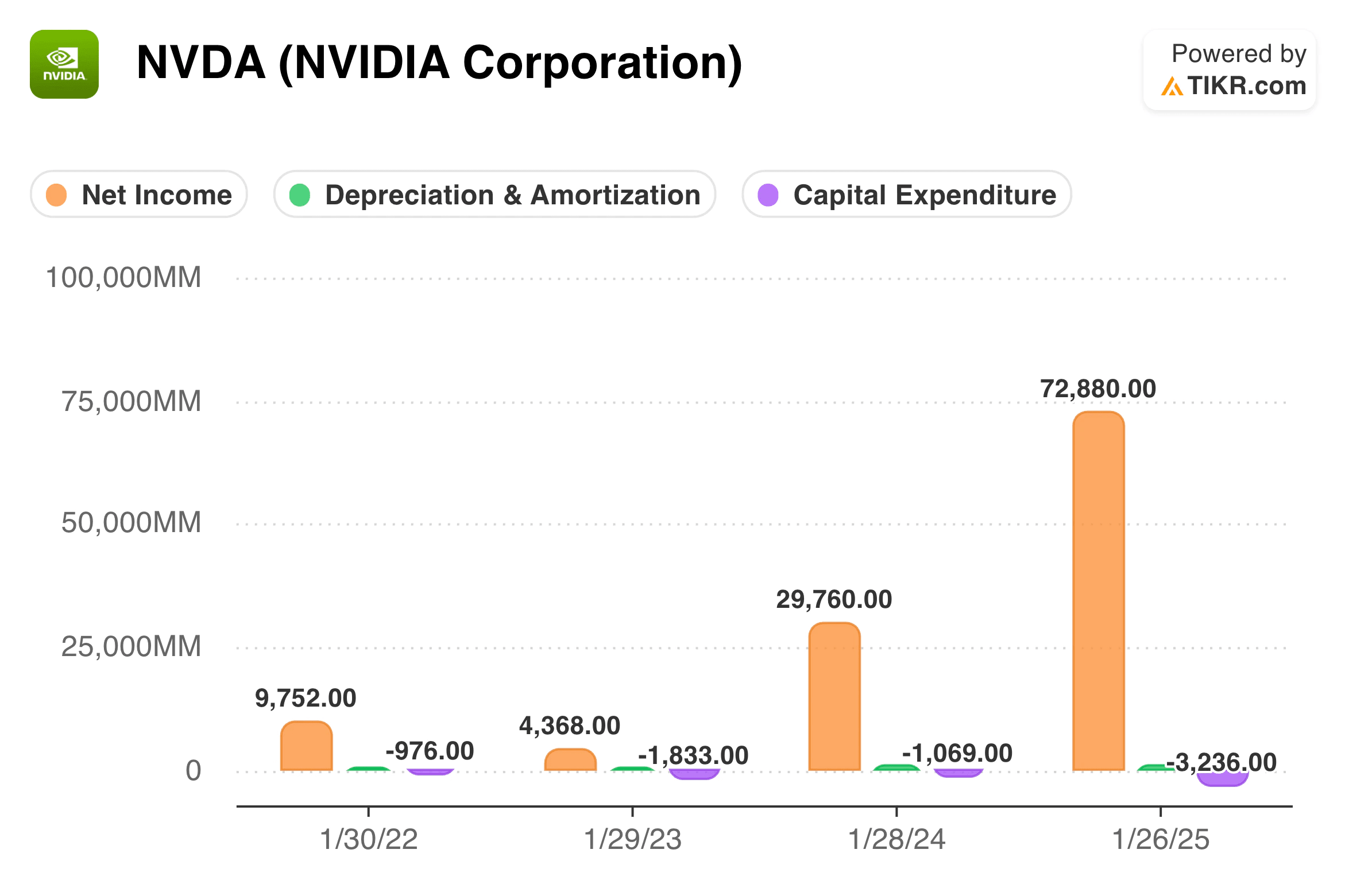
- Use the Cash Flow Statement to calculate owner earnings from net income, depreciation, and capex
- Check the Estimates tab for analyst projections on revenue, earnings, and margins
- Review the Ownership tab for insider holdings and recent transactions
- Compare current multiples to history in the Valuation tab

TIKR handles the quantitative side of Buffett’s framework better than any other free platform.
SEC EDGAR: The Official Source for Deep Reading
Buffett reads annual reports obsessively. He has said that he reads 500 pages a day and that knowledge builds up like compound interest. The SEC’s EDGAR database is where every public company files its official documents, and it remains essential for serious fundamental analysis.
The 10-K annual report contains everything: business description, risk factors, management discussion, and complete financial statements with footnotes. The proxy statement provides information on executive compensation, insider ownership, and board composition. Quarterly 10-Qs provide updates between annual reports.
EDGAR is not user-friendly, but it is complete and authoritative. No summary or third-party data replaces reading the actual filings.
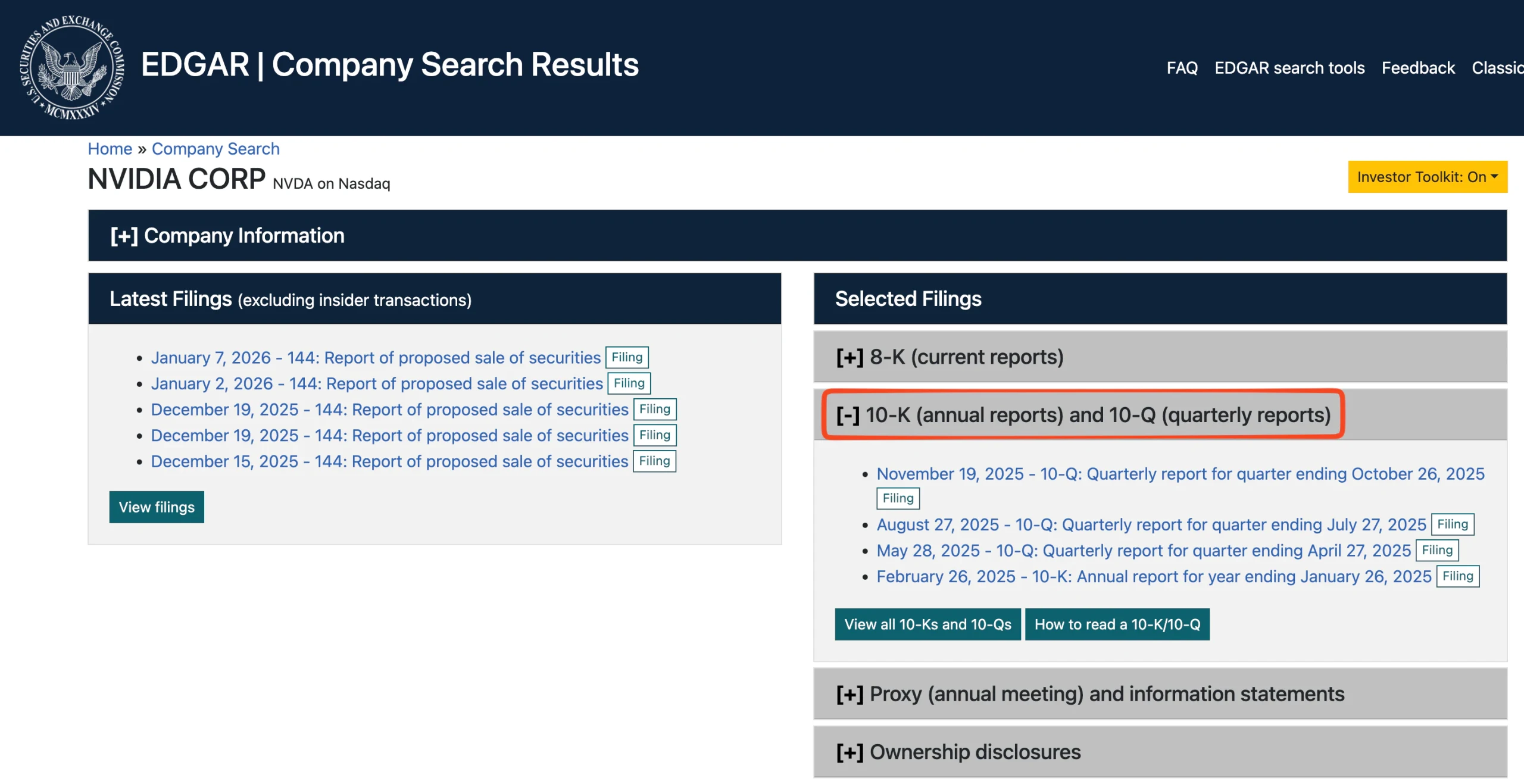
How to use it:
- Search by company name or ticker at sec.gov/edgar
- Start with the most recent 10-K for a comprehensive business overview
- Read the MD&A section for management’s perspective on performance
- Review the proxy statement (DEF 14A) for compensation and ownership details
- Compare current filings to those from five or ten years ago to see how the business has evolved
OpenInsider: Track Executives Do With Their Own Money
Buffett places enormous weight on management quality. He wants leaders who think like owners, not hired hands collecting a paycheck. One of the clearest signals of owner mentality is when executives buy shares on the open market with their own money.
OpenInsider aggregates Form 4 filings from the SEC in real time, making it easy to see which insiders are buying or selling. The interface is simple but fast, and it categorizes transactions by insider title, transaction type, and size.
Insider buying is particularly meaningful because executives already receive equity through compensation. When they go beyond those grants to purchase additional shares, it usually reflects genuine confidence in the business. Buffett has noted that there are many reasons an insider might sell, but typically only one reason they buy.
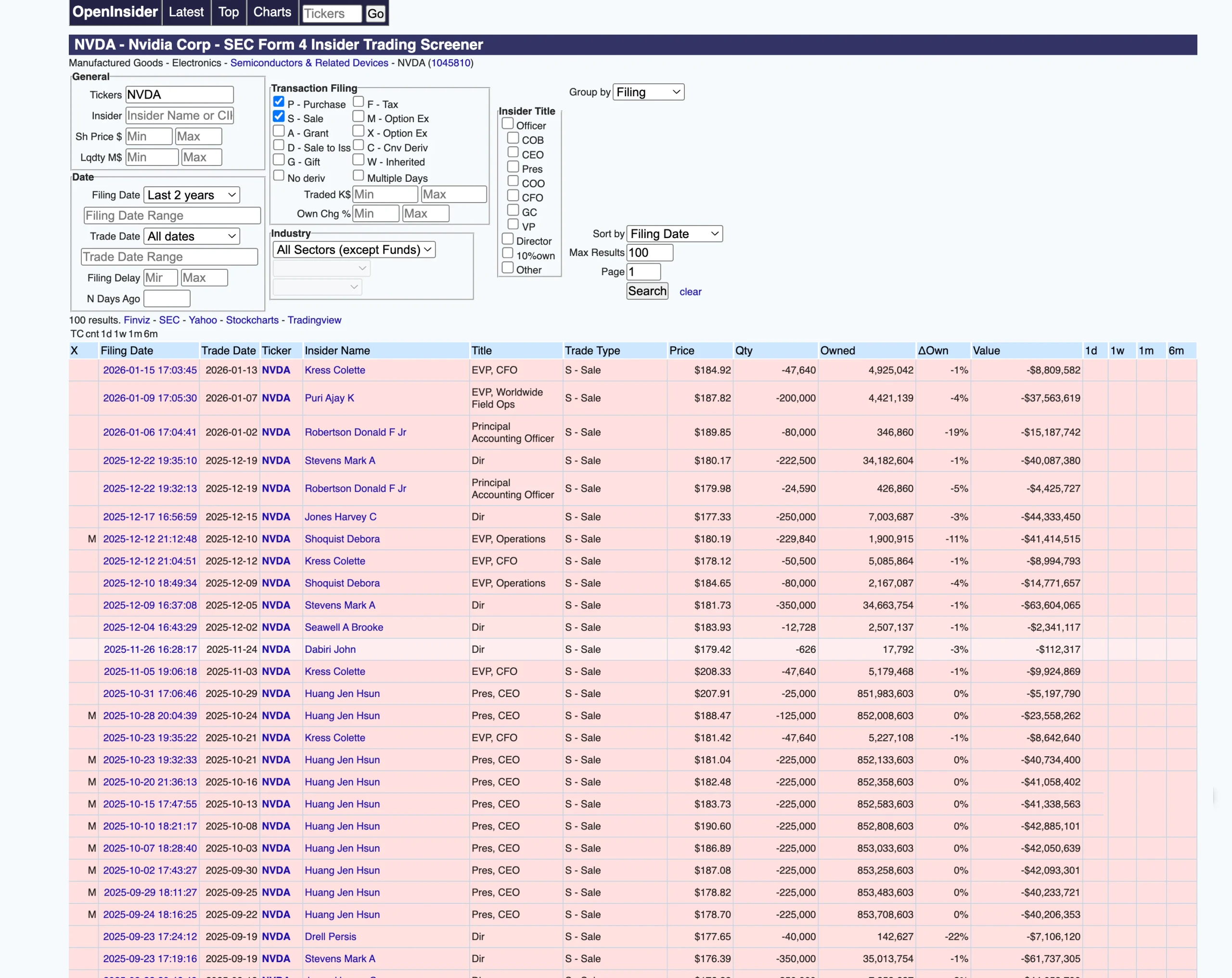
How to use it:
- Visit openinsider.com and search by ticker
- Filter for open-market purchases (code “P”) rather than option exercises or grants
- Look for clusters of buying from multiple executives, which signals broad internal confidence
- Note the size of purchases relative to the insider’s total holdings
- Cross-reference findings with TIKR’s Ownership tab for a complete picture
Track the hedge fund ownership level of each stock with TIKR (It’s free) >>>
Company Investor Relations Pages
Annual shareholder letters often reveal more about management quality than any financial ratio. Buffett’s own letters to Berkshire shareholders are famous for their clarity and honesty. Many other CEOs write thoughtful letters that explain strategy, acknowledge mistakes, and outline long-term priorities.
Company investor relations pages also provide earnings presentations, investor day materials, and supplemental data that may not appear in SEC filings. These resources help you understand how management thinks about the business.

How to use it:
- Read the CEO/CFO’s letter in the annual report for tone and transparency
- Review investor day presentations and press release for long-term strategy and financial targets
- Search for the company name plus “investor relations” to find the IR page
- Compare what management promised in past years to what actually happened
Review stock fundamentals in less than 60 seconds with TIKR (It’s free) >>>
Putting the Tools Together
The most effective workflow combines these resources in sequence. Start broad and narrow down as you build conviction.
Step 1: Search for the company in TIKR and review the business overview. Check whether revenue, margins, and returns on capital have been stable over time. If the numbers look inconsistent or declining, move on.

Step 2: If the quantitative picture looks promising, pull up the most recent 10-K on EDGAR. Read the business description, risk factors, and management discussion. Confirm you understand how the company makes money and what could go wrong.

Step 3: Check OpenInsider for recent insider activity. Look for executives buying shares on the open market, especially after price declines. Heavy insider selling without corresponding buying may warrant caution.

Step 4: Visit the company’s investor relations page and read the CEO’s shareholder letter. Look for honest communication about challenges, not just the celebration of successes. Review any investor-day materials on long-term targets.

Step 5: Use the financial data you have gathered to estimate intrinsic value. From TIKR’s Cash Flow Statement, note net income, depreciation, and capital expenditures to calculate owner earnings. From the Estimates tab, review analyst projections as a baseline for growth assumptions.
Then, in a simple spreadsheet or by hand, project earnings forward, apply a reasonable exit multiple, and discount back to the present. If the current stock price sits at least 25% below your estimate, you may have found an opportunity worth deeper research.
This process quickly filters out most companies, and the few that pass every screen deserve your attention.
A Quick Checklist for Buffett-Style Valuation
Use this framework when evaluating any potential investment:
- Can you explain the business model in simple terms?
- Has ROC remained above 15% for at least five years?
- Are gross and operating margins stable or improving?
- Does free cash flow consistently track or exceed net income?
- Are insiders buying shares on the open market?
- Is the current price at least 25% below your intrinsic value estimate?
If most answers are yes, the company fits the Buffett mold.
Now Live: Discover how much upside your favorite stocks could have using TIKR’s new Valuation Model (It’s free) >>>
TIKR Takeaway
Buffett’s valuation approach does not require expensive tools or complex models. It requires discipline, patience, and access to the right data.
TIKR provides the financial foundation by aggregating ratios, cash flows, estimates, and ownership data into a single platform. SEC EDGAR supplies the official filings for deep reading. OpenInsider tracks whether executives are backing their words with their own capital. Company investor relations pages reveal management quality through shareholder letters and presentations.
Together, these free resources give individual investors everything they need to value companies the way Buffett does. The principles are timeless. The tools make them accessible.
Accurately Value a Stock in Under 30 Seconds
With TIKR’s new Valuation Model tool, you can accurately estimate a stock’s potential share price in 30 seconds or less.
All it takes are three simple inputs:
- Revenue Growth
- Operating Margins
- Exit P/E Multiple
If you’re not sure what to enter, TIKR will enter analysts’ consensus estimates for you.
From there, TIKR calculates the potential share price and total returns under Bull, Base, and Bear scenarios so you can quickly see whether a stock looks undervalued or overvalued today.
See a stock’s true value in under 30 seconds (Free with TIKR) >>>
Looking for New Opportunities?
- Discover which stocks billionaire investors are purchasing, so you can follow the smart money.
- Analyze stocks in as little as 5 minutes with TIKR’s all-in-one, easy-to-use platform.
- The more rocks you overturn… the more opportunities you’ll uncover. Search 100K+ global stocks, global top investor holdings, and more with TIKR.
Disclaimer:
Please note that the articles on TIKR are not intended to serve as investment or financial advice from TIKR or our content team, nor are they recommendations to buy or sell any stocks. We create our content based on TIKR Terminal’s investment data and analysts’ estimates. Our analysis might not include recent company news or important updates. TIKR has no position in any stocks mentioned. Thank you for reading, and happy investing!