Key Stats for Intel Stock
- Pre-market price change for Intel stock: -11%
- $INTC Share Price as of Jan. 22: $54.32
- 52-Week High: $54.60
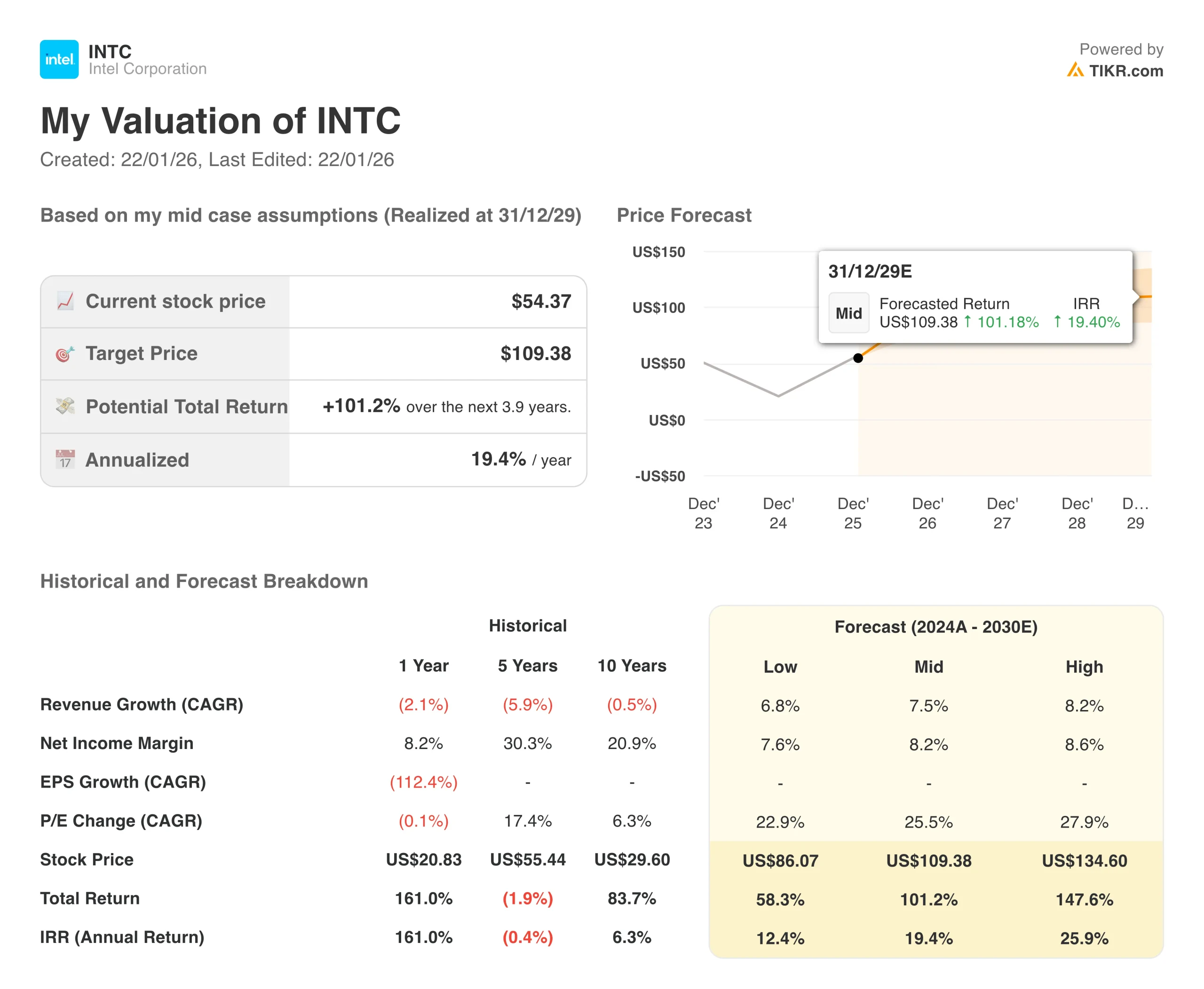
- $INTC Stock Price Target: $42.46
Now Live: Discover how much upside your favorite stocks could have using TIKR’s new Valuation Model (It’s free)>>>
What Happened?
Intel (INTC) stock is getting hammered in pre-market, dropping as much as 11% despite beating Wall Street’s expectations for fourth-quarter results. The culprit? Disappointing guidance for the current quarter caught investors off guard.
The company reported Q4 revenue of $13.7 billion, beating the $13.4 billion analysts expected. Adjusted earnings per share came in at $0.15, nearly double the $0.08 consensus estimate. Those numbers looked solid on the surface.
But then came the guidance.
- Intel projected first-quarter revenue of $11.7 billion to $12.7 billion, with the midpoint of $12.2 billion falling short of the $12.51 billion analysts were expecting.
- Even worse, the company expects to break even on adjusted earnings per share, missing the $0.05 profit analysts anticipated.
CFO David Zinsner explained to CNBC that the weak guidance stems from supply constraints. Simply put, Intel doesn’t have enough chips to meet seasonal demand in Q1. He added that supply should improve starting in the second quarter.
On the earnings call, CEO Lip-Bu Tan dove deeper into the supply issues. He said the company is working to improve production yields—essentially the percentage of chips that come out of the factory working properly. While yields are meeting Intel’s internal targets, Tan admitted they’re “still below what I want them to be.”
The disappointing outlook is a tough pill to swallow for investors who had been riding the Intel stock rally. Shares had surged 147% over the past year on growing optimism about the company’s turnaround efforts and its foundry business.
Much of that excitement centered on Intel’s 18A manufacturing technology, which competes with Taiwan Semiconductor’s cutting-edge 2nm process.
Tan said earlier this month that 18A “over-delivered” in 2025, suggesting the technology is ready for high-volume production. Intel is already using 18A to manufacture its Core Ultra Series 3 processors for laptops.
But investors were also hoping to hear about external customers—companies that would pay Intel to manufacture their chips in Intel’s factories.
Zinsner told CNBC that customers for Intel’s next-generation 14A technology should materialize in the second half of 2026, though he cautioned that Intel likely won’t announce these deals publicly.
“Once we get them, we’re gonna need to start really spending capital on the 14A front, and that’s how you’ll know,” Zinsner said.

The foundry business generated $4.5 billion in revenue during Q4, though much of that comes from making Intel’s own chips rather than chips for outside customers.
Intel’s data center and AI chip sales hit $4.7 billion in Q4, up 9% year-over-year. That growth reflects strong demand for Intel’s server processors as companies build out AI infrastructure.
Tan emphasized that CPUs are becoming increasingly important in AI systems, not just the specialized AI accelerators like Nvidia’s GPUs.
On the flip side, Intel’s Client Computing Group—which sells chips for laptops and desktops—posted $8.2 billion in revenue, down 7% compared to the prior year.
See analysts’ growth forecasts and price targets for Intel stock (It’s free!) >>>
What the Market Is Telling Us About Intel Stock
The brutal selloff in Intel stock tells you everything you need to know: investors had priced in a much stronger outlook for 2026, and the supply-constrained guidance deflated those expectations fast.
Intel stock had been on an incredible run, up nearly 150% over the past year. That rally was built on faith that CEO Lip-Bu Tan could execute a successful turnaround after taking over in March 2025. Between cost cuts, strategic partnerships with Nvidia and the U.S. government, and progress on advanced manufacturing, the narrative was compelling.
But Thursday’s earnings call exposed a harsh reality.
- Intel still can’t produce enough chips to capture all the demand it’s seeing, particularly in the lucrative data center market.
- The company is prioritizing server chips over PC chips with its limited supply, which explains why Client Computing revenue is expected to drop more sharply than Data Center revenue in Q1.
The yield issues Tan mentioned are particularly concerning. Improving yields is crucial for ramping production and reducing costs. If Intel can’t raise yields quickly, it could struggle to capitalize on the AI boom driving demand for both traditional CPUs and custom chips.
There’s also the foundry question. Intel has made significant investments to build a business manufacturing chips for other companies, positioning itself as a U.S.-based alternative to Taiwan Semiconductor.
The U.S. government has poured billions into Intel as part of this strategy, making it the company’s largest shareholder with an $8.9 billion stake. NVIDIA invested another $5 billion.
But Intel still hasn’t landed the kind of marquee external customer that would validate this strategy. Without naming names, Zinsner suggested those deals are coming in the second half of 2026. Investors will be watching closely, but in the meantime, they’re stuck waiting and hoping.
The weak Q1 guidance also raises concerns about whether Intel can sustain the momentum in its data center business.
Demand is clearly there—hyperscalers and enterprises are upgrading servers to handle AI workloads. But if Intel can’t deliver the chips, that business could go to rival AMD instead.
On the positive side, Intel beat Q4 expectations for the fifth consecutive quarter, demonstrating some execution consistency. The company also generated $2.2 billion in adjusted free cash flow in Q4 and expects positive free cash flow for the full year 2026.
Still, with gross margins of just 34.5% expected in Q1—far below the 40%+ levels Intel needs to be truly profitable—the path back to financial health remains long and uncertain. Investors are clearly losing patience with the timeline.
Estimate a company’s fair value instantly (Free with TIKR) >>>
How Much Upside Does Intel Stock Have From Here?
With TIKR’s new Valuation Model tool, you can estimate a stock’s potential share price in under a minute.
All it takes is three simple inputs:
- Revenue Growth
- Operating Margins
- Exit P/E Multiple
If you’re not sure what to enter, TIKR automatically fills in each input using analysts’ consensus estimates, giving you a quick, reliable starting point.
From there, TIKR calculates the potential share price and total returns under Bull, Base, and Bear scenarios so you can quickly see whether a stock looks undervalued or overvalued.
See a stock’s true value in under 60 seconds (Free with TIKR) >>>
Looking for New Opportunities?
- See what stocks billionaire investors are buying so you can follow the smart money.
- Analyze stocks in as little as 5 minutes with TIKR’s all-in-one, easy-to-use platform.
- The more rocks you overturn… the more opportunities you’ll uncover. Search 100K+ global stocks, global top investor holdings, and more with TIKR.
Disclaimer:
Please note that the articles on TIKR are not intended to serve as investment or financial advice from TIKR or our content team, nor are they recommendations to buy or sell any stocks. We create our content based on TIKR Terminal’s investment data and analysts’ estimates. Our analysis might not include recent company news or important updates. TIKR has no position in any stocks mentioned. Thank you for reading, and happy investing!