Key Stats
- Current Price: ~$191 (May 1, 2026 close)
- Q1 2026 Revenue: $48.6B (+2.1% YoY)
- Q1 2026 Adjusted EPS: $1.41 (+45.6% vs. Street estimate of $0.97; -35.3% YoY)
- Q1 2026 GAAP EPS: $1.11 (-44.5% YoY)
- Q1 2026 Adjusted Earnings: $2.8B
- Full-Year Capital Guidance: $18B-$19B (unchanged)
- Full-Year Production Growth Guidance: 7%-10% (reconfirmed)
- Full-Year Buyback Guidance: $2.5B-$3B per quarter (unchanged)
- TIKR Model Price Target: $194
- Implied Upside: ~2%
Chevron Q1 2026 Earnings Breakdown

Chevron stock (CVX) posted Q1 2026 adjusted EPS of $1.41, coming in 45.6% ahead of Street expectations of $0.97, though down 35% from $2.18 in Q1 2025 as lower commodity prices weighed on the year-over-year comparison.
Revenue of $48.6B grew 2.1% year over year, up from $47.6B in Q1 2025 and ahead of the prior quarter’s $46.9B.
The standout driver was production scale: Chevron added approximately 500,000 barrels of oil equivalent per day versus Q1 2025, according to CFO Eimear Bonner on the Q1 2026 earnings call, reflecting the integration of legacy Hess assets and continued organic growth.
TCO production exceeded 1 million BOE per day following repairs to the electrical system and Black Sea logistics issues in February and early March.
The upstream segment benefited from higher realizations, lower DD&A, and favorable operating cost and tax impacts.
Adjusted downstream earnings declined quarter over quarter, driven by unfavorable timing effects totaling approximately $3 billion, according to CFO Bonner on the Q1 2026 earnings call, split evenly between inventory valuation and mark-to-market accounting on paper derivative positions.
Reported earnings were $2.2B, or $1.11 per diluted share, reduced by a $360 million legal reserve charge and $223 million in unfavorable foreign currency effects, according to CFO Bonner on the Q1 2026 earnings call.
Cash flow from operations, excluding working capital, was $7.1B for the quarter, inclusive of approximately $3B in unfavorable special items and timing effects, according to CFO Bonner on the Q1 2026 earnings call.
Share repurchases of $2.5B were executed in the quarter, in line with guidance.
Chevron raised its affiliate distribution guidance by more than $2 billion versus Q1 levels, citing TCO’s return to full production rates, CPChem margin improvement, and Angola LNG running full.
Full-year capital guidance of $18B-$19B and production growth guidance of 7%-10% were both reconfirmed unchanged.
Chevron Stock: Financials
Chevron stock enters Q1 2026 carrying four consecutive years of operating margin compression from the 2022 commodity price peak.

Total revenues fell from a high of $235.9B in 2022 to $195.6B in 2024 and $184.7B in 2025, a 21.7% decline from peak.
Gross margin recovered modestly, rising from 39.5% in 2024 to 41.9% in 2025 as cost of goods sold fell from $118.3B to $107.3B.
Operating income declined from $42.0B in 2022 to $17.6B in 2025, a compression from an 17.8% operating margin to 9.5%.
The 2025 operating margin of 9.5% compares to 13.8% in 2023 and 11.4% in 2024, confirming the compression is sustained, not a one-year event.
Total operating expenses rose from $47.5B in 2021 to $59.7B in 2025, even as revenues fell, creating a structural cost headwind management acknowledged directly on the Q1 2026 call.
CFO Bonner reconfirmed on the Q1 2026 earnings call that Chevron remains on track to deliver $3B to $4B in structural cost reductions by year-end 2026, the primary mechanism the company is deploying to arrest the operating margin slide.
What Does the Valuation Model Say?
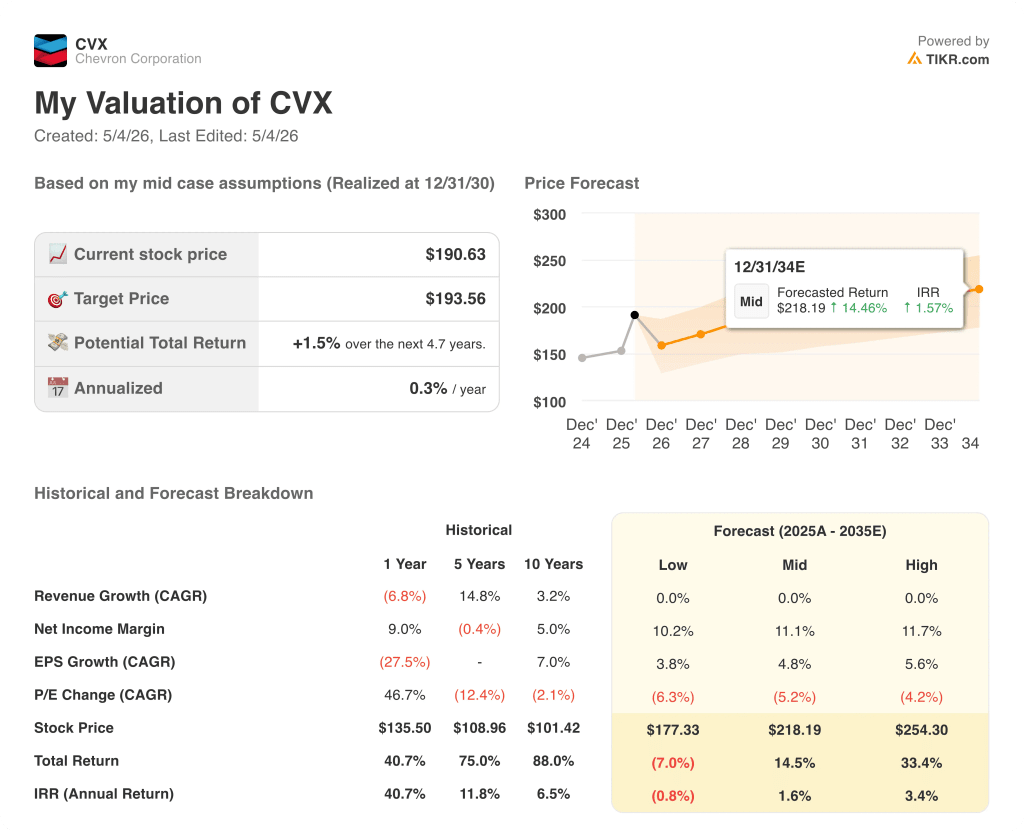
The TIKR model prices Chevron stock at $194, implying roughly 2% upside from the May 1 close of $191.
The mid-case model assumes flat revenue growth (0.0% CAGR through 2035) and an 11.1% net income margin, with EPS growing at a 4.8% CAGR over the same period.
The Q1 2026 results do not materially shift the risk/reward: adjusted EPS beat expectations cleanly, but the year-over-year decline and sustained operating margin compression below 10% confirm that Chevron’s earnings power remains tied to commodity price recovery rather than structural improvement.
At 2% implied upside and a 0.3% annualized return to the mid-case target, Chevron stock is priced for minimal margin of safety under base assumptions; the investment case at current levels is a bet on commodity prices, not multiple expansion.
The core tension: Chevron is running operationally at near-peak efficiency, but the income statement is still eroding; whether the stock deserves a re-rating depends entirely on where oil goes from here.
Bull Case
- TCO exceeded 1 million BOE/day in Q1 2026 and free cash flow guidance of $6B for the asset is unchanged, with upside at prices above $70 Brent, according to CEO Mike Wirth on the Q1 2026 earnings call.
- Approximately $1B of Q1 timing effects on paper derivative positions are expected to unwind in Q2 2026, providing a direct earnings tailwind, according to CFO Bonner on the Q1 2026 earnings call.
- Affiliate distribution guidance was raised by more than $2B above Q1 levels, driven by TCO, CPChem, and Angola LNG, signaling confidence in H2 2026 cash generation.
- The $3B-$4B structural cost reduction target, if delivered by year-end, would directly address operating expense growth that drove operating margin from 17.8% in 2022 to 9.5% in 2025.
Bear Case
- Operating margin has declined every year since 2022, from 17.8% to 9.5% in 2025, and the Q1 2026 EBIT margin of 8.8% shows no improvement in the trajectory.
- The TIKR model’s mid-case assumes 0% revenue CAGR through 2035, meaning the valuation gives Chevron no credit for volume growth, and a miss on the 7%-10% production growth guidance would pressure the stock.
- Unfavorable timing effects of approximately $3B in Q1 2026 highlight structural volatility in reported earnings that can diverge materially from underlying cash generation, complicating valuation.
- The $1.5B Venezuela receivable, expected to be partially recovered by year-end but not fully resolved until 2027, according to CEO Wirth on the Q1 2026 earnings call, keeps a meaningful capital return uncertainty on the table.
Should You Invest in Chevron Corporation?
The only way to really know is to look at the numbers yourself. TIKR gives you free access to the same institutional-quality financial data that professional analysts use to answer exactly that question.
Pull up Chevron Corporation stock and you’ll see years of historical financials, what Wall Street analysts expect for revenue and earnings in the quarters ahead, how valuation multiples have moved over time, and whether price targets are trending up or down.
You can build a free watchlist to track Chevron Corporation alongside every other stock on your radar. No credit card required. Just the data you need to decide for yourself.
Access Professional Tools to Analyze CVX stock on TIKR for Free →