


Key Stats for Coinbase Stock
- Current Price: $195.43
- Target Price (Mid): ~$259
- Street Target: ~$231
- Potential Total Return (Mid): ~33%
- Annualized IRR (Mid): ~3% / year
- Bull Case Target: ~$354
- Bull Case Total Return: ~81%
- Bull Case IRR: ~7% / year
- Earnings Reaction: +4.25% (5/7/26)
- Max Drawdown: -66.39% (2/12/26)
Now Live: Discover how much upside your favorite stocks could have using TIKR’s new Valuation Model (It’s free) >>>
What Happened?
Coinbase Global, Inc. (COIN) peaked at $444.65 in July 2025. Ten months later, the stock trades at $195.43, a decline of more than 56%. In that same period, the company acquired Deribit, the world’s leading crypto options exchange, for $2.9 billion, generated $7.2 billion in full-year 2025 revenue, and hit an all-time high in USDC held in its products. The stock fell anyway.
That contradiction is the central argument about COIN right now. Bears point to Q1 2026: revenue of $1.4 billion missed the ~$1.48 billion Wall Street consensus by 4.45%, the company posted a net loss of $394 million, and the results confirmed how much the business still depends on crypto trading volumes it cannot control. Bulls say the market is pricing a company that no longer exists. This week alone, two developments made that case harder to dismiss.
On May 14, the U.S. Senate Banking Committee advanced the Digital Asset Market Clarity Act, a bill that would create a comprehensive regulatory framework for digital assets by a vote of 15 to 9, sending COIN up 10% on the session. That same day, Coinbase announced it had become the official USDC treasury deployer on Hyperliquid, one of the fastest-growing on-chain trading networks, where USDC supply has grown to roughly $5 billion, doubling year over year. Neither event changes Q1. Both change what the next several years could look like.
What Q1 Actually Said
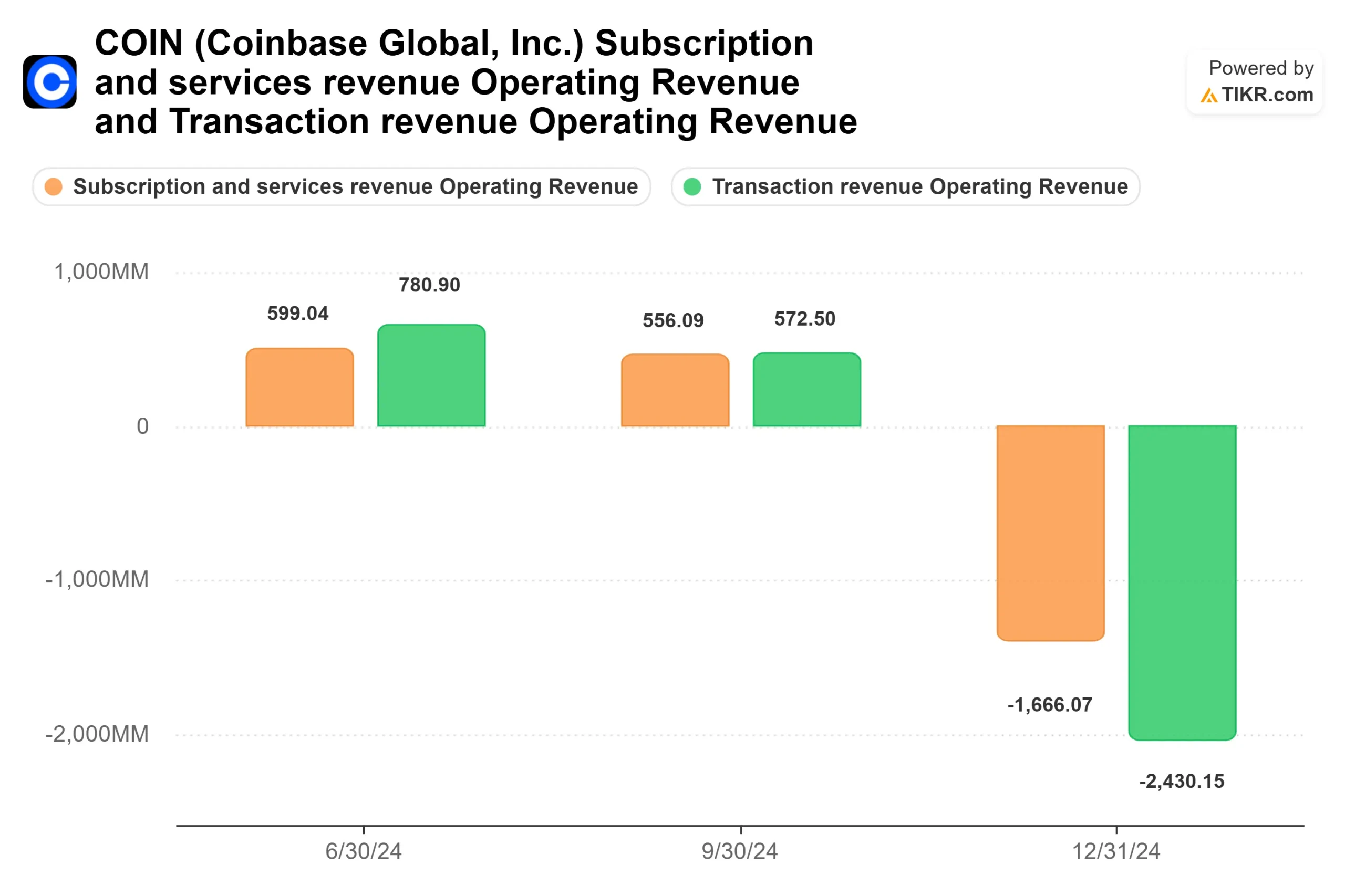
Q1 revenue of $1.4 billion fell 21% quarter-over-quarter. Transaction revenue of $756 million bore the brunt: consumer was down 23% against a 35% drop in overall consumer spot volumes, and institutional dropped 27% as lower volatility reduced hedging demand at Deribit, per CFO Alesia Haas on the earnings call. A $482 million non-cash markdown on crypto held for investment pushed the net GAAP loss to $394 million.
Beneath the headline, two things stand out. First, Coinbase hit every guidance range it set in February. Subscription and services revenue of $584 million landed within the $550 million to $630 million range, and technology plus G&A of $902 million came in below the $925 million to $975 million target. In a quarter Haas described as “genuinely tough,” the company controlled what it could.
Second, the Everything Exchange, Coinbase’s push to offer every major asset class on one platform, is producing real revenue faster than expected. Retail derivatives crossed $200 million in annualized revenue. Prediction markets hit $100 million in annualized revenue by March, just two months after launch. Non-crypto contracts, including gold, silver, and oil, grew more than 4x quarter-over-quarter, per CEO Brian Armstrong. Per TIKR’s Beats & Misses data, GAAP EPS came in at ($1.49) against a consensus of ($0.13), a miss driven largely by the non-cash markdown rather than the operating business, which stayed profitable at $303 million in adjusted EBITDA.
See historical and forward estimates for Coinbase stock (It’s free!) >>>
Three Structural Shifts Still Being Underpriced
The bull case does not require a crypto price surge. It requires three things already in motion to keep moving.
Regulatory clarity is weeks away, not years. Chief Legal Officer Paul Grewal told investors the CLARITY Act is expected to reach a floor vote in early summer, with a signed bill by end of summer. The legislation draws regulatory lines between the SEC and CFTC for digital assets, clarifies rules for exchanges and custodians, and provides a framework for tokenized securities. Armstrong compared the expected impact to the GENIUS Act for stablecoins, after which “a couple hundred large companies” announced integrations in the subsequent months. According to Polymarket, the probability of the CLARITY Act passing in 2026 rose from 46% to 64% following the stablecoin yield compromise in early May.
USDC economics are locked in and growing. Average USDC held in Coinbase products hit a new all-time high of $19 billion in Q1, even as the total crypto market cap fell more than 20%. Stablecoin transaction volume doubled in the quarter, with USDC and partner stablecoins driving more than 80% of total volume. Coinbase captures roughly 50% of all USDC economics, per Armstrong on the Q1 call, and that revenue-share contract with Circle auto-renews every three years in perpetuity and cannot be terminated. The Hyperliquid deal extends USDC’s dominance into one of the most active on-chain derivatives venues in the world, where USDC supply has already doubled year over year.
Agentic commerce is an entirely new revenue surface. As of Q1, 99% of transactions through the x402 protocol, an open standard for AI agent payments that Coinbase incubated and contributed to the Linux Foundation, settled in USDC, and more than 90% of agentic stablecoin transaction volumes settled on Coinbase’s Base network. Contributors to x402 now include Cloudflare, AWS, Stripe, Shopify, and Google. Armstrong noted that the tokenized real-world asset market is expected to reach $16 trillion by 2030. Even a fraction of that activity settling on USDC and Base is not captured in the current consensus estimates.
Coinbase One, the company’s paid subscription product, crossed 1 million paid subscribers in Q1, independent of broader crypto market conditions. Haas noted that One subscribers generate incrementally higher trading volume and revenue on a recurring base that compounds regardless of where Bitcoin closes on any given week.
How Coinbase Is Priced Against Peers
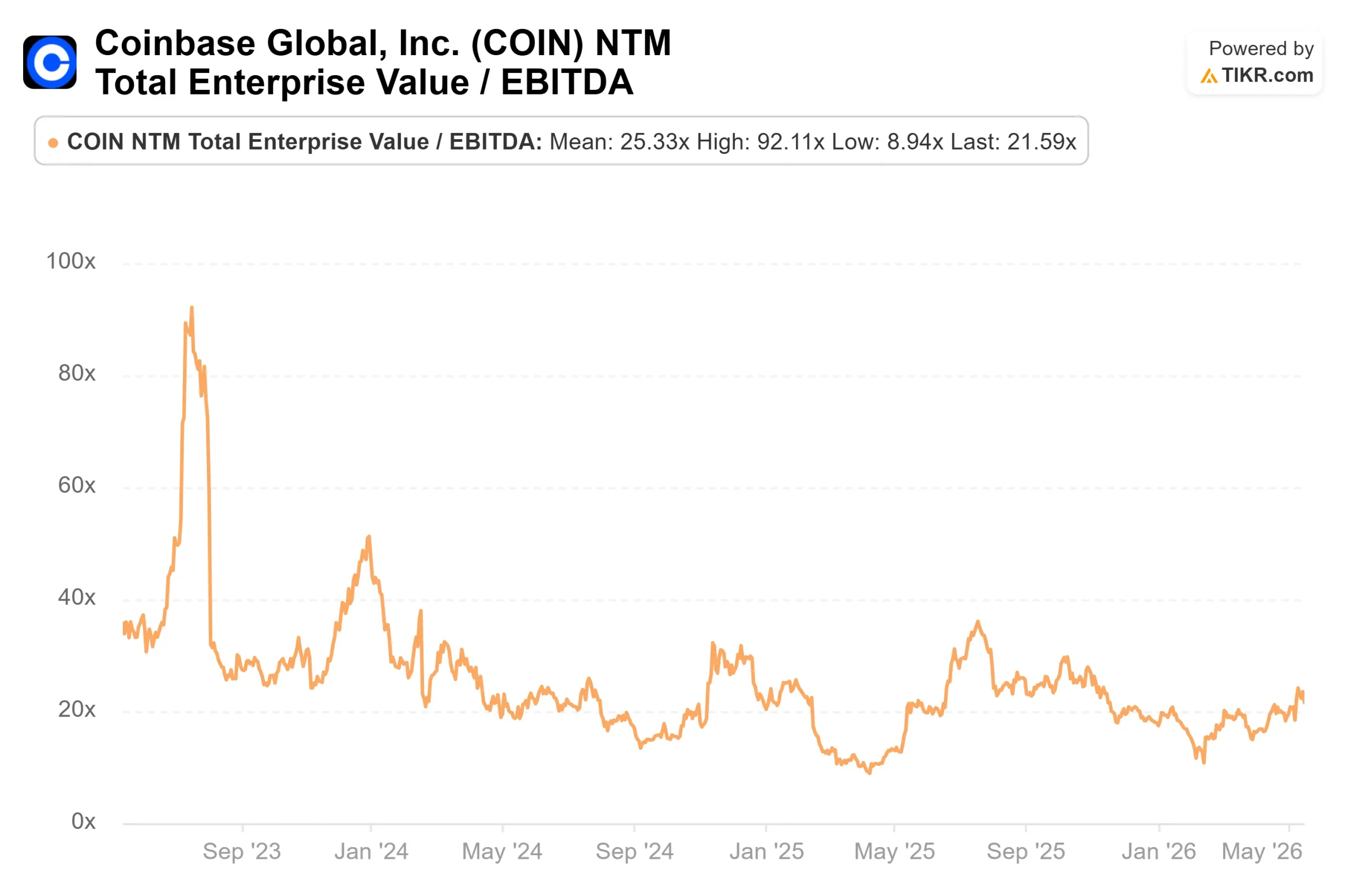
Coinbase trades at 21.59x NTM EV/EBITDA, per TIKR’s Competitors data, against a Capital Markets peer median of around 11.26x. Robinhood Markets (HOOD) trades at 34.51x NTM P/E and Galaxy Digital (GLXY) at 26.77x NTM EV/EBITDA. On NTM EV/Revenue, COIN is at 7.64x versus a peer median of 3.27x.
The premium reflects a combination no listed peer holds: a regulated exchange, a stablecoin network capturing around 50% of USDC economics, a developer platform integrated by some of the world’s largest tech companies, and a blockchain processing more than 90% of agentic stablecoin volumes. The OCC conditionally approved a national trust bank charter for Coinbase in April 2026, which would replace its patchwork of state licenses with a single federal framework for institutional custody.
The counterargument is real: transaction revenue remains cyclical, and subscription and services revenue of $584 million per quarter is not yet large enough to fully absorb a soft trading environment. That gap is what keeps the multiple volatile.
See how Coinbase performs against its peers in TIKR (It’s free!) >>>
TIKR Advanced Model Analysis
- Current Price: $195.43
- Target Price (Mid): ~$259
- Potential Total Return (Mid): ~33%
- Annualized IRR (Mid): ~3% / year

See analysts’ growth forecasts and price targets for Coinbase stock (It’s free!) >>>
The TIKR model is built on mid-case assumptions realized at 12/31/34. The mid case projects around 5% revenue compound annual growth rate (CAGR) and a net income margin of around 20%, arriving at a target price of around $259 and a total return of around 33%, or around 3% annualized.
The two primary CAGR drivers are USDC subscription revenue, which grows with stablecoin adoption independent of crypto price cycles, and derivatives revenue through the Deribit integration. Armstrong confirmed on the Q1 call that Deribit will be “fully integrated in 2026,” unifying spot, perpetuals, futures, and options on a single platform. The margin driver is cost discipline: Coinbase guided full-year 2026 adjusted expenses to $4.3 billion to $4.6 billion, roughly $500 million below its Q4 2025 annualized run rate, following the 700-person reduction in May. The primary risk is a prolonged suppression of crypto trading volumes, which would prevent free cash flow from recovering toward the $3.1 billion consensus estimate for 2027.
The bull case, at around 5.1% revenue CAGR and a net income margin approaching 21%, arrives at around $354 and around 81% total return, or around 7% annualized through 12/31/34. That scenario does not require a supercycle. It requires USDC to continue gaining share, Deribit to scale toward its potential, and CLARITY to unlock institutional integrations. All three were measurably closer this week than a month ago.
The bear case at around $185 prices in a prolonged crypto winter and minimal CLARITY tailwind, implying a (5.4%) total loss. At $195.43, the stock is trading just above that floor, with limited downside relative to the upside in either the mid or bull scenario.
Conclusion
The first real test of the bull thesis is the CLARITY Act floor vote, expected in June or July per Grewal’s Q1 call remarks. Watch whether the final legislation preserves activity-based stablecoin rewards and draws clean SEC vs. CFTC lines. Those two provisions determine whether the institutional capital Armstrong is counting on flows through Coinbase’s products or gets routed around them.
The second test is Q2 transaction revenue. Coinbase disclosed approximately $215 million in transaction revenue through early May. That pace needs to accelerate through June. If Q2 subscription and services revenue lands above the $645 million guidance ceiling and transaction revenue recovers meaningfully, the market will begin repricing the diversification thesis. If both disappoint, the bear case at $185 is the level to watch.
The stock is 56% off its high, sitting just above the model’s downside scenario, with a regulatory unlock potentially weeks away and a stablecoin business hitting all-time highs. That setup rarely stays unpriced for long.
See what stocks billionaire investors are buying so you can follow the smart money with TIKR.
Should You Invest in Coinbase?
The only way to really know is to look at the numbers yourself. TIKR gives you free access to the same institutional-quality financial data that professional analysts use to answer exactly that question.
Pull up Coinbase, and you’ll see years of historical financials, what Wall Street analysts expect for revenue and earnings in the quarters ahead, how valuation multiples have moved over time, and whether price targets are trending up or down.
You can build a free watchlist to track Coinbase alongside every other stock on your radar. No credit card required. Just the data you need to decide for yourself.
Analyze Coinbase on TIKR Free →
Looking for New Opportunities?
- See what stocks billionaire investors are buying so you can follow the smart money.
- Analyze stocks in as little as 5 minutes with TIKR’s all-in-one, easy-to-use platform.
- The more rocks you overturn… the more opportunities you’ll uncover. Search 100K+ global stocks, global top investor holdings, and more with TIKR.
Disclaimer:
Please note that the articles on TIKR are not intended to serve as investment or financial advice from TIKR or our content team, nor are they recommendations to buy or sell any stocks. We create our content based on TIKR Terminal’s investment data and analysts’ estimates. Our analysis might not include recent company news or important updates. TIKR has no position in any stocks mentioned. Thank you for reading, and happy investing!


