Key Stats for Lyft Stock
- Pre-market price change for Lyft stock: -3%
- $LYFT Share Price as of May. 7: $14
- 52-Week High: $26
- $LYFT Stock Price Target: $19.43
Now Live: Discover how much upside your favorite stocks could have using TIKR’s new Valuation Model (It’s free)>>>
What Happened?
Lyft (LYFT) stock slipped roughly 3% in after-hours trading after the company reported first-quarter earnings that came in below what Wall Street had expected.
The company earned 4 cents per share, missing the average analyst estimate of 5.7 cents. The gap was partly driven by costs tied to recent acquisitions as Lyft continues its push to expand internationally and move upmarket.
Gross bookings — which include fares, taxes, tolls, and fees — came in at $4.95 billion, just ahead of the $4.91 billion analysts had penciled in.
But the earnings miss was enough to spook investors, even after shares briefly spiked when the results first dropped.
Lyft stock is now down 27% year-to-date heading into the print, so the after-hours decline adds more pressure to an already rough stretch for shareholders.
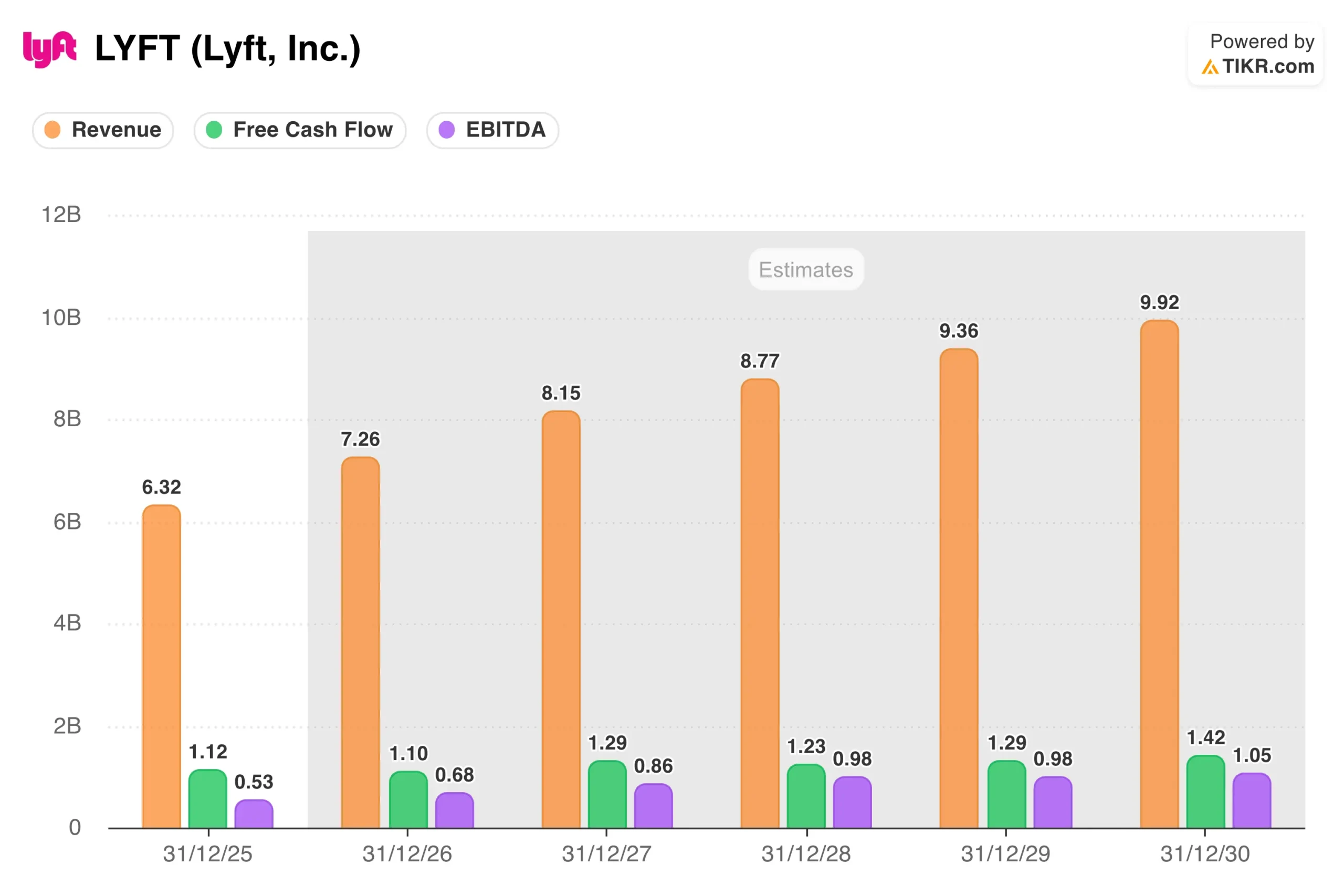
Lyft has been spending heavily to close the gap with Uber and grow outside North America. The company bought European taxi app Freenow last year and just this week closed its acquisition of UK-based Gett.
It also picked up TBR Global Chauffeuring — a Glasgow-based luxury ride service — back in October.
All of that activity comes with integration costs, and those expenses are clearly showing up in the bottom line right now.
CEO David Risher has been candid about the strategy. On the earnings call, he pointed to the company’s growing presence in more than 120 countries and highlighted Nashville as a key market where Lyft plans to launch Waymo’s autonomous vehicles on its platform later this summer.
See analysts’ growth forecasts and price targets for Lyft stock (It’s free) >>>
What the Market Is Telling Us About Lyft Stock
Beyond the earnings miss, the number of rides also disappointed. Lyft recorded 236.9 million rides in the quarter, falling short of the 241.5 million analysts had expected.
The company blamed severe winter storms in the Northeast, which it says wiped out more than three million rides. Bikes and scooters — which are heavily concentrated in that region — took the biggest hit.
Despite the miss, Lyft stock may find some support from the company’s forward guidance. For the second quarter, Lyft is projecting gross bookings of $5.30 billion to $5.43 billion, which tops the $5.31 billion consensus estimate. Adjusted EBITDA guidance of $160 million to $180 million landed roughly in line with expectations.
CFO Erin Brewer noted that high-value ride modes — think Lyft Black, chauffeur services, and premium tiers — grew 35% year over year. The company is deliberately leaning into this shift, expecting gross bookings growth to outpace overall ride volume as the mix moves upmarket.
California is also showing early signs of a recovery following insurance reform in the state, with demand in the region beginning to accelerate into Q2.
The reaction to Lyft stock after earnings reflects a familiar tension — solid top-line momentum, but profitability still under pressure as the company spends to grow.
The acquisitions make strategic sense for the long term, but they’re creating short-term drag that the market isn’t willing to ignore.
If Lyft can start showing that its European expansion and premium push are paying off in margins, the story could change. For now, investors seem content to wait and see.
Estimate a company’s fair value instantly (Free with TIKR) >>>
How Much Upside Does Lyft Stock Have From Here?
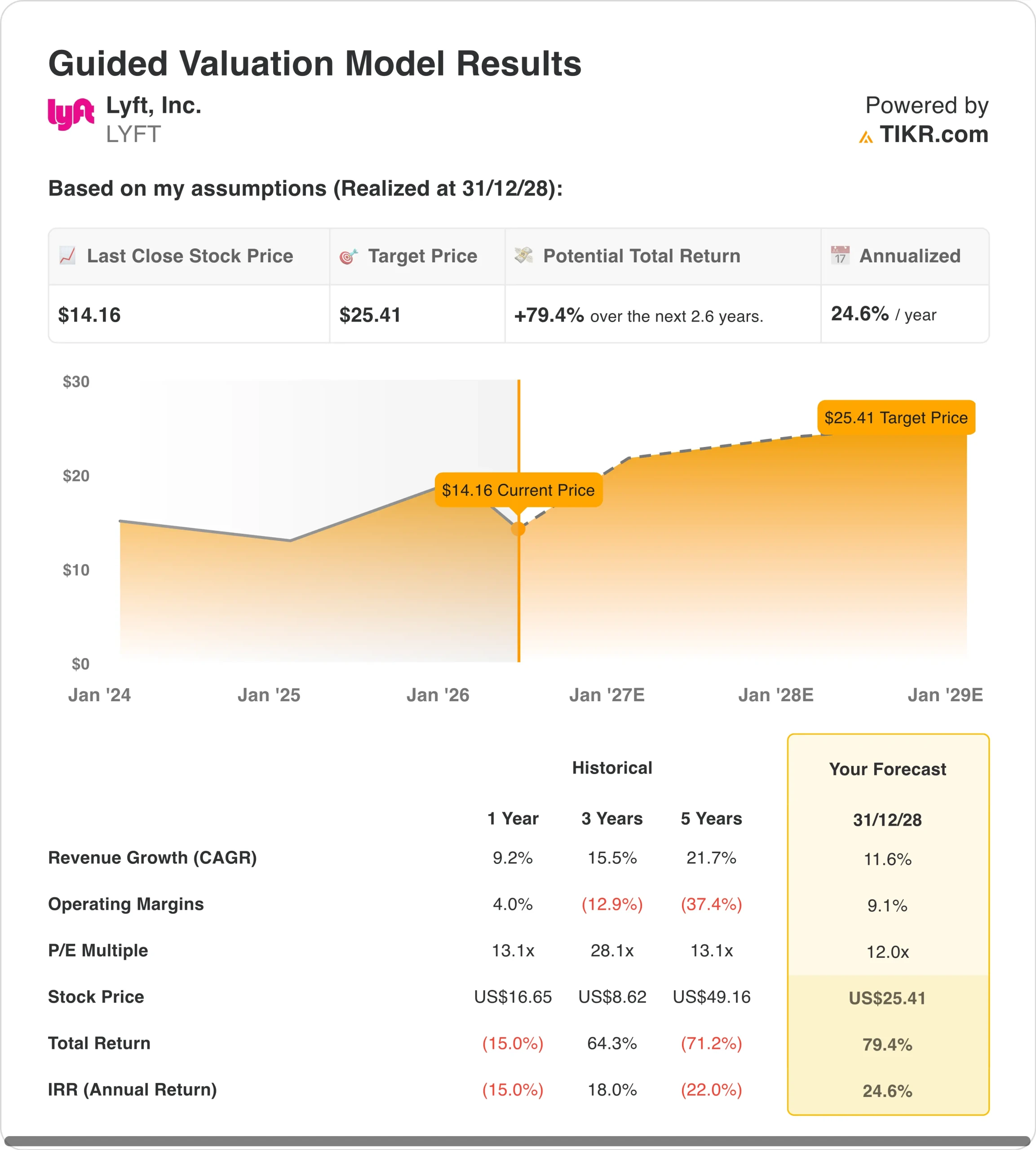
With TIKR’s new Valuation Model tool, you can estimate a stock’s potential share price in under a minute.
All it takes is three simple inputs:
- Revenue Growth
- Operating Margins
- Exit P/E Multiple
If you’re not sure what to enter, TIKR automatically fills in each input using analysts’ consensus estimates, giving you a quick, reliable starting point.
From there, TIKR calculates the potential share price and total returns under Bull, Base, and Bear scenarios so you can quickly see whether a stock looks undervalued or overvalued.
See a stock’s true value in under 60 seconds (Free with TIKR) >>>
Looking for New Opportunities?
- See what stocks billionaire investors are buying so you can follow the smart money.
- Analyze stocks in as little as 5 minutes with TIKR’s all-in-one, easy-to-use platform.
- The more rocks you overturn… the more opportunities you’ll uncover. Search 100K+ global stocks, global top investor holdings, and more with TIKR.
Disclaimer:
Please note that the articles on TIKR are not intended to serve as investment or financial advice from TIKR or our content team, nor are they recommendations to buy or sell any stocks. We create our content based on TIKR Terminal’s investment data and analysts’ estimates. Our analysis might not include recent company news or important updates. TIKR has no position in any stocks mentioned. Thank you for reading, and happy investing!