Key Stats for Micron Stock
- Current Price: $874.66
- Target Price (Mid): ~$899
- Street Target: ~$1,507
- Potential Total Return (Mid): ~3%
- Annualized IRR (Mid): ~1% / year
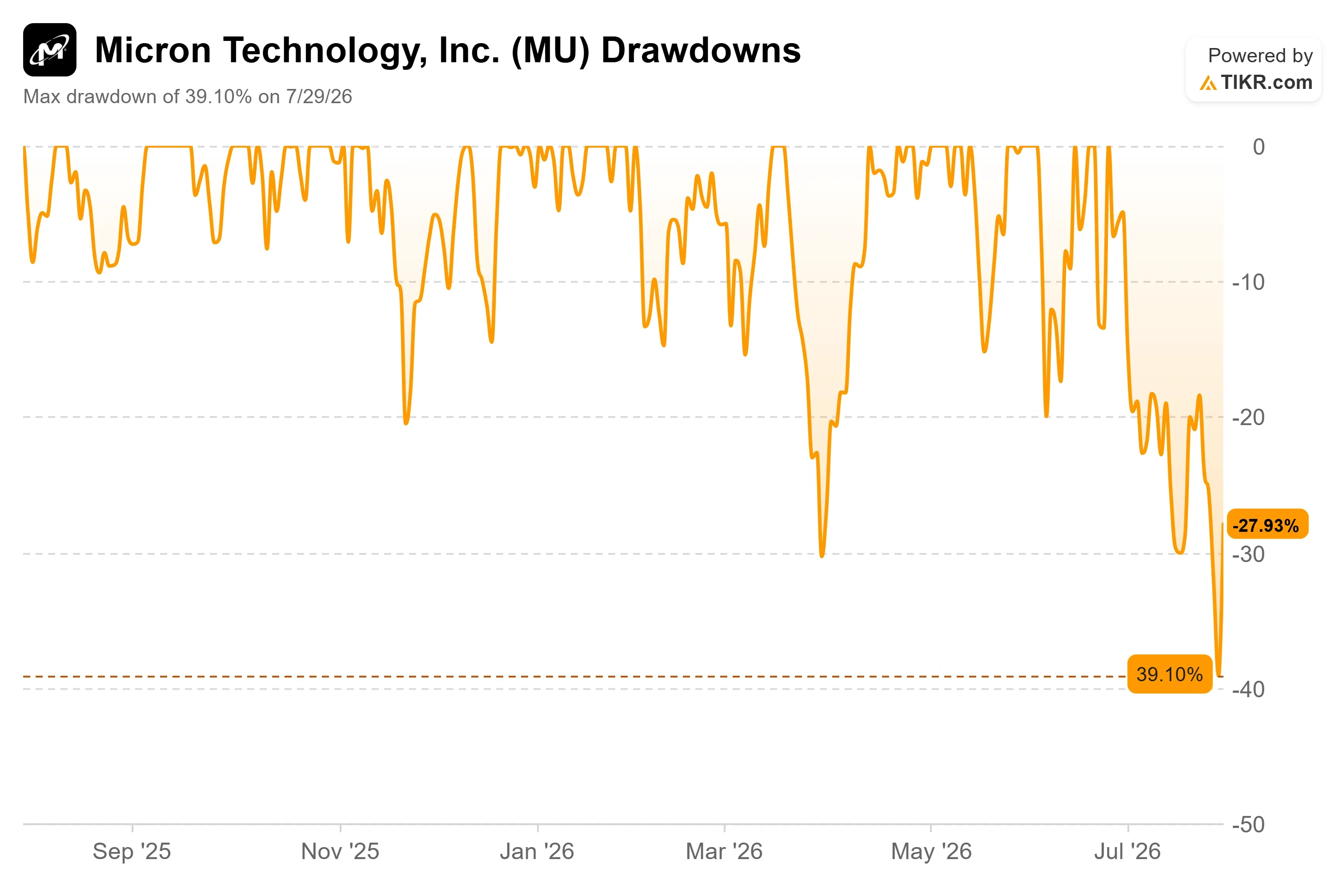
- Max Drawdown: 39.10% peak-to-trough (July 29, 2026)
Now Live: Discover how much upside your favorite stocks could have using TIKR’s new Valuation Model (It’s free) >>>
What Happened?
Micron Technology (MU) closed up 18.36% on July 30, its sharpest one-day jump in months, and the trigger had almost nothing to do with Micron. The move came the morning after Samsung reported record quarterly earnings and told investors the memory shortage driving those profits would deepen in 2027 and last through 2028. Shares had slid to a $739 close on Wednesday, down roughly 20% over four sessions, so a rival’s blowout print became the spark that reversed the slide. The stock added another 5% overnight to trade near $919.
That leaves an uncomfortable read. A company sitting on record revenue and 16 signed supply contracts needed a competitor’s earnings to move its stock. The tension now is whether Samsung’s warning confirms a durable shortage worth buying, or whether a name that rallied roughly 24% off Wednesday’s low in two sessions is trading on sentiment rather than fundamentals.
See historical and forward estimates for Micron stock (It’s free!) >>>
Samsung’s Warning Did What Micron’s Own Results Could Not
Samsung’s CFO Sooncheol Park told analysts that unmet demand from this year will carry into next, and that supply constraints will grow more severe in 2027 before the shortage persists through 2028. Operating profit at the Korean giant rose roughly 19-fold year over year, driven almost entirely by memory. For Micron holders, the value was not in Samsung’s numbers but in Samsung’s forecast, because it echoed what Micron’s own management said a month earlier.
On the June 24 fiscal Q3 call, CEO Sanjay Mehrotra put it plainly: “We see tightness continuing beyond 2027.” He added that even as supply improves gradually in 2028, “we currently do not have line of sight as to when memory supply will be able to catch up with increasing demand.” He also spelled out why that gap is so hard to close. New supply depends on greenfield fabs that face long construction lead times, shortages of skilled trades, complex permitting, and rising costs per bit as HBM consumes an outsized share of wafers. When the largest memory maker in the world independently confirms that same supply picture on its own call, the thesis gets harder for skeptics to dismiss. The read-through is what markets bought on Thursday, not Samsung itself.
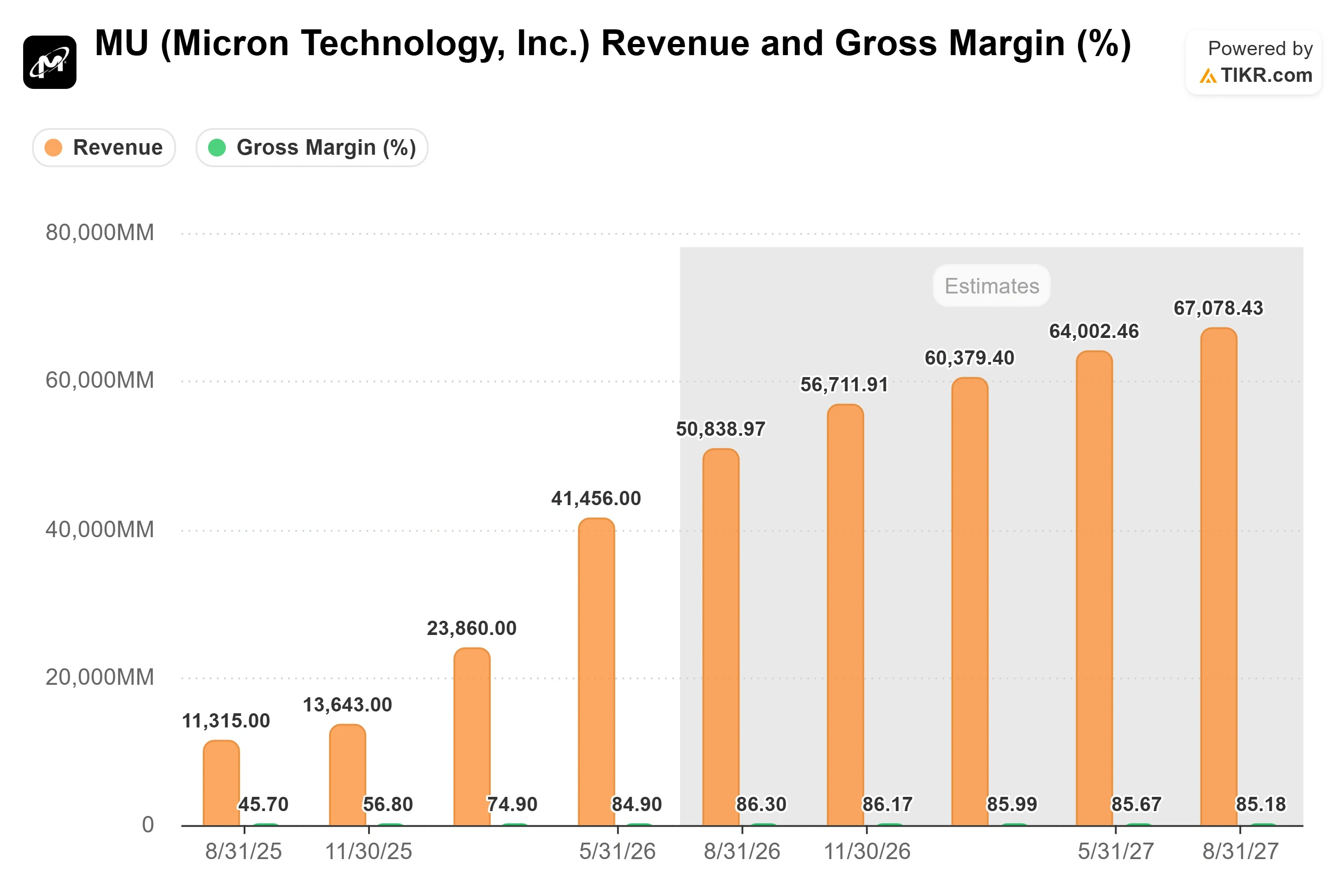
Micron’s fiscal Q3 gave that thesis real weight. Revenue hit a record $41.46 billion, up 346% year over year, non-GAAP EPS of $25.11 crushed the TIKR consensus estimate of $20.71, and gross margin reached a record 84.9%. Management reported record free cash flow of roughly $18 billion, from operating cash flow of $25.4 billion less $7.1 billion of capital spending, and the balance sheet now holds a net cash position of $24.4 billion after a BBB+ credit upgrade. Underpinning it are 16 strategic customer agreements, non-cancelable take-or-pay contracts that lock buyers into fixed volumes over multiyear terms, backed by $22 billion in customer deposits and financial commitments. Management says that even at the floor prices inside those contracts, gross margins would sit above the peak of any past cycle.
Cheap on the Surface, and a Model That Won’t Buy It
The bull case has a live counterweight, and it showed up the same week. HSBC’s Alastair Pinder flagged the fear that China floods the memory market with cheap chips, a worry underscored by Chinese DRAM maker CXMT’s recent public listing to fund capacity expansion. Note what that is, though: a stated capacity plan, not oversupply arriving tomorrow. Most analysts still place meaningful new industry supply in 2028 at the earliest, which is precisely the year Samsung and Micron both flag as the soonest any relief could come.
On valuation, Micron looks cheap on the surface. The stock trades at an NTM P/E near 6 times and an NTM EV/EBITDA of 4.62 times. Against peers on the same NTM EV/EBITDA basis, that sits below ASML at 22.86 times and MediaTek at 31.28 times, though closer to fellow memory maker SK Hynix at 2.21 times. Memory multiples compress exactly when earnings look strongest, because the market prices in the downturn that has historically followed every boom. Whether today’s discount is an opportunity or a warning is where TIKR’s model and Wall Street split hard, and that split is the real decision facing a buyer at $874.
See how Micron performs against its peers in TIKR (It’s free!) >>>
TIKR Advanced Model Analysis
- Current Price: $874.66
- Target Price (Mid): ~$899
- Potential Total Return (Mid): ~3%
- Annualized IRR (Mid): ~1% / year

See analysts’ growth forecasts and price targets for Micron stock (It’s free!) >>>
That target sits barely above today’s price, against a Street mean near $1,507. Neither can be right, and the gap between them is the story for anyone buying here. The mid-case leans on two revenue drivers: AI-led data center demand, already running above a $100 billion annualized rate, and rising memory content in autos, where L2+ vehicles carry over five times the memory of an average car. The margin driver is the SCA floor pricing that management says preserves margins above any prior cycle peak. The primary risk is structural: the model prices in P/E compression every year, reflecting the market’s refusal to award a durable multiple to a business it still treats as cyclical.
The upside case is that contracted revenue and a shortage lasting through 2028 finally break memory’s cyclical discount, pulling the price toward the Street’s number. The downside case is that new capacity and Chinese supply arrive faster than expected, memory prices roll over, and the model’s cautious target proves generous rather than conservative.
Conclusion
The next real test is Micron’s fiscal Q4 report on September 29, where management has guided to record revenue of $50 billion and EPS around $31. Watch two things. First, whether gross margin holds near the guided 86%, because any meaningful slip there is the first sign pricing power is peaking. Second, the RPO disclosure on the 14 larger contracts, expected to reach roughly $100 billion, which will show how fast contracted revenue actually feeds the model. Good looks like margins holding and RPO landing at or above that figure. Bad looks like a margin miss and softer forward commitments. Until then, remember that Thursday’s rally was borrowed conviction from a rival’s call, and borrowed conviction can be repossessed just as fast.
See what stocks billionaire investors are buying so you can follow the smart money with TIKR.
Should You Invest in Micron?
The only way to really know is to look at the numbers yourself. TIKR gives you free access to the same institutional-quality financial data that professional analysts use to answer exactly that question.
Pull up Micron, and you’ll see years of historical financials, what Wall Street analysts expect for revenue and earnings in the quarters ahead, how valuation multiples have moved over time, and whether price targets are trending up or down.
You can build a free watchlist to track Micron alongside every other stock on your radar. No credit card required. Just the data you need to decide for yourself.
Looking for New Opportunities?
- See what stocks billionaire investors are buying so you can follow the smart money.
- Analyze stocks in as little as 5 minutes with TIKR’s all-in-one, easy-to-use platform.
- The more rocks you overturn… the more opportunities you’ll uncover. Search 100K+ global stocks, global top investor holdings, and more with TIKR.
Disclaimer:
Please note that the articles on TIKR are not intended to serve as investment or financial advice from TIKR or our content team, nor are they recommendations to buy or sell any stocks. We create our content based on TIKR Terminal’s investment data and analysts’ estimates. Our analysis might not include recent company news or important updates. TIKR has no position in any stocks mentioned. Thank you for reading, and happy investing!