Key Stats for Eli Lilly Stock
- Current Price: $1,154.97
- Target Price (Mid): ~$2,140
- Street Target: ~$1,277
- Potential Total Return: ~85%
- Annualized IRR: ~15% / year
- Max Drawdown: 23.31% (April 29, 2026)
Now Live: Discover how much upside your favorite stocks could have using TIKR’s new Valuation Model (It’s free) >>>
What Happened?
Eli Lilly and Company (LLY) reports second-quarter results before the market opens on Wednesday, August 5, and the stock walked in already flinching. Shares fell 4.55% on July 30 to close at $1,154.97, a pullback that had little to do with the business and everything to do with a stock priced for near-perfection. The setup is a company that has beaten estimates for four straight quarters, trading at a premium that leaves no room for a stumble.
The market has largely stopped asking whether Lilly beats. It asks how much management raises its full-year outlook, because at this valuation, the guidance number carries more weight than the quarter behind it.
Why the Guidance Raise Outweighs the Beat
Lilly currently guides to 2026 revenue of $82 billion to $85 billion and non-GAAP EPS of $35.50 to $37.00, a range it raised by $2 billion alongside Q1. Goldman Sachs argues the size of the next raise is the single most important variable for how the stock trades on report day. The bank sees room for a raise of up to $1 billion and models $86.1 billion for the year.
The logic is simple. When a company lifts its own forecast, investors read it as management confidence backed by real demand. Lilly took the low end from $80 billion to $82 billion at Q1, so the bar for an encore is high. A raise near the $1 billion Goldman flags signals the incretin franchise is still outrunning the Street. A token raise, or none, would land badly here even if the quarter beats.
The headline EPS number is messier than usual, which is why guidance matters more. Consensus scatters because analysts disagree on an expected acquired research and development charge tied to Lilly’s recent deal flow. Goldman models adjusted EPS of $5.83 on revenue of $20.8 billion, close to the $20.5 billion Street consensus, so treat any single EPS figure cautiously in this print.
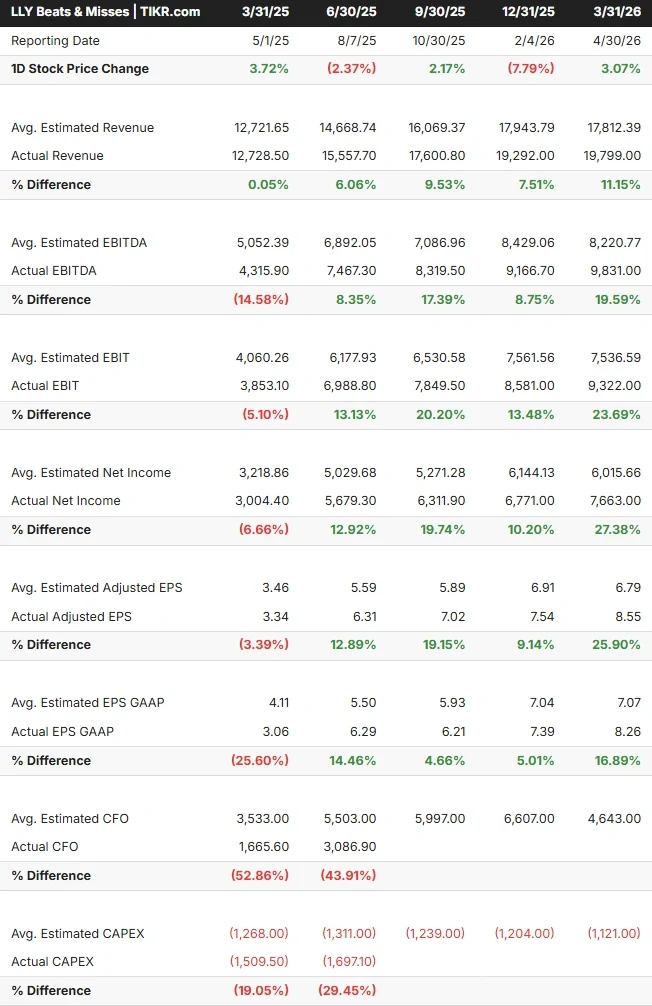
See historical and forward estimates for Eli Lilly stock (It’s free!) >>>
The Franchise Carrying the Quarter
The revenue engine remains the injectable GLP-1 duo. In Q1 2026, reported April 30, Lilly beat revenue by 11.15% ($19.80 billion against a $17.81 billion estimate) and topped adjusted EPS consensus by 25.90%, per TIKR’s Beats and Misses data. Mounjaro and Zepbound drove the surprise, and the international line is where the runway looks longest.
At the Goldman Sachs Healthcare Conference on June 9, Mike Czapar, EVP at Lilly, said aggregate international Mounjaro market share had moved north of 50%, with roughly three-quarters of those sales paid in cash. “What that is encouraging is that it’s showing that there’s a high willingness to pay, and there’s a large unmet need that exists outside the U.S.,” Czapar said. Cash-pay demand at scale is the cleanest evidence that the market, not just insurance coverage, is pulling the product through.
Foundayo Is the Debate the Bears Will Press
The soft spot is Foundayo (orforglipron), Lilly’s oral GLP-1 pill approved April 1 and available through LillyDirect from April 6. Its ramp has lagged Novo Nordisk’s rival Wegovy pill badly. Weekly prescriptions have hovered near 20,000, dipping to 19,830 for the week ended June 26 on IQVIA data cited by Jefferies, roughly the level Novo’s pill hit within two to three weeks of its own launch. Goldman cut its 2026 U.S. Foundayo estimate to $755 million from $1.1 billion to reflect the slower start.
Lilly frames the pace as deliberate. On the same June call, Czapar walked through a sequenced launch: rep promotion in April, sampling in May, consumer advertising and all three pharmacy benefit managers in June, and Medicare GLP bridge access from July 1. Kenneth Custer, EVP at Lilly, added that the drug “had 0 unaided or aided awareness” two months earlier, arguing that scripts follow awareness once the levers turn on. Bulls read a long runway: a small-molecule pill is cheaper to make and easier to distribute than a peptide, and scales as access matures. Bears read a curve that is simply behind. The August 5 run rate and channel mix settle, which view holds.
The valuation makes the debate urgent. Lilly trades near 24.5x NTM EV/EBITDA against Merck at 15.0x and Novo at 11.1x, per TIKR. The Street still leans bullish, with 17 Buy and 5 Outperform ratings against just 1 Underperform and 1 Sell, and a mean target near $1,277, but that premium holds only if growth keeps landing, which is exactly what the guidance line will signal.

See how Eli Lilly performs against its peers in TIKR (It’s free!) >>>
TIKR Advanced Model Analysis
- Current Price: $1,154.97
- Target Price (Mid): ~$2,140
- Potential Total Return: ~85%
- Annualized IRR: ~15% / year

See analysts’ growth forecasts and price targets for Eli Lilly stock (It’s free!) >>>
Using TIKR’s mid-case scenario, LLY reaches a target near $2,140, a total return of roughly 85% over about 4.4 years, or near 15% per year. The mid case is the fair anchor: it neither assumes obesity demand disappoints nor prices in a best-case pipeline sweep.
- What the model needs: revenue compounding near the low-teens as international Mounjaro volume and the Foundayo pill together offset the low-to-mid-teens price erosion management has guided to for 2026.
- Where the margin comes from: operating leverage on a largely fixed manufacturing base (more than $50 billion committed since 2020), carrying net income margin toward the low-40% range from around 26% today.
- What breaks it: price falling faster than volume climbs, which at this multiple re-rates the stock lower on any quarter that misses the bar.
The mid-case target is reachable if international volume and the oral pill both inflect from here. If neither does, the premium compresses toward peers regardless of the headline beat.
Conclusion
Everything routes back to one line on August 5: the full-year revenue guidance. Lilly guides to $83 billion to $85 billion now. A raise near $1 billion or more reads as management confirming that volume is still outrunning price, and the premium is earned. A thin raise, or none, reads as a stock that has finally caught up to its own expectations, and the reaction could be sharp given the 4.5% it already gave back walking in. Foundayo’s weekly script rate is the secondary tell, but the guidance number is the one that moves the stock.
See what stocks billionaire investors are buying so you can follow the smart money with TIKR.
Should You Invest in Eli Lilly?
The only way to really know is to look at the numbers yourself. TIKR gives you free access to the same institutional-quality financial data that professional analysts use to answer exactly that question.
Pull up Eli Lilly, and you’ll see years of historical financials, what Wall Street analysts expect for revenue and earnings in the quarters ahead, how valuation multiples have moved over time, and whether price targets are trending up or down.
You can build a free watchlist to track Eli Lilly alongside every other stock on your radar. No credit card required. Just the data you need to decide for yourself.
Analyze Eli Lilly on TIKR Free →
Looking for New Opportunities?
- See what stocks billionaire investors are buying so you can follow the smart money.
- Analyze stocks in as little as 5 minutes with TIKR’s all-in-one, easy-to-use platform.
- The more rocks you overturn… the more opportunities you’ll uncover. Search 100K+ global stocks, global top investor holdings, and more with TIKR.
Disclaimer:
Please note that the articles on TIKR are not intended to serve as investment or financial advice from TIKR or our content team, nor are they recommendations to buy or sell any stocks. We create our content based on TIKR Terminal’s investment data and analysts’ estimates. Our analysis might not include recent company news or important updates. TIKR has no position in any stocks mentioned. Thank you for reading, and happy investing!