Key Takeaways: PepsiCo Stock vs Target Stock
- Dividend Safety Winner: Target’s 55% earnings payout ratio leaves nearly twice the cushion of PepsiCo’s 93%, making it the safer income play at the same price.
- Yield Premium: PepsiCo stock yields 4.4%, a full point above Target’s 3.4%.
- Cash Exhaustion: PepsiCo spent $7.64B on dividends against $7.67B in FY2025 FCF, a 100% FCF payout, while Target used 72% of its $2.83B in FCF.
- Model Returns: TIKR values PepsiCo stock at $191 (40% total return, 8% annualized) and Target stock at $182 (33% total return, 7% annualized) over 4.5 years.
PepsiCo Stock vs Target Stock: Which Aristocrat Can Actually Afford Its Dividend?
A Dividend Aristocrat is a company that has raised its payout every year for at least 25 consecutive years, a record that signals durability through recessions and rate cycles. PepsiCo (PEP) and Target (TGT) each carry the title, each with more than 50 years of unbroken increases. And both have sold off hard enough to push their yields above historical norms:

PepsiCo stock now yields 4.4%, up from 2.6% three years ago, and Target stock yields 3.4%, up from 2.6% over the same span. For income investors scanning for bargains, these two look like rare markdowns on reliable cash streams. The question is whether both can keep delivering.
PepsiCo sells snacks and beverages through brands like Lay’s, Doritos, Gatorade, and its namesake cola. Revenue topped $94 billion in fiscal 2025, but growth has stalled: the North America business managed just 2% last year, weighed down by consumer pushback on pricing and softness in convenience-store traffic tied to elevated gas prices. CEO Ramon Laguarta told analysts on the Q2 2026 earnings call that U.S. volume “is not as much as we expected” and that teams are “optimizing the return on investment” of the company’s affordability push. Earnings barely grew, and the dividend consumed 93% of net income, up from 69% three years ago.
Target is a general-merchandise retailer that stumbled in 2022 and 2023 on inventory mismanagement and a pullback in discretionary spending. Operating income cratered from $9 billion to under $4 billion in a single year. The stock reflected it. But the turn has started: Q1 fiscal 2027 comparable sales grew 5.6%, driven by a 4.4% traffic increase, with strength across all six merchandise categories. CEO Michael Fiddelke credited the response to merchandising changes and noted that comp growth was “driven by traffic,” meaning more guests choosing Target more often, “an incredibly healthy sign.” The earnings payout ratio sits at 55%.
The case for PepsiCo stock over Target is the yield itself and the business behind it. PepsiCo’s international segment, now crossing $40 billion in annual revenue and growing 7% in the first half of 2026, provides a growth engine that Target, a purely domestic retailer, cannot match. Staples businesses also tend to hold up better in downturns than discretionary retailers. If the North America turnaround gains traction and the record productivity Laguarta described takes hold, the payout ratio compresses without a cut, and the 4.4% yield wins outright.
The Payout Math That Separates PepsiCo and Target Stock

PepsiCo’s dividend has grown from $4.25 per share in fiscal 2021 to $5.62 in fiscal 2025, a 32% increase over four years.
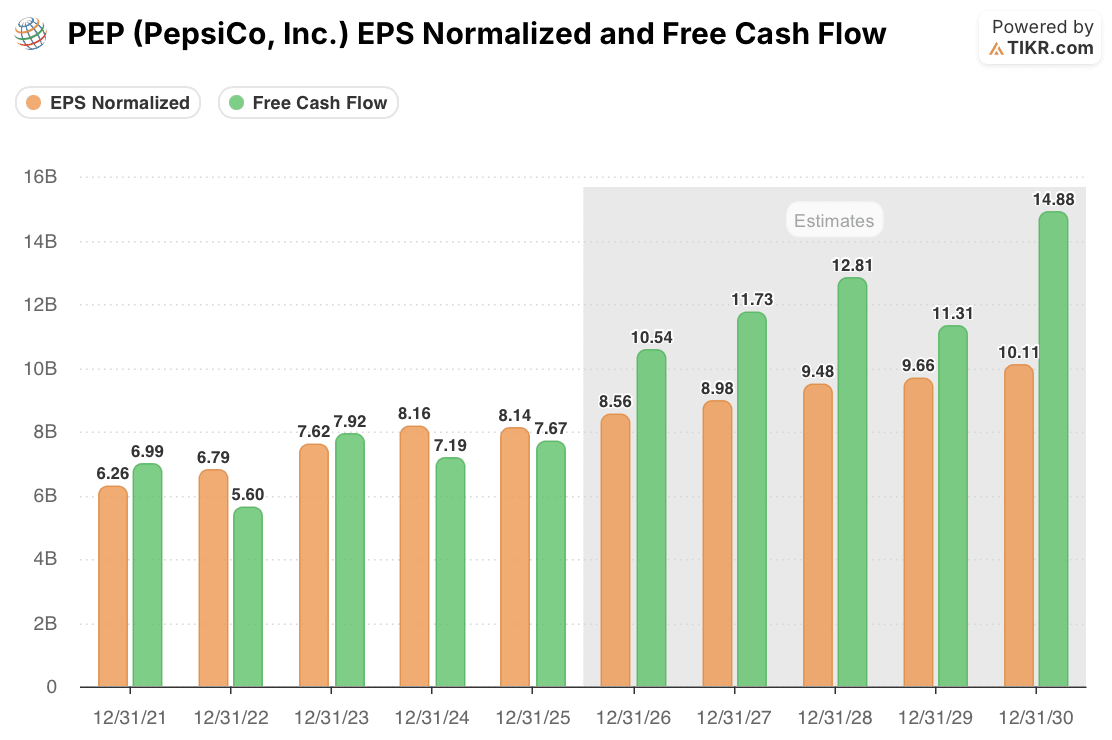
The streak is intact. But the earnings powering it have not kept pace: fiscal 2025 normalized EPS of $8.14 barely moved from fiscal 2024’s $8.16, and the Street expects just 5% growth to $8.56 in fiscal 2026. On a cash basis the picture is starker. PepsiCo generated $7.67 billion in free cash flow in fiscal 2025 and paid $7.64 billion in dividends, leaving $30 million. A consumer-staples company spending 100% of its free cash flow on the dividend is a company with no cushion for a bad quarter.

Meanwhile, Target’s dividend climbed from $2.68 to $4.52 over the same period, a 69% increase at nearly double PepsiCo’s growth rate.
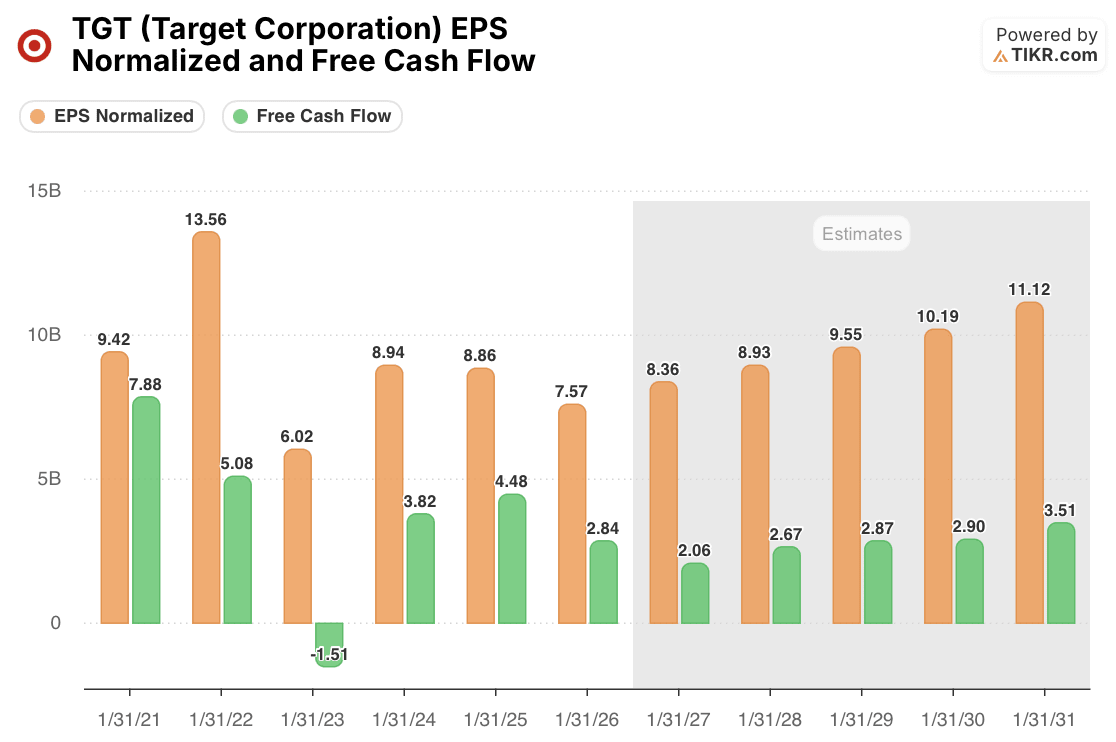
EPS swung from $13.56 at the pandemic peak to $6.02 at the trough, then recovered to $7.57 in fiscal 2026, and the Street projects $8.36 next year, a 10% jump. Free cash flow of $2.84 billion against $2.05 billion in dividends leaves a 72% FCF payout and real headroom. CFO Jim Lee even told analysts the company plans to request another dividend increase while moving toward a 40% payout ratio “over time,” a signal that Target sees room to grow the payout and rebuild its balance sheet at the same time.

At 16x forward earnings, PepsiCo stock and Target stock trade at nearly identical valuations. PepsiCo offers the higher NTM dividend yield at 4.4% versus Target’s 3.4%.
Target Stock Is the Safer Dividend Buy at the Same Price
Target stock wins this matchup on the metric that matters most for income investors: the gap between what the company earns and what it pays out. A 55% earnings payout ratio and a 72% FCF payout ratio mean Target can absorb a real earnings miss and still cover the dividend with room to spare. PepsiCo, at 93% of earnings and 100% of free cash flow, has no such buffer.
PepsiCo’s higher yield is real, and its global reach provides ballast that a domestic retailer cannot offer. But a 4.4% yield funded by 93% of earnings is a bet that nothing else goes wrong, and the Q2 2026 call made clear that several things already have: convenience-store traffic fell and affordability investments returned less than planned, prompting management to guide toward the low end of its EPS range. That yield premium compensates for the risk; it does not erase it.
The fact that would flip this call: if PepsiCo’s North America turnaround delivers mid-single-digit EPS growth by late 2026, the payout ratio drops back below 80% on its own, and the higher yield wins cleanly.
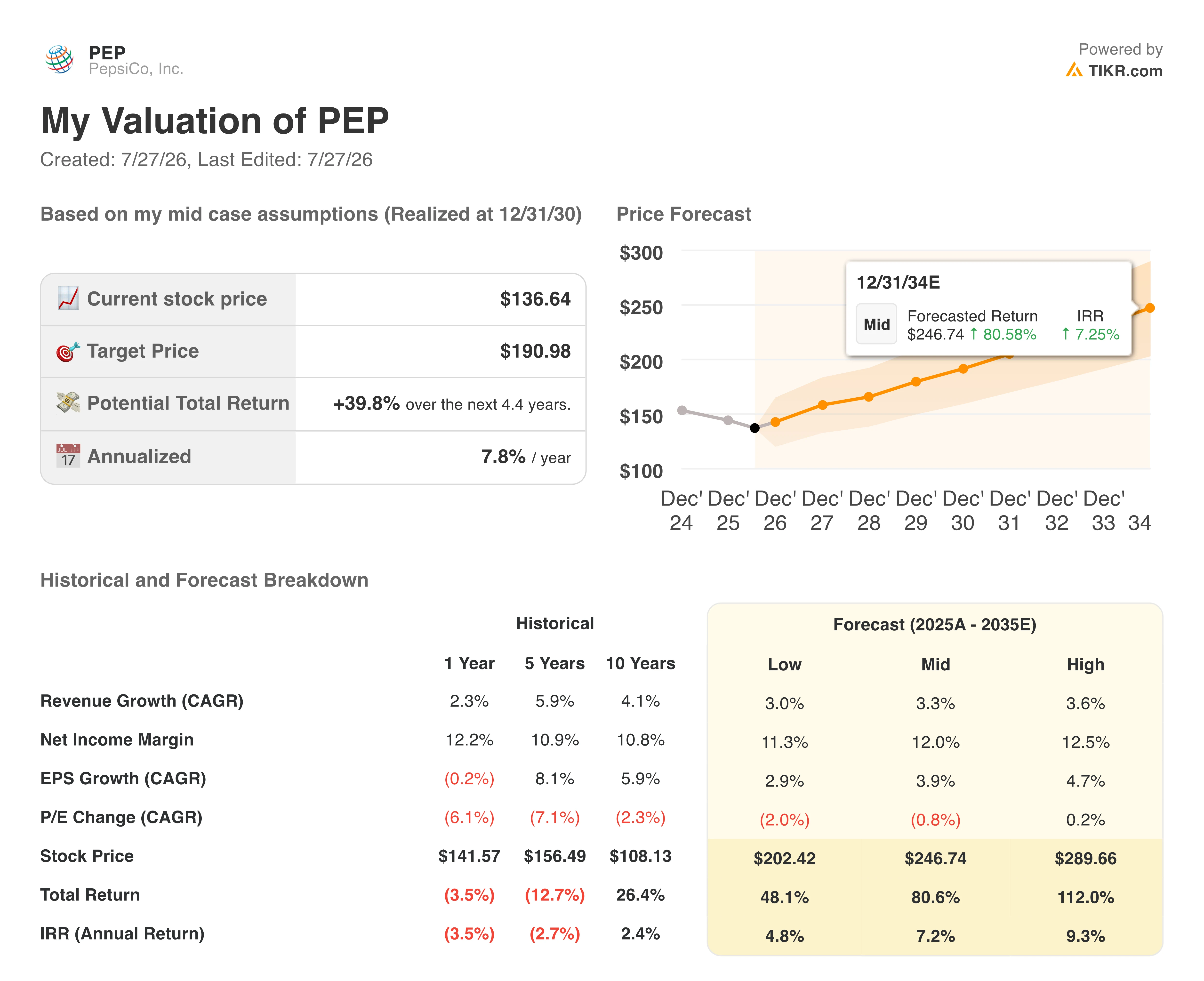
TIKR’s mid-case model values PepsiCo stock at $191 by December 2030, implying 40% total return or 8% annualized.
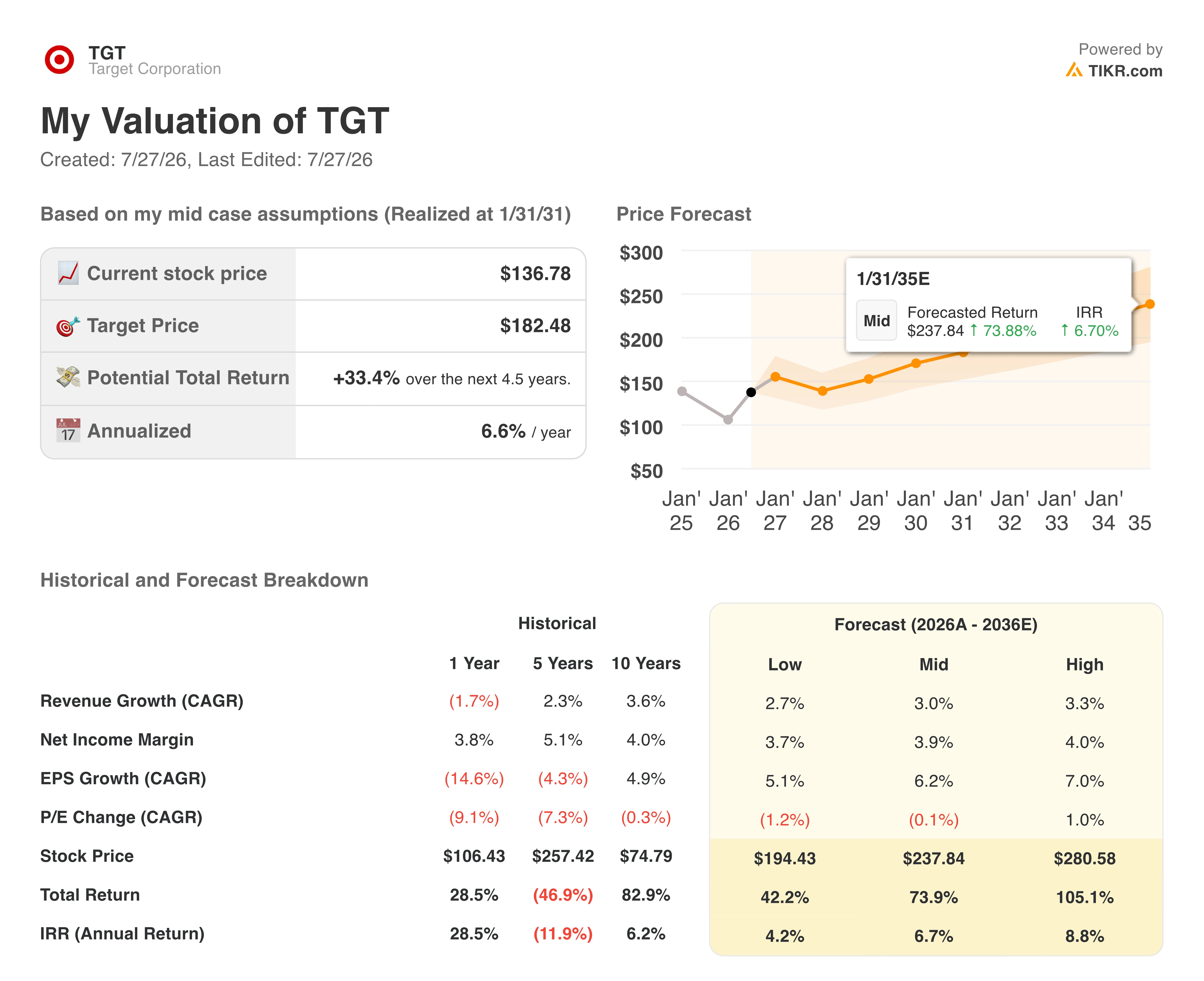
The model values Target stock at $182 by January 2031, implying 33% total return or 7% annualized. The returns are close. Target’s arrives with a wider safety margin on the dividend.
Should You Invest in PepsiCo or Target?
The only way to really know is to look at the numbers yourself. TIKR gives you free access to the same institutional-quality financial data that professional analysts use to answer exactly that question.
Pull up PepsiCo and Target side by side and you’ll see years of historical financials, what Wall Street analysts expect for revenue and earnings in the quarters ahead, how valuation multiples have moved over time, and whether price targets are trending up or down for either stock.
You can build a free watchlist to track PepsiCo, Target, and every other stock on your radar. No credit card required. Just the data you need to decide for yourself.
Access Professional Tools to Analyze PEP Stock and TGT Stock on TIKR for Free →
Looking for New Opportunities?
- See what stocks billionaire investors are buying so you can follow the smart money.
- Analyze stocks in as little as 5 minutes with TIKR’s all-in-one, easy-to-use platform.
- The more rocks you overturn… the more opportunities you’ll uncover. Search 100K+ global stocks, global top investor holdings, and more with TIKR.
Disclaimer:
Please note that the articles on TIKR are not intended to serve as investment or financial advice from TIKR or our content team, nor are they recommendations to buy or sell any stocks. We create our content based on TIKR Terminal’s investment data and analysts’ estimates. Our analysis might not include recent company news or important updates. TIKR has no position in any stocks mentioned. Thank you for reading, and happy investing!