
Key Stats for Navitas Semiconductor Stock
- 52-Week Range: $5.44 – $34.17
- Current Price: $10.92
- Street Mean Target: $14.46
- Market Cap: ~$2.7B
- YTD Return: +30.3%
- FY2025 Revenue: $45.9M
- LTM Gross Margin: 30.1%
- Net Cash: $215M
Earlier this year, Navitas Semiconductor (NVTS) was trading near $34. Today it sits at $11, down 68% from its high, and the income statement is not going to make anyone feel better about it. Revenue fell sharply in 2025, gross margins are near multi-year lows, and profitability is years away.
What has not changed is the underlying technology thesis: GaN and SiC power chips are winning design slots at major AI data centers, and Navitas is one of the few pure-play companies positioned to benefit from that transition at scale.
Now Live: Discover how much upside your favorite stocks could have using TIKR’s new Valuation Model (It’s free) >>>
The Margin Compression Tells You Where the Business Is in Its Transition
Navitas Semiconductor Corporation makes gallium nitride and silicon carbide power semiconductors.
These chips control how electricity flows through devices and systems, far more efficiently than traditional silicon at the high voltages and temperatures AI data centers require.
When a hyperscale facility runs tens of thousands of servers, each generating significant heat, the power conversion efficiency of every chip in the stack matters enormously.
GaN and SiC are the solution the industry is moving toward, and Navitas is one of the few pure-play companies building chips specifically for that transition.

Gross margins have been volatile and are currently near a multi-year low. After hitting 45% in 2021, margins compressed to 31.5% in 2022 during the consumer electronics downturn, recovered to 39% in 2023, and have since fallen back to 31% in 2025.
The compression reflects a deliberate but painful transition: Navitas spent years selling GaN chips into smartphones and consumer electronics in China, which generated volume but was becoming increasingly commoditized.
Management has been systematically exiting that business in favor of AI data centers, EV chargers, and grid infrastructure. The problem is the exit happened faster than the replacement revenue arrived.
See historical and forward estimates for Navitas stock (It’s free!) >>>
The Revenue Trough Is Real, and So Is the Recovery Estimate
Revenue tells the same story with more clarity. After growing from $24M in 2021 to $83M in 2024, revenue fell sharply to $46M in 2025 as the China consumer exit accelerated.
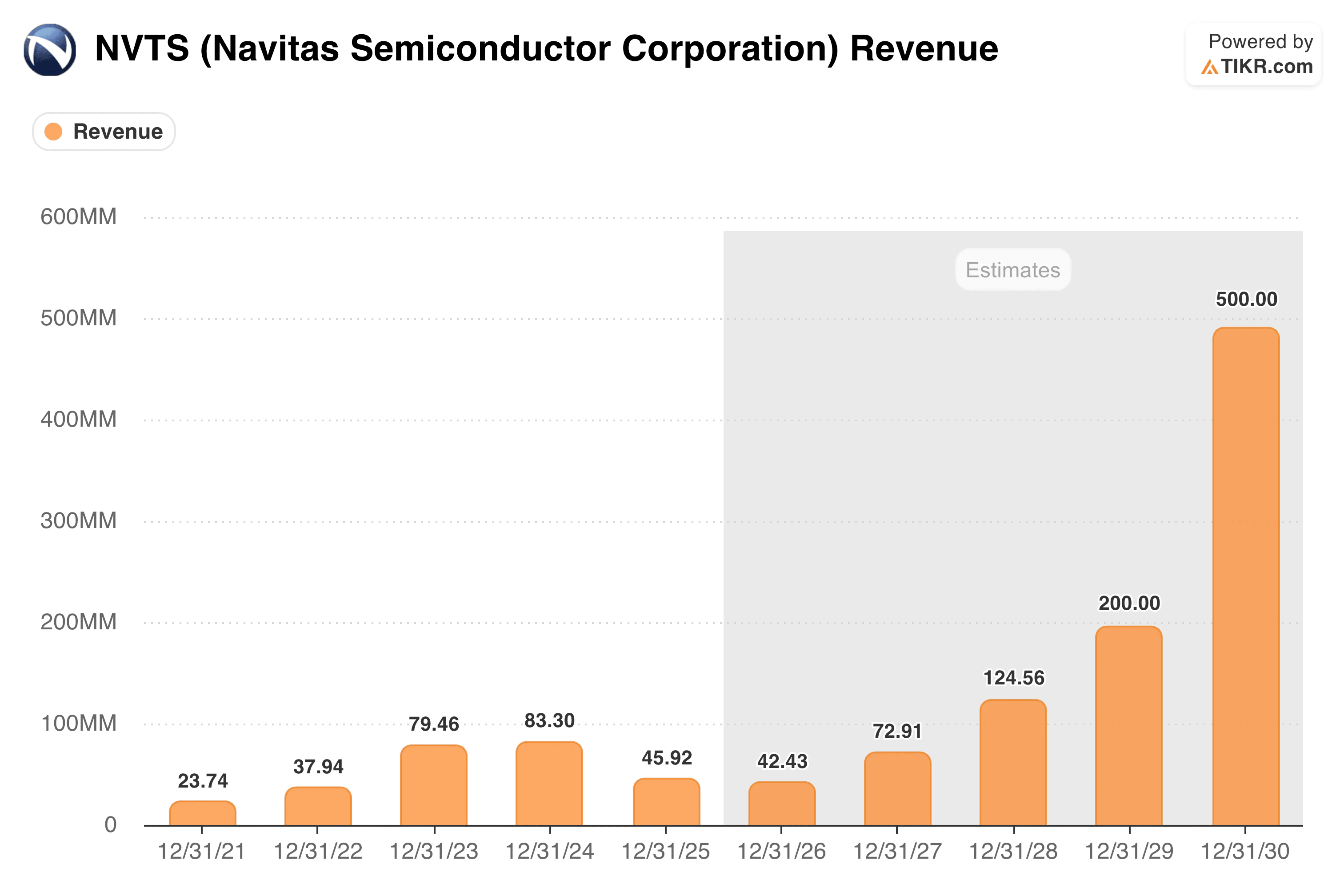
Consensus estimates project a further dip to around $42M in 2026 before recovery begins: $73M in 2027, $125M in 2028, $200M in 2029, and $500M in 2030.
Navitas has guided to approximately $130M for FY2026, substantially above the consensus estimate, reflecting management’s confidence that AI data center design wins are converting to production revenue faster than analysts currently model.
The 48V power architecture that hyperscalers are adopting for high-density AI servers is a specific area where Navitas has announced design wins with major customers, though production-scale revenue has not yet materialized.
See how Navitas performs against its peers in TIKR (It’s free!) >>>
What Does the TIKR Valuation Model Say About Navitas?
TIKR’s mid-case target sits at around $22, implying roughly 101% total return over the next 4.4 years, or around 17% annualized.

Returns in the mid-case are driven almost entirely by revenue growth, with the model assuming roughly 45% revenue CAGR and deeply negative net margins throughout the forecast period.
The scenario range runs from around $50 on the low end to around $130 on the high end, a very wide spread that reflects genuine uncertainty about how fast the AI data center ramp converts to revenue at scale.
A 45% revenue CAGR from a $46M base requires near-flawless execution across multiple end markets simultaneously. The mid-case is optimistic, not conservative.
Should You Invest in Navitas Semiconductor?
Navitas has the right technology at a difficult moment in its commercialization cycle. GaN and SiC power chips are not a speculative bet on an unproven technology, they are already designed into production programs at major AI infrastructure customers. The question is timing and scale.
At $10.92, down 68% from its 52-week high, the stock is pricing in significant skepticism about how quickly that design win pipeline converts to revenue.
The street mean target of around $14 implies modest upside on conventional estimates, while the TIKR mid-case at $22 reflects what the business could be worth if the 2027 to 2030 ramp arrives roughly on schedule.
Investors buying here are making a multi-year bet on a real technology transition, with a company that has the right product but genuinely messy near-term financials. How comfortable you are with that combination is the decision.
See analysts’ growth forecasts and price targets for Navitas stock (It’s free!) >>>
Looking for New Opportunities?
- See what stocks billionaire investors are buying so you can follow the smart money.
- Analyze stocks in as little as 5 minutes with TIKR’s all-in-one, easy-to-use platform.
- The more rocks you overturn… the more opportunities you’ll uncover. Search 100K+ global stocks, global top investor holdings, and more with TIKR.
Disclaimer:
Please note that the articles on TIKR are not intended to serve as investment or financial advice from TIKR or our content team, nor are they recommendations to buy or sell any stocks. We create our content based on TIKR Terminal’s investment data and analysts’ estimates. Our analysis might not include recent company news or important updates. TIKR has no position in any stocks mentioned. Thank you for reading, and happy investing!