Key Takeaways
- Cash Conversion Edge: Palantir turned 51% of 2025 revenue into free cash flow against Snowflake’s 24%, and TIKR’s model puts Palantir’s annualized return at 53% versus Snowflake’s 26%.
- Valuation Discount: Snowflake stock trades at 15x forward sales, less than half Palantir stock’s 35x.
- Growth Divide: Palantir’s revenue grew 85% YoY in Q1 against Snowflake’s 34%, and Palantir’s 150% net dollar retention topped Snowflake’s 126% net revenue retention.
- Profit Milestone: Palantir posted $0.34 in GAAP EPS last quarter while Snowflake’s GAAP EPS stays negative through TIKR’s estimates until 2031.
Palantir Stock vs Snowflake Stock: When P/E Breaks, What Do You Trust?
Palantir (PLTR) and Snowflake (SNOW) share a problem that breaks the usual way investors size up software: neither company’s price-to-earnings ratio tells you much by itself.

As of July 28, 2026, Palantir traded at 78x forward normalized earnings and Snowflake at 128x, a number that looks backwards once you notice Snowflake stock costs less than half of Palantir stock on a price-to-sales basis. If P/E says Snowflake is pricier and P/S says the opposite, which do you believe?
Neither, on its own. Reported net income at fast-growing software companies gets distorted by stock-based compensation and years of deliberate reinvestment, so a thin or negative GAAP profit rarely means the business is struggling. It usually means the company is plowing cash into growth instead of banking it.
Palantir spent years posting losses before flipping to an $871 million GAAP quarterly profit in Q1 2026. Snowflake is still climbing that slope: analysts’ estimates keep its GAAP earnings per share negative through fiscal 2031, even though its free cash flow turned positive years ago. The fix is judging both on revenue growth, how much revenue survives and expands within existing customers, and how much cash the business throws off regardless of stock compensation.
Snowflake’s case starts with acceleration, not decline. CEO Sridhar Ramaswamy told analysts on the Q1 fiscal 2027 call that “product revenue came in at $1.334 billion, with growth accelerating to 34% year-over-year, up from 30% last quarter and 26% a year ago, marking our strongest sequential dollar growth in company history.” Management raised full-year guidance from 27% to 31% on the strength of Cortex Code, its AI coding agent, which crossed 7,100 accounts within months of launch. A company reaccelerating off a $4.68 billion base, priced at 15x forward sales, is not an easy stock to write off.
Palantir’s number simply runs at a different scale. Revenue grew 85% year over year last quarter, its highest growth rate as a public company, with U.S. commercial revenue up 133%. CEO Alex Karp put the cash story bluntly on the Q1 earnings call: “Our free cash flow this quarter is larger than our revenue a year ago in the same quarter.” That’s acceleration Snowflake still needs years to prove out. Whether Palantir’s valuation already prices in more of that edge than Snowflake’s discount prices in caution is the question the evidence has to settle.
The Financials and Valuation Tabs: Palantir Stock’s Cash Edge Over Snowflake Stock
Growth is the first place the gap shows up cleanly.

Palantir grew revenue 85% year over year in Q1 2026, its eleventh straight quarter of accelerating growth. Snowflake grew product revenue 34%, itself an acceleration from 30% the quarter before. Palantir’s pace runs roughly two and a half times faster in absolute terms, though Snowflake’s trajectory is the more unusual one: reaccelerating off a five-year-old base rather than a fresh AI mandate. Retention echoes the split at a smaller scale.
Net dollar retention, the share of existing customer revenue retained and expanded a year later, ran 150% at Palantir versus 126% net revenue retention at Snowflake, meaning Palantir’s existing customers alone grew their spend by half again, before counting a single new logo.
Cash conversion is where the case tightens further.
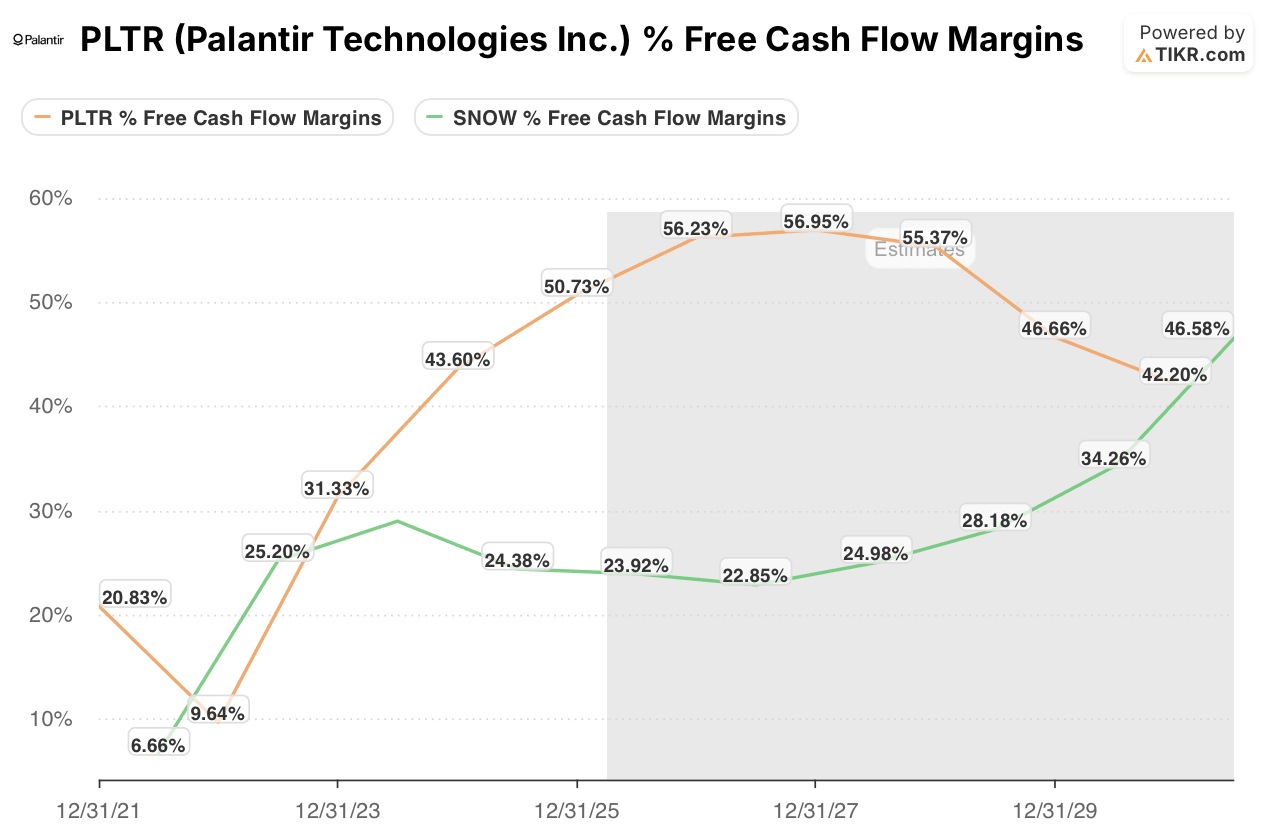
Palantir’s free cash flow margin hit 51% in 2025, and its adjusted free cash flow topped $925 million in a single quarter this year. Snowflake converted 23.9% of fiscal 2026 revenue to free cash, an improving figure but still less than half of Palantir’s rate.

On price, though, Snowflake looks like the discount: 15x forward sales against Palantir’s 35x, a gap wide enough that value-conscious buyers gravitate toward Snowflake by instinct.
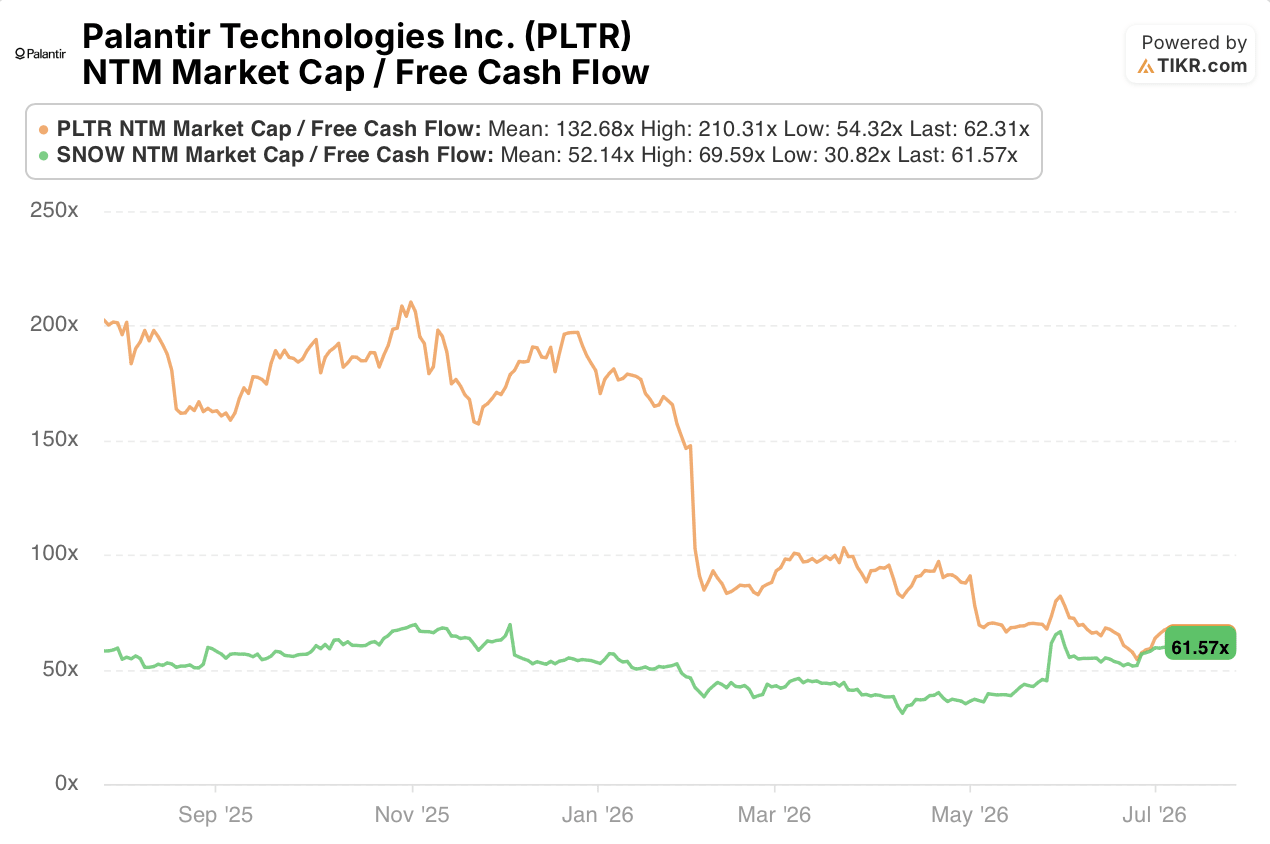
That instinct softens once the lens shifts to cash. Palantir trades at 62x next-twelve-month free cash flow, and Snowflake trades at 62x as well, an almost identical price tag on two very different growth engines.
TIKR’s own valuation model extends that logic forward.


It targets $813 for Palantir stock, implying a 53% annualized return over 4.4 years, against $767 for Snowflake stock and a 26% annualized return over 4.5 years, roughly half Palantir’s pace.


Street analysts lean the same direction: the mean target on Palantir stock sits 48% above its July 28 close, compared with 10% upside built into Snowflake’s mean target. Forward estimates hint at why the gap could persist. Palantir’s GAAP EPS is projected at $1.35 for 2026, while Snowflake’s stays negative until TIKR’s fiscal 2031 estimate, a five-year difference in when each company’s accounting finally catches up to its cash flow.
Why Palantir Stock Wins the Growth-to-Cash Test Snowflake Hasn’t Passed
Palantir stock wins this comparison because it already does what Snowflake stock is still working toward: convert breakneck growth into real, recurring GAAP profit, at a free cash flow multiple that costs about the same as its slower-growing rival’s.
Snowflake’s cheaper price-to-sales ratio looks like the safer trade, but a 15x sales multiple built on 24% free cash flow conversion isn’t much of a discount once measured against cash instead of revenue. Palantir and Snowflake both trade near 62x forward free cash flow, so the extra premium on Palantir stock buys 85% revenue growth and a GAAP profit Snowflake’s own estimates don’t project until 2031.
What would flip the call is deceleration.
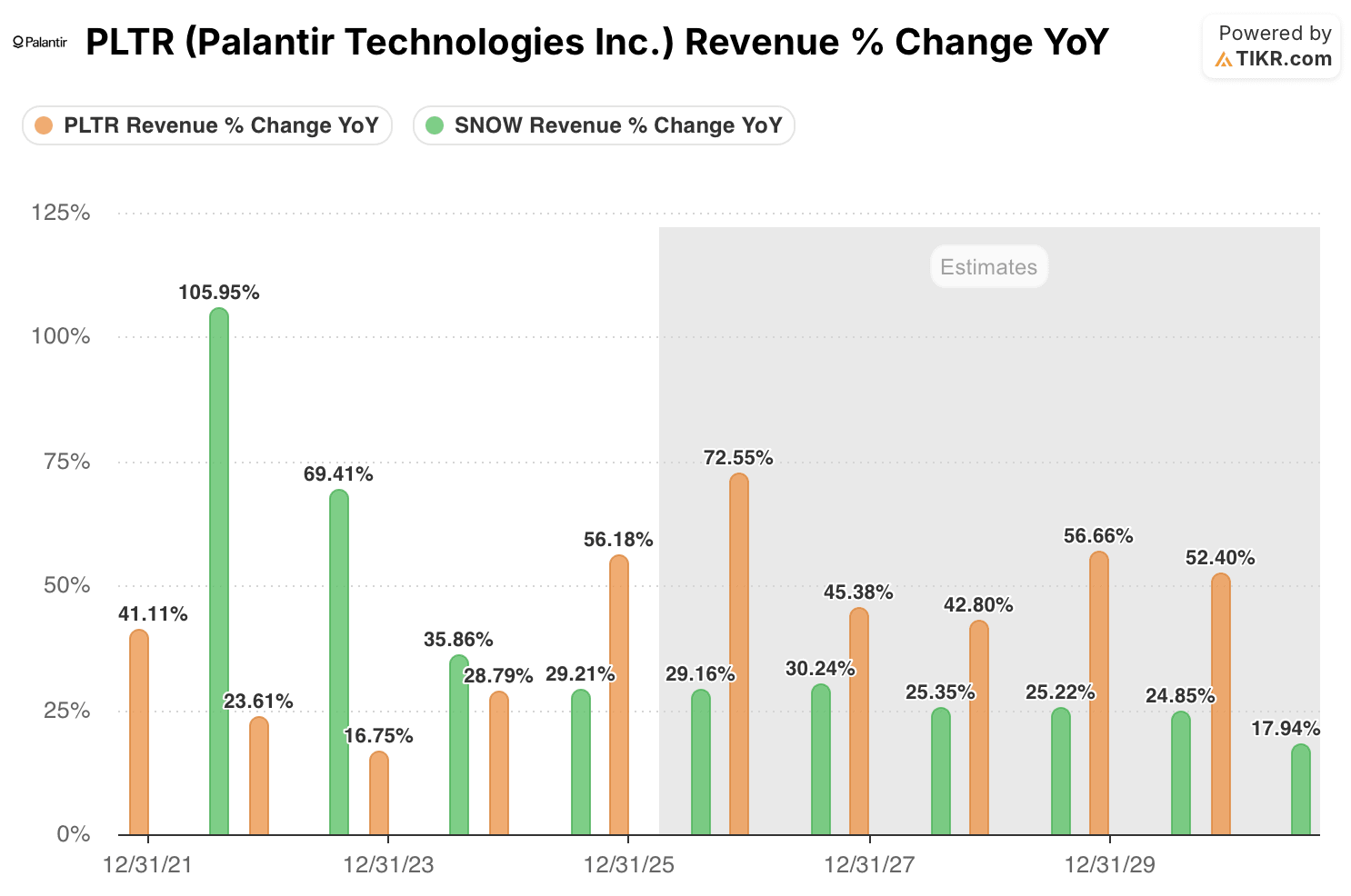
TIKR’s estimates show Palantir’s growth cooling from 73% this year to 45% in 2027, while Snowflake’s growth eases more gradually, from 30% in 2027 to 25% by 2028. If those two lines converge before Palantir’s cash advantage fully compounds, Snowflake’s cheaper sales multiple stops being a consolation prize and starts being the better entry point.
TIKR’s base case backs the near-term call. It points to a $813 target on Palantir stock, a 558% total return, and a 53% annualized rate through 2030, more than double Snowflake’s modeled 26% annual pace toward its own $767 target.
Should You Invest in Palantir or Snowflake?
The only way to really know is to look at the numbers yourself. TIKR gives you free access to the same institutional-quality financial data that professional analysts use to answer exactly that question.
Pull up Palantir and Snowflake side by side and you’ll see years of historical financials, what Wall Street analysts expect for revenue and earnings in the quarters ahead, how valuation multiples have moved over time, and whether price targets are trending up or down for either stock.
You can build a free watchlist to track Palantir, Snowflake, and every other stock on your radar. No credit card required. Just the data you need to decide for yourself.
Access Professional Tools to Analyze PLTR stock and SNOW stock on TIKR for Free →
Looking for New Opportunities?
- See what stocks billionaire investors are buying so you can follow the smart money.
- Analyze stocks in as little as 5 minutes with TIKR’s all-in-one, easy-to-use platform.
- The more rocks you overturn… the more opportunities you’ll uncover. Search 100K+ global stocks, global top investor holdings, and more with TIKR.
Disclaimer:
Please note that the articles on TIKR are not intended to serve as investment or financial advice from TIKR or our content team, nor are they recommendations to buy or sell any stocks. We create our content based on TIKR Terminal’s investment data and analysts’ estimates. Our analysis might not include recent company news or important updates. TIKR has no position in any stocks mentioned. Thank you for reading, and happy investing!