Key Takeaways:
- Rocket Lab builds and launches rockets, plus satellite hardware, while EchoStar holds satellite communications assets and valuable wireless spectrum tied to a pending SpaceX stake.
- Rocket Lab’s revenue grew from $62.2 million in 2021 to $601.8 million in 2025, with estimates reaching $2.5 billion by 2030, according to TIKR.com.
- EchoStar’s revenue has fallen every year since 2021, from $19.8 billion to $15.0 billion in 2025, with further declines expected through 2030.
- Based on growth, margins, and cash flow trends, Rocket Lab currently offers more direct exposure to the space economy than EchoStar.
Now Live: Discover how much upside your favorite stocks could have using TIKR’s new Valuation Model (It’s free)>>>
Space stocks get thrown around a lot these days. Investors hear “satellites” or “rockets” and assume they’re buying pure exposure to the next big frontier.
Rocket Lab (RKLB) and EchoStar (ECHO) both get lumped into that bucket. But they are very different businesses at very different points in their life cycle, and the numbers back that up.
Here’s a plain look at what each company actually does, what the financials show, and why one looks like the stronger bet based on growth and cash generation.
See analysts’ full growth forecasts and estimates for RocketLab stock (It’s free) >>>
What these two companies do
Rocket Lab builds and launches small rockets.
Its workhorse, Electron, has flown 88 times, with roughly 21 launches last year and closer to the upper 20s expected this year, according to CFO Adam Spice at a Wells Fargo industrials conference in June.
The company is also building a bigger, reusable rocket called Neutron, aiming to launch it before the end of this year. Beyond launch, Rocket Lab makes satellite hardware, reaction wheels, radios and propulsion systems, a business Spice says now makes up about 70% of revenue.
EchoStar is a different animal. It operates satellite communications and once ran a wireless network, but the more important story is its spectrum.
The company sold spectrum to SpaceX and is set to receive a stake in that company once the deal closes. It also faces a wireless network wind-down after the FCC opened an investigation into its spectrum use, and it’s dealing with litigation from tower companies tied to that shutdown.
Growth and cash flow tell different stories
The financial trajectories couldn’t be more different.
Rocket Lab’s revenue jumped from $62.2 million in 2021 to $601.8 million in 2025, and analysts expect it to climb toward $2.5 billion by 2030, according to TIKR.com estimates.
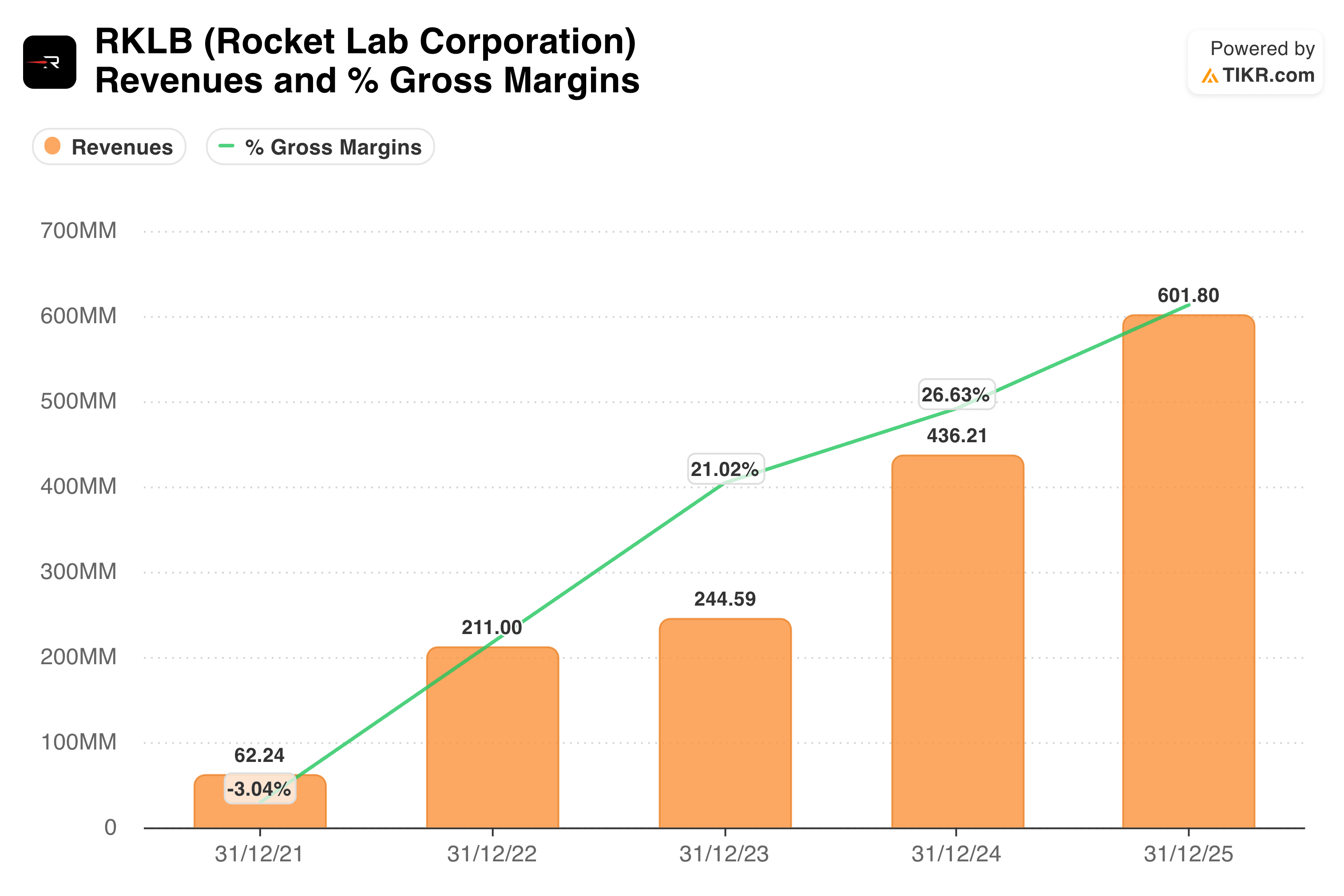
Gross margins have also improved steadily, moving from negative territory in 2021 to 26.6% in 2024.

Free cash flow remains negative at $321.8 million in 2025. But estimates show it will turn positive by 2027 and then climb to nearly $1.2 billion by 2030.
EchoStar is heading the other way.

Revenue has fallen every year since 2021, from $19.8 billion to $15.0 billion in 2025, with estimates indicating continued declines to $13.2 billion by 2030.
Gross margins have also compressed sharply, from almost 37% in 2021 to under 26% now.

Free cash flow was negative $1.07 billion in 2025 but is expected to turn positive and grow modestly to around $1.9 billion by 2030 as the company sheds its costly wireless network.
Estimate a company’s fair value instantly (Free with TIKR) >>>
What the market is paying for each stock
Valuation multiples reflect that gap in growth expectations.

Rocket Lab trades at a next 12-month price-to-sales ratio of near 39 times, well above its historical average of about 21 times, according to TIKR.com data.
That’s a premium investors are willing to pay for a company still scaling rapidly.
EchoStar trades at a trailing price-to-sales ratio of about 1.68 times, close to its historical high of 2.78 times but a fraction of Rocket Lab’s multiple. That’s typical for a legacy telecom asset rather than a growth story.

See what analysts think about RKLB stock right now (Free with TIKR) >>>
Why Rocket Lab looks like the stronger space bet
Spice laid out where the margin story is headed as Neutron ramps up. “By the time you get to your reusability… the margins really become much more predictable, and I think predictably towards our model of 50% non-GAAP gross margin,” he said on the June call.
He also noted the company doesn’t need fresh capital to fund that growth. “With the capital that we had exiting Q1, I don’t think there’s… what we’ve talked about around needs for Neutron, we really don’t need to raise any more capital for Neutron or even our Space Systems business,” Spice said.
EchoStar, by contrast, is still working through uncertainty. Chairman Charlie Ergen was candid about the company’s stake in SpaceX during the March earnings call.
“We don’t actually have that equity yet,” he said, referring to shares tied to the spectrum sale. “So we’ll see how that plays out.”
That single line captures the difference well. Rocket Lab’s growth and cash flow inflection are backed by contracts already in hand, including an $816 million award from the Space Development Agency.
EchoStar’s upside depends heavily on a deal that hasn’t closed and litigation that hasn’t resolved.
Both stocks have real ties to the space industry.
But based on revenue growth, improving margins and a clearer path to positive free cash flow, Rocket Lab currently offers investors the more direct and durable exposure to the space economy.
Build your own Valuation Model to value any stock (It’s free!) >>>
How Much Upside Does EchoStar Stock Have From Here?
With TIKR’s new Valuation Model tool, you can estimate a stock’s potential share price in under a minute.
All it takes is three simple inputs:
- Revenue Growth
- Operating Margins
- Exit P/E Multiple
If you’re not sure what to enter, TIKR automatically fills in each input using analysts’ consensus estimates, giving you a quick, reliable starting point.
From there, TIKR calculates the potential share price and total returns under Bull, Base, and Bear scenarios so you can quickly see whether a stock looks undervalued or overvalued.
See a stock’s true value in under 60 seconds (Free with TIKR) >>>
Looking for New Opportunities?
- See what stocks billionaire investors are buying so you can follow the smart money.
- Analyze stocks in as little as 5 minutes with TIKR’s all-in-one, easy-to-use platform.
- The more rocks you overturn… the more opportunities you’ll uncover. Search 100K+ global stocks, global top investor holdings, and more with TIKR.
Disclaimer:
Please note that the articles on TIKR are not intended to serve as investment or financial advice from TIKR or our content team, nor are they recommendations to buy or sell any stocks. We create our content based on TIKR Terminal’s investment data and analysts’ estimates. Our analysis might not include recent company news or important updates. TIKR has no position in any stocks mentioned. Thank you for reading, and happy investing!