

Key Stats for AMD Stock
- 52-Week Range: $149.22 – $584.73
- Current Price: $454.62
- Street Target Price: ~$575
- NTM P/E: ~51x
- YTD Return: +103%
- Market Cap: ~$741B
- Fwd 2-Yr Revenue CAGR: ~52%
Now Live: Discover how much upside your favorite stocks could have using TIKR’s new Valuation Model (It’s free)>>>
AMD’s Data Center Business Just Posted Its Strongest Quarter Ever
For most of the past decade, AMD (AMD) was the scrappy underdog, one step behind Intel in server CPUs and nowhere near Nvidia in GPUs. Then a sustained run of competitive products changed the conversation.
The EPYC server processor line steadily took share from Intel, and the MI300X AI GPU gave hyperscalers a credible alternative to Nvidia’s dominant accelerators. Q1 2026 made that case with numbers that are hard to argue with.
Total revenue reached $7.4 billion, up 36% year-over-year. The data center segment, which combines EPYC server processors with Instinct GPU accelerators used for AI training and inference workloads, grew 57% to $3.7 billion, hitting a new quarterly record.
Client Computing added $2.3 billion, up 28%. Gaming fell 30% to $0.6 billion as the console cycle winds down, though it represents a shrinking slice of the overall business.
Non-GAAP gross margin expanded to 54%, up from 52% a year earlier, driven by the data center mix shift. AMD guided Q2 revenue of approximately $7.9 billion, with margins holding near 54%.

The forward revenue picture is where the AI thesis becomes fully visible. Consensus estimates show AMD at around $50 billion in 2026, climbing toward $80 billion in 2027 and approaching $194 billion by 2030.
Those numbers embed the assumption that AMD continues gaining share in AI accelerators, a market worth well over $200 billion annually and still expanding rapidly.
See analysts’ growth forecasts and price targets for AMD stock (It’s free) >>>
How the AI Chip Ramp Is Rebuilding AMD’s Profitability
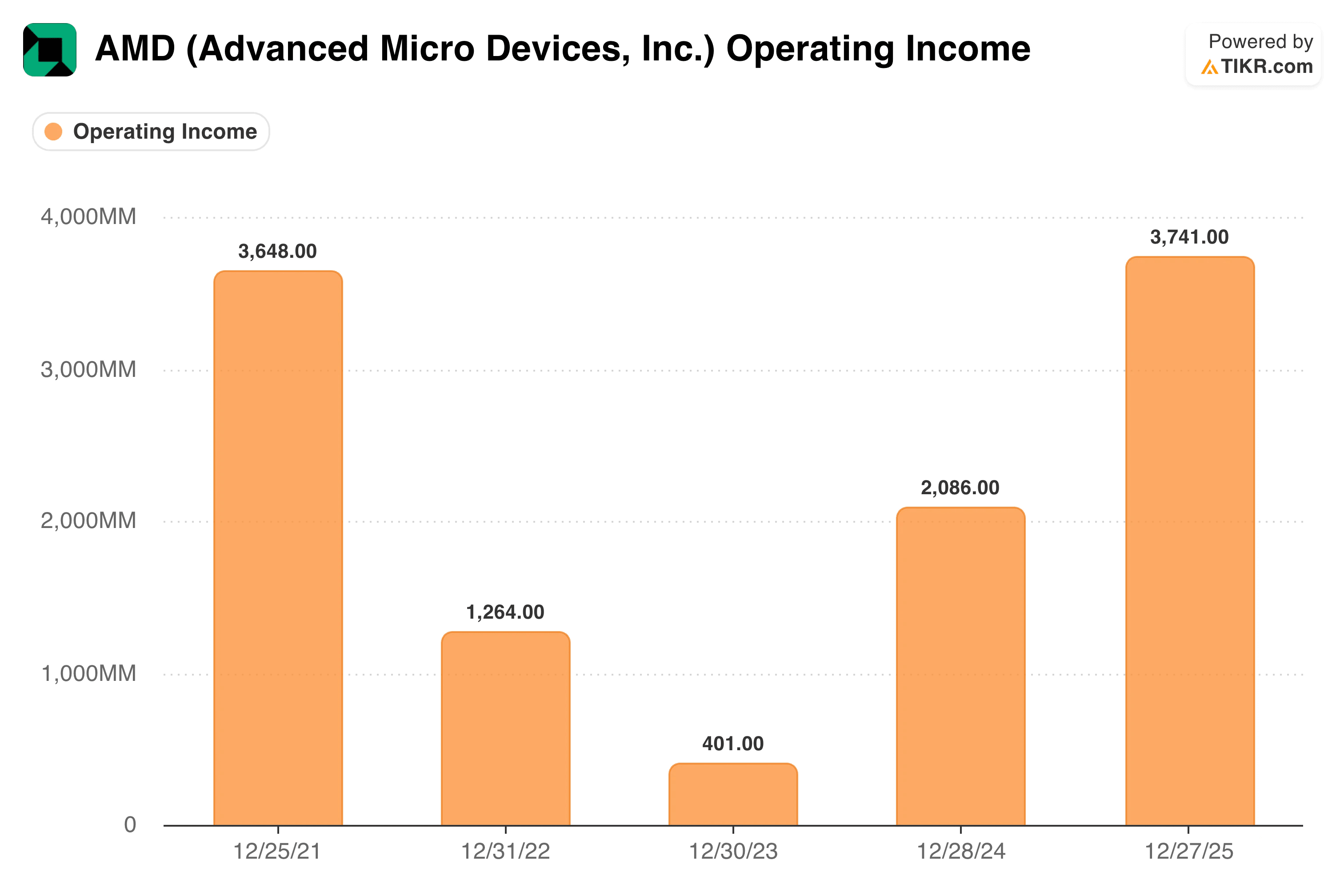
The operating income chart tells AMD’s story more honestly than any other single number. Operating income was $3.6 billion in 2021, then cratered to $1.3 billion in 2022 and bottomed at just $401 million in 2023 as the PC market collapsed and gaming revenue fell sharply.
The recovery has been equally dramatic: $2.1 billion in 2024, $3.7 billion in 2025, back near prior peak levels on a revenue base that is now more than double what it was four years ago.
The reason profitability snapped back so quickly while revenue grew more gradually is the product mix.
Data center GPUs carry higher margins than consumer PC chips meaningfully, and as the Instinct line ramped, MI300X was the fastest-ramping product in AMD’s history, scaling from initial 2024 guidance of around $2 billion to actual revenue north of $5 billion. As a result, the business became more profitable per dollar of sales.
Microsoft Azure, Meta, and Oracle have all deployed AMD accelerators in production, and the software stack that makes those chips usable has matured considerably.
AMD holds an estimated 5–7% of the AI accelerator market today, against Nvidia’s roughly 80%, but even a modest share of a $200 billion-plus market is worth enormous revenue.
See AMD’s full consensus estimates and price target history on TIKR for free →
What the Valuation Model Says About AMD Stock
The TIKR valuation model mid-case target comes out to around $2,020 per share, representing a potential total return of roughly 344% from the current price at around 40% annualized.
It is worth being direct about what those assumptions require: revenue growing at around 43% annually through 2030, net income margins expanding to roughly 32%, and EPS compounding near 50% per year.
Those are aggressive inputs even by AMD’s recent standards, and the model is better read as a bull scenario than a base case.

The Street’s consensus target of around $575 is a more grounded near-term anchor, implying roughly 26% upside.
At around 51 times forward earnings, AMD is priced for continued strong execution with little margin for error if data center growth decelerates.
Returns in the TIKR model are driven almost entirely by earnings growth rather than multiple expansion. The P/E barely changes across the forecast period, which at least means the model is not layering in unrealistic re-rating assumptions on top of aggressive growth.
Should You Buy AMD Stock?
AMD’s Q1 results and the broader data center trajectory make a compelling fundamental case: the company is executing well, its GPU roadmap is competitive, and AI infrastructure spending shows no signs of slowing.
The risks are real, though. Nvidia’s CUDA software ecosystem remains a durable moat, particularly for training workloads where switching costs are highest, and custom silicon from companies like Broadcom is taking share in inference applications.
At around 51 times forward earnings on numbers that require sustained strong execution, AMD is a high-conviction growth story at a high-conviction price, and investors should go in with clear eyes about both sides of that trade.
Estimate a company’s fair value instantly (Free with TIKR) >>>
Looking for New Opportunities?
- See which stocks billionaire investors are buying to follow the smart money.
- Analyze stocks in as little as 5 minutes with TIKR’s all-in-one, easy-to-use platform.
- The more rocks you overturn… the more opportunities you’ll uncover. Search 100K+ global stocks, global top investor holdings, and more with TIKR.
Disclaimer:
Please note that the articles on TIKR are not intended to serve as investment or financial advice from TIKR or our content team, nor are they recommendations to buy or sell any stocks. We create our content based on TIKR Terminal’s investment data and analysts’ estimates. Our analysis might not include recent company news or important updates. TIKR has no position in any of the stocks mentioned. Thank you for reading, and happy investing!


