

Key Stats for ARM Stock
- Past week’s performance: -13.5%
- 52-week range: $100 to $453
- Valuation model target price: $332
- Implied upside: 35.8% over 2.7 years
Estimate Arm’s fair value in under 60 seconds (It’s free) >>>
ARM’s AGI CPU Bet Meets a Market Pullback
Arm Holdings (ARM) shares slid about 13.5% this week, giving back part of a rally that had been building since the company’s record fiscal fourth quarter. The drop looks more like a broad cooldown in AI-linked chip names than anything company-specific, since Arm has not released new guidance or negative news this week.

That matters because Arm’s underlying business just had one of its strongest stretches yet. In May, the company posted fiscal fourth quarter revenue of $1.49 billion, up 20% year over year, and licensing revenue jumped 29% to $819 million. Royalty revenue, the recurring fee Arm collects each time a partner ships a chip using its architecture, grew 11% to $671 million. Full-year revenue hit a record $4.92 billion, up 23%.
The bigger story is the Arm AGI CPU, a new data center chip aimed at agentic AI workloads. Customer demand for it has already topped $2 billion across fiscal 2027 and 2028, more than double what management disclosed at launch just weeks earlier. CEO Rene Haas summed up the quarter simply: “Arm delivered a record quarter and record fiscal year.” Meta is co-developing the chip, and OpenAI, Cloudflare, SAP and SK Telecom have signed on as customers.
Investors are now weighing whether this pullback is noise or the start of a broader repricing of AI hardware stocks. If Arm stock continues to track sector sentiment rather than company fundamentals, the gap between price and business performance could keep widening in either direction.
See analysts’ growth forecasts and price targets for ARM (It’s free) >>>
Is ARM’s AI Bet Already Priced In?
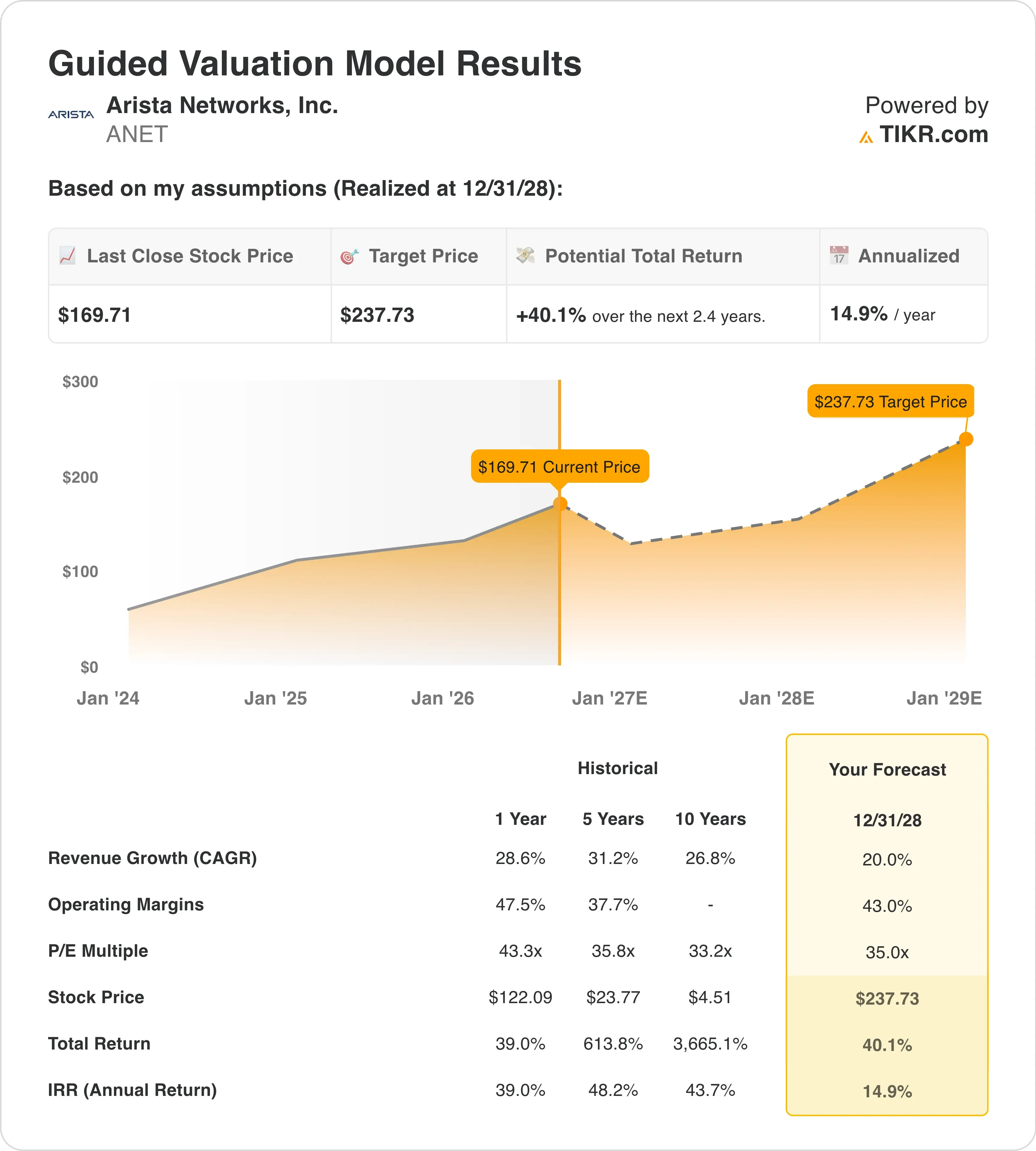
Under valuation model assumptions realized through 12/31/28, the stock is modeled using:
- Revenue Growth (CAGR): 25.0%
- Operating Margins: 43.0%
- Exit P/E Multiple: 81.6x
Based on these inputs, the model estimates a target price of $332, implying 35.8% upside from the current share price and a 12.1% annualized return over the next 2.7 years.
That 12.1% annualized figure sits in a middle zone. It clears the 10% bar that generally makes a stock worth owning, but it falls short of the 15% threshold that would flag Arm as a clear bargain. So the model reads as fairly valued with room to grow, not deeply discounted.
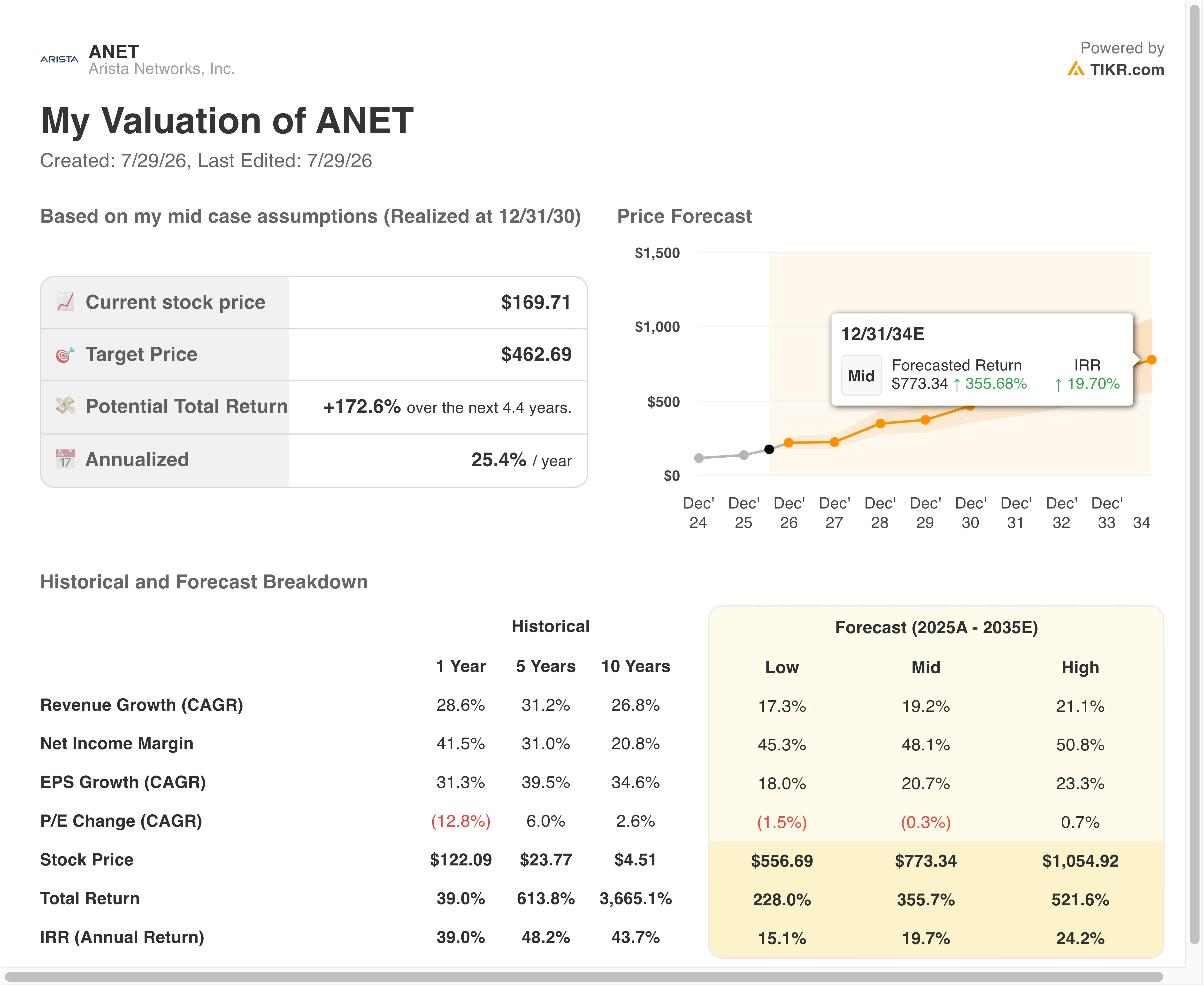
Revenue growth assumptions look conservative next to what Arm just delivered. The model assumes 25.0% CAGR, while licensing revenue alone grew 29% last quarter. If the AGI CPU ramps as management expects, actual growth could run ahead of the model’s baseline, which would push the real return higher than the current estimate suggests.
The 81.6x exit multiple carries real risk, though, because a lot of that AGI CPU optimism has to show up in earnings before the multiple can hold. Arm’s licensing model already earns unusually high margins since it collects fees without manufacturing chips itself, and that structure supports the 43.0% operating margin assumption. But first production revenue from the AGI CPU is not expected until fiscal 2027, so the near-term story still runs on royalty growth from Neoverse and custom silicon deals with AWS, Google and Microsoft.
Estimate a company’s fair value instantly (Free with TIKR) >>>
Arm vs the x86 Old Guard
Arm’s core competitive edge is architecture licensing rather than chip manufacturing, and that puts it in a different lane from traditional CPU makers. Intel and AMD still dominate data center CPUs built on x86 architecture, but hyperscalers are increasingly designing custom Arm-based chips instead. Google’s TPU accelerators now pair with custom Arm-based Axion CPUs rather than x86 host processors, and AWS continues scaling its Graviton line on Arm’s architecture.

Against Nvidia (NVDA), the comparison is less direct but still relevant: Nvidia’s new Vera CPU itself runs on Arm’s architecture, showing how deeply embedded Arm has become even among AI’s biggest winners. Nvidia trades at a far richer multiple given its GPU dominance, while Arm’s 81.6x exit multiple assumption reflects a business still transitioning from smartphone royalties toward data center scale.
Qualcomm (QCOM) remains Arm’s closest licensing peer, though Qualcomm trades at a much lower forward P/E near the mid-teens because its growth outlook is tied more to smartphones than AI infrastructure. Arm’s premium multiple only makes sense if the AGI CPU pipeline converts into real production revenue starting in fiscal 2027, which is why execution on that timeline matters more for Arm than for almost any of its peers right now.
Read our full take on Arm’s AI momentum, valuation, and next catalysts >>>
What’s Driving ARM Stock Going Forward?
The clearest near-term catalyst is supply. Management has said Arm has secured manufacturing capacity for the first $1 billion of AGI CPU orders but has not yet locked in capacity for the next billion, so foundry and memory partner negotiations will shape how quickly that $2 billion pipeline turns into revenue.
Data center royalties are another swing factor. Haas said on the earnings call that royalties tied to Neoverse-based chips have already doubled year over year and are expected to double again this year. Because royalties compound as more partners ship Arm-based silicon, this line could become the steadiest growth driver even if AGI CPU shipments slip.
Partnerships with server makers like Supermicro, Lenovo and ASRock could also speed adoption, since these companies can ship finished racks built around Arm’s architecture without customers needing to redo their software work. That removes a common friction point that has slowed enterprise adoption of new chip architectures in the past.
Longer term, management points to a structural shift in AI compute needs. Agentic AI workloads are expected to require more than four times today’s CPU capacity by 2030, according to Haas, creating what the company frames as a $100 billion data center CPU opportunity. Whether Arm captures a meaningful share of that market will likely determine if this week’s pullback turns out to be a buying opportunity or an early warning sign.
Estimate a company’s fair value instantly (Free with TIKR) >>>
Should You Invest in Arm Holdings?
The only way to really know is to look at the numbers yourself. TIKR gives you free access to the same institutional-quality financial data that professional analysts use to answer exactly that question.
Pull up ARM, and you’ll see years of historical financials, what Wall Street analysts expect for revenue and earnings in the quarters ahead, how valuation multiples have moved over time, and whether price targets are trending up or down.
You can build a free watchlist to track ARM alongside every other stock on your radar. No credit card required. Just the data you need to decide for yourself.
Analyze ARM stock on TIKR Free→
Disclaimer:
Please note that the articles on TIKR are not intended to serve as investment or financial advice from TIKR or our content team, nor are they recommendations to buy or sell any stocks. We create our content based on TIKR Terminal’s investment data and analysts’ estimates. Our analysis might not include recent company news or important updates. TIKR has no position in any stocks mentioned. Thank you for reading, and happy investing!


