


Key Stats for Mastercard Stock
- 52-Week Range: $464.52 – $601.77
- Current Price: $562.75
- Street Target Price: ~$644
- NTM P/E: 28x
- YTD Return: ~flat
- Market Cap: ~$497B
- Fwd 2-Yr Revenue CAGR: ~13%
Now Live: Discover how much upside your favorite stocks could have using TIKR’s new Valuation Model (It’s free)>>>
The Toll Booth on Global Spending Just Reported 16% Revenue Growth
Most companies with a $500 billion market cap are fighting to stay relevant. Mastercard’s (MA) challenge is a different one, the business is almost too consistent to make a compelling news story. Net revenue grew 16% year over year to $8.4 billion in Q1 2026.
Adjusted EPS of $4.60 came in ahead of the $4.41 consensus estimate, up 23% from $3.73 a year earlier. Cross-border volume, spending that occurs when a Mastercard-branded card is used outside its home country, which carries higher fees and is the company’s most lucrative revenue line, grew 13% in local currency.
The reason those numbers matter is the model behind them. Mastercard does not lend money, take credit risk, or manufacture anything. It operates a network connecting banks, merchants, and consumers, collecting a small percentage of every transaction that runs across it.
Worldwide gross dollar volume hit $2.7 trillion in Q1 alone. The value-added services business, which includes fraud detection, identity verification, and data analytics sold on top of the core network, grew 22% year over year, adding a higher-margin layer to an already high-margin foundation.

Revenue has compounded from $18.9 billion in 2021 to $32.8 billion in 2025 without a single down year, and estimates point toward $58.8 billion by 2030.
That is not a turnaround story or a bet on a new product cycle, it is a business that grows because global consumer spending grows, cross-border travel recovers, and digital payments continue displacing cash in markets where physical currency still dominates.
See what analysts think about MA stock right now (Free with TIKR) >>>
Why the Margin Story Is Just as Important as the Growth
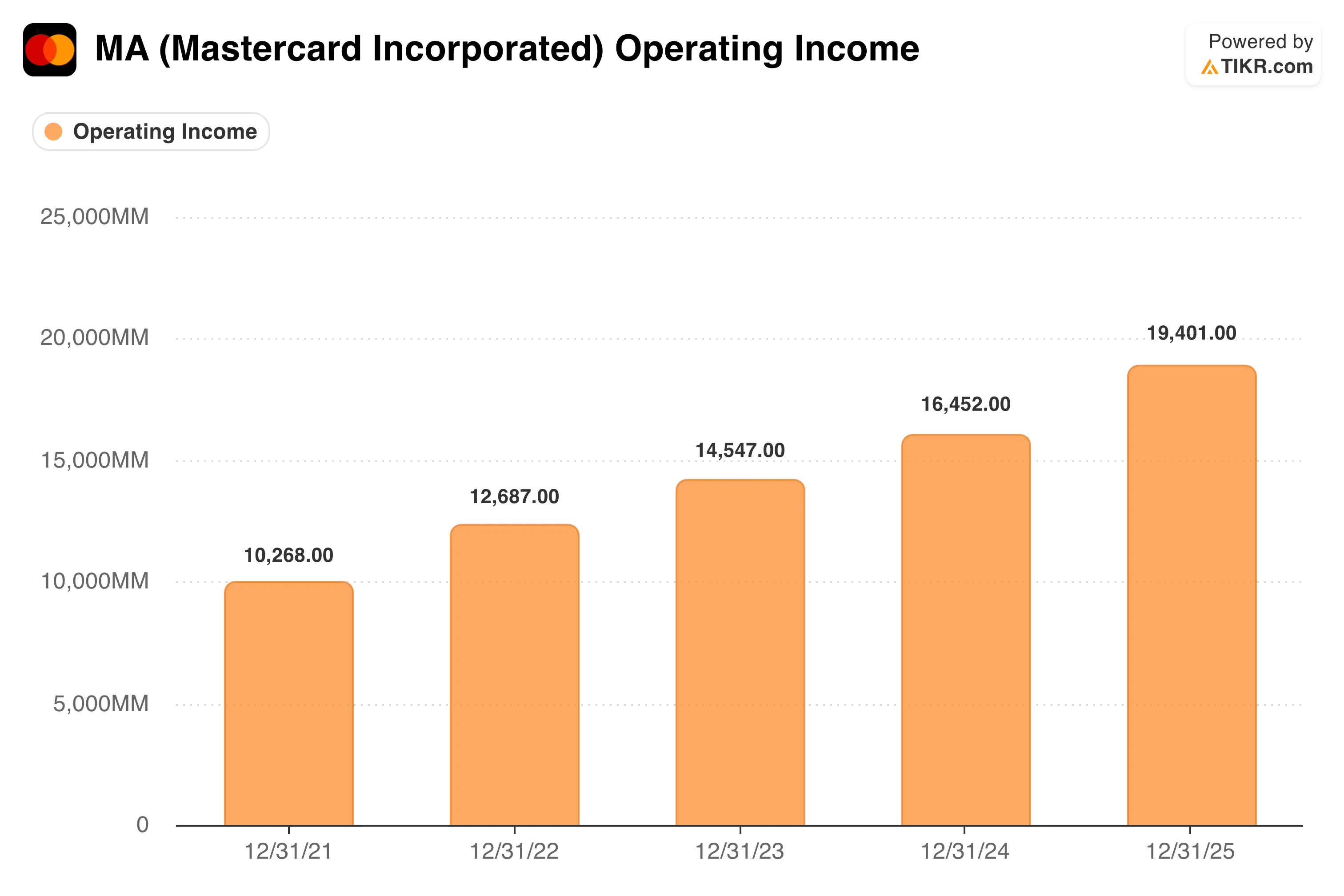
The more interesting chart for Mastercard is not revenue, it is what the company keeps. Operating income has grown from $10.3 billion in 2021 to $19.4 billion in 2025, nearly doubling in four years, while revenue grew around 74%.
Profits are growing faster than sales because the network has almost no marginal cost. Connecting one more merchant or issuing one more card does not require a proportional increase in employees or infrastructure.
The Q1 2026 adjusted operating margin came in at 60.8%, up 150 basis points year over year, after absorbing an 11% increase in operating expenses due to technology investments and new customer deals.
There is one genuine near-term headwind worth understanding. Cross-border travel volume decelerated from 13% growth in Q1 to roughly 9% by late April as geopolitical tensions in the Middle East disrupted travel patterns in that corridor.
Management sized the exposure at around 6% of total cross-border volume and guided Q2 growth to the low end of the low double digits, with recovery expected in the second half of the year.
The e-commerce side of cross-border spending held at 17% growth through late April, a sign the softness is regional and travel-specific rather than structural.
Read the full Mastercard transcript on TIKR to see the 2026 guidance breakdown >>>
What the Valuation Model Says About Mastercard Stock
The TIKR valuation model assumes revenue growing at around 9% annually through 2030 in the mid case, net income margins expanding to roughly 47%, and EPS compounding at around 10.5% per year.
The mid-case target is around $1,013 per share, representing a potential total return of around 80% from the current price, or roughly 14% annualized over 4.4 years.
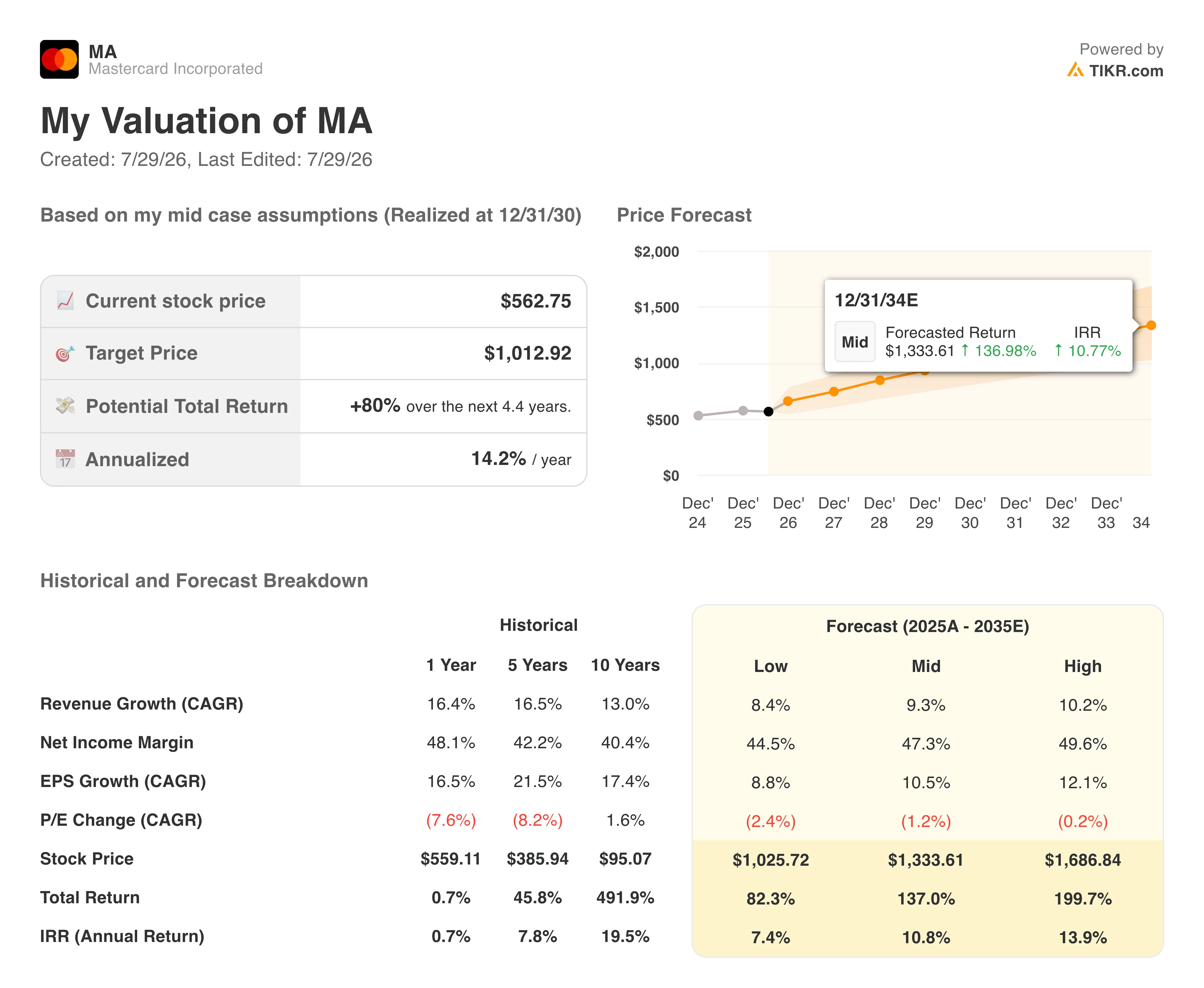
Those returns are not spectacular on paper, but context matters. The model bakes in meaningful multiple compression of about 1% per year, meaning the path to $1,013 is driven almost entirely by earnings growth rather than a re-rating.
For a business of Mastercard’s quality, 60% operating margins, no credit risk, a structurally growing addressable market, and a 14% annualized return with limited downside, it is a reasonable value proposition.
The high case reaches around $1,687, while the Street consensus sits around $644, implying roughly 14% upside on a shorter-term horizon.
Should You Buy Mastercard Stock?
Mastercard rarely looks cheap, and it does not look cheap today. At roughly 28 times forward earnings, investors are paying a premium for one of the most durable business models in public markets.
The counterargument is that Mastercard has traded at a premium for a decade and consistently grown into it, compounding earnings at 17–21% annually over the past three and five years while navigating rate cycles, geopolitical disruptions, and the occasional fintech threat.
The near-term question is whether the Middle East travel headwind lingers longer than management expects and whether consumer spending holds up through the second half of 2026. Neither risk changes the long-term story. Global commerce is migrating to digital rails, and Mastercard owns some of the most important ones in the world.
For long-term investors who can absorb a quarter or two of softer cross-border numbers, the business underneath continues to execute almost exactly as it always has.
Build your own Valuation Model to value any stock (It’s free!) >>>
Looking for New Opportunities?
- See what stocks billionaire investors are buying so you can follow the smart money.
- Analyze stocks in as little as 5 minutes with TIKR’s all-in-one, easy-to-use platform.
- The more rocks you overturn… the more opportunities you’ll uncover. Search 100K+ global stocks, global top investor holdings, and more with TIKR.
Disclaimer:
Please note that the articles on TIKR are not intended to serve as investment or financial advice from TIKR or our content team, nor are they recommendations to buy or sell any stocks. We create our content based on TIKR Terminal’s investment data and analysts’ estimates. Our analysis might not include recent company news or important updates. TIKR has no position in any stocks mentioned. Thank you for reading, and happy investing!


