Key Stats for Applied Materials Stock
- Current Price: $501.77
- Target Price (Mid): ~$672
- Street Target: ~$628
- Potential Total Return: ~34% (over ~4.2 years)
- Annualized IRR: ~7% / year
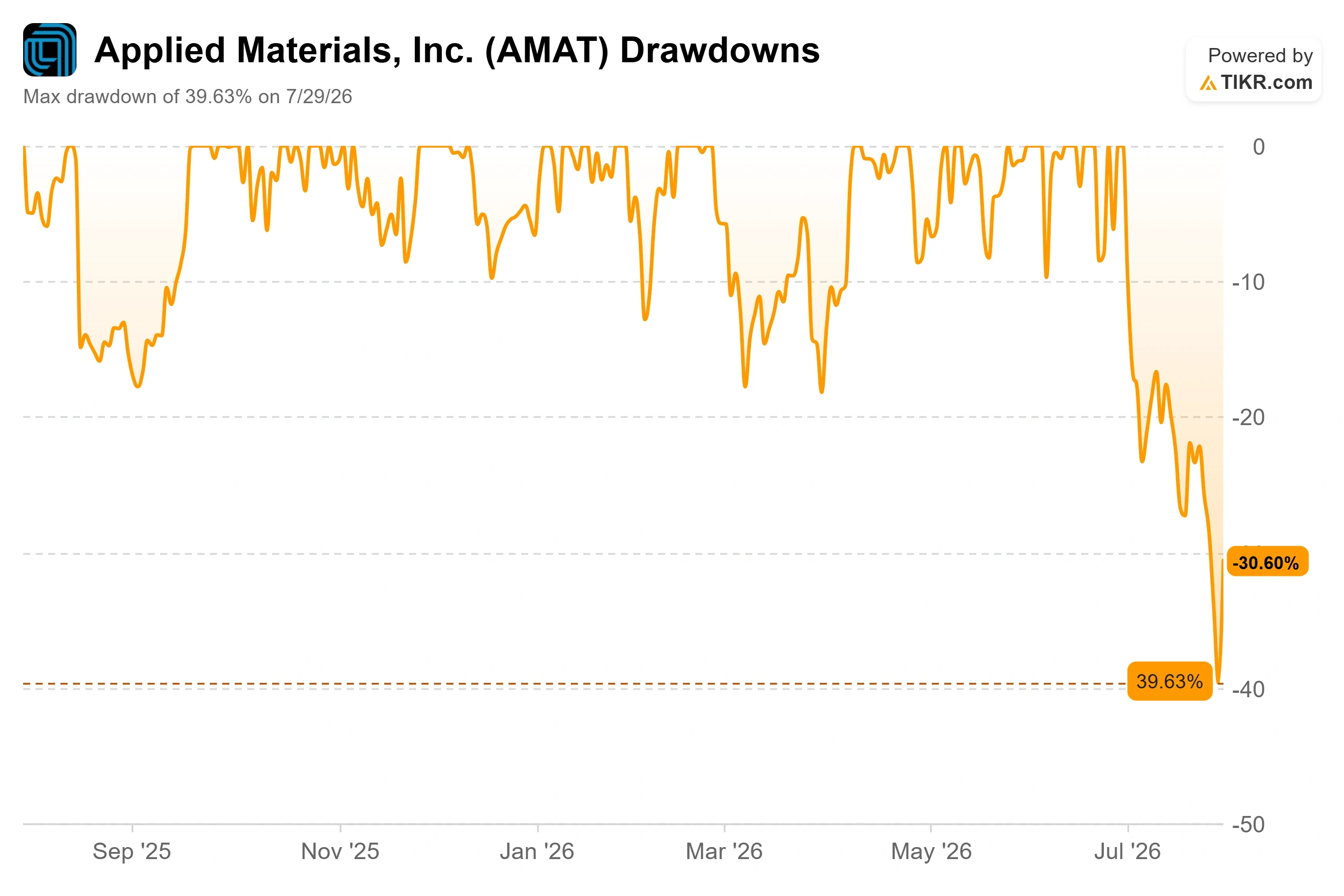
- Max Drawdown (1yr): 39.63% (July 29, 2026)
Now Live: Discover how much upside your favorite stocks could have using TIKR’s new Valuation Model (It’s free) >>>
What Happened?
Applied Materials, Inc. (AMAT) closed at $501.77 on July 30, up 14.97% in a single session, among its sharpest daily gains in years. The move is more striking for where it started. The day before, the stock sat near $436, down 39.63% from its June 30 peak of about $723, one of the ugliest month-long drawdowns a mega-cap chip name has taken in this cycle.
So a stock the market had been dumping for four weeks turned on a dime. Almost none of the reversal was about Applied Materials, which leaves a buyer today with a single question: was July 29 the bottom, or is this a violent bounce inside a chart that is still broken? The company reports earnings on August 13, and that print is what turns the guess into an answer.
The Rally Came From Three Companies, None of Them Applied
Nothing company-specific happened to Applied on July 30. The spark came from elsewhere in the chip complex. Microsoft reported strong Azure growth and lifted its capital spending, easing the fear that AI infrastructure demand had peaked. Lam Research popped roughly 18% on a strong beat and guidance, its best day since 1999. And Samsung told investors it expects the memory chip shortage to worsen and stretch into 2028, backing that view with multi-year supply deals with the five largest data center operators. Memory names went vertical: Micron rose about 18%, and the iShares Semiconductor ETF gained more than 8% on the day.
Applied rose because it sells the tools that build memory, not because it said anything new, and that borrowed strength is the risk in the bounce. A stock lifted by sector sentiment can hand the move back just as fast, and the prior month showed exactly that. The same memory names that soared on July 30 had spent weeks collapsing on fears of Chinese supply and peaking AI spend, dragging Applied down with them. Michael Burry, who shorted the 2008 housing market, disclosed a fresh AMAT short at $729.40 on June 30, a bet the AI rally had run past its fundamentals. The round trip from $723 to $436 to $502 inside a single month shows how unsettled the name has become.
See historical and forward estimates for Applied Materials stock (It’s free!) >>>
Why Agentic AI Is What Actually Feeds Applied’s Memory Business
The reason a Samsung warning lifts Applied at all runs through a piece of plumbing the company detailed at its June 26 briefing: the memory wall. Kevin Moraes, who leads Applied’s DRAM and packaging strategy, described the gap between processors that keep getting faster and memory that struggles to keep them fed. In AI inference, he noted, memory access and data movement can consume the vast majority of a system’s activity and energy. Every attempt to close that gap means more memory, more advanced packaging, and more of the equipment Applied builds.
Agentic AI widens the gap. As models run longer context windows and persist across more steps, the “KV cache,” a model’s running memory of what it has already processed, expands with them. That data leans on DRAM for the fast, frequently updated portion and NAND for the overflow, which is why Applied now expects the DRAM equipment market to run more than twice the size of the NAND market for the foreseeable future. When Samsung says the shortage runs to 2028, it is describing years of DRAM and high-bandwidth memory capacity that have to be built, and Applied holds the number one position in HBM packaging.
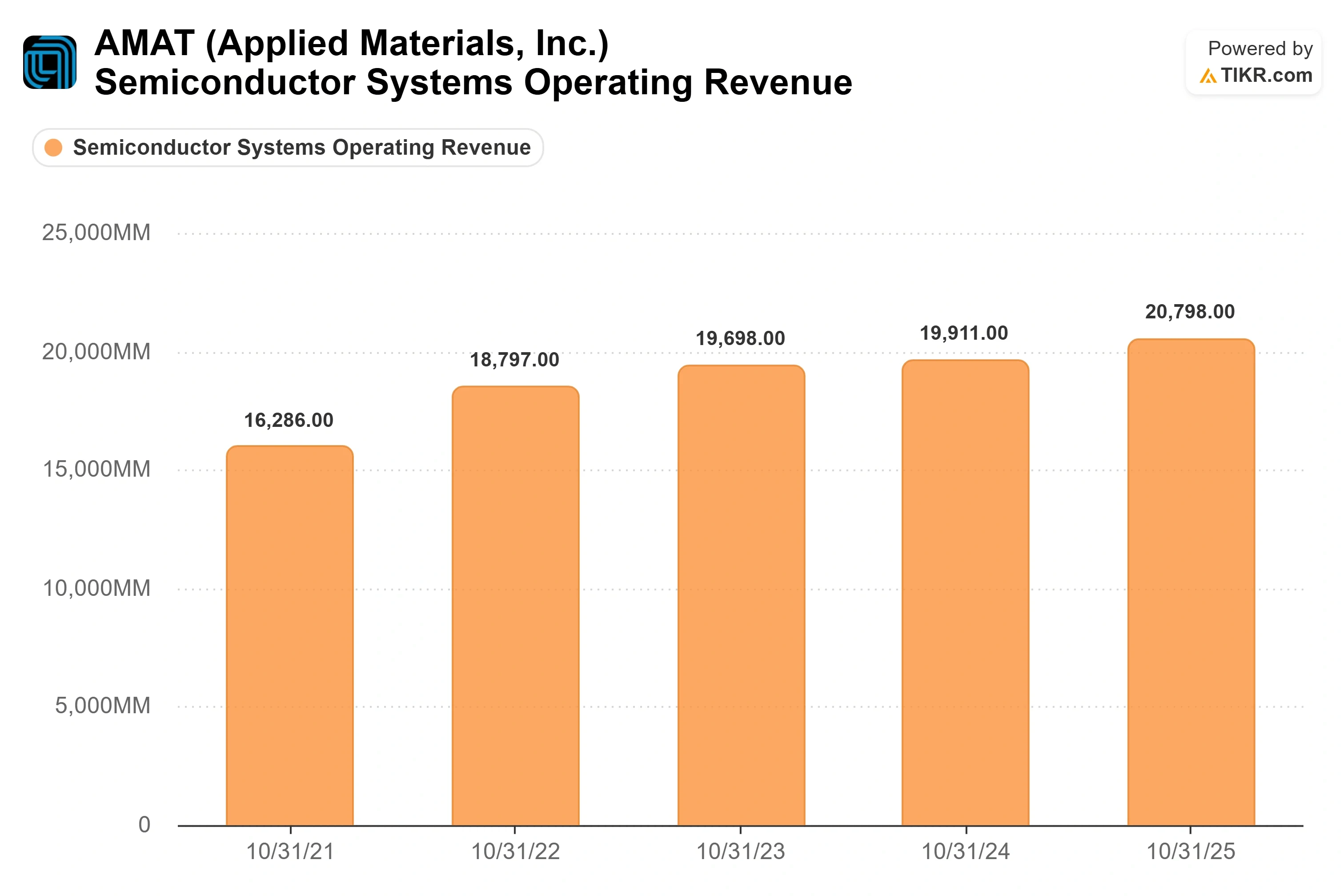
The connection reaches into Applied’s logic business, too. In HBM4, the base die beneath every memory stack is moving to advanced FinFET logic to handle higher bandwidth, so the memory upcycle pulls Applied’s foundry-logic tools along with its memory tools. That breadth is the case for the stock: Applied touches nearly every step of the wafer and captures value across the buildout, no matter which chipmaker or memory maker wins. It is also why the stock does not screen cheap, trading at around 28.6 times forward EV/EBITDA, a premium to Lam Research at 26.4 times and well above chip designers growing faster, like NVIDIA at 15.5 times.
See how Applied Materials performs against its peers in TIKR (It’s free!) >>>
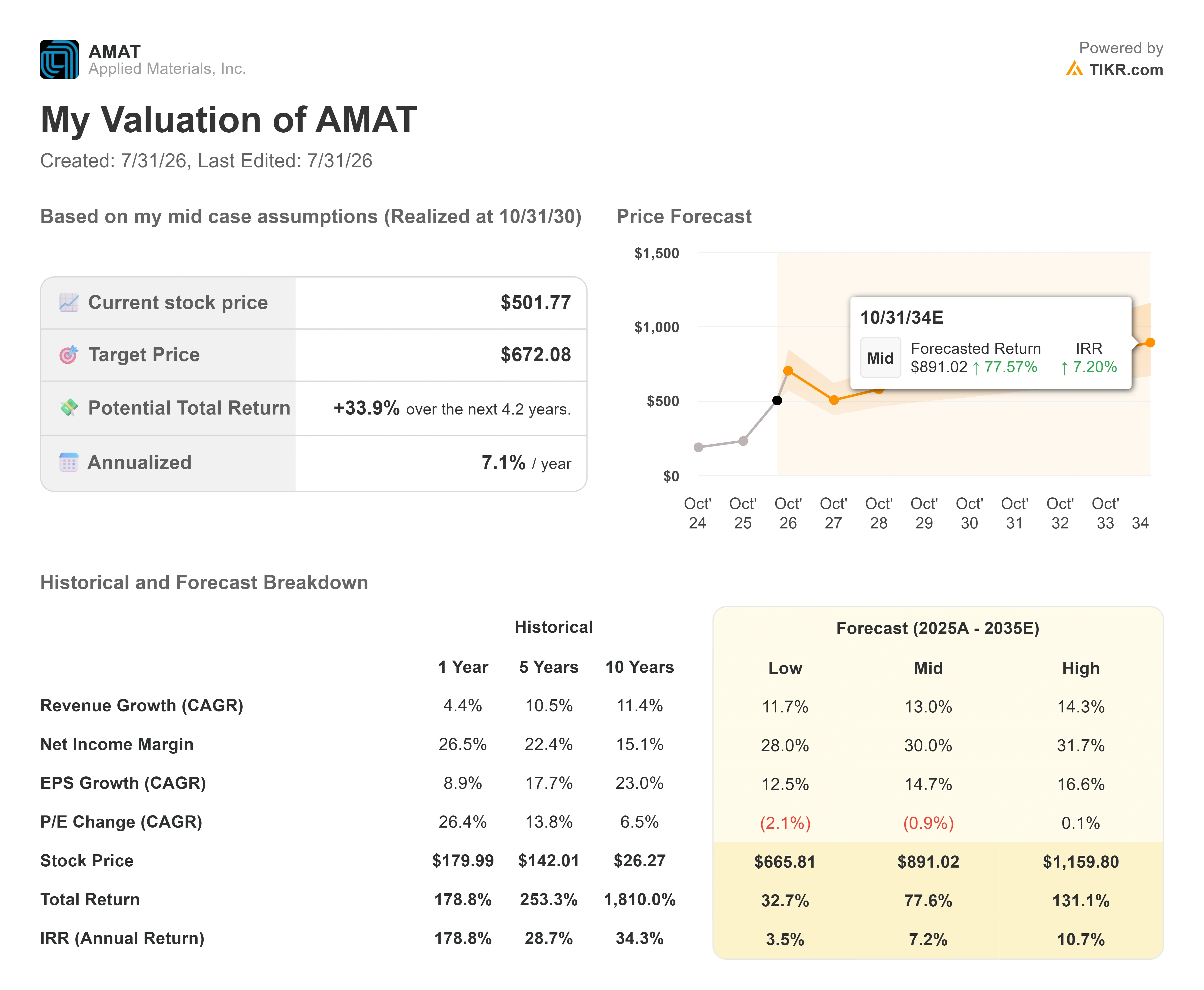
TIKR Advanced Model Analysis
- Current Price: $501.77
- Target Price (Mid): ~$672
- Potential Total Return: ~34% (over ~4.2 years)
- Annualized IRR: ~7% / year
See analysts’ growth forecasts and price targets for Applied Materials stock (It’s free!) >>>
That is a fair-value read, not a bargain, because the model already assumes the cycle holds. Two drivers carry the revenue line: a forward growth rate of around 13% annually, split between the DRAM equipment ramp and advanced packaging. The margin driver is mix, as leading-edge logic, DRAM, and packaging tools take a larger share of sales, lifting modeled net income margin toward around 30% from the mid-20s of the past five years. The primary risk is the cycle itself: Applied sells lumpy capital equipment, and if AI capex slows or memory makers pause expansion, orders fall faster than any model expects, the exact scenario Burry is pressing.
If Samsung’s shortage drives a longer, deeper equipment cycle than consensus assumes, Applied’s lead in DRAM and HBM packaging lets it capture more than its share. If today’s price already embeds that cycle, one soft guide sends the stock back toward the July lows.
Conclusion
The August 13 print is where Applied proves the bounce deserved. After the close, the company reports fiscal Q3, already guided to $8.95 billion in revenue, up about 23% year over year, and $3.36 in non-GAAP EPS. The number that decides the reaction is not the headline beat but the calendar 2026 equipment growth outlook management raised to more than 30% last quarter. Reaffirm or lift it, and the July 30 rally starts to look like a floor forming. Trim it, or sound cautious on memory pricing, and the bounce reads as a trap set by one good day in the sector. Watch the guide, not the print.
See what stocks billionaire investors are buying so you can follow the smart money with TIKR.
Should You Invest in Applied Materials?
The only way to really know is to look at the numbers yourself. TIKR gives you free access to the same institutional-quality financial data that professional analysts use to answer exactly that question.
Pull up Applied Materials, and you’ll see years of historical financials, what Wall Street analysts expect for revenue and earnings in the quarters ahead, how valuation multiples have moved over time, and whether price targets are trending up or down.
You can build a free watchlist to track Applied Materials alongside every other stock on your radar. No credit card required. Just the data you need to decide for yourself.
Analyze Applied Materials on TIKR Free →
Looking for New Opportunities?
- See what stocks billionaire investors are buying so you can follow the smart money.
- Analyze stocks in as little as 5 minutes with TIKR’s all-in-one, easy-to-use platform.
- The more rocks you overturn… the more opportunities you’ll uncover. Search 100K+ global stocks, global top investor holdings, and more with TIKR.
Disclaimer:
Please note that the articles on TIKR are not intended to serve as investment or financial advice from TIKR or our content team, nor are they recommendations to buy or sell any stocks. We create our content based on TIKR Terminal’s investment data and analysts’ estimates. Our analysis might not include recent company news or important updates. TIKR has no position in any stocks mentioned. Thank you for reading, and happy investing!