Key Stats for CAT Stock
- Past week’s performance: -7.3%
- 52-week range: $405 to $1,073
- Valuation model target price: $981
- Implied upside: 21.2% over 2.4 years
See what Caterpillar’s record $51 billion order book could mean for the stock on TIKR >>>
Record Backlog, Record Highs
Caterpillar (CAT) has climbed toward $809 this week, extending a rally that has taken the stock up sharply over the past year. The move traces back to a business transformation that has less to do with construction equipment and more to do with powering AI data centers.
Caterpillar’s Power & Energy segment has become the standout growth driver, with power generation revenue surging on hyperscale data center buildouts. That strength helped the company post a record backlog exceeding $50 billion, up sharply from the prior year. This gives investors clear visibility into demand well beyond the current quarter.
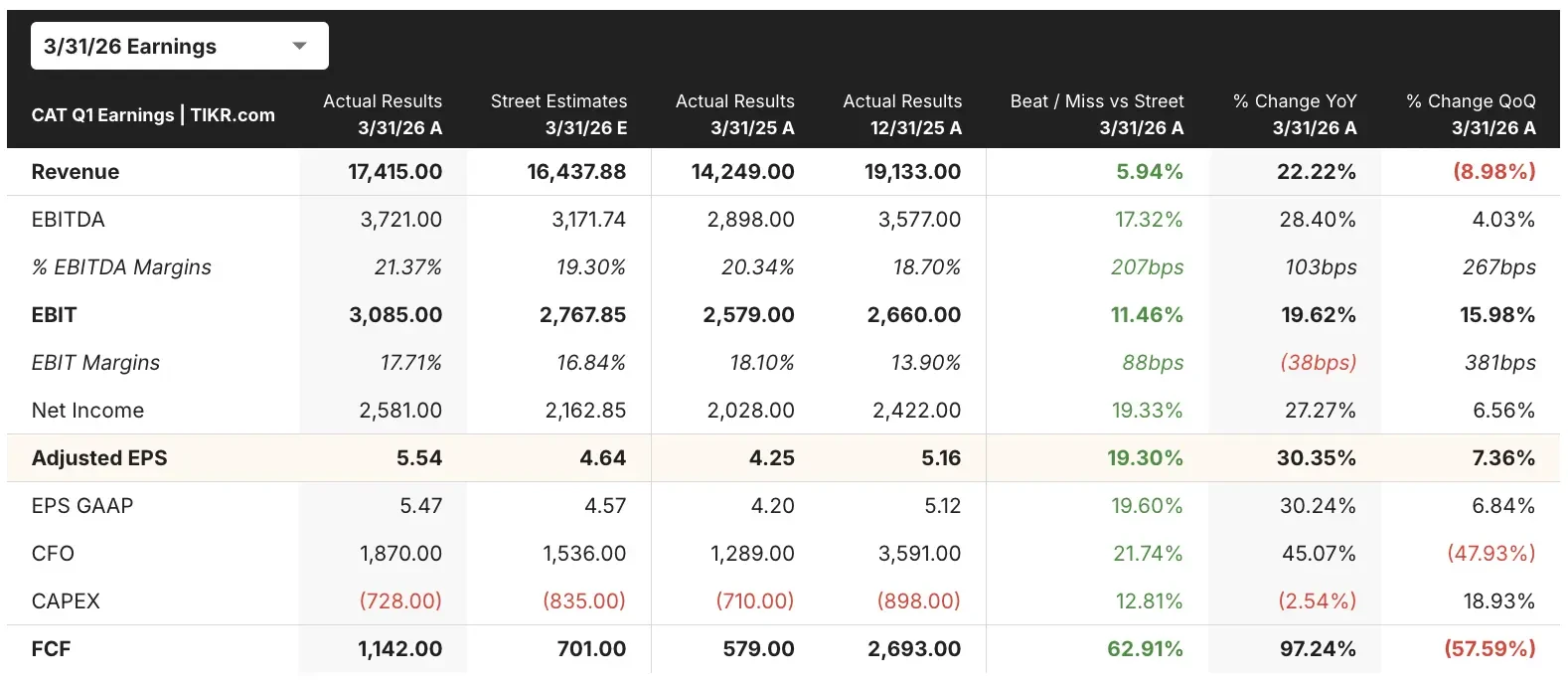
The first quarter results reinforced that momentum. Revenue rose 22% year over year to $17.4 billion. Adjusted earnings per share climbed 30.4% to $5.54, comfortably beating the roughly $4.62 analysts expected. Management attributed the strength to higher sales volumes across construction, energy, and resource industries, even while absorbing meaningful tariff costs.
Caterpillar has also been expanding its footprint in electrification and AI-adjacent mining technology. The company acquired Skycatch, a spatial data and AI analytics firm for mine sites, and it’s trialing battery-electric haul trucks with BHP and Rio Tinto in Australia’s Pilbara region, positioning Caterpillar as a supplier for lower-carbon, data-driven mining operations.
The board also raised the quarterly dividend to $1.63 per share in June, continuing a pattern of steady capital returns even as the company funds growth investments. If Caterpillar can keep converting its record backlog into delivered revenue, the current valuation may still have room to run heading into 2027.
Get the free rundown on Caterpillar’s Skycatch deal and electric haul truck trials on TIKR >>>
Priced for Perfection or Still Room to Run?
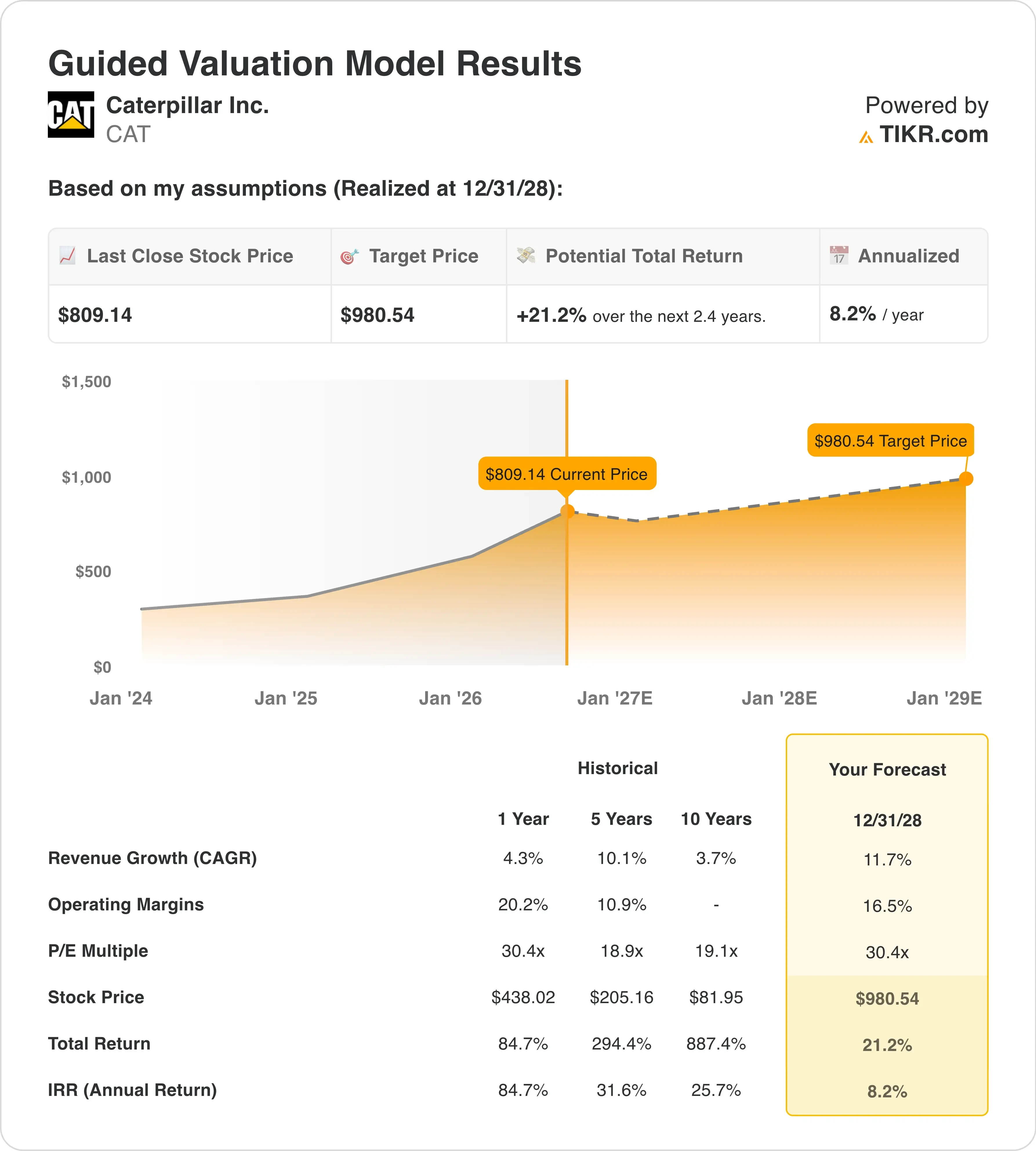
Under valuation model assumptions realized through 12/31/28, the stock is modeled using:
- Revenue Growth (CAGR): 11.7%
- Operating Margins: 16.5%
- Exit P/E Multiple: 30.4x
Based on these inputs, the model estimates a target price of $981, implying a 21.2% total return from the current share price and an 8.2% annualized return over the next 2.4 years.
Caterpillar’s stock has already rallied hard, so the natural question is whether there’s still value left at these levels. The model suggests a modest but real cushion remains, anchored by genuinely improving fundamentals rather than pure multiple expansion.
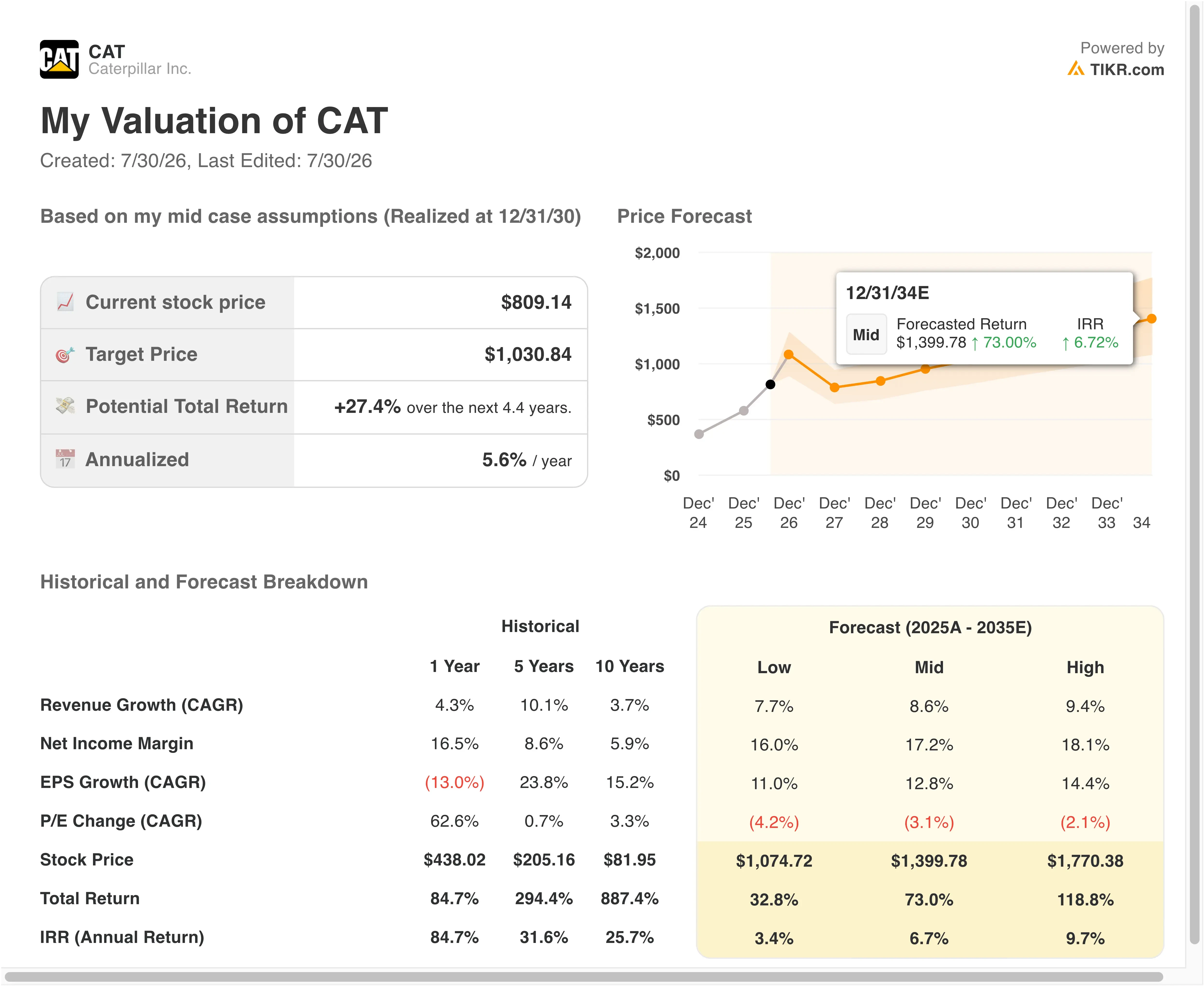
Revenue growth near 12% annually is well above Caterpillar’s historical 5% to 7% long-term target, reflecting the AI power tailwind layered on top of its traditional construction and resource cycles. That’s a meaningful acceleration for a company this size, and it’s the main reason the stock has re-rated higher over the past year.
Margins are the area to watch most closely. Operating margin near 16.5% sits below Caterpillar’s recent peak levels, since tariff costs are expected to create a $2.6 billion headwind in 2026. Management has guided margins toward the lower end of its 15% to 19% range for now, with room to expand if revenue scales toward $72 billion or higher.
The exit multiple of 30.4x is elevated relative to Caterpillar’s own 10-year average near 19x, which is the clearest sign the market is now pricing in sustained AI-driven demand rather than a typical industrial cycle. If that demand proves durable, the multiple could hold. If it fades, Caterpillar could see a sharper pullback than a traditional cyclical stock.
Test whether Caterpillar’s 30x multiple holds up under your own assumptions (Free) >>>
Caterpillar vs. Deere: A Widening Gap
Deere (DE) is Caterpillar’s most natural comparison, and the two stocks have told sharply different stories in 2026. Caterpillar’s Q4 2025 revenue of $19.13 billion crushed the $16.2 billion consensus estimate, driven by its Power & Energy segment growing 23% to $9.4 billion, while Deere’s agricultural segment saw operating profit collapse 59% as the large agriculture market heads for a 15% to 20% decline this year.

On valuation, Deere trades at a forward multiple near 26x, actually higher than some periods of Caterpillar’s own multiple, despite Deere’s quarterly revenue recently falling double digits year over year. That disconnect exists because investors are betting Deere’s agricultural downcycle bottoms in 2026, setting up a 2027 recovery, while Caterpillar’s growth is already showing up in current results.
Caterpillar’s 46.3% return on equity and roughly 17% operating margin reflect a more profitable and diversified business model today, with far less exposure to the cyclical swings currently hitting agricultural equipment makers. Deere’s cheaper valuation does offer more downside protection if its turnaround thesis plays out as management expects.
Cummins is a more direct competitor in the power generation niche specifically, trading at a forward multiple near 23x with quarterly earnings recently down 21% year over year, underscoring how uniquely positioned Caterpillar’s power segment has become relative to peers still working through their own demand cycles.
See how CAT’s data-center power boom and record backlog could fuel the next leg >>>
What’s Driving CAT Stock Going Forward?
The most immediate catalyst is Caterpillar’s Q2 2026 earnings report, due August 4, where investors will look for confirmation that the Power & Energy segment kept accelerating and that the record backlog is converting into delivered revenue on schedule.
Tariff costs remain a swing factor worth tracking closely. Caterpillar expects a full-year headwind of roughly $2.6 billion, and any update on how much of that gets offset through pricing or supply chain adjustments could move margin expectations meaningfully.
The electrification and AI-mining technology push is the more structural story. As the Skycatch integration matures and the battery-electric haul truck trials with BHP and Rio Tinto progress, expect more detail on how these initiatives translate into new revenue streams rather than just efficiency gains for customers.
Finally, continued strength in data center power demand is the single biggest variable behind the stock’s premium valuation. Any signs that hyperscaler capital spending is slowing would likely pressure the multiple faster than it pressures the underlying business.
Estimate a company’s fair value instantly (Free with TIKR) >>>
Should You Invest in Caterpillar?
The only way to really know is to look at the numbers yourself. TIKR gives you free access to the same institutional-quality financial data that professional analysts use to answer exactly that question.
Pull up CAT, and you’ll see years of historical financials, what Wall Street analysts expect for revenue and earnings in the quarters ahead, how valuation multiples have moved over time, and whether price targets are trending up or down.
You can build a free watchlist to track CAT alongside every other stock on your radar. No credit card required. Just the data you need to decide for yourself.
Analyze CAT stock on TIKR Free→
Disclaimer:
Please note that the articles on TIKR are not intended to serve as investment or financial advice from TIKR or our content team, nor are they recommendations to buy or sell any stocks. We create our content based on TIKR Terminal’s investment data and analysts’ estimates. Our analysis might not include recent company news or important updates. TIKR has no position in any stocks mentioned. Thank you for reading, and happy investing!