


Key Stats for Coca-Cola Stock
- Current Price: $78.42
- Target Price (Mid): ~$104
- Street Target: ~$86
- Potential Total Return: ~33%
- Annualized IRR: ~6% / year
- Earnings Reaction: +0.66% (April 28, 2026)
Now Live: Discover how much upside your favorite stocks could have using TIKR’s new Valuation Model (It’s free) >>>
What Happened?
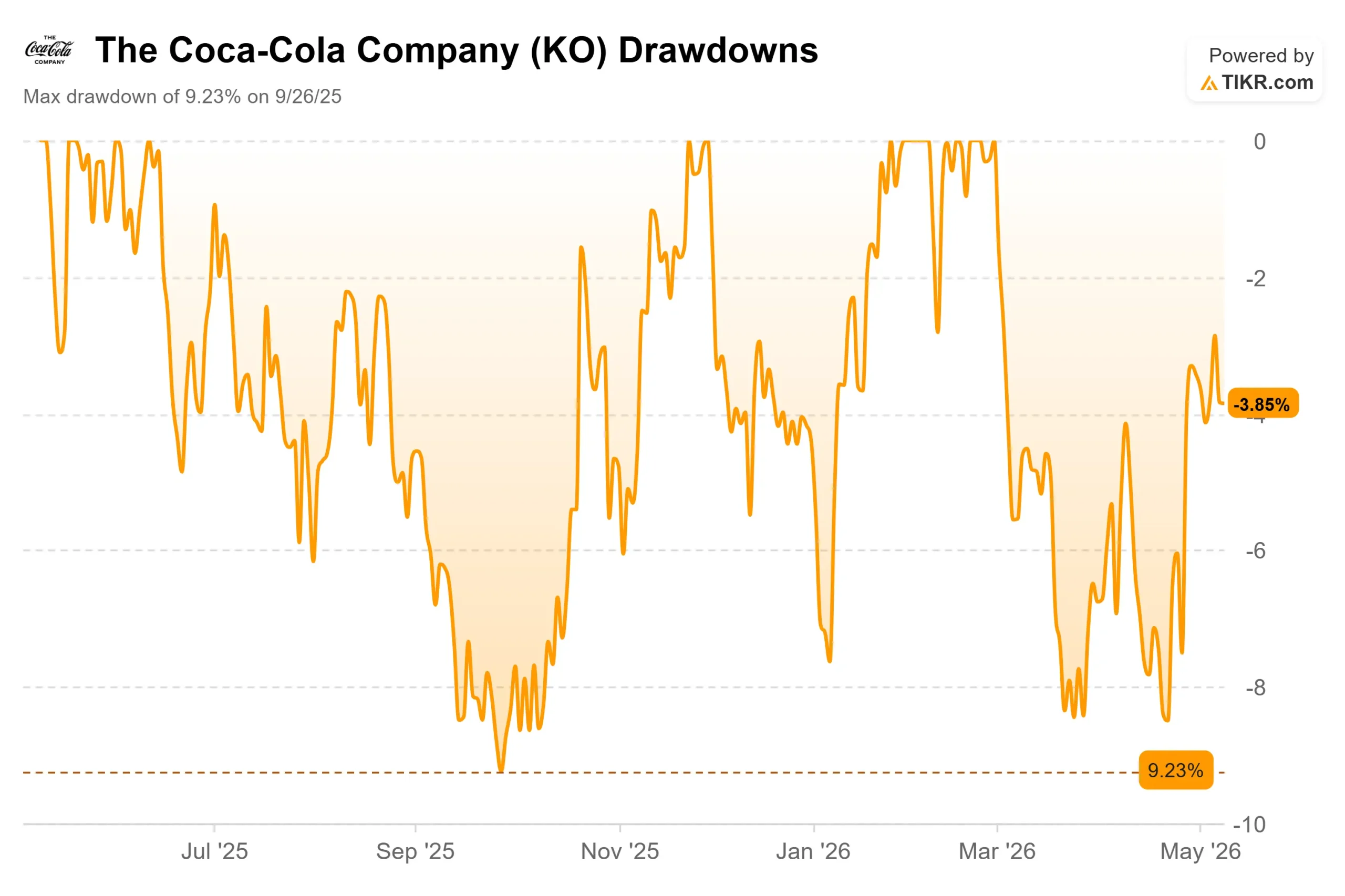
Consumer staples stocks have led the defensive rotation in 2026, and Coca-Cola (KO) has been at the center of it, up roughly 12% year to date. The debate is not whether the business can grow. It is whether the new CEO can extend that growth narrative convincingly enough to justify a premium multiple.
On April 28, Coca-Cola reported Q1 2026 results that beat on every major line. Adjusted EPS came in at $0.86, above the $0.81 consensus. Revenue reached $12.471 billion, ahead of the $12.231 billion expected. The stock rose 0.66% on the day. The following morning, multiple Wall Street banks raised their price targets: TD Cowen to $90, UBS to $92, Citigroup to $90, and JPMorgan and Barclays both to $85.
Then on April 29, Coca-Cola held its 2026 Annual Meeting of Shareowners. Henrique Braun, who formally took the CEO role on March 31, gave his first Annual Meeting address as the company’s leader. He did not recap one quarter. He addressed the structural questions every long-term KO investor carries: GLP-1 headwinds, AI cost discipline, pricing elasticity, and the 64-year dividend streak.
What he said matters beyond the headline beat.
See historical and forward estimates for Coca-Cola stock (It’s free!) >>>
What Braun Said and Why It Matters
When a shareowner asked whether Coca-Cola’s AI spending was “just trendy hype,” Braun answered precisely. The company’s digital agenda, he said, has always been “about doing better at what we do best.” He pointed to the Christmas campaign as a concrete proof point: generative AI produced it “at a fraction of the cost and way faster than we used to do.” At Coca-Cola’s global marketing scale, that efficiency compounds.
On GLP-1 weight-loss drugs, a worry that has rattled food and beverage investors for two years, Braun was equally specific. Based on Coca-Cola’s own research, GLP-1 users shift toward low- or no-calorie beverages, not away from beverages entirely. He cited Fairlife, Core Power, Smartwater, Coke Zero, and Diet Coke as the natural beneficiaries. He also noted that 30% of Coca-Cola’s 2024 global volume was already low or no-calorie, and 18 of the top 20 brands carry a reduced- or zero-sugar option. The headwind is real. The portfolio is already ahead of it.
On pricing, Executive Chair James Quincey pointed to packaging size architecture as the primary lever. Offering everything from mini cans to large multipacks lets the company meet consumers at their price point without discounting the brand. Quincey confirmed that North America posted 4% volume growth in Q1, driven by Trademark Coca-Cola, water, sports, coffee, and tea, which evidences that the strategy is working in the most price-sensitive market the company operates.
On the dividend, Quincey addressed the 64-year streak directly. He said the company determines reinvestment needs first, then supports dividends and buybacks from remaining free cash flow. He added that net debt leverage sits at 1.80x EBITDA below the company’s own targeted range of 2x to 2.5x, giving KO the flexibility to keep growing the payout.
Braun’s playbook is to compound what is already working, not disrupt it. For a Dividend King trading at a modest discount to its historical multiple, that is the right message.
The Business Underneath the Speeches
The Q1 numbers give Braun’s words a foundation. Net revenues grew 12% to $12.471 billion, organic revenue rose 10%, and adjusted EPS of $0.86 was up 18% year over year from $0.73. Volume grew in all operating segments: global unit case volume up 3%, North America at 4%, Asia Pacific at 5%, and Coca-Cola Zero Sugar up 13% globally. This was not a pricing-only quarter; volume and price both contributed.
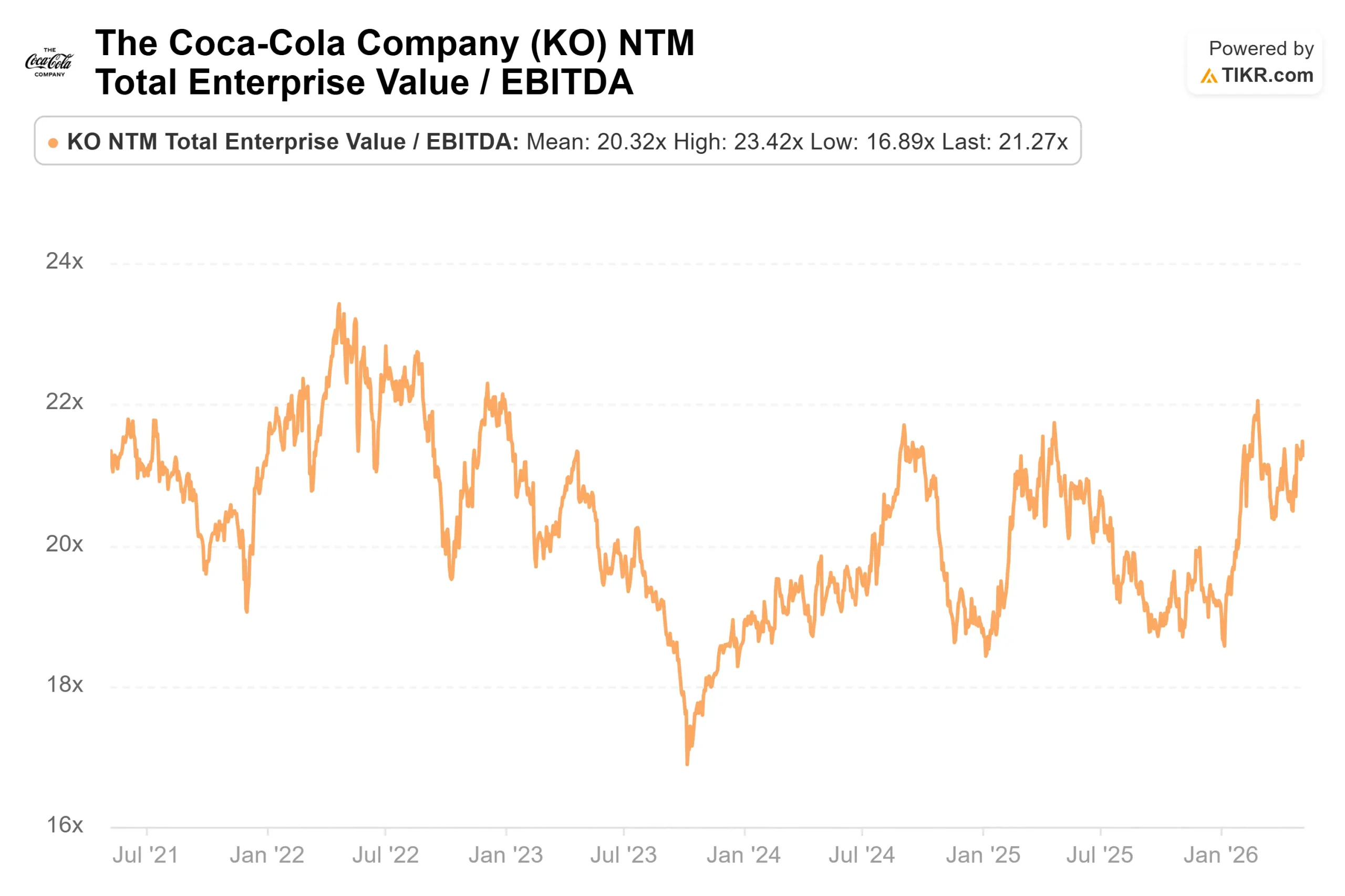
On valuation multiples, Coca-Cola trades at 21.27x NTM EV/EBITDA per TIKR’s Competitors page, versus PepsiCo at 12.91x and Keurig Dr Pepper at 10.86x. That is roughly a 65% premium to PepsiCo. It is justified by Coca-Cola’s LTM gross margin of 61.7% and EBIT margin of 31.8%, both well above peers, driven by the asset-light concentrate model. Whether that premium holds depends on margin expansion continuing through 2027.
Full-year EPS guidance was raised to 8%–9% growth from a 2025 base of $3.00, up from the prior 7%–8% range. Organic revenue growth guidance of 4%–5% was held steady. The pending sale of Coca-Cola Beverages Africa expected in the second half of 2026 will create roughly a 4-point headwind to reported revenues but should lift consolidated margins as lower-margin bottling operations exit the P&L.
The risks deserve equal weight. The IRS transfer-pricing dispute carries an estimated $14 billion in potential liability for tax years 2010 through 2025, with roughly $450 million of additional exposure for Q1 2026, as disclosed in Coca-Cola’s 10-Q filing. Mexico’s new 2026 sugar tax is already pressuring Latin America’s results. Commodity costs in tea, coffee, and aluminum remain “manageable” in CFO John Murphy’s words, but that framing leaves room for the situation to shift.
See how Coca-Cola performs against its peers in TIKR (It’s free!) >>>
TIKR Advanced Model Analysis
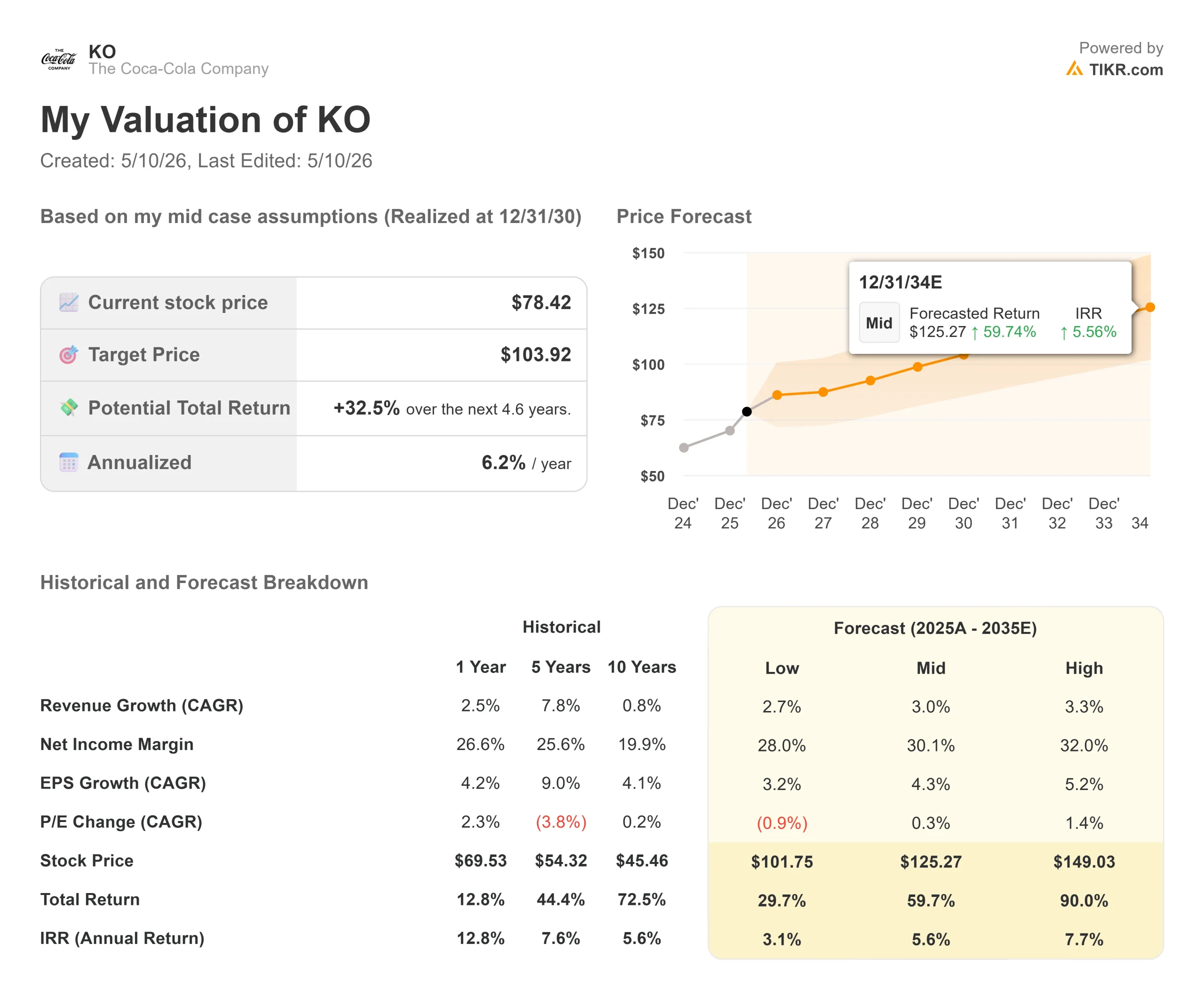
- Current Price: $78.42
- Target Price (Mid): ~$104
- Potential Total Return: ~33%
- Annualized IRR: ~6% / year
See analysts’ growth forecasts and price targets for Coca-Cola stock (It’s free!) >>>
The TIKR mid-case runs a revenue CAGR of around 3% through 2030. The two primary growth drivers are North America’s pricing discipline across a broad packaging portfolio and continued unit case expansion in the Asia Pacific. The margin driver is operating leverage. Q1 showed operating margin expanding even as gross margin faced mild commodity pressure because SG&A grew more slowly than revenue. The mid-case models’ net income margins are rising toward ~30% by 2030, from 26.6% today.
The high case reaches ~$149 by 12/31/30, roughly 90% total return if FIFA World Cup activations sustain volume momentum and Fairlife’s expanded Michigan capacity captures premium protein demand. The low case lands near ~$102, roughly 30% total return if the IRS dispute resolves unfavorably and commodity costs erode bottler economics.
At $78.42, the mid-case implies a ~6% annualized return through 2030. Alongside a 2.7% dividend yield growing behind 64 consecutive annual increases, in a stock carrying a 5-year beta of 0.36, the total picture is built for investors who prioritize capital stability and income growth alongside modest price appreciation.
Conclusion
Watch North America volume growth at the Q2 2026 earnings report, expected July 21. Q1 showed that the pricing architecture works. Q2 will confirm whether it holds through the FIFA World Cup activation period and against continued pressure on lower-income shoppers. Sustained volume growth in North America would validate Braun’s playbook heading into the back half of the year.
Coca-Cola is a defensive compounder with a new CEO who speaks precisely, a Q1 beat across every segment, and a ~$104 TIKR mid-case target built on assumptions that already look conservative relative to the earnings acceleration visible in 2026.
See what stocks billionaire investors are buying so you can follow the smart money with TIKR.
Should You Invest in Coca-Cola?
The only way to really know is to look at the numbers yourself. TIKR gives you free access to the same institutional-quality financial data that professional analysts use to answer exactly that question.
Pull up Coca-Cola, and you’ll see years of historical financials, what Wall Street analysts expect for revenue and earnings in the quarters ahead, how valuation multiples have moved over time, and whether price targets are trending up or down.
You can build a free watchlist to track Coca-Cola alongside every other stock on your radar. No credit card required. Just the data you need to decide for yourself.
Analyze Coca-Cola on TIKR Free →
Looking for New Opportunities?
- See what stocks billionaire investors are buying so you can follow the smart money.
- Analyze stocks in as little as 5 minutes with TIKR’s all-in-one, easy-to-use platform.
- The more rocks you overturn… the more opportunities you’ll uncover. Search 100K+ global stocks, global top investor holdings, and more with TIKR.
Disclaimer:
Please note that the articles on TIKR are not intended to serve as investment or financial advice from TIKR or our content team, nor are they recommendations to buy or sell any stocks. We create our content based on TIKR Terminal’s investment data and analysts’ estimates. Our analysis might not include recent company news or important updates. TIKR has no position in any stocks mentioned. Thank you for reading, and happy investing!


