
Key Stats for AMZN Stock
- Past-30-Day Performance: -5%
- 52-Week Range: $161 to $259
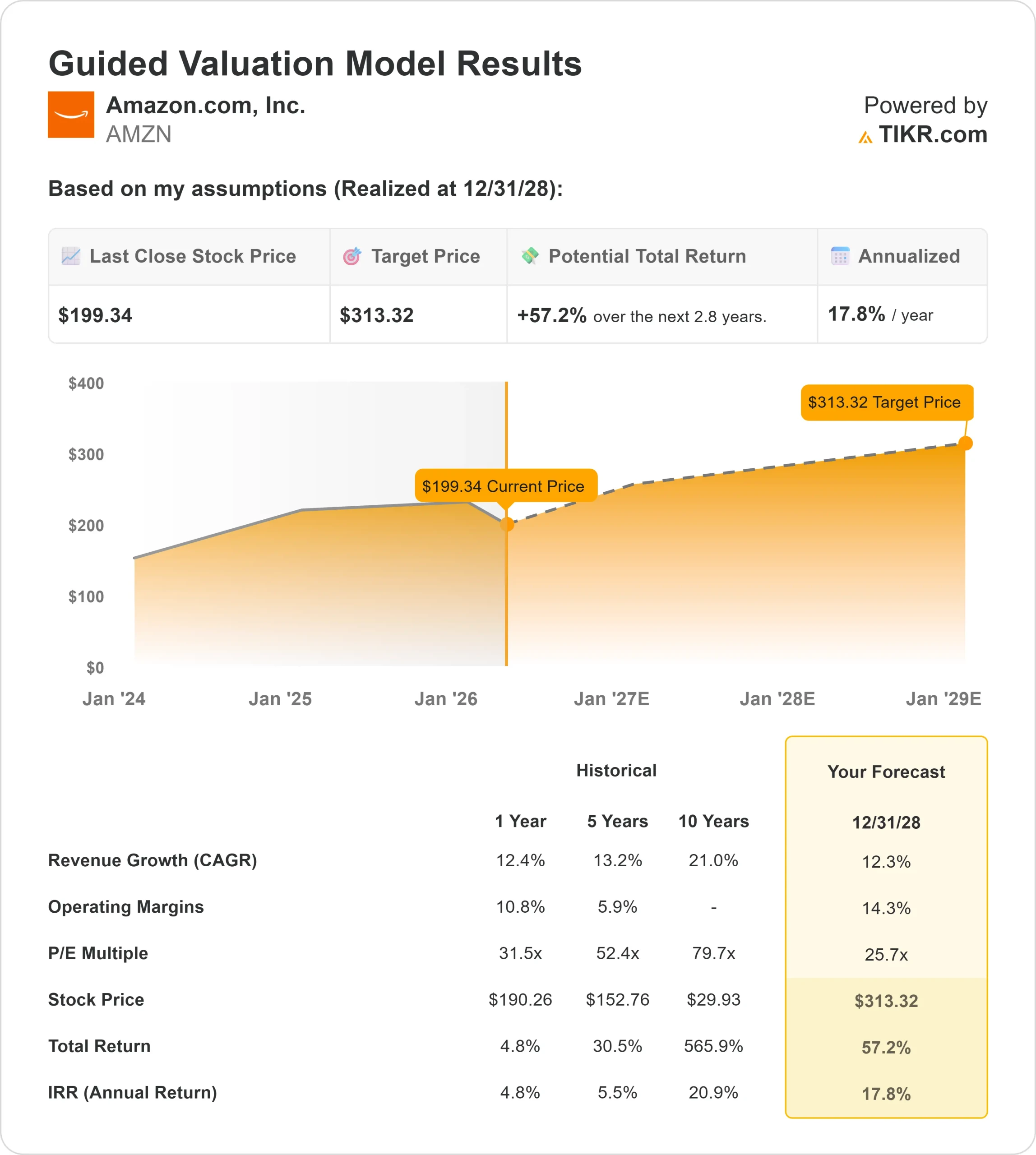
- Valuation Model Target Price: $313
- Implied Upside: 57%
Analyze your favorite stocks like Amazon with TIKR (It’s free) >>>
What Happened?
Amazon.com, Inc. stock fell about 5% over the past 30 days, finishing near $199 per share, as investors increasingly focused on whether the company’s aggressive AI and infrastructure investments will translate into near-term profitability.
Shares have steadily declined rather than experiencing a sharp drop, reflecting sustained selling pressure tied to concerns around margin expansion.
The current market narrative centers on a growing tension between Amazon’s strong revenue growth and delayed profitability, especially as competitors like Microsoft and Alphabet are already showing clearer earnings leverage from AI through their cloud platforms.
The stock moved lower primarily because Amazon’s elevated capital expenditures in AWS data centers, AI compute infrastructure, and logistics expansion are expected to remain high in the near term, which directly delays operating margin expansion and earnings growth.
In contrast, Microsoft’s Azure platform has demonstrated faster margin improvement from AI services, while Alphabet’s Google Cloud has shown more disciplined cost control, making Amazon’s heavier reinvestment cycle stand out and weigh on sentiment.
Amazon reported that its AWS Bahrain region was disrupted due to ongoing geopolitical conflict, with workloads shifted to other regions as recovery efforts continue, highlighting operational risks tied to its global cloud infrastructure.
The company is also pushing for updates to satellite spectrum rules, citing potential for a 180% increase in broadband capacity and up to $100 billion in new economic activity, while investing over $200 million to accelerate its satellite launch infrastructure, noting that “personnel safety” remains a priority.
Institutional activity showed a mixed but active backdrop. Nordea Investment Management increased its stake by 8.3% to about 13.9 million shares, while GuoLine Advisory raised its position by 23.5% and Procyon Advisors increased its holdings by 29.4%, alongside additional buying from firms like Lake Street Private Wealth and WESPAC Advisors.
At the same time, Sarasin & Partners reduced its position by 11.5%, Northside Capital trimmed its stake by 1.9%, and Significant Wealth Partners cut its exposure by 64.4%, reflecting continued divergence in investor conviction as some funds lean into Amazon’s long-term AI opportunity while others remain cautious on near-term margins.
Value Amazon instantly (Free with TIKR) >>>
Is AMZN Undervalued?
Under valuation assumptions, the stock is modeled using:
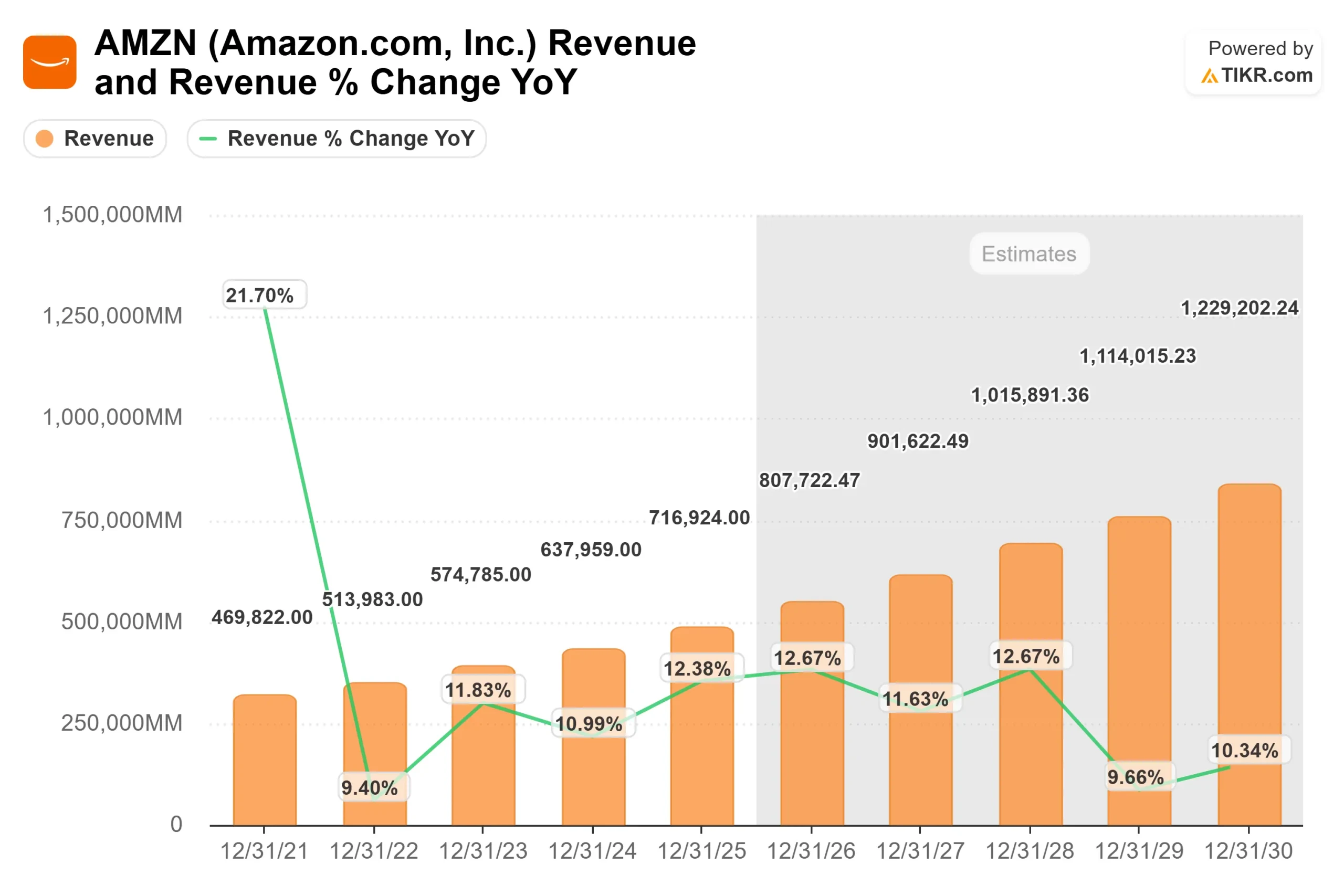
- Revenue Growth (CAGR): 12.3%
- Operating Margins: 14.3%
- Exit P/E Multiple: 25.7x
The company continues to deliver consistent double-digit expansion, supported by AWS, its cloud computing segment that provides high-margin infrastructure and AI services, along with its advertising business, which generates recurring revenue from sellers on its platform.
See analysts’ growth forecasts and price targets for Amazon (It’s free) >>>
Future performance is increasingly tied to AWS, where rising demand for AI workloads is driving capacity expansion, although competitors like Microsoft Azure and Google Cloud are currently showing faster near-term margin realization from similar investments.
At the same time, improvements in Amazon’s fulfillment network, including automation and regionalized delivery systems, are expected to reduce per-unit costs, which could support operating margin expansion even if retail growth remains moderate.
However, the timing of returns on Amazon’s elevated capital expenditures remains a key variable, as sustained investment in AI infrastructure may delay margin expansion before driving stronger earnings in later periods.
At current levels, Amazon appears undervalued, with future performance driven by AWS growth, advertising monetization, and the company’s ability to translate heavy investment into sustained margin expansion over the next few years.
How Much Upside Does AMZN Stock Have From Here?
Investors can estimate Amazon’s potential share price, or what any stock could be worth, in under a minute using TIKR’s New Valuation Model tool.
All it takes is three simple inputs:
- Revenue Growth
- Operating Margins
- Exit P/E Multiple
From there, TIKR calculates the potential share price and total returns under Bull, Base, and Bear scenarios so you can quickly see whether a stock looks undervalued or overvalued.
If you’re not sure what to enter, TIKR automatically fills in each input using analysts’ consensus estimates, giving you a quick, reliable starting point.