Key Stats for Carvana Stock
- 52-Week Range: $194 to $487
- Current Price: $359
- Street Mean Target: $424
- Street High Target: $519
- TIKR Model Target (Dec. 2030): $872
What Happened?
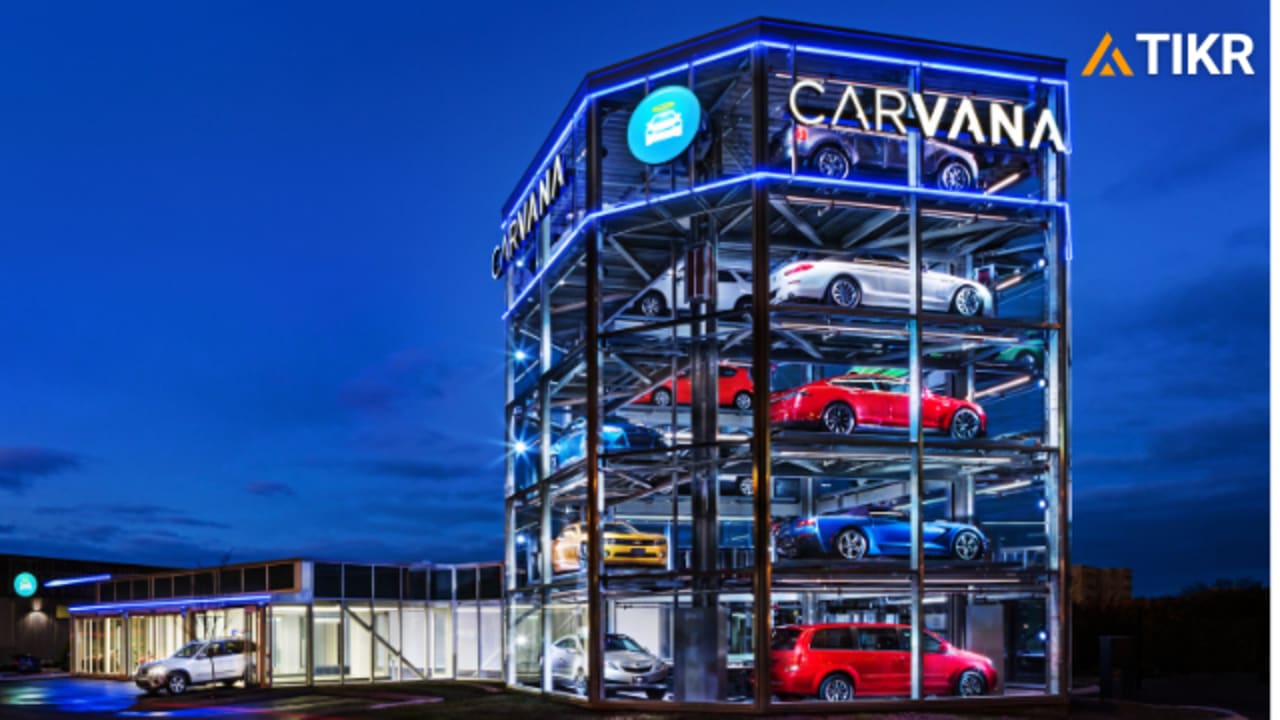
Carvana Co. (CVNA), the online used-car retailer known for its towering vehicle vending machines, grew retail unit sales 43% in 2025 to a record 596,641 vehicles while achieving its highest-ever adjusted EBITDA margin of 11%.
Full-year 2025 revenue reached $20.32 billion, a 48.6% increase over 2024, as inflation-pressured consumers continued shifting away from new-vehicle purchases toward the used-car market where Carvana holds a structural cost and experience advantage.
The record growth came with an asterisk: Q4 adjusted EBITDA margin slipped to 9.1% from 10.1% a year earlier, driven by elevated reconditioning costs at newly opened ADESA vehicle inspection and reconditioning centers, with CFO Mark Jenkins confirming on the February 18 earnings call that those cost pressures would persist into Q1 2026.
CEO Ernie Garcia addressed the Q4 miss directly, stating on the Q4 2025 earnings call that “I really do believe that in 6 months, we’re going to be in a better spot than we would have been if we didn’t have a fourth quarter miss,” framing the reconditioning hiccup as a temporary consequence of scaling 34 inspection sites at once rather than a structural deterioration.
With 1.6% market share in a 40-million-unit annual used-car market, Carvana’s stated long-term goals of 3 million retail units per year and 13.5% adjusted EBITDA margin by 2030 to 2035 remain mathematically intact, and at the Morgan Stanley Technology, Media and Telecom Conference on March 2, Garcia cited operating return on assets exceeding 20% for 2025 as evidence that Carvana now ranks among capital-efficient long-term compounders rather than speculative used-car retailers.
The board’s March 13 announcement of a 5-for-1 stock split (pending a May 5 shareholder vote, effective May 7) and the expansion of same-day delivery to more than 20 states signal management’s confidence in the growth trajectory even as the stock has pulled back sharply year to date.
Short seller Gotham City Research alleged on January 28 that Carvana overstated 2023 to 2024 earnings by over $1 billion, a claim Jenkins called “100% inaccurate,” and BofA downgraded Carvana stock to neutral on April 6 citing macro risks from oil price pressure on lower-income consumers and the competitive threat from a reinvigorated CarMax taking intentional margin hits to regain share.
Wall Street’s Take on CVNA Stock
The reconditioning cost miss obscured something more important: Carvana’s EBITDA dollar growth in 2025 ($2.24 billion, up 62% from $1.38 billion in 2024) has set a trajectory that a single operational quarter cannot undo, and the stock’s 26% YTD decline now prices in a much worse scenario than the data supports.

CVNA’s revenue is projected to grow around 32% in 2026 to roughly $27 billion, then roughly $33 billion in 2027 at approximately 23% growth, entirely consistent with the compounding unit volume Carvana laid the infrastructure groundwork for in 2025 by opening 10 ADESA integration sites and growing total reconditioning capacity by more than 40%.

Seventeen of 24 analysts with active ratings on the stock (11 buys and 6 outperforms) are watching Q1 2026 reconditioning cost trends as the specific inflection that either validates Garcia’s 6-month recovery timeline or forces a structural re-rating; the mean price target sits at $423.50, roughly 18% above current levels, with targets spanning $300 to $519.
That spread signals a genuine debate: the $519 high target assumes reconditioning costs normalize quickly and EBITDA margins recover toward the long-term 13.5% goal, while the $300 floor implies that competitive intensity from CarMax and macroeconomic pressure on the lower- and middle-income consumer (Carvana’s core demographic) compounds the margin headwinds beyond a single quarter.
Trading at roughly 27x 2026 consensus EBITDA against a business targeting 29% EBITDA growth this year while holding only 1.6% of a 40-million-unit market, Carvana stock appears undervalued relative to the magnitude of the addressable runway, with the YTD pullback having substantially outpaced any rational downgrade to the long-term unit and margin thesis.
Garcia’s March 2 Morgan Stanley presentation delivered a specific reframe: with operating return on assets exceeding 20% in 2025, Carvana now profiles as a capital-efficient compounder, not a speculative used-car retailer.
Reconditioning cost normalization is the single risk that breaks the model: if elevated per-unit costs persist beyond Q2, EBITDA margin recovery stalls, free cash flow generation (consensus: around $1.85 billion in 2026, more than double 2025’s $0.89 billion) gets revised down, and the valuation case collapses.
Q1 2026 earnings on April 29 is the binary event: the specific number to watch is retail GPU (gross profit per unit, a key measure of per-car economics), which signals whether Garcia’s 3-to-6-month reconditioning fix is tracking or whether the cost pressure is deeper than management acknowledged.
Carvana Stock Financials
Carvana’s revenue turnaround is one of the sharpest in the used-car retail industry: after declining 20.8% in 2023 to $10.77 billion, revenue rebounded 26.9% to $13.67 billion in 2024, then accelerated further to $20.32 billion in 2025, a 48.6% increase that reflects the compounding benefit of scale and an expanding customer base.

The more significant story sits below the revenue line: CVNA’s operating income swung from a loss of $0.07 billion in 2023 to $1.00 billion in 2024 and then $1.88 billion in 2025, an 88.0% year-over-year increase, driven by the SG&A cost leverage that comes with growing unit volume faster than fixed overhead, with SG&A rising only 25.1% in 2025 against 48.6% revenue growth.
Operating margins expanded from negative 0.6% in 2023 to 7.3% in 2024 and 9.3% in 2025, a trajectory that makes the current reconditioning cost headwind look like a speed bump on a multi-year margin expansion curve rather than a directional reversal.
The tension in the income statement is gross margins: after expanding from 16.0% in 2023 to 21.0% in 2024, gross margins compressed slightly to 20.6% in 2025, a signal that the per-unit cost pressures flagged in Q4 reconditioning costs were present throughout the year, and any further compression would slow the path to the 13.5% EBITDA margin goal.
What Does the Valuation Model Say?
The TIKR mid-case model assigns Carvana a target price of $871.50 by end of 2030, built on a 22% revenue CAGR from 2025 through 2035 and a 7.3% net income margin assumption, both directly supported by management’s stated 3-million-unit goal, the fixed-cost leverage embedded in a business where contribution margins are already very high, and Carvana’s proven ability to compound growth while simultaneously improving unit economics.

A 142.6% total return potential over roughly 4.7 years at a 20.6% annualized IRR makes a compelling case, and with the stock down 26% year to date on a single quarter of elevated reconditioning costs, Carvana stock appears undervalued against the scale of growth that a 22% revenue CAGR and a 13.5% long-term EBITDA margin target imply.
The entire bull/bear debate on CVNA hinges on one question: whether the reconditioning cost pressure that drove Q4’s EBITDA miss is temporary operational friction or the leading edge of a structural margin ceiling.
What Has to Go Right
- Q1 2026 reconditioning costs normalize as Garcia’s 3-to-6-month timeline plays out, with retail GPU recovering sequentially as new ADESA sites reach operating efficiency
- Revenue grows around 32% in 2026, consistent with consensus at roughly $27 billion, validating that unit demand has not softened despite BofA’s macro concern about lower-income consumer pressure
- Free cash flow roughly doubles to around $1.85 billion in 2026 as SG&A leverage accelerates and loan sale agreements ($12 billion committed through 2027 with four partners) provide stable financing capacity
- The 5-for-1 stock split (pending May 5 vote, effective May 7) broadens the retail shareholder base at a more accessible per-share price, adding incremental demand for shares in a stock already prone to retail-driven momentum
What Could Go Wrong
- CarMax’s intentional margin sacrifice to recapture share, flagged explicitly by BofA in its April 6 downgrade, puts pressure on Carvana’s retail GPU as the largest traditional competitor changes its competitive posture for the first time in years
- Oil shock and tariff-driven inflation continue pressuring the lower- and middle-income consumer cohort that drives the majority of Carvana’s unit volume, stalling the unit growth trajectory Carvana needs to deliver fixed-cost leverage
- Gotham City Research’s January 28 short report, alleging $1 billion-plus in earnings overstatement related to related-party transactions with DriveTime and Bridgecrest, has not been definitively resolved in the market’s mind, and any SEC inquiry or follow-on reporting would create sustained headline risk regardless of the underlying accuracy
- Reconditioning cost pressure persists past Q2, forcing downward revisions to 2026 EBITDA consensus of roughly $2.89 billion and compressing the EBITDA margin trajectory away from the 13.5% long-term target
Should You Invest in Carvana Co.?
The only way to really know is to look at the numbers yourself. TIKR gives you free access to the same institutional-quality financial data that professional analysts use to answer exactly that question.
Pull up CVNA stock and you’ll see years of historical financials, what Wall Street analysts expect for revenue and earnings in the quarters ahead, how valuation multiples have moved over time, and whether price targets are trending up or down.
You can build a free watchlist to track Carvana Co. alongside every other stock on your radar. No credit card required. Just the data you need to decide for yourself.
Access Professional Tools to Analyze CVNA stock on TIKR for Free →