
When you’re evaluating a software company, the income statement only tells part of the story. GAAP revenue is useful, but for subscription businesses, it’s often a lagging indicator of what’s actually happening inside the business. By the time official revenue reflects a major acceleration or slowdown, the window for acting on that insight has usually closed. That’s why investors who follow SaaS and cloud companies closely have learned to pay attention to a different number first: Annual Recurring Revenue, or ARR.
ARR is the metric that subscription businesses use to communicate the predictable, contracted portion of their revenue on an annualized basis. It’s not an accounting figure, and you won’t find it on any standardized financial statement. Companies choose to report it because it gives investors a clearer view of the business’s underlying growth trajectory than GAAP revenue alone. When CrowdStrike, Snowflake, or Cloudflare reports earnings, analysts aren’t waiting for the revenue line. They’re watching ARR.
Understanding ARR, how it’s calculated, what it captures, and where it falls short is one of the more useful skills you can build as a SaaS investor. It won’t replace reading the full financials, but it gives you a faster read on whether a software business is gaining or losing momentum, and that context changes how you interpret almost everything else.
Find out what a stock’s really worth in under 60 seconds with TIKR’s new Valuation Model (It’s free)>>>
What ARR Actually Measures
The formula is straightforward: you take the value of all active subscription contracts and annualize it. If a customer is paying $10,000 per month on a contract, that’s $120,000 of ARR. Add up every active contract across the entire customer base, and you have total ARR. Some companies calculate it as Monthly Recurring Revenue multiplied by 12, which is essentially the same thing expressed differently.
MRR and ARR are closely related, and companies sometimes report one or the other depending on how they prefer to communicate the business. MRR is useful for tracking month-to-month changes, particularly when you’re watching for churn or new customer additions in real time. ARR smooths that out and gives you an annualized view, which is typically what public company investors care about most. For a company reporting quarterly results, ARR provides the clearest snapshot of where the business stands at any given moment.
What ARR captures is the contracted, predictable portion of revenue. It doesn’t include one-time professional services fees, usage-based revenue that varies with consumption, or anything not tied to an ongoing subscription agreement. That distinction matters, and we’ll come back to it.
Screen over 75,000 stocks to find companies with high earnings growth (Free with TIKR) >>>
Why ARR Matters More Than GAAP Revenue for SaaS
GAAP revenue for a subscription business is recognized over the life of the contract, which means a deal signed in December might contribute only one month of revenue to the current year’s income statement, even though the company has locked in 12 months of future cash.
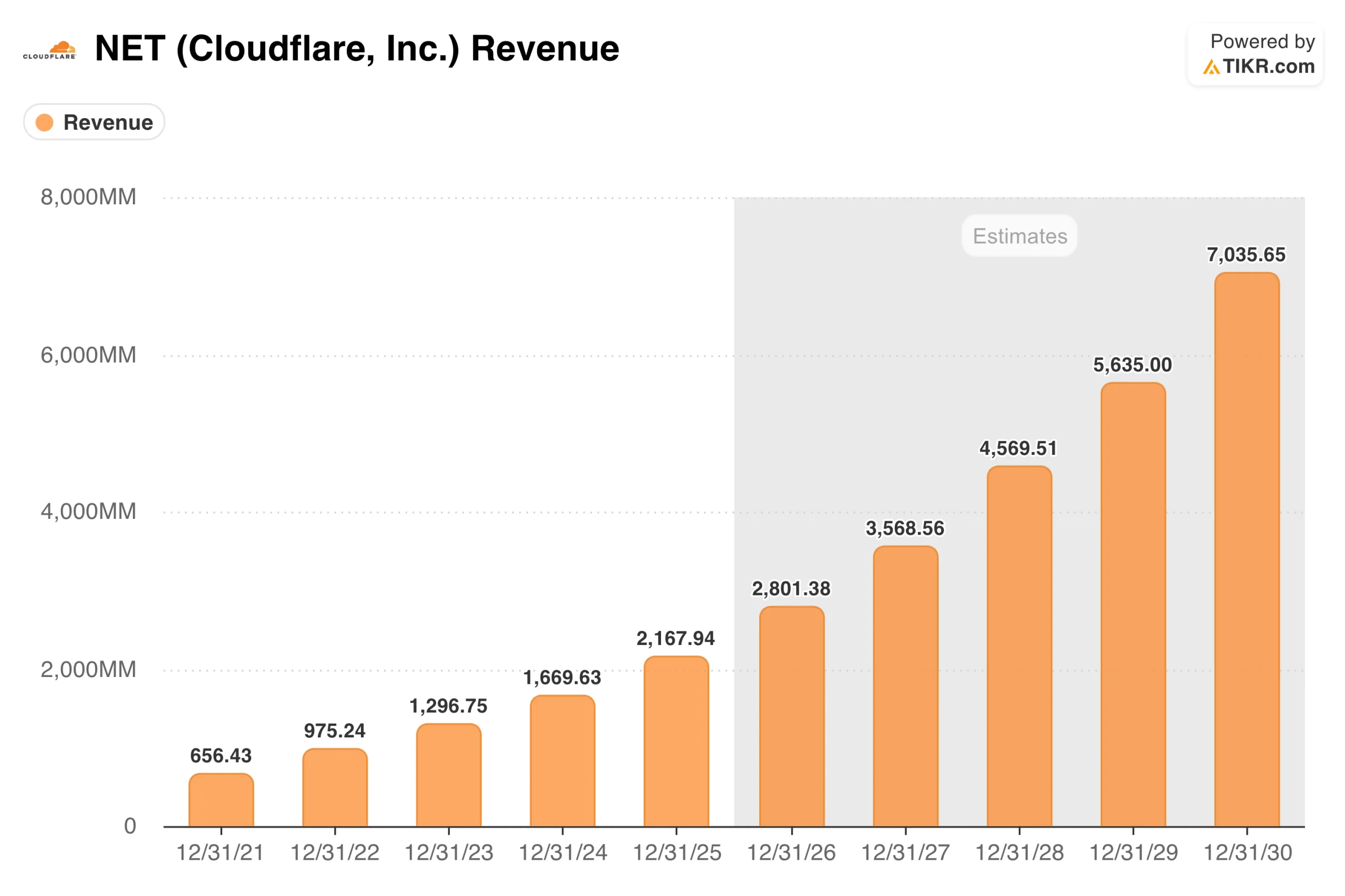
The thing is, ARR doesn’t have that timing problem. When a customer signs a contract, the full annualized value shows up in ARR immediately. That makes ARR a leading indicator while GAAP revenue is a lagging one.
This matters a lot when you’re trying to evaluate momentum. A SaaS company could report flat GAAP revenue growth in a given quarter while its ARR is accelerating quickly, because the revenue from recent deals hasn’t had time to flow through the income statement yet. Miss that, and you might misread the quarter entirely.
On the flip side, a company can report strong GAAP revenue growth while ARR quietly decelerates, a warning sign that the best growth may already be behind it.
Companies like CrowdStrike, Snowflake, and Cloudflare report ARR prominently in their earnings releases and conference calls because they know this is what analysts and sophisticated investors are watching. CrowdStrike reports Annual Recurring Revenue as one of its headline metrics every quarter.
Snowflake emphasizes product revenue and remaining performance obligations alongside ARR-style metrics to show contracted future revenue. Cloudflare has consistently highlighted ARR growth as a signal of its expansion within enterprise customers.
When management leads with these numbers in prepared remarks, it’s because they understand that ARR tells the clearest story of business health before the rest of the financials catch up.
Review revenue statements on any stock in less than 60 seconds with TIKR (It’s free) >>>
ARR Growth Rate: The Number Within the Number
The ARR figure itself is useful, but the growth rate is what most investors are really watching. A company with $1 billion in ARR growing at 40% annually is fundamentally different from one growing at 10%, even if the absolute ARR looks similar at a given point in time. Growth rate tells you the business’s velocity, which drives future revenue and, eventually, earnings.

Investors typically track ARR growth on both a year-over-year basis and sequentially from quarter to quarter. Year-over-year growth smooths out seasonal patterns and gives you a cleaner read on the underlying trajectory. Sequential growth is more sensitive and can flag an acceleration or deceleration earlier in the cycle. When a company’s ARR growth rate starts compressing, that compression usually shows up in GAAP revenue six to twelve months later. Following ARR closely gives you that early signal.
Pairing ARR growth with net revenue retention is also worth attention. Net revenue retention measures how much ARR the company is generating from its existing customer base after accounting for expansions, contractions, and churn.
A number above 120% means existing customers are spending significantly more over time, which is a strong signal of product value and pricing power. Companies like Snowflake and Datadog have historically posted net revenue retention well above that threshold, and it shows up clearly in their ARR trajectories.
How to Use TIKR to Track SaaS Metrics and Earning Calls
TIKR is one of the most efficient places to track the metrics that matter most for SaaS companies. The Estimates tab shows analyst consensus data for revenue, earnings, and growth rates across multiple years, giving you both historical actuals and forward projections in a single view. For companies like CrowdStrike or Cloudflare, you can pull up revenue growth CAGRs, margin trends, and analyst price targets without stitching together data from multiple sources.

The call transcripts feature is particularly useful for ARR-focused research. Because ARR is a non-GAAP metric, it doesn’t appear on standardized financial statements. Companies disclose it verbally on earnings calls and in their press releases. On TIKR, you can access full transcripts of earnings calls and conference presentations for thousands of global companies.

When CrowdStrike’s management gives a quarterly ARR update in prepared remarks, or when Snowflake discusses remaining performance obligations in the Q&A, those transcripts are available directly on the platform. You’re not hunting for PDFs or relying on someone else’s summary. You go to the source, read what management actually said, and connect it to the financial data sitting one tab away.
Where ARR Falls Short
ARR is a useful lens, but it has real limitations, and treating it as the whole story is a mistake. The most important point is that ARR captures only subscription revenue. For companies with significant usage-based or consumption models, a large portion of actual revenue won’t show up in ARR at all.
Snowflake is a good example of this tension. Its revenue model is heavily consumption-based, meaning customers pay based on how much compute and storage they actually use rather than a fixed contract amount. That makes Snowflake’s ARR a less complete picture of the business than it would be for a purer subscription company.
Professional services revenue, implementation fees, and one-time charges are also excluded. For some companies, these are small enough to ignore. For others, they represent a meaningful piece of total revenue, and ignoring them gives you a distorted sense of how the business actually generates cash.
The right approach is to use ARR as a starting point, then layer in GAAP revenue, remaining performance obligations, and cash flow data to build a complete picture. ARR gives you the signal. The rest of the financials tell you whether that signal holds up.
Track company financials to quickly review revenue with TIKR (It’s free) >>>
TIKR Takeaway
ARR is the number that tells you what a SaaS business has already sold and what it’s likely to collect over the next twelve months. It cuts through the timing noise in GAAP revenue and gives investors a cleaner read on momentum, growth velocity, and the health of the customer base.
For companies that report it, ARR is often the first number worth looking at when earnings arrive, not because the other metrics don’t matter, but because ARR sets the context for everything else.
TIKR gives you the tools to follow ARR-driven businesses the way professionals do. The Estimates tab lets you track revenue growth trends and analyst forecasts across multiple years, while the call transcripts feature puts you directly inside the earnings calls where ARR disclosures actually happen. You don’t need to hunt for press releases or rely on secondhand summaries.
With coverage of more than 100,000 global stocks and access to transcripts from earnings calls and investor conferences, TIKR makes it straightforward to stay on top of the metrics that drive SaaS valuations and understand the business behind the numbers.
Value Any Stock in Under 60 Seconds with TIKR
With TIKR’s new Valuation Model tool, you can estimate a stock’s potential share price in under a minute.
All it takes is three simple inputs:
- Revenue Growth
- Operating Margins
- Exit P/E Multiple
If you’re not sure what to enter, TIKR automatically fills in each input using analysts’ consensus estimates, giving you a quick, reliable starting point.
From there, TIKR calculates the potential share price and total returns under Bull, Base, and Bear scenarios so you can quickly see whether a stock looks undervalued or overvalued.
See a stock’s true value in under 60 seconds (Free with TIKR) >>>
Looking for New Opportunities?
- Discover which stocks billionaire investors are purchasing, so you can follow the smart money.
- Analyze stocks in as little as 5 minutes with TIKR’s all-in-one, easy-to-use platform.
- The more rocks you overturn… the more opportunities you’ll uncover. Search 100K+ global stocks, global top investor holdings, and more with TIKR.
Disclaimer:
Please note that the articles on TIKR are not intended to serve as investment or financial advice from TIKR or our content team, nor are they recommendations to buy or sell any stocks. We create our content based on TIKR Terminal’s investment data and analysts’ estimates. Our analysis might not include recent company news or important updates. TIKR has no position in any stocks mentioned. Thank you for reading, and happy investing!