When you look at a stock’s price-to-earnings (P/E) ratio on a standard finance site, you are almost always looking at a “trailing” number. This means you are judging a company based on the money it has already made and spent. For a slow-moving utility company, that is fine. But for a high-octane growth business or a company in the middle of a major turnaround, the past is often a poor predictor of the future.
This is where NTM (Next Twelve Months) metrics become your most powerful tool. Instead of looking backward, NTM uses analyst consensus estimates to project a company’s performance over the next year. It allows you to see the “expected” earnings that the market is already pricing in. If a company is expected to double its profits next year, its NTM valuation will look radically different from its TTM valuation, often revealing a bargain where others only see an “overvalued” stock.
In this guide, we will break down how NTM multiples such as NTM P/E and NTM EV/EBITDA are derived from Wall Street estimates. We will look at a real-world example of how forward-looking data can flip a valuation story on its head and cover the essential risks of relying on projections. Finally, we will show you how to use TIKR to instantly bridge the gap between historical actuals and forward-looking expectations, so you are always valuing a business based on its future potential.
NTM vs. TTM: The Forward-Looking Edge

The core difference between TTM (Trailing Twelve Months) and NTM (Next Twelve Months) is the source of the data. TTM is rooted in “hard” numbers, the last four quarters of reported filings. NTM is rooted in “expectations,” the average (consensus) of all analyst estimates for the next four quarters.
For investors, NTM is often the more relevant metric because the stock market is a “discounting mechanism.” It doesn’t care about the dividend check you got last year; it cares about the cash flow the business will generate tomorrow. NTM multiples allow you to see if a company’s current stock price is justified by its upcoming growth.
Review a stock’s multiples instantly (Free with TIKR) >>>
Real Example: Flipped Valuation Stories

Consider a high-growth technology leader in early 2026. The stock might be trading at $200 with TTM earnings of only $2.00 per share.
- TTM P/E Ratio: 100x (This looks terrifyingly expensive to a traditional value investor).
However, analysts expect the company to scale its new global infrastructure over the next 12 months, projecting earnings of $8.00 per share as its margins expand.
- NTM P/E Ratio: 25x ($200 / $8.00).
In this scenario, the “100x” TTM P/E is a distraction. The NTM P/E of 25x suggests that, for a company growing at that pace, the stock might be reasonably priced, or even cheap. This is why growth investors almost exclusively use NTM multiples: they look for the point where future earnings “catch up” to today’s price.
Look at analyst estimates for earnings per share on any stock in less than 60 seconds with TIKR (It’s free) >>>
How NTM Multiples are Built
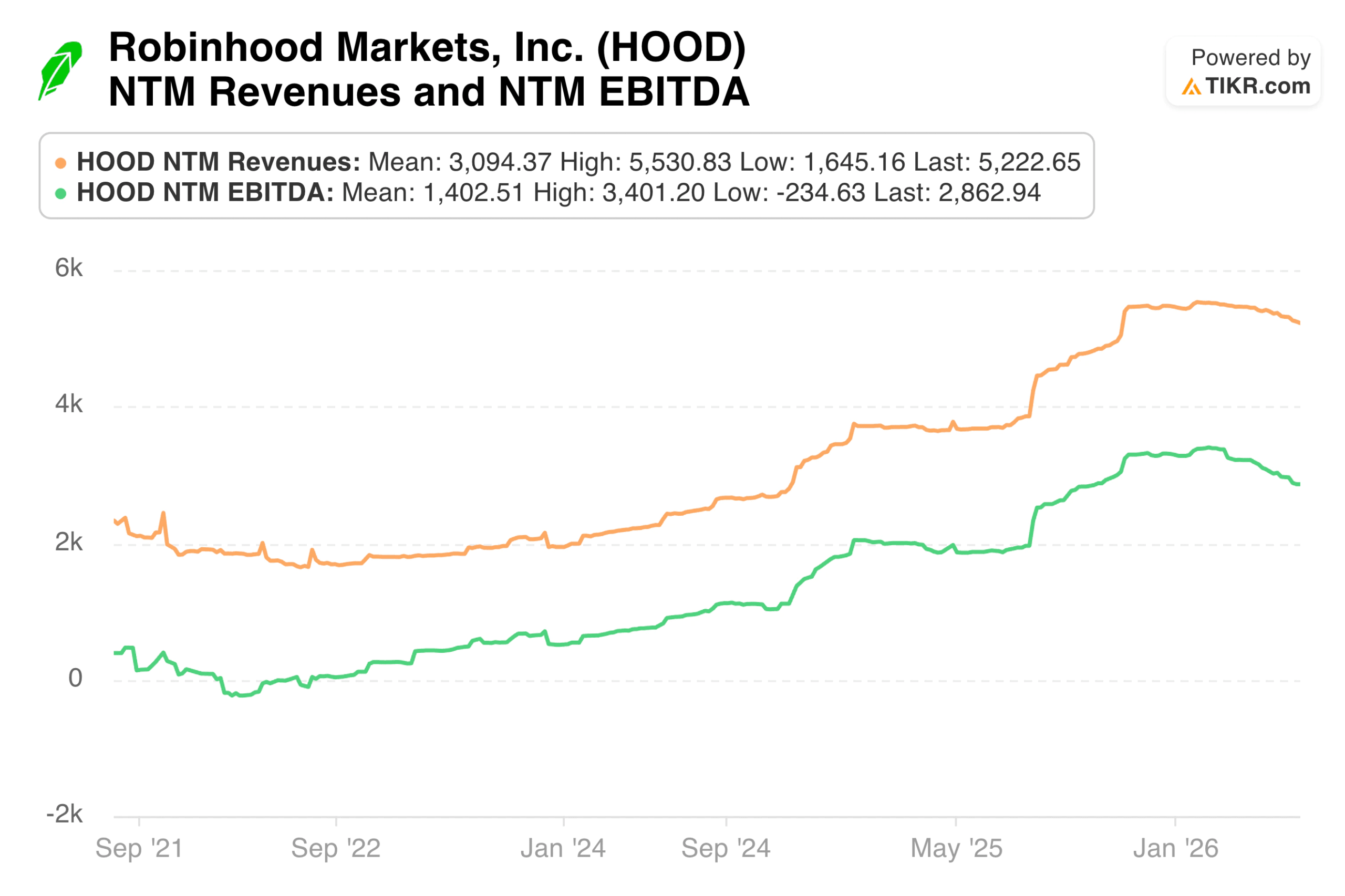
NTM metrics aren’t just guesses; they are calculated using a process called Calendarization. Because companies have different fiscal year-ends, platforms like TIKR take estimates for the current fiscal year (FY1) and the next fiscal year (FY2) and weight them to create a rolling 12-month window.
NTM Metric = (CurrentQuarterWeight X FY1 Estimate) + (RemainingWeight x FY2 Estimate)
This ensures that the “Forward P/E” you see always looks exactly one year ahead, regardless of whether the company is two or ten months away from its next annual report.
The Risks: Revision and Accuracy
The danger of NTM is that it relies on human predictions. Analysts can be overly optimistic during bull markets and too slow to cut estimates when a recession looms. This creates Revision Risk, the possibility that a stock looks “cheap” on an NTM basis only because the earnings estimates are too high and are about to be slashed. Always check the “Number of Analysts” in the consensus to ensure the NTM data is backed by a broad group of experts rather than just one or two outliers.
Track company financials to quickly review the Next Twelve Months (It’s free) >>>
TIKR Takeaway
TIKR makes forward-looking analysis effortless by calculating NTM multiples and consensus estimates across 100,000+ global stocks. You do not have to manually weight fiscal years or hunt for analyst notes.
On TIKR, you can go to the Valuation tab to see NTM multiples compared to historical averages. This allows you to see if a company is trading at a “Forward Discount” relative to its own history.
By switching to the Estimates tab, you can see the raw data, Revenue, EBITDA, and EPS that fuel these multiples, giving you a clear view of exactly what the market expects the company to achieve.
Value Any Stock in Under 60 Seconds with TIKR
With TIKR’s new Valuation Model tool, you can estimate a stock’s potential share price in under a minute.
All it takes is three simple inputs:
- Revenue Growth
- Operating Margins
- Exit P/E Multiple
If you’re not sure what to enter, TIKR automatically fills in each input using analysts’ consensus estimates, giving you a quick, reliable starting point.
From there, TIKR calculates the potential share price and total returns under Bull, Base, and Bear scenarios so you can quickly see whether a stock looks undervalued or overvalued.
See a stock’s true value in under 60 seconds (Free with TIKR) >>>
Looking for New Opportunities?
- Discover which stocks billionaire investors are purchasing, so you can follow the smart money.
- Analyze stocks in as little as 5 minutes with TIKR’s all-in-one, easy-to-use platform.
- The more rocks you overturn… the more opportunities you’ll uncover. Search 100K+ global stocks, global top investor holdings, and more with TIKR.
Disclaimer:
Please note that the articles on TIKR are not intended to serve as investment or financial advice from TIKR or our content team, nor are they recommendations to buy or sell any stocks. We create our content based on TIKR Terminal’s investment data and analysts’ estimates. Our analysis might not include recent company news or important updates. TIKR has no position in any stocks mentioned. Thank you for reading, and happy investing!