Key Stats for Vertiv Stock
- Current Price: $241.57
- Target Price (Mid): ~$558
- Street Target: ~$343
- Potential Total Return: ~131%
- Annualized IRR: ~21% / year
Now Live: Discover how much upside your favorite stocks could have using TIKR’s new Valuation Model (It’s free) >>>
What Happened?
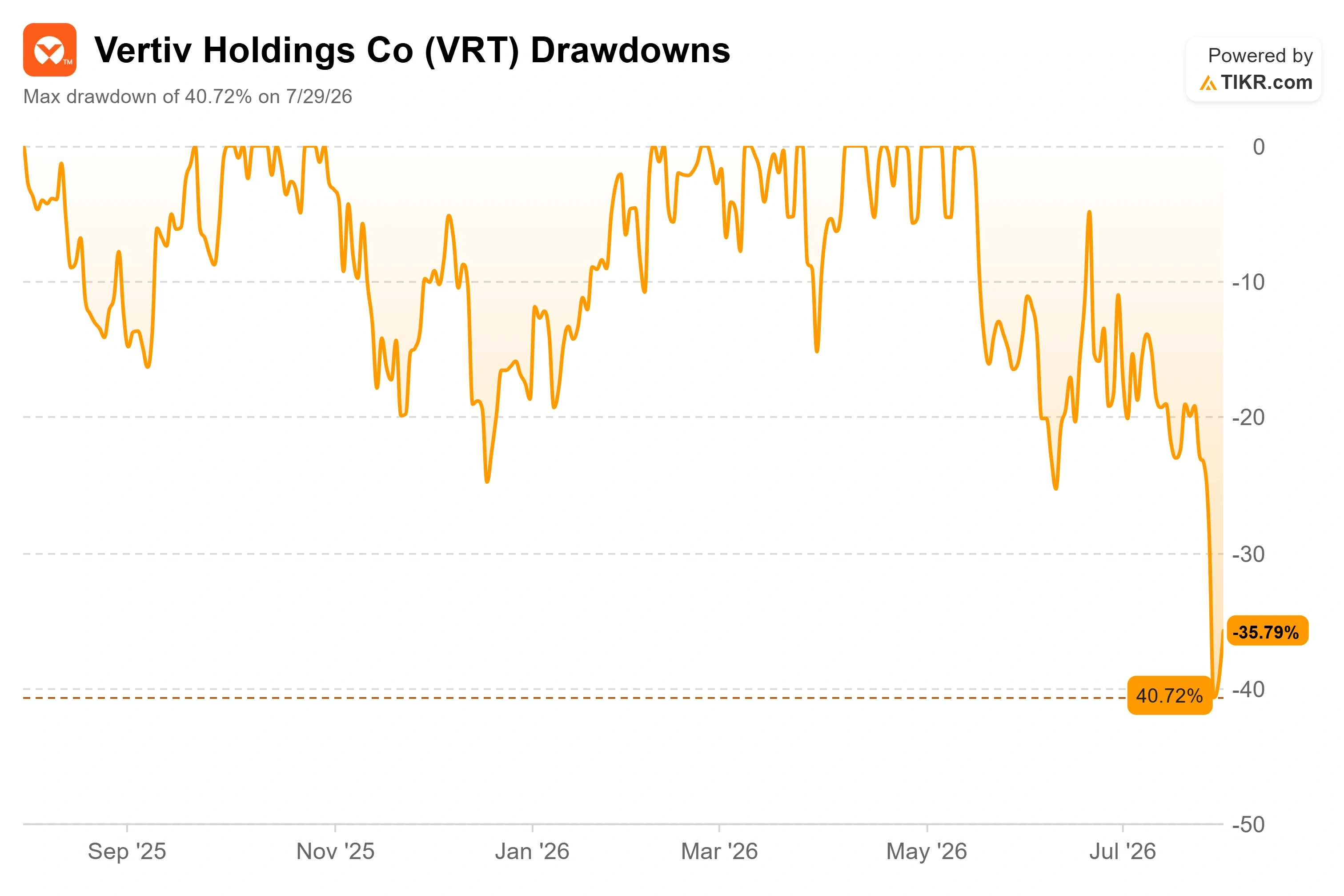
Vertiv Holdings Co (VRT) did almost everything right in the second quarter and got punished for it. Adjusted earnings of $1.52 beat the roughly $1.43 the Street expected, margins expanded more than 400 basis points, free cash flow more than tripled, and management raised full-year guidance across every metric. The stock fell about 17% on July 29 anyway, because revenue of $3.27 billion missed the $3.38 billion consensus by roughly 3%.
Demand was not the problem. On the call, Vertiv said VisionBay AI had awarded it the power, thermal, and services business for Taiwan’s first AI data center featuring NVIDIA’s GB300, and that it is collaborating on what CEO Giordano Albertazzi called the world’s first data center adopting 800-volt DC architecture at the rack and pod level, featuring NVIDIA’s next-generation Vera Rubin. A single word in the release did the damage: timing. After a run that carried the stock from its 52-week low near $118 to a high near $380 this year, a 3% revenue miss triggered a 17% drop. The shares have since recovered part of it, closing July 31 at $241.57, up 6.18% that day but still about 36% below the peak.
A 3% Miss That Management Calls Temporary
The shortfall was not orders drying up. Albertazzi tied it to minor timing shifts from multiphase project execution and temporary supply chain congestion on Vertiv’s first genuinely enormous builds. He rejected the word disruption, framing it as complexity in the interdependencies, where several Vertiv factories feed one another on a single giant project, and stressed that the delayed revenue is being deployed in the second half, not lost.
The market did not fully buy it, and the timing was unlucky. Vertiv reported into a broader AI selloff, and at roughly 31 times forward earnings, the stock had no cushion for a revenue wobble. Oppenheimer trimmed its target to $325 from $353 while keeping an Outperform rating, a reset of the entry price rather than the thesis. Even after the drop, shares have remained up sharply over the past year, so this is a pullback inside a strong uptrend.
See historical and forward estimates for Vertiv stock (It’s free!) >>>
The Real Debate Is Execution, Not Demand
Nearly every analyst circled the same worry. Vertiv now builds projects like OneCore and SmartRun that carry, in the CEO’s words, significant interdependencies, a lot of coordination, a lot of rapid learning. A late part on a small product is absorbed easily. On a megaproject pulling from several internal factories at once, it compounds. That is the execution risk the selloff is pricing.
Management’s answer rests on three supports. Capacity that was constrained in the second quarter is coming online now, with plant expansions across the Americas, a new Johor site in Malaysia, and added chiller capacity in EMEA. The delayed revenue converts in the back half. And for anyone skeptical of a 45% second-half growth guide, Albertazzi called the guidance deliberately conservative: “we’re not assuming all stars aligned,” leaving room for the learning curve to stay imperfect. The bar for the back half was set below what management expects to clear.
The guidance itself is the strongest evidence. A company managing a demand problem does not raise every line. Vertiv lifted 2026 adjusted EPS to a $6.70 midpoint, up 60% from 2025, raised net sales to $14 billion, and pushed adjusted free cash flow guidance to $2.5 billion. That is a logistics learning curve on already-booked work, not a demand story unraveling.
A Premium Price Against Slower Peers
Vertiv does not screen cheaply, and pretending otherwise would be dishonest. Shares trade near 22.9 times NTM EV/EBITDA, a clear premium to Schneider Electric at 17.4 times and Legrand at 14.3 times, both growing far slower than Vertiv’s guided high-30s organic pace in the Americas. The market is right to demand execution proof before paying it. What tilts the argument is the free cash flow: $925 million in the quarter, up 234%, with the company ending the second quarter in a net cash position, funding the ramp without stretching the balance sheet.

See how Vertiv performs against its peers in TIKR (It’s free!) >>>
TIKR Advanced Model Analysis
- Current Price: $241.57
- Target Price (Mid): ~$558
- Potential Total Return: ~131%
- Annualized IRR: ~21% / year

See analysts’ growth forecasts and price targets for Vertiv stock (It’s free!) >>>
Using TIKR’s mid-case scenario, the model prices Vertiv near $558 by December 2030, implying roughly 131% total return and about a 21% annualized IRR. This is a scenario built on stated assumptions, not a promise. Two revenue drivers carry it: continued high-30s organic growth in the Americas from AI data center deployment, and EMEA returning to growth in the back half after a soft first half. The margin driver is operating leverage as new capacity reaches run rate, pushing adjusted operating margin toward the roughly 24% full-year guide and higher beyond. The primary risk is execution: if the megaproject learning curve drags into 2027, revenue slips when the multiple leaves no room for error.
The upside case is that Vertiv’s record order backlog converts on schedule and the market re-rates a proven compounder. The downside case is that AI sentiment cools while a premium multiple compresses into slower delivery, and a high-beta stock falls faster than the business.
Conclusion
The next print, expected October 21, settles the argument. Watch third-quarter revenue against the $3.75 billion midpoint guide, because that is where the delayed second-quarter revenue is supposed to appear. Clear it, and the timing explanation holds, and the selloff looks like an overreaction. Miss it again, and execution stops being a timing story and becomes a pattern the multiple cannot support. Demand was never the question. October 21 answers whether Vertiv can build fast enough to meet it.
See what stocks billionaire investors are buying so you can follow the smart money with TIKR.
Should You Invest in Vertiv?
The only way to really know is to look at the numbers yourself. TIKR gives you free access to the same institutional-quality financial data that professional analysts use to answer exactly that question.
Pull up Vertiv, and you’ll see years of historical financials, what Wall Street analysts expect for revenue and earnings in the quarters ahead, how valuation multiples have moved over time, and whether price targets are trending up or down.
You can build a free watchlist to track Vertiv alongside every other stock on your radar. No credit card required. Just the data you need to decide for yourself.
Looking for New Opportunities?
- See what stocks billionaire investors are buying so you can follow the smart money.
- Analyze stocks in as little as 5 minutes with TIKR’s all-in-one, easy-to-use platform.
- The more rocks you overturn… the more opportunities you’ll uncover. Search 100K+ global stocks, global top investor holdings, and more with TIKR.
Disclaimer:
Please note that the articles on TIKR are not intended to serve as investment or financial advice from TIKR or our content team, nor are they recommendations to buy or sell any stocks. We create our content based on TIKR Terminal’s investment data and analysts’ estimates. Our analysis might not include recent company news or important updates. TIKR has no position in any stocks mentioned. Thank you for reading, and happy investing!