Key Stats for Live Nation Stock
- Current Price: $174.13
- Target Price (Mid, 2030): ~$290
- Street Target (12-Month): ~$198
- Potential Total Return: ~67%
- Annualized IRR: ~12% / year
Now Live: Discover how much upside your favorite stocks could have using TIKR’s new Valuation Model (It’s free) >>>
What Happened?
Live Nation Entertainment (LYV) reported one of its strongest quarters on record on July 30, and the stock fell 5.14% the next day to close at $174.13. Revenue rose 9% to $7.67 billion, GAAP earnings of $1.05 per share came in roughly 62% above the GAAP consensus, and event-related deferred revenue hit a second-quarter record of $6.4 billion, up 25%. On almost every demand metric investors watch, the quarter was a beat.
So why did shares drop? The market looked past the headline and fixed on one number: adjusted operating income grew just 2%, and profit in the core Concerts segment actually fell. Management then said most of this year’s Concerts profit improvement is still coming, concentrated in the fourth quarter. For a stock trading on a recovery thesis, “the profit is coming later” was not the message investors wanted.
The Beat Everyone Ignored and the Number They Didn’t
The demand side is running hot. Concerts revenue rose 8% to $6.44 billion on record attendance of 48.7 million fans, up 10%. Ticketing revenue climbed 15% to $852 million, with 90 million fee-bearing tickets sold and a gross transaction value of $10.4 billion. Sponsorship revenue grew 12%. CEO Michael Rapino told analysts the company has seen “no consumer issues to date in terms of purchasing,” with fan counts up over 10% across every venue type and geography.
The problem was profit. Concerts’ adjusted operating income fell 14%, which management tied to stadium show timing, pre-opening costs at new venues, and investment in new international festivals. Total adjusted operating income grew only 2%, short of the double-digit full-year pace the company still targets. President and CFO Joe Berchtold was direct about the cadence: “We expect double-digit fan growth year-on-year in each of Q3 and Q4 for the U.S.” The confidence matters, but it also means the payoff lands in the back half, not now.

See historical and forward estimates for Live Nation stock (It’s free!) >>>
Why the Deferred Revenue Number Is the Real Tell
If profit timing is the bear case, deferred revenue is the bull rebuttal. It reached a second-quarter record of $6.4 billion, up 25%, and Berchtold framed it as money already committed: “tickets are in the bank. It’s a matter of playing off the shows.” In a business where fans buy months ahead, that backlog is a strong read on second-half revenue.
The margin story hangs on where those shows happen. Live Nation earns more at venues it operates than at third-party buildings, and operated-venue attendance is growing faster, which is the foundation of the margin expansion management keeps citing. The company generated about $1.9 billion of free cash in the quarter but has committed roughly $1.1 billion in capex for 2026, about $800 million of it building venues across Latin America, Japan, and beyond. Those venues take a couple of years to ramp, so the spend is a drag now and a driver later. That gap, strong demand today against profit and cash payoff tomorrow, is what split the market on this print.
The legal overhang is more nuanced than the headlines suggest. In March 2026, the DOJ settled with Live Nation without forcing a Ticketmaster breakup, agreeing instead to a 15% service-fee cap, the exit of exclusive booking deals at 13 amphitheaters, and a $280 million fund for states, all under Tunney Act review. A separate group of state plaintiffs rejected that deal and won an April 15 jury verdict finding the company liable for monopolizing live-event ticketing, with damages tied to $1.72 per ticket; Live Nation has said that the verdict is not final and has motions pending. A $450 million charge tied to the litigation, booked in the first quarter, pushed the company to a $94.7 million first-half loss for common shareholders, which is why the trailing earnings picture still screens as unprofitable despite a strong operating quarter. The remedies phase, where a judge could still order structural relief, remains open. Against peers, the stock trades near 16x NTM EV/EBITDA, versus a median closer to 9x across a peer set that includes Madison Square Garden Sports, CTS Eventim, and Vivid Seats, so the market is paying up for a recovery that still has to arrive.
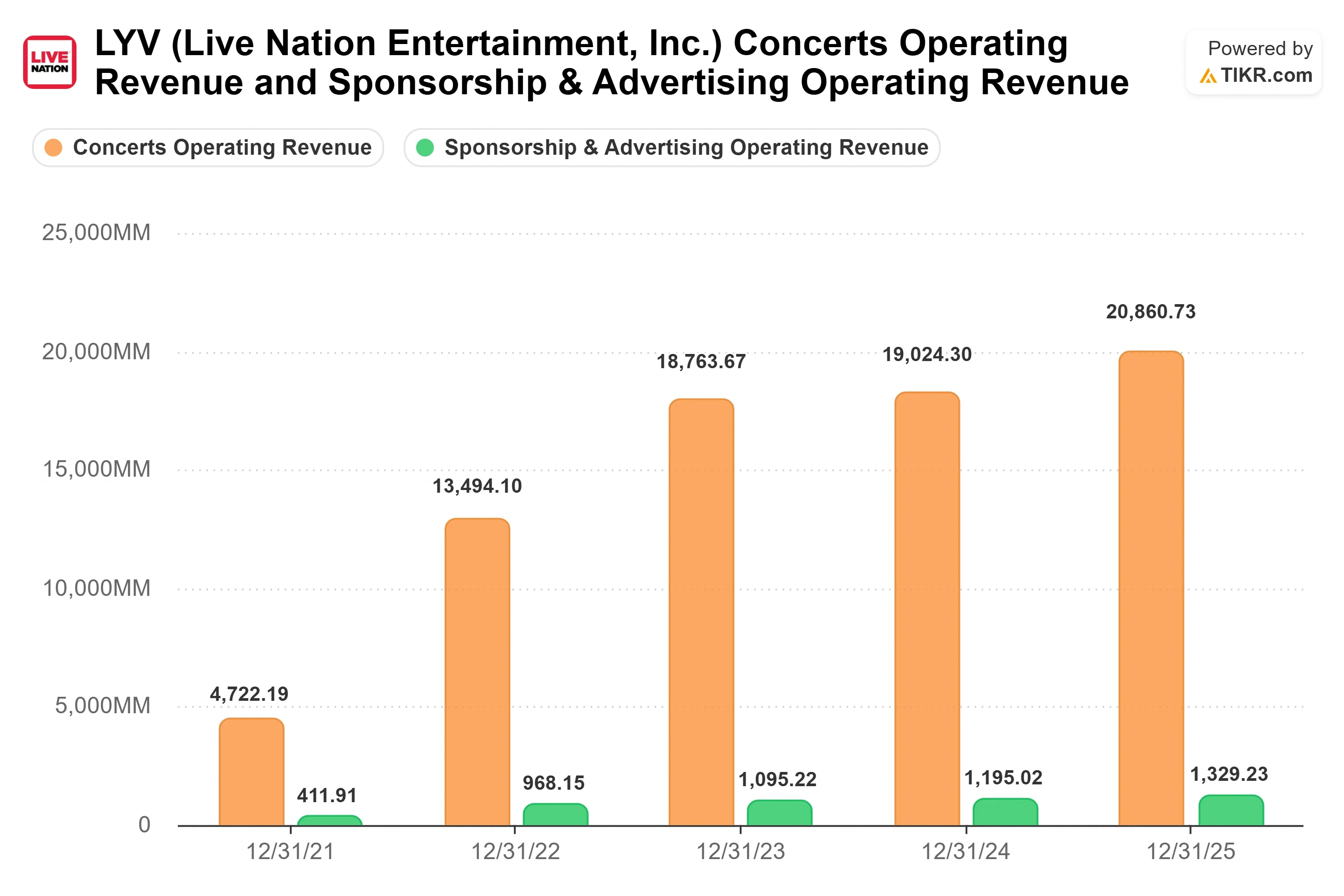
See how Live Nation performs against its peers in TIKR (It’s free!) >>>
TIKR Advanced Model Analysis
- Current Price: $174.13
- Target Price (Mid, 2030): ~$290
- Potential Total Return: ~67%
- Annualized IRR: ~12% / year

See analysts’ growth forecasts and price targets for Live Nation stock (It’s free!) >>>
Using the TIKR mid-case scenario, LYV could reach around $290 by the end of 2030, implying a total return of about 67% and an annualized return of roughly 12% over the next 4.4 years. Two revenue drivers carry it: continued global concert supply growth across arenas, amphitheaters, and stadiums, and international expansion into underdeveloped markets like Brazil, Japan, and the rest of Latin America, where Rapino called the opportunity the “second kind of inning” of a nine-inning game. Revenue compounds at around 6% annually in this scenario.
The margin driver is the mix shift toward operated venues, which carry higher profitability and lift net income margin to around 2% in the mid case. The primary risk is the unresolved antitrust remedies phase, where a structural breakup, though not ordered, remains legally possible. On the upside, if second-half Concerts profit lands as guided and remedies stay behavioral rather than structural, the recovery has room to reprice. On the downside, a heavier capex ramp or an adverse ruling pushes the payoff further out and pressures the multiple.
Conclusion
The number to watch is the fourth-quarter Concerts’ adjusted operating income. Management has staked its full-year double-digit AOI target on the back half, with most of the improvement landing in Q4, which the company will not report until February 2027, so this is a two-quarter wait. If Concerts AOI returns to double-digit growth, then the profit-timing explanation holds, and this selloff looks like an overreaction to a strong quarter. If it doesn’t, the market’s caution about the gap between record demand and delivered profit will look justified. Watch the antitrust remedies schedule alongside it, because both the profit and the legal picture have to move the right way for the recovery thesis to pay.
See what stocks billionaire investors are buying so you can follow the smart money with TIKR.
Should You Invest in Live Nation?
The only way to really know is to look at the numbers yourself. TIKR gives you free access to the same institutional-quality financial data that professional analysts use to answer exactly that question.
Pull up Live Nation, and you’ll see years of historical financials, what Wall Street analysts expect for revenue and earnings in the quarters ahead, how valuation multiples have moved over time, and whether price targets are trending up or down.
You can build a free watchlist to track Live Nation alongside every other stock on your radar. No credit card required. Just the data you need to decide for yourself.
Analyze Live Nation on TIKR Free →
Looking for New Opportunities?
- See what stocks billionaire investors are buying so you can follow the smart money.
- Analyze stocks in as little as 5 minutes with TIKR’s all-in-one, easy-to-use platform.
- The more rocks you overturn… the more opportunities you’ll uncover. Search 100K+ global stocks, global top investor holdings, and more with TIKR.
Disclaimer:
Please note that the articles on TIKR are not intended to serve as investment or financial advice from TIKR or our content team, nor are they recommendations to buy or sell any stocks. We create our content based on TIKR Terminal’s investment data and analysts’ estimates. Our analysis might not include recent company news or important updates. TIKR has no position in any stocks mentioned. Thank you for reading, and happy investing!