


Key Stats for ET Stock
- Past week’s performance: 1.7%
- 52-week range: $16 to $21
- Valuation model target price: $28
- Implied upside: 37% over 2.4 years
See how Energy Transfer’s yield and growth combine in TIKR’s Valuation Model (It’s free) >>>
A Streak That Keeps Extending
Energy Transfer (ET) trades near $20, just below its 52-week high of $20.70, after announcing its nineteenth consecutive quarterly distribution increase. The partnership raised its payout to $0.34 per unit, translating to an annualized distribution near $1.36 and a yield close to 7% at current prices. That streak has become a core part of the investment case, since it shows management’s continued confidence in cash flow even as it invests heavily in new pipeline and export projects.
Supporting that confidence, Energy Transfer priced $1.75 billion of junior subordinated notes earlier this month, with proceeds earmarked mainly to redeem higher-cost preferred units and refinance shorter-term debt. Junior subordinated notes are a type of long-dated debt that ranks below other bonds but above equity in a bankruptcy, and using them here lets Energy Transfer lock in financing while reducing near-term refinancing risk.
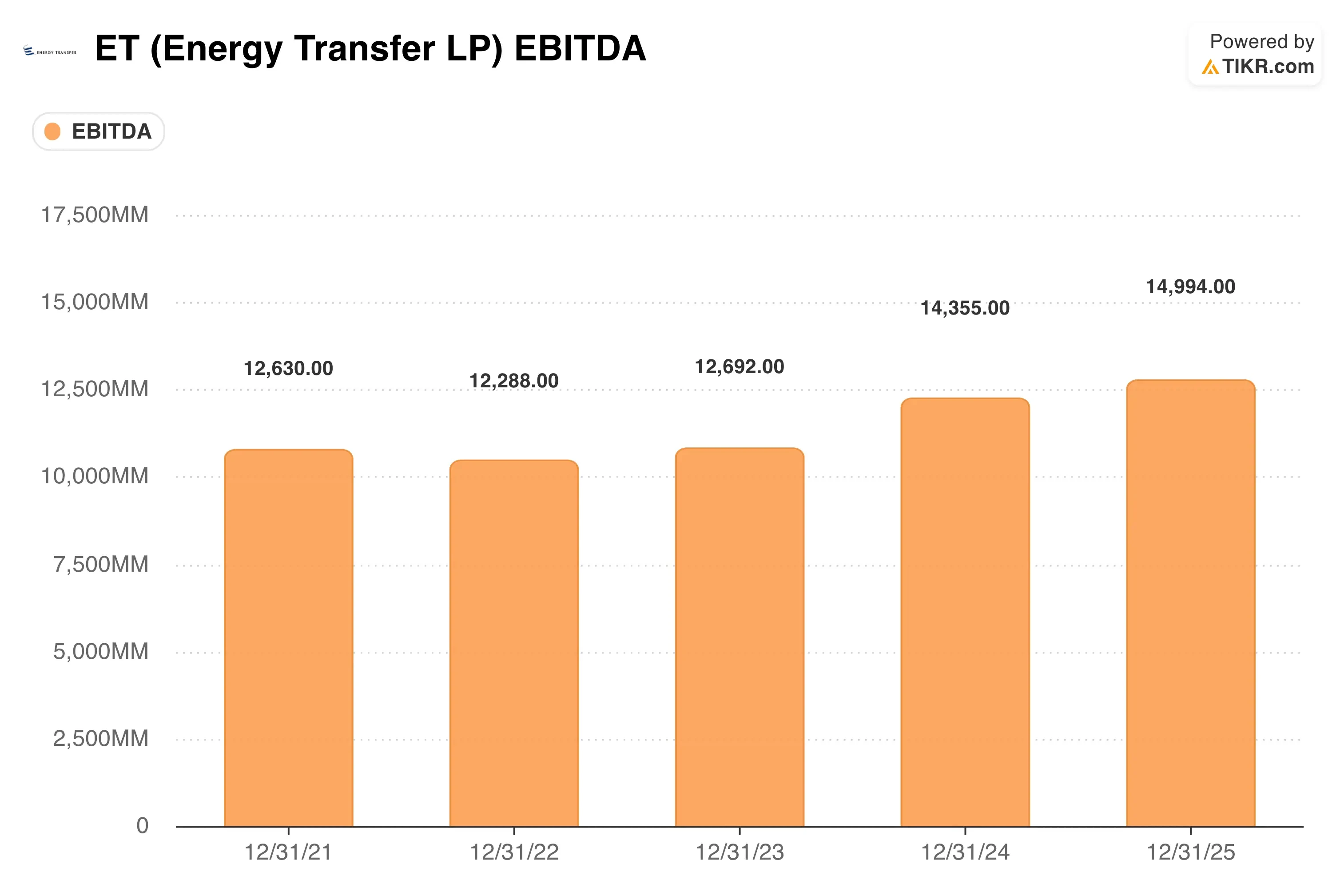
That move followed the partnership’s first-quarter results, where adjusted EBITDA rose to roughly $4.9 billion from $4.1 billion a year earlier, prompting management to raise full-year guidance meaningfully.
Energy Transfer is also managing a planned leadership transition. Co-CEO Marshall McCrea plans to retire by the end of 2026. Afterward, Thomas Long will become sole CEO, with McCrea staying on the board under a separation agreement. Co-CEO Tom Long said the partnership remains optimistic and excited about its future. He pointed to a pipeline of growth projects supported by long-term contracts.
If Energy Transfer’s distribution growth continues at its targeted 3% to 5% annual pace, the current yield near 7% could become even more attractive relative to peers, especially if unit prices stay near current levels.
See analysts’ growth forecasts and price targets for ET (It’s free) >>>
Is ET Stock Undervalued?
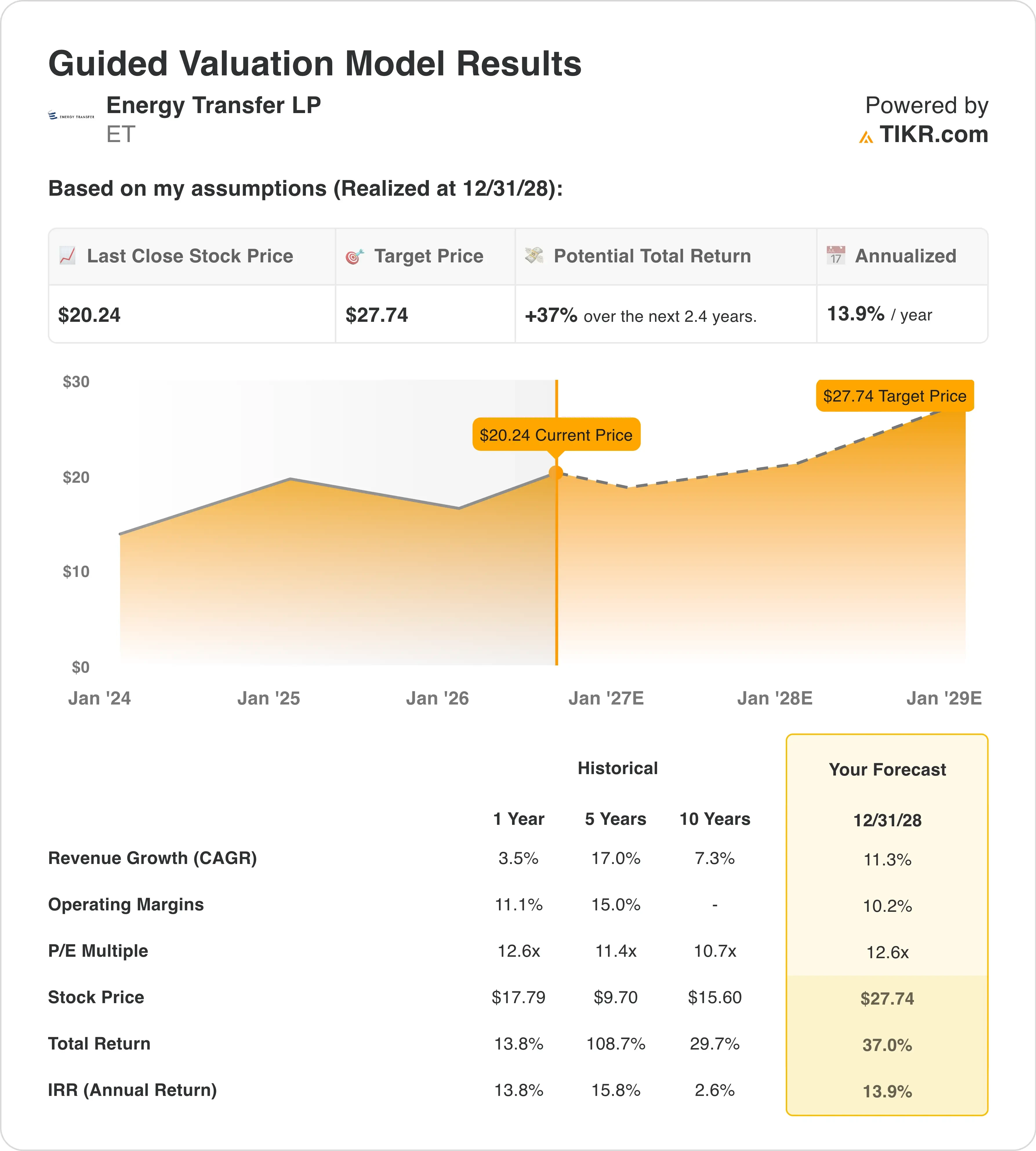
Under valuation model assumptions realized through 12/31/28, the stock is modeled using:
- Revenue Growth (CAGR): 11.3%
- Operating Margins: 10.2%
- Exit P/E Multiple: 12.6x
Based on these inputs, the model estimates a target price of $28, implying 37% total upside from the current share price and a 13.9% annualized return over the next 2.4 years.
A 13.9% projected annual return lands comfortably above the 10% threshold that typically signals an attractive stock, and it comes with a nearly 7% current yield layered on top. That combination of income and growth is uncommon, since most high-yield names sacrifice growth for payout stability. Energy Transfer’s exit multiple assumption of 12.6x is modest by market standards, reflecting how cheaply midstream energy partnerships tend to trade relative to their cash flow.

Compared with Kinder Morgan and Enterprise Products Partners, two of the largest midstream peers, Energy Transfer’s forward P/E sits in a similar range, though its distribution growth rate has recently outpaced both.
Enterprise Products Partners has a longer, more conservative track record of distribution increases. Kinder Morgan’s growth has been more project-dependent in recent years. Energy Transfer’s diversified asset base across natural gas, NGLs, and crude oil gives it more optionality than either peer. This is especially true as demand grows from data centers and power generation.
If Energy Transfer keeps converting new pipeline and export projects into cash flow at the pace management guided, its valuation gap to steadier peers like Enterprise could narrow over time.
Model Energy Transfer’s yield and growth against its midstream peers (Free with TIKR) >>>
Energy Transfer vs. Kinder Morgan and Enterprise Products Partners
Enterprise Products Partners (EPD) is often viewed as the gold standard for distribution reliability in midstream energy, with a longer streak of steady increases and a more conservative leverage profile than Energy Transfer.
Enterprise’s revenue growth has been slower recently, in the mid-single digits. However, its distribution coverage ratio tends to run higher, giving income investors more of a safety cushion. Its forward P/E multiple is roughly comparable to Energy Transfer’s. Its lower leverage often earns it a slightly higher premium.

Kinder Morgan (KMI), meanwhile, has leaned more heavily on new natural gas pipeline projects tied to data center and power demand growth, a theme increasingly overlapping with Energy Transfer’s own strategy. Kinder Morgan’s revenue growth has been choppier quarter to quarter depending on project timing, and its yield sits modestly below Energy Transfer’s current level.
Energy Transfer’s combination of a higher yield and a longer recent distribution growth streak is why some investors see it as offering more total return potential than either peer today.
See how the $750M EBITDA lift translates into distribution coverage and unit upside >>>
What’s Driving ET Stock Going Forward?
The clearest near-term catalyst is Q2 earnings, scheduled for August 4. Investors will look for confirmation that strong first-quarter EBITDA growth carried into the second quarter. Management’s raised full-year guidance of $18.2 billion to $18.6 billion in adjusted EBITDA sets a high bar. Any signs of project delays or cost overruns could weigh on sentiment, even if the distribution keeps growing.
Several major infrastructure projects remain in progress and will shape Energy Transfer’s growth for years to come. The Desert Southwest pipeline is expected to enter service by late 2029, while the Springerville Lateral, a roughly 120-mile natural gas pipeline, is targeted for the same timeframe and is backed by 20-year customer agreements. These long-dated contracts give Energy Transfer unusually strong revenue visibility for a midstream operator.
Data center and power demand growth is emerging as a fresh tailwind, since Energy Transfer’s nationwide pipeline network positions it to supply natural gas to new power generation facilities. Co-CEO Marshall McCrea has described the company’s system as uniquely flexible for capturing this opportunity. If that demand materializes as management expects, it could extend Energy Transfer’s distribution growth streak well beyond its current nineteen quarters.
Estimate a company’s fair value instantly (Free with TIKR) >>>
Should You Invest in Energy Transfer LP?
The only way to really know is to look at the numbers yourself. TIKR gives you free access to the same institutional-quality financial data that professional analysts use to answer exactly that question.
Pull up ET, and you’ll see years of historical financials, what Wall Street analysts expect for revenue and earnings in the quarters ahead, how valuation multiples have moved over time, and whether price targets are trending up or down.
You can build a free watchlist to track ET alongside every other stock on your radar. No credit card required. Just the data you need to decide for yourself.
Analyze ET stock on TIKR Free→
Disclaimer:
Please note that the articles on TIKR are not intended to serve as investment or financial advice from TIKR or our content team, nor are they recommendations to buy or sell any stocks. We create our content based on TIKR Terminal’s investment data and analysts’ estimates. Our analysis might not include recent company news or important updates. TIKR has no position in any stocks mentioned. Thank you for reading, and happy investing!


