Key Stats for Shopify Stock
- Current Price: $117.15
- Target Price (Mid): ~$287
- Street Target: ~$148
- Potential Total Return: ~145%
- Annualized IRR: ~23% / year
Now Live: Discover how much upside your favorite stocks could have using TIKR’s new Valuation Model (It’s free) >>>
What Happened?
Shopify (SHOP) reports second-quarter results before the market opens on Wednesday, August 5, and for once, the print matters less for the numbers themselves than for what they say about a single competitor. On July 21, Rothschild & Co Redburn analyst Dominic Ball downgraded Shopify to Neutral and cut his target to $130, calling the threat from Meta an “existential” one and estimating that half of Shopify’s U.S. business is exposed. Q2 is the first quarter that can begin to prove him right or wrong.
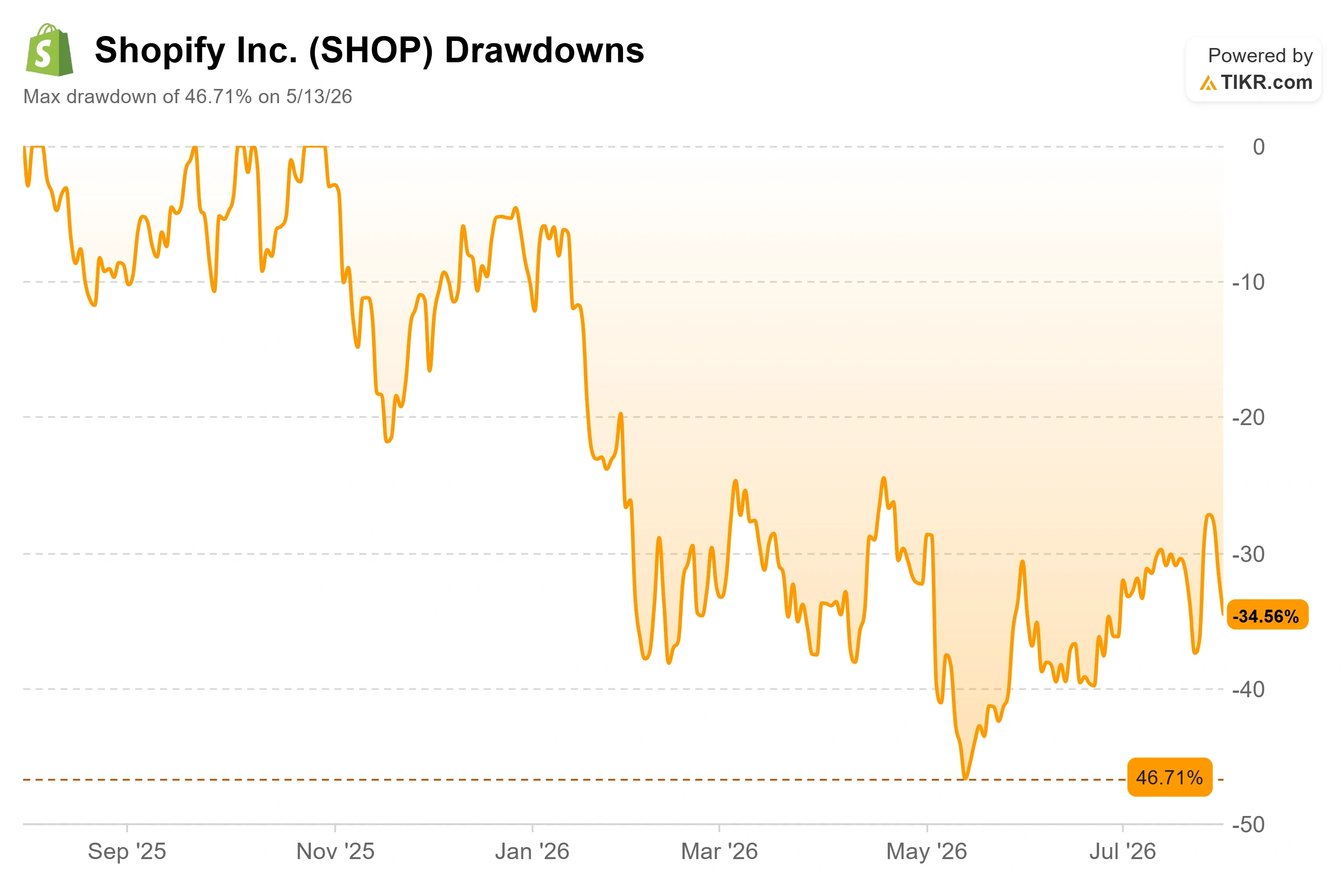
Shares closed at $117.15 on July 31, down 4.29% that session on broad e-commerce weakness, and they sit roughly 36% below the 52-week high of $182.19. The board still leans bullish at 29 Buy, 10 Outperform, 11 Hold, and 1 Sell, but the targets are nearly $30 apart and the disagreement is now about one thing. This report is where the data starts to answer it.
What Dominic Ball Actually Said
Ball’s downgrade was not a valuation call dressed up as caution. He was blunt about the reason: “With a heavy heart, we downgrade Shopify to Neutral,” he wrote, adding that “the downgrade is predominantly due to the Meta threat.” His thesis is specific and therefore testable. Meta launched its Business Agent globally on June 3, and Ball expects Meta to extend it into tools that let small businesses build storefronts, run ads, handle payments, and manage customers, which is precisely what Shopify sells. He puts up to 50% of Shopify’s U.S. business in the blast radius.
That specificity is what makes August 5 a test rather than a scorecard. Because Meta’s product went live on June 3, Q2 caught only its final month, so this print is an early read, not a verdict. The fuller test comes in Q3. Still, the SMB-sensitive lines are where any early damage would surface first, and those lines report on Wednesday.
See historical and forward estimates for Shopify stock (It’s free!) >>>
The Metrics That Confirm or Break the Thesis
If Meta is starting to pull small merchants away, it shows up in three places, and Shopify breaks out all three. The first is new-merchant acquisition. On the Q1 call, CFO Jeff Hoffmeister said growth was “essentially evenly split between same-store sales growth and new merchant acquisitions.” If that split tilts hard toward existing merchants, the top of the funnel is thinning, which is exactly what a Meta-driven SMB leak would look like. The second is the smallest GMV cohort. Management reports merchants doing under $2 million in GMV separately, and that band is the one most exposed to a free Meta alternative. The third is same-store growth itself, the pillar bulls have leaned on since late 2024.
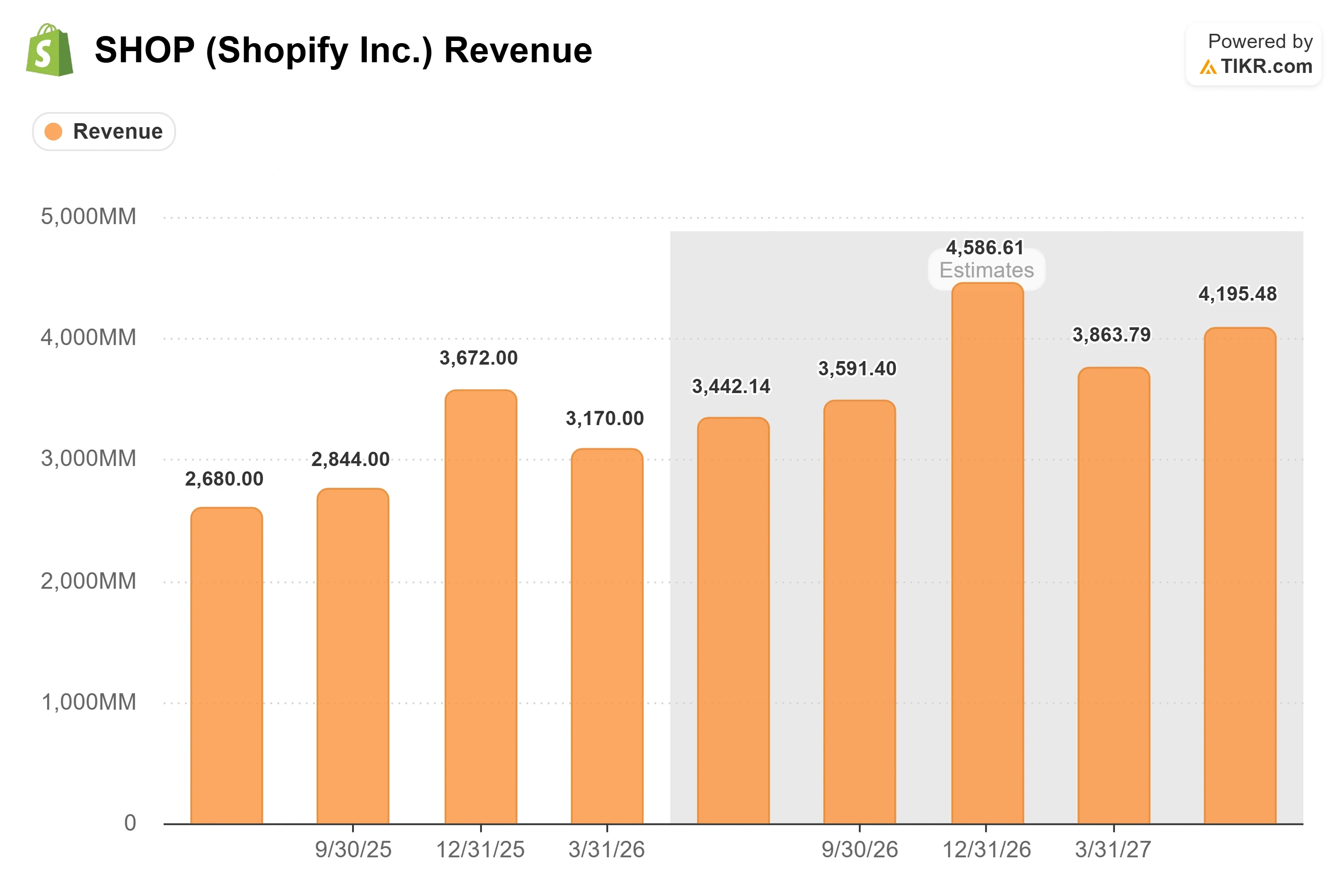
Set against the Meta worry is the guide Shopify has to clear, regardless. Hoffmeister guided Q2 revenue growth to the “high 20s,” a step down from the 34% posted in Q1, and he was specific about why: “our Q2 revenue guidance assumes approximately 0.5 point of FX tailwinds versus the more than 2 points of FX tailwinds that we saw in Q1.” Consensus sits near $3.44 billion, roughly 28% growth, inside management’s $3.40 billion to $3.46 billion guide. Watch operating expenses too, guided to 35% to 36% of revenue from 37% in Q1. A clean revenue number paired with soft merchant adds would tell a very different story than the headline alone.
The Analyst Split That Frames the Print
The disagreement is stark. Jefferies ($160) and Stifel ($150, upgraded July 10) both moved to Buy in July on Q2 upside, and a path to 30%-plus revenue growth, and Morgan Stanley initiated at Overweight with a $192 target built around Shopify’s Sidekick AI product. Jefferies analyst Samad Samana cited alternative data suggesting Q2 GMV is running ahead of Street expectations, a reported read on third-party data, not a company disclosure, so treat it as a hypothesis the print will confirm or deny. Against all of them stands Ball’s $130 and the Meta thesis.
Shopify’s own answer to the Meta worry is that it sits at the center of agentic commerce rather than on the losing side of it. As President Harley Finkelstein put it on the Q1 call, “we are currently the only platform on the planet, powering selling inside of ChatGPT, Copilot, and Google, all from one system of record.” The company reinforced that on July 28, when it made DoorDash a native sales channel inside its App Store, letting merchants push catalogs onto DoorDash’s marketplace from the Shopify Admin. Whether that positioning holds against a free Meta tool is the question Q2 starts to answer.
See how Shopify performs against its peers in TIKR (It’s free!) >>>
TIKR Advanced Model Analysis
- Current Price: $117.15
- Target Price (Mid): ~$287
- Potential Total Return: ~145%
- Annualized IRR: ~23% / year
See analysts’ growth forecasts and price targets for Shopify stock (It’s free!) >>>
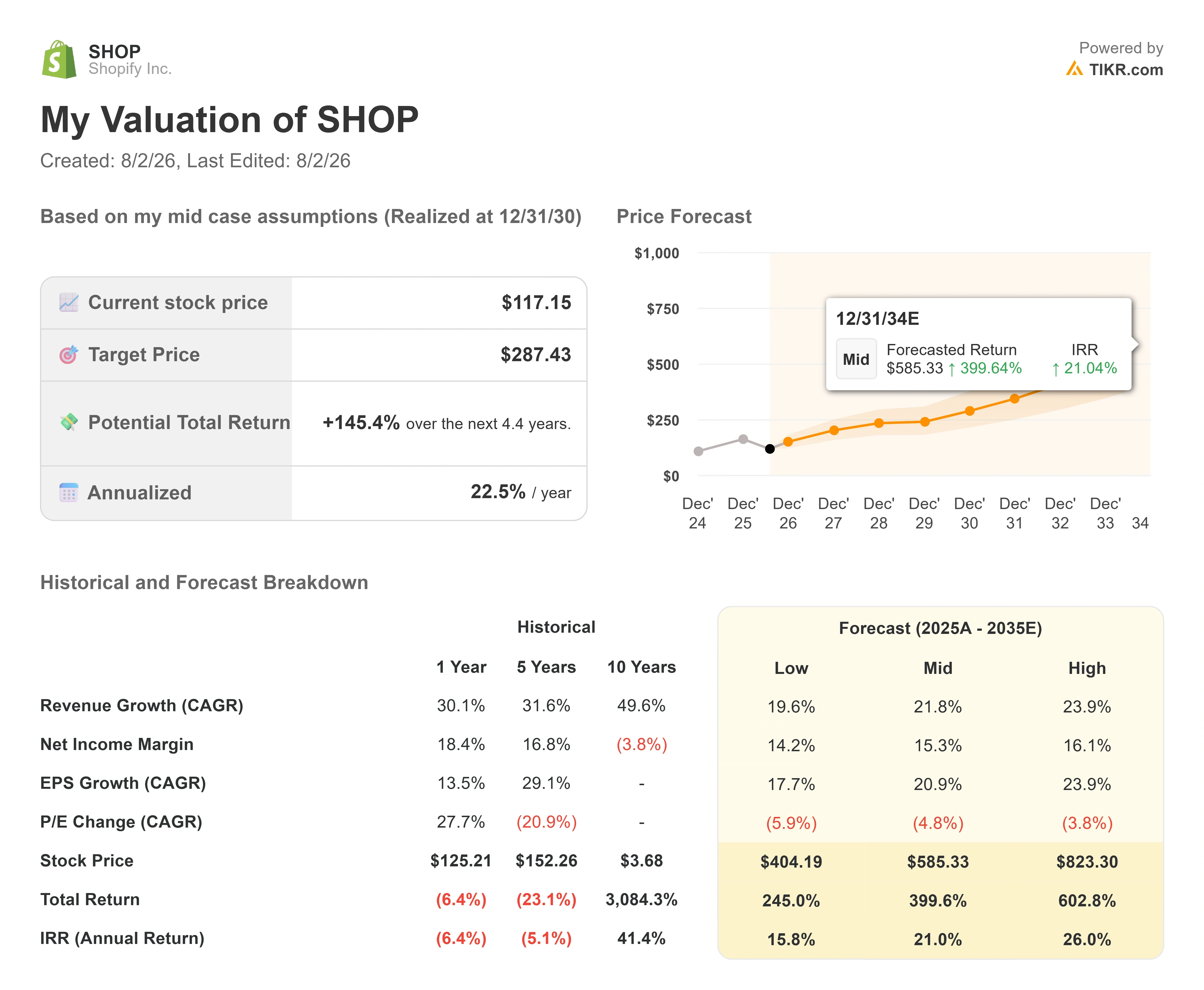
The TIKR mid-case model values Shopify at around $287 by the end of 2030, a total return of roughly 145% from today, or about 23% annualized over the next 4.4 years. The number rests on two revenue drivers holding: continued Shopify Payments penetration as more GMV runs through Shopify’s own rails, which reached 67% in Q1, and international plus enterprise expansion, where Europe grew 42%, and the count of merchants doing over $100 million in GMV has nearly doubled in two years. The margin driver is operating leverage, with the model assuming net income margin holds in the mid-teens as OpEx falls as a share of revenue.
The primary risk is the one Ball named. If Meta genuinely peels off the SMB base, the new-merchant engine that feeds every other line slows, and the model’s revenue assumptions are the first thing to break. Upside: a clean beat with merchant adds intact tells that the Meta fear is overbuilt, and the stock re-rates off a depressed multiple. Downside: soft SMB metrics hand Ball his proof and the $130 target its footing.
Conclusion
Headline revenue against the high-20s guide will set the tone on August 5, but the number that actually matters is the same-store versus new-merchant split. Hold that near even, with SMB GMV steady, and Ball’s Meta thesis looks early at best, and the July selloff looks overdone. Let new-merchant contribution sag, and the “existential threat” call gets its first data point. The report lands before the open, and because Meta’s tool only went live on June 3, this is the opening read, not the final word. The fuller test comes with Q3.
See what stocks billionaire investors are buying so you can follow the smart money with TIKR.
Should You Invest in Shopify?
The only way to really know is to look at the numbers yourself. TIKR gives you free access to the same institutional-quality financial data that professional analysts use to answer exactly that question.
Pull up Shopify, and you’ll see years of historical financials, what Wall Street analysts expect for revenue and earnings in the quarters ahead, how valuation multiples have moved over time, and whether price targets are trending up or down.
You can build a free watchlist to track Shopify alongside every other stock on your radar. No credit card required. Just the data you need to decide for yourself.
Analyze Shopify on TIKR Free →
Looking for New Opportunities?
- See what stocks billionaire investors are buying so you can follow the smart money.
- Analyze stocks in as little as 5 minutes with TIKR’s all-in-one, easy-to-use platform.
- The more rocks you overturn… the more opportunities you’ll uncover. Search 100K+ global stocks, global top investor holdings, and more with TIKR.
Disclaimer:
Please note that the articles on TIKR are not intended to serve as investment or financial advice from TIKR or our content team, nor are they recommendations to buy or sell any stocks. We create our content based on TIKR Terminal’s investment data and analysts’ estimates. Our analysis might not include recent company news or important updates. TIKR has no position in any stocks mentioned. Thank you for reading, and happy investing!