Key Stats for Fortinet Stock
- Current Price: $161.95
- Target Price (Mid): ~$189
- Street Target: ~$158
- Potential Total Return: ~17%
- Annualized IRR: ~4% / year
Now Live: Discover how much upside your favorite stocks could have using TIKR’s new Valuation Model (It’s free) >>>
What Happened?
Fortinet (FTNT) closed at $161.95 on July 31, up 104% in 2026 and within a few dollars of its 52-week high of $170.35. The run is not a story about hype outrunning results. In the last two weeks, the company landed Intel as a manufacturing partner for its next security chip, won the highest credit rating in cybersecurity, and reported a second quarter that beat every line of guidance.
So why are insiders selling, and why does the average analyst target now sit below the share price? That is the tension for anyone thinking about buying at $162. The business keeps proving the bulls right, but the price has moved faster than the fundamentals, and the people closest to the company are taking money off the table. This is a question about valuation, not quality.
The Case Got Stronger, and the Insiders Sold Anyway
Two announcements in July widened Fortinet’s durability case. On July 21, the company named Intel as the manufacturing partner for its next-generation Security Processor, SP6, becoming the first named cybersecurity customer for Intel Foundry. Days earlier, Moody’s upgraded Fortinet’s senior unsecured notes to A3, the highest rating of any public cybersecurity company. Both reinforce the same edge: the custom-silicon advantage Fortinet has built over 26 years is widening, not fading.
That edge showed up in the numbers. Second-quarter revenue grew 26% to $2.05 billion, roughly 8% above Street estimates, with product revenue accelerating 52% to $773 million. Non-GAAP operating margin hit a second-quarter record of 38%, and free cash flow more than tripled to $966 million. CEO Ken Xie told analysts the acceleration is structural, not a cycle. Asked directly how durable the growth is, he said the company studied “whether it’s a new market trend or it’s a supply or the other things” and concluded, “the growth actually is a long term for Fortinet.” Management raised full-year guidance for the second straight quarter.
Against that backdrop, the insider behavior is the discordant note. Per GuruFocus, insiders sold roughly $43.7 million of stock over the past three months with no offsetting purchases, including a $23.4 million sale by Xie himself in early June at around $146. Executives sell for many reasons, so this is a weak signal on its own, but a cluster of selling into a vertical run, with no buying, is worth noting rather than dismissing.

See historical and forward estimates for Fortinet stock (It’s free!) >>>
What $162 Already Assumes
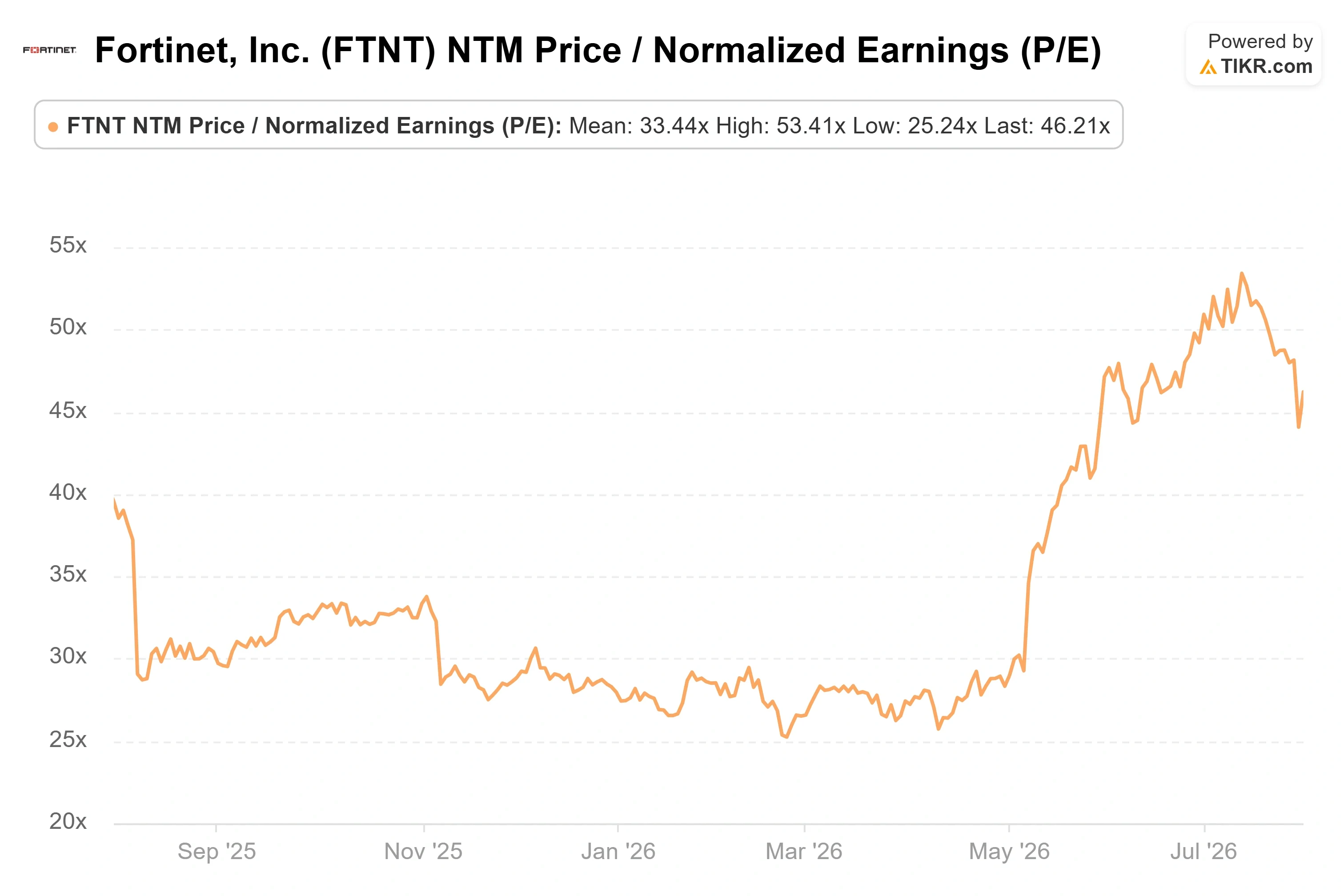
Fortinet trades at around 46 times next-twelve-month earnings. The multiple has expanded faster than earnings this year, and a rating that high leaves little room for growth to normalize, which is exactly what guidance implies for the back half as revenue growth steps toward 19%.
The premium is defensible on quality, not obviously cheap. On next-twelve-month EV/EBITDA, Fortinet sits at 35.9 times. That is far above mature software names like Oracle at 10.3 times and Salesforce at 10.5 times, yet below the hyper-growth security peers, with Palo Alto Networks at 54.7 times and CrowdStrike at 100.3 times. Fortinet’s 38% operating margin and 49% free cash flow margin are best-in-class, which justifies paying up. Whether it justifies paying up this much depends entirely on whether the recent 50%-plus product growth holds or reverts, and management is guiding to deceleration. The clearest external caution sign is the Street itself: the average price target of around $158 sits just below the current price, meaning the mean analyst target implies no upside from here even after post-earnings raises.
See how Fortinet performs against its peers in TIKR (It’s free!) >>>
TIKR Advanced Model Analysis
- Current Price: $161.95
- Target Price (Mid): ~$189
- Potential Total Return: ~17%
- Annualized IRR: ~4% / year

See analysts’ growth forecasts and price targets for Fortinet stock (It’s free!) >>>
Using TIKR’s mid-case, realized at the end of 2030, Fortinet is worth around $189, implying roughly 17% total return over about 4.4 years, or around 4% annualized. That is the answer to the chase question, and it is a sober one: a strong business still produces a below-market return because the starting valuation is high.
Two drivers carry the revenue line: the SASE Firewall convergence that pulls firewall, SD-WAN, and SASE spend onto one operating system, and operational technology security, where billings grew over 55%, and Fortinet holds a lead that few competitors contest. The margin driver is Fortinet’s in-house ASIC design, which holds gross margin near 81% while passing component costs through. The primary risk is the multiple: with the model assuming only modest P/E change from a high base, almost the entire return depends on earnings compounding without a valuation reset. The upside is that product growth stays near current levels, and the model’s conservative 11% revenue assumption proves too low. The downside is a slide toward the 15% industry growth rate at a lower multiple, which would erase years of price gains even as the business keeps growing.
Conclusion
The next real test is the third-quarter print, guided for revenue of $2.01 billion to $2.10 billion and non-GAAP EPS of $0.83 to $0.87. Watch product revenue growth specifically. It ran 52% this quarter; a reading that holds above 40% would tell that the acceleration is durable and the premium is earned, while a slide toward the high 20s would confirm the deceleration the full-year guide already implies. At 46 times earnings, Fortinet does not need a bad quarter to disappoint. It needs a merely good one. That is why buying here is a different decision than buying in March, and why the answer to “is it too late” is less about the company than about the price.
See what stocks billionaire investors are buying so you can follow the smart money with TIKR.
Should You Invest in Fortinet?
The only way to really know is to look at the numbers yourself. TIKR gives you free access to the same institutional-quality financial data that professional analysts use to answer exactly that question.
Pull up Fortinet, and you’ll see years of historical financials, what Wall Street analysts expect for revenue and earnings in the quarters ahead, how valuation multiples have moved over time, and whether price targets are trending up or down.
You can build a free watchlist to track Fortinet alongside every other stock on your radar. No credit card required. Just the data you need to decide for yourself.
Analyze Fortinet on TIKR Free →
Looking for New Opportunities?
- See what stocks billionaire investors are buying so you can follow the smart money.
- Analyze stocks in as little as 5 minutes with TIKR’s all-in-one, easy-to-use platform.
- The more rocks you overturn… the more opportunities you’ll uncover. Search 100K+ global stocks, global top investor holdings, and more with TIKR.
Disclaimer:
Please note that the articles on TIKR are not intended to serve as investment or financial advice from TIKR or our content team, nor are they recommendations to buy or sell any stocks. We create our content based on TIKR Terminal’s investment data and analysts’ estimates. Our analysis might not include recent company news or important updates. TIKR has no position in any stocks mentioned. Thank you for reading, and happy investing!