Key Stats for Verizon Stock
- 52-Week Range: $38.39 – $51.68
- Current Price: $47.22
- Street Target Price: ~$52
- NTM P/E: ~9x
- YTD Return: +16.5%
- Dividend Yield: 6.1%
- Market Cap: ~$196B
Now Live: Discover how much upside your favorite stocks could have using TIKR’s new Valuation Model (It’s free)>>>
Record EBITDA Margins and the Best Subscriber Quarter in 5 Years
Verizon (VZ) is a business that rewards patience rather than excitement. Total Q2 2026 operating revenue came in at $34.3 billion, down 0.7% year over year, as a nearly 20% drop in equipment revenue offset solid service growth.
Mobility and broadband service revenue, the number that actually drives long-term value in telecom, grew 2.8% to $23.4 billion. Adjusted EBITDA rose 7.2% to a record $13.7 billion, lifting the adjusted EBITDA margin to 40.1%, the highest in the company’s history.
Subscriber momentum was the genuine surprise. Verizon added 184,000 postpaid phone net subscribers in the quarter, nearly double the 106,000 analyst consensus, and a year ago the company was shedding postpaid customers entirely.
Consumer postpaid phone churn fell to 0.84%, down 6 basis points year over year, while promotional acquisition costs dropped around 15% and retention costs declined roughly 17%.
CEO Dan Schulman put it plainly: “We are gaining subscribers and earning long-term retention based on real value rather than subsidized promotions.” Full-year adjusted EPS guidance was raised to $4.99-$5.04, representing 6-7% growth.
Dividend investors will want to understand what is funding that yield. Verizon’s annual dividend obligation runs around $12 billion, and the free cash flow chart tells the sustainability story directly.
FCF dropped from $19.3 billion in 2021 to $14.1 billion in 2022 as 5G spectrum and buildout spending peaked, then recovered steadily to $20.1 billion in 2025, covering the dividend obligation by a wide margin.

The Frontier Communications acquisition, which closed in January 2026, added fiber infrastructure across 31 states and is integrating ahead of schedule. Fiber broadband added 155,000 net customers in Q2, and total broadband connections reached 17.1 million.
Net unsecured debt stood at $128.7 billion at quarter-end, though leverage has improved to 2.5x adjusted EBITDA, and Verizon expects to repay substantially all of Frontier’s acquired debt by year-end.
See analysts’ growth forecasts and price targets for VZ (It’s free) >>>
Is Verizon Actually Cheap at 7x EBITDA?
Verizon is a capital-intensive infrastructure business, which makes EV/EBITDA a more meaningful valuation lens than P/E.
The long-term mean for NTM EV/EBITDA is 7.11x, the historical high is 8.49x, and the all-time low is 5.09x. At the current reading of 7.0x, the stock trades almost exactly at its historical average, but not discounted.
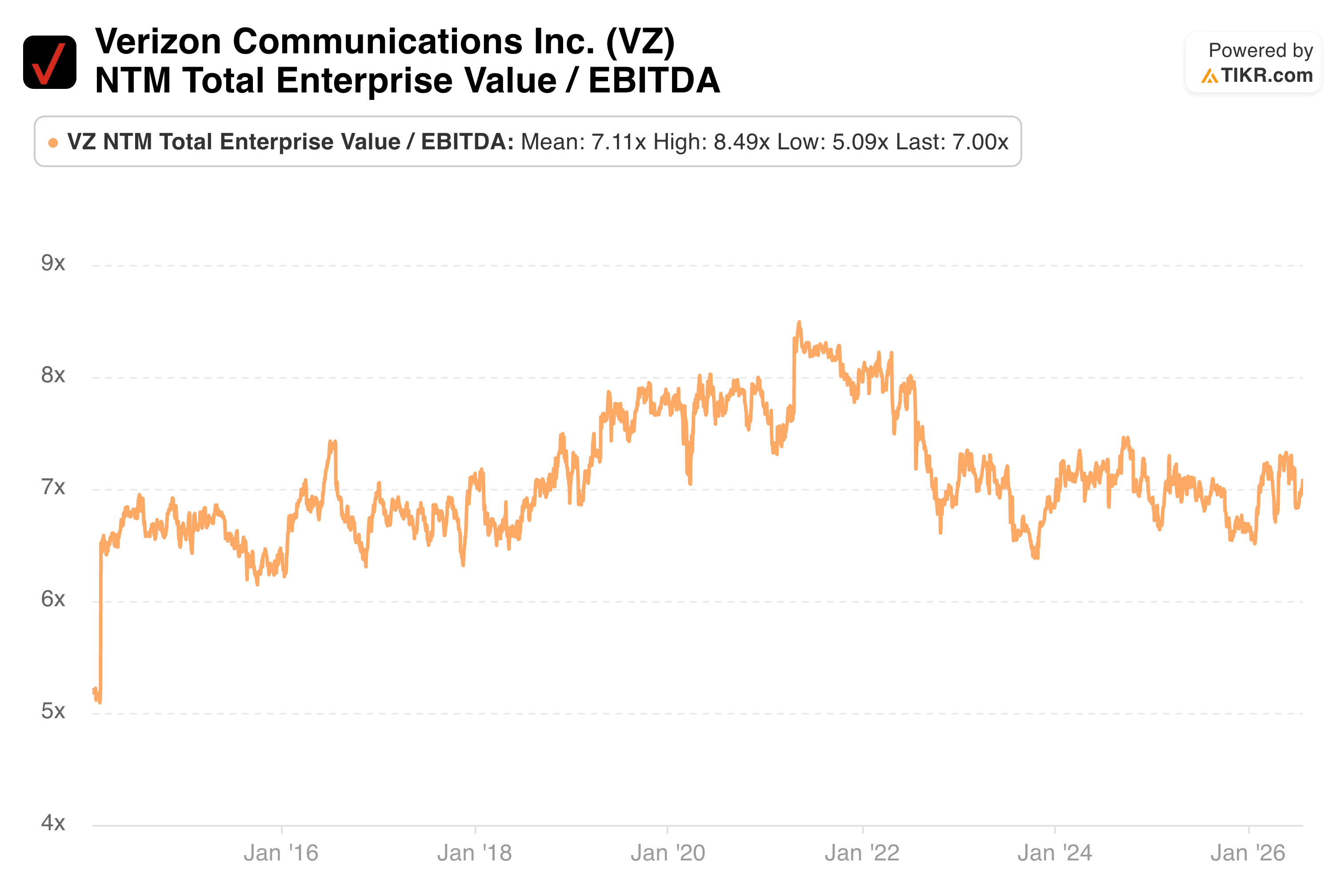
The stock spent much of 2023 and early 2024 trading closer to 6-6.5x as rate fears and debt concerns mounted.
The recovery toward the mean reflects improving fundamentals, but it also means the obvious discount is gone. Re-rating above the historical average would require a sustained acceleration in service revenue growth or a meaningful reduction in the debt load.
See Verizon’s full consensus estimates and price target history on TIKR for free →
What the Valuation Model Says About Verizon Stock
The TIKR valuation model mid-case target comes out to around $68, representing a potential total return of roughly 44% at an annualized rate of 8.6% over 4.4 years.
The model assumes revenue growing at around 2% annually, net income margins holding near 16%, and EPS compounding at roughly 3% per year. Adding the 6.1% dividend yield to those assumptions produces a total annual return in the 10-12% range, a more complete picture of what Verizon actually offers.

The Street consensus of around $52 implies around 10% price upside from current levels. Neither figure is particularly exciting in isolation, but Verizon was never meant to be exciting.
Should You Buy Verizon Stock?
Verizon’s Q2 results were better than most observers expected, and the combination of record EBITDA margins, improving subscriber trends, and a well-covered 6.1% dividend makes a reasonable case for income-oriented investors.
The Frontier debt load is real and worth monitoring, though management has moved aggressively to address it.
At 7x EBITDA and 9x forward earnings, the stock is priced fairly rather than cheaply, and meaningful upside from here likely requires either faster service revenue growth or a re-rating that the current fundamentals do not yet fully support.
Read our full take on Verizon’s 2026 gains, dividend, and outlook >>>
Looking for New Opportunities?
- See which stocks billionaire investors are buying to follow the smart money.
- Analyze stocks in as little as 5 minutes with TIKR’s all-in-one, easy-to-use platform.
- The more rocks you overturn… the more opportunities you’ll uncover. Search 100K+ global stocks, global top investor holdings, and more with TIKR.
Disclaimer:
Please note that the articles on TIKR are not intended to serve as investment or financial advice from TIKR or our content team, nor are they recommendations to buy or sell any stocks. We create our content based on TIKR Terminal’s investment data and analysts’ estimates. Our analysis might not include recent company news or important updates. TIKR has no position in any of the stocks mentioned. Thank you for reading, and happy investing!