
Key Stats for UPST Stock
- Past week’s performance: -1.2%
- 52-week range: $24 to $87
- Valuation model target price: $37
- Implied upside: 38.8% over 2.4 years
Get ahead of Upstart’s earnings with your own price target (It’s free) >>>
Steady Into a Catalyst
Upstart Holdings (UPST) has traded largely flat this week, down about 1%, as investors position ahead of second-quarter results due August 4. That quiet stretch follows a first quarter that gave bulls plenty to work with, even though it didn’t immediately translate into a sustained rally.
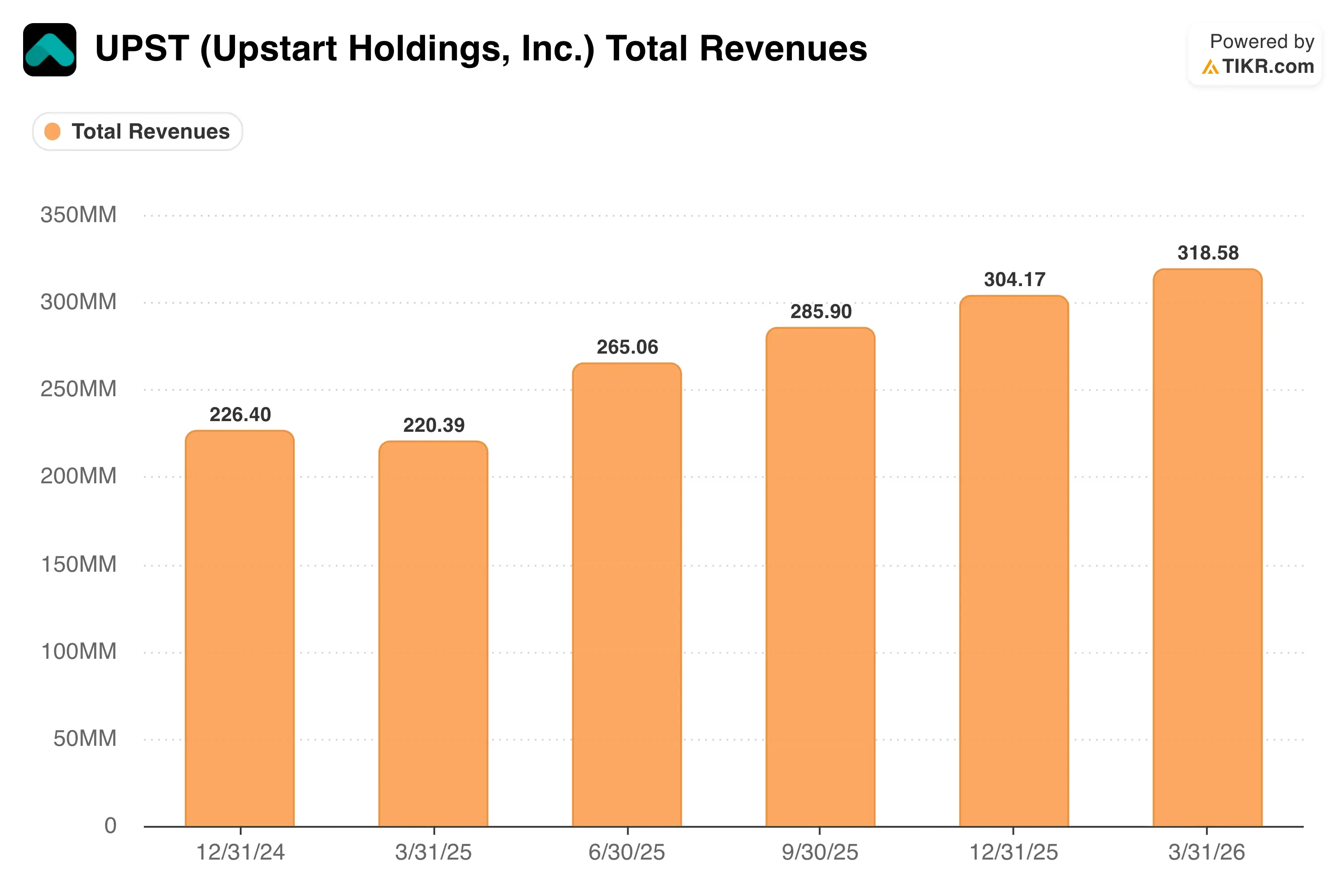
In Q1, Upstart grew loan originations 61% year over year to $3.4 billion, while revenue rose 44% to roughly $308 million. Co-founder and CEO Dave Girouard called it a quarter that put the company “comfortably on track” to hit its full-year outlook, which calls for approximately $1.4 billion in total revenue.
Girouard has been vocal about running the business differently than typical high-growth fintechs. “At Upstart, we have always treated equity as a real cost, and I intend to double down on that rigor,” he told analysts, emphasizing that the company funds expansion primarily through third-party capital rather than diluting shareholders. That discipline has helped Upstart secure more than $4 billion in new committed funding capital so far this year.
Auto and home lending are becoming meaningful growth drivers alongside Upstart’s core personal loan business, with both categories posting strong sequential growth in Q1. Going forward, next week’s report should show whether that momentum carried through the seasonally softer summer months or whether growth is starting to moderate.
See if Upstart can hit its full-year target under your own assumptions (Free with TIKR) >>>
Is UPST Stock Undervalued?
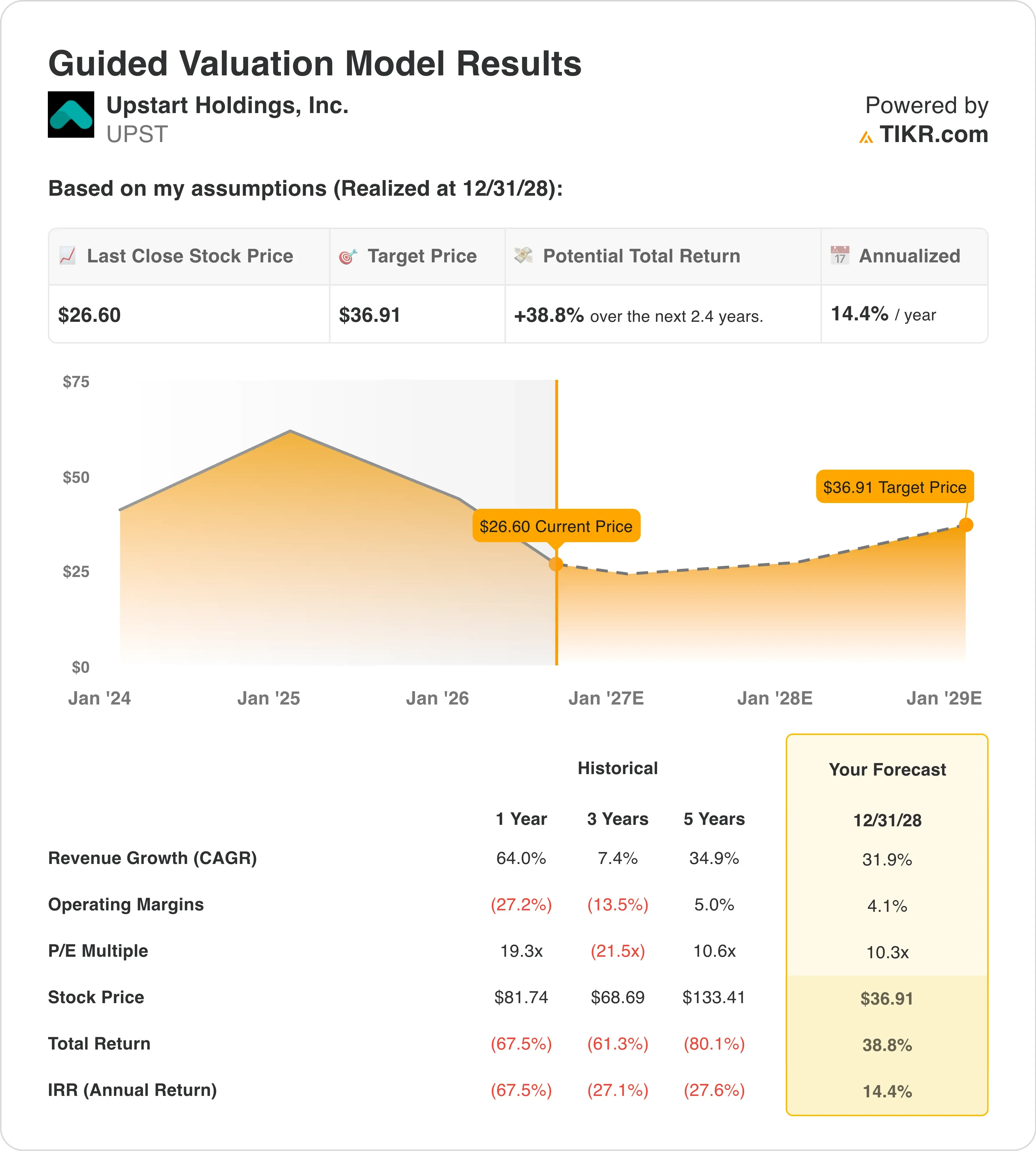
Under valuation model assumptions realized through 12/31/28, the stock is modeled using:
- Revenue Growth (CAGR): 31.9%
- Operating Margins: 4.1%
- Exit P/E Multiple: 10.3x
Based on these inputs, the model estimates a target price of $37, implying 38.8% upside and a 14.4% annualized return by the end of 2028.
Upstart’s valuation reflects a company still proving out its path to consistent profitability. Operating margins remain thin at just over 4% in this model, a sharp contrast to the 82.7% gross margin the business generates, showing just how much operating leverage is still on the table if origination growth continues outpacing expense growth.
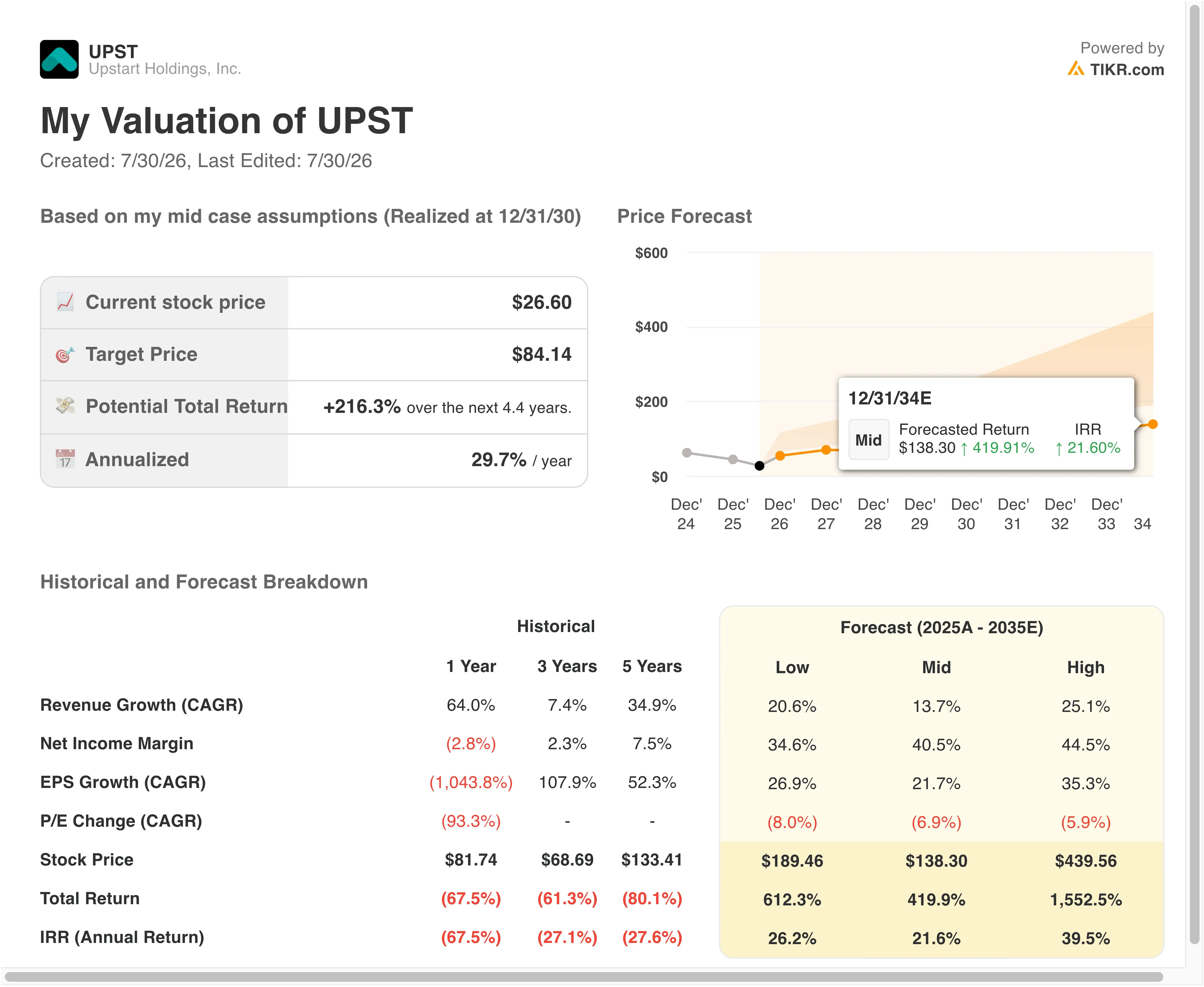
The revenue acceleration case is the clearest bull argument here. Upstart’s forward two-year revenue CAGR sits near 33.6%, among the fastest of any consumer fintech, driven by AI underwriting models that management says are improving accuracy faster than traditional credit scoring methods can match. Auto and home lending, still tiny relative to personal loans, represent a large runway if AI-driven underwriting scales the way it has in the core business.
Upstart’s own history also shows how volatile this stock can be relative to its growth. The company’s three and five-year total returns remain deeply negative even after this year’s rebound, a reminder that Upstart’s business model is still sensitive to funding availability and credit conditions in a way more established lenders aren’t.
Given the AI underwriting angle, the strongest visual for this section is a revenue and forward-estimates chart, showing quarterly originations and revenue against analyst projections for the remainder of 2026, ideally placed right after the valuation inputs above.
Stress-test Upstart’s growth assumptions before earnings drop (It’s free) >>>
Upstart vs. SoFi: Growth at a Discount
Upstart’s most relevant comparisons are SoFi (SOFI) and traditional bank-partnered lenders, since all three compete for similar personal loan and auto loan volume. Upstart’s forward two-year revenue CAGR of roughly 33.6% outpaces the mid-to-high-teens growth SoFi has recently guided for in its lending segment, reflecting the AI underwriting advantage management continues to emphasize.
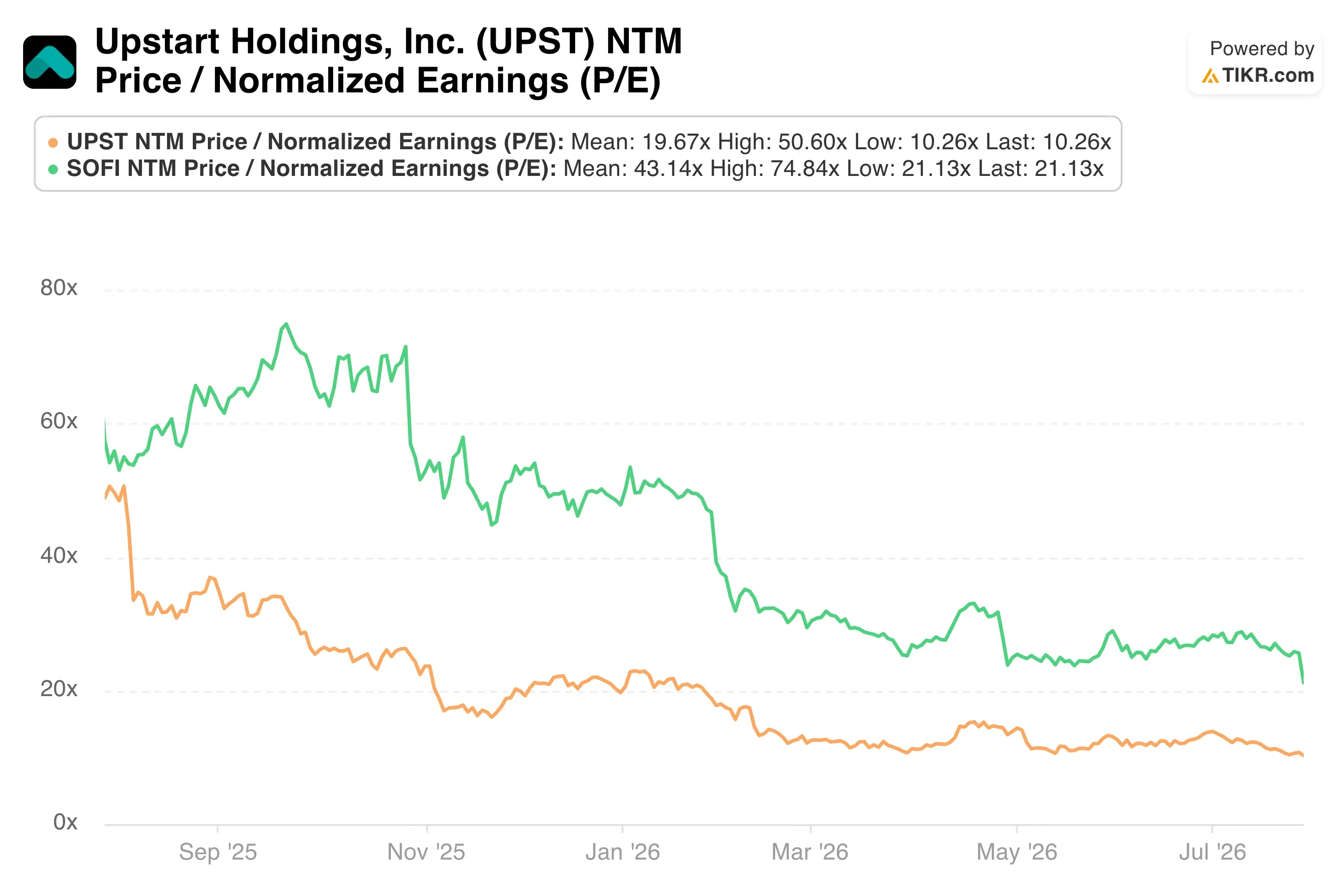
On profitability, Upstart still trails more established fintech peers on a GAAP basis, having posted a Q1 net loss of about $7 million even as its full-year 2025 results returned to profitability with $54 million in net income. Its NTM P/E of roughly 10.3x looks inexpensive next to SoFi’s mid-20s forward multiple, though that discount also reflects the market’s lingering skepticism about credit quality during any economic downturn.
The competitive moat, according to management, comes down to a decade-long data advantage in AI-based credit modeling. Girouard has argued that AI will eventually turn consumer credit from a commodity business into one where the technology leader wins disproportionate market share, a claim that will be tested more rigorously as larger banks and fintechs like SoFi build out their own AI underwriting capabilities.
See how Fortress’s $1.25B forward-flow deal reshapes Upstart’s funding runway >>>
What’s Driving UPST Stock Going Forward?
The most immediate catalyst is next week’s second-quarter earnings report, where investors will be watching whether origination growth held near the 61% pace posted in Q1 and whether contribution margin, which management said would bottom out in Q1, is beginning to expand as guided.
Upstart’s national bank charter application is a second theme worth tracking. Management has said the charter would provide regulatory benefits and more direct interaction with regulators, though it wouldn’t fundamentally change Upstart’s reliance on third-party capital to fund loans.
Macro credit conditions remain the biggest wildcard. Upstart’s model assumes a stable economic backdrop for the rest of 2026, and any deterioration in consumer credit quality or a pullback in funding partner appetite could quickly change the growth trajectory that’s currently supporting the stock’s valuation.
Estimate a company’s fair value instantly (Free with TIKR) >>>
Should You Invest in Upstart?
The only way to really know is to look at the numbers yourself. TIKR gives you free access to the same institutional-quality financial data that professional analysts use to answer exactly that question.
Pull up UPST, and you’ll see years of historical financials, what Wall Street analysts expect for revenue and earnings in the quarters ahead, how valuation multiples have moved over time, and whether price targets are trending up or down.
You can build a free watchlist to track UPST alongside every other stock on your radar. No credit card required. Just the data you need to decide for yourself.
Analyze UPST stock on TIKR Free→
Disclaimer:
Please note that the articles on TIKR are not intended to serve as investment or financial advice from TIKR or our content team, nor are they recommendations to buy or sell any stocks. We create our content based on TIKR Terminal’s investment data and analysts’ estimates. Our analysis might not include recent company news or important updates. TIKR has no position in any stocks mentioned. Thank you for reading, and happy investing!