Key Stats for Texas Instruments Stock
- 52-Week Range: $152.73 to $334.03
- Current Price: $291.22
- Street Mean Target: $303.31
- Market Cap: $265 billion
- Q1 2026 Revenue: $4.83 billion (up 19% year over year)
- Q1 2026 EPS: $1.68 (beat consensus of $1.36)
- Q1 2026 Industrial Revenue Growth: 30% year over year
- Q1 2026 Data Center Revenue Growth: ~90% year over year
- Dividend Yield: 2.0%
Analyze your favorite stocks like Texas Instruments Incorporated with TIKR (It’s free) >>>
A Stock That Nearly Doubled From Its Lows and Is Now Pulling Back From Its High
Texas Instruments (TXN) is not a name that generates breathless excitement like Nvidia or AMD, and that is somewhat by design. The company makes analog and embedded semiconductors, the workhorse chips that regulate power, sense temperature, convert signals, and manage data flows inside factory equipment, automobiles, appliances, and increasingly, AI data centers.
These are not the chips on the front page of technology news, but they are in almost every piece of electronic hardware ever made, which gives Texas Instruments a breadth of end-market exposure that few semiconductor companies can match.
Coming into 2026, the stock was sitting around $180, still recovering from a brutal two-year downturn driven by an industry-wide inventory correction. Customers had over-ordered chips during the pandemic and spent 2023 and 2024 burning through that excess rather than placing new orders. Texas Instruments kept its factories running anyway, building internal capacity for a recovery it believed was inevitable.
By April, with Q1 earnings confirming that recovery was well underway, the stock had nearly doubled from its lows before pulling back to around $291 today.

The drawdown chart shows how volatile that ride has been, even within the recovery. The stock hit a maximum drawdown of nearly 18% in late March as tariff fears rattled the sector, recovered sharply on strong April earnings, then sold off again in June and July, and is currently about 12% below its recent high.
For investors watching from the sidelines, the question is whether that pullback is a buying opportunity or a sign that cycle enthusiasm has run ahead of the fundamentals.
Value Texas Instruments Incorporated instantly (Free with TIKR) >>>
The Gross Margin Chart Shows Why the Recovery Still Has Room to Run
Gross margins peaked at nearly 69% in 2022, then fell every single year, reaching 57% by the end of 2025. Over three years, Texas Instruments gave up nearly 12 percentage points of margin, which looks alarming without context.
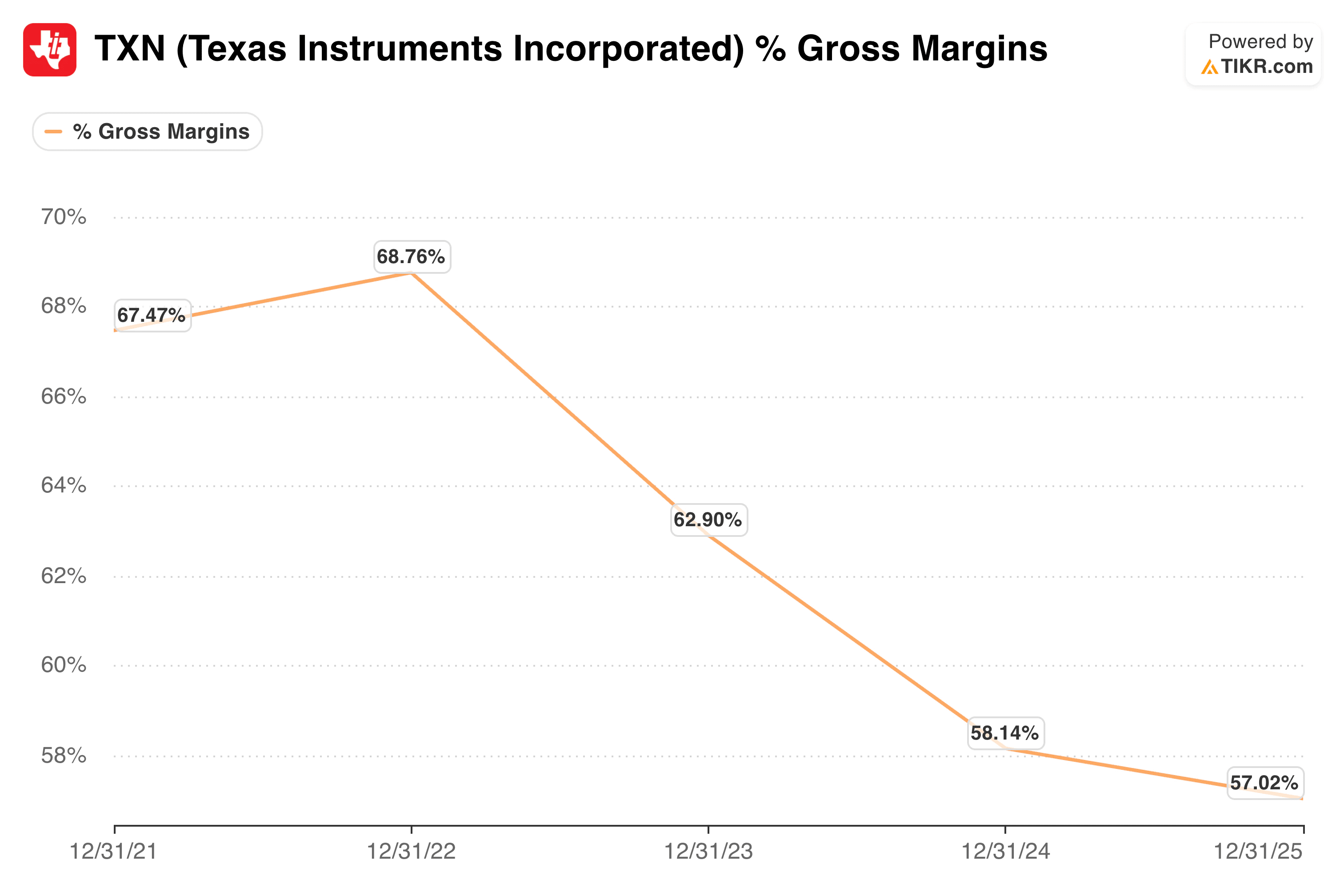
The context matters enormously. Texas Instruments made a deliberate choice to build and operate its own 300mm wafer fabrication facilities rather than outsourcing to foundries like TSMC.
Running those factories below full capacity during a demand downturn means absorbing fixed costs against lower revenue, which compresses gross margin mechanically. The compression was not a competitive weakness. It was the visible cost of a long-term strategic bet.
Now that industrial demand is recovering and data center demand is surging, factory utilization is rising, and margins should follow. CEO Haviv Ilan noted that industrial revenue grew more than 30% year over year across all sectors and regions in Q1, while data center revenue grew roughly 90%.
Capital expenditures also declined to $676 million in Q1 from $1.1 billion a year earlier, as the heaviest construction phase winds down. The margin recovery thesis is intact.
See analysts’ growth forecasts and price targets for Texas Instruments Incorporated (It’s free) >>>
A 14% Annualized Return in the Mid Case, With Earnings Growth Doing Most of the Heavy Lifting
The TIKR valuation model projects a mid-case target of around $524 over the next 4.5 years, implying a total return of roughly 80% and an annualized IRR of around 14%. The low case lands at around 10% annually, and the high case reaches nearly 17%.
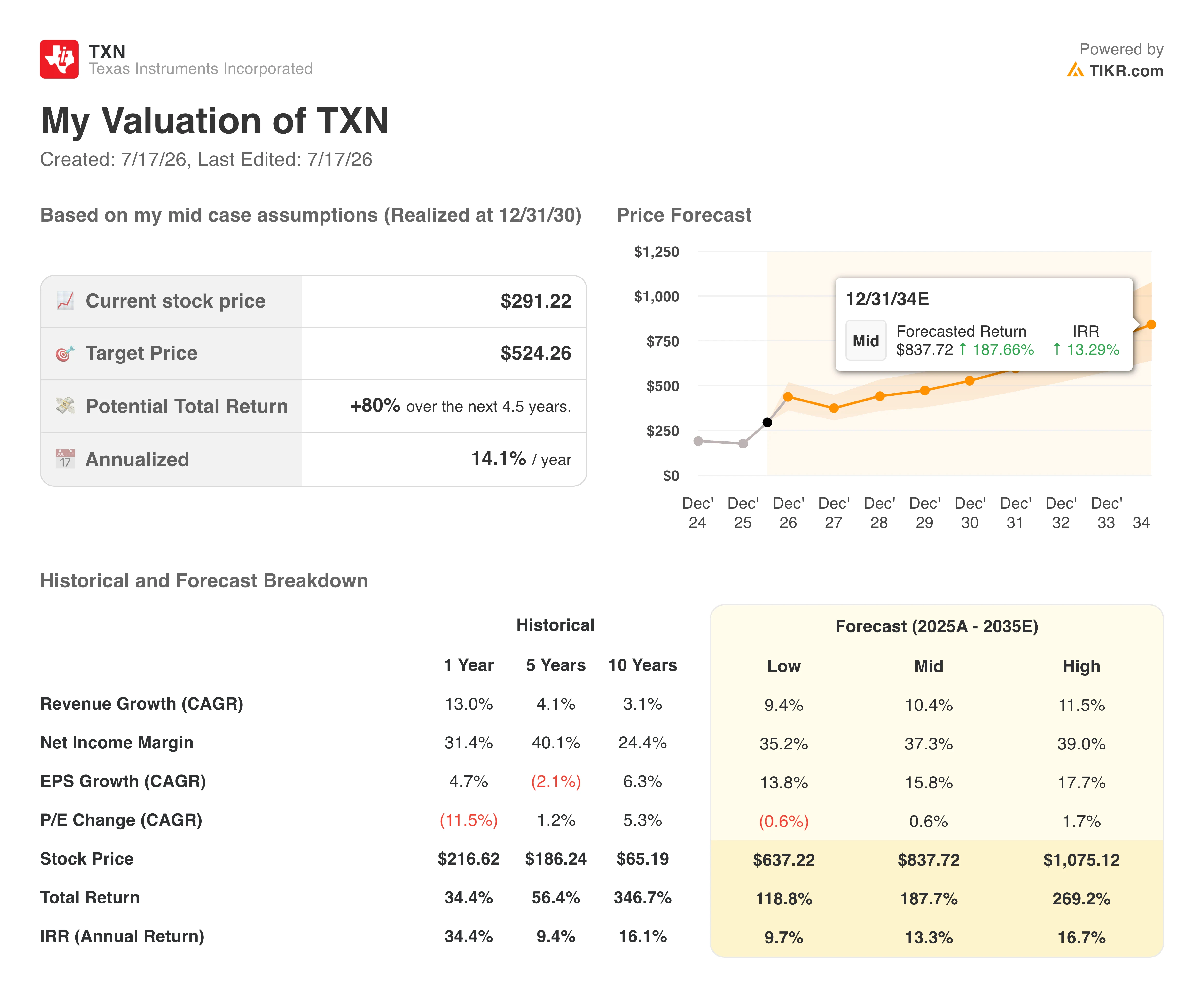
Those returns assume around 10% annual revenue growth, with net income margins recovering from the current 31% back toward the high 30s as factory utilization improves and the capex cycle eases.
EPS is forecast to grow at roughly 16% annually in the mid-case, and the model assumes essentially flat multiple expansion, meaning the return is driven almost entirely by earnings compounding.
The risk worth flagging is that at around 35 times forward earnings, Texas Instruments is trading at a meaningful premium to its historical average, leaving limited room for error if the industrial recovery stalls, automotive demand in China continues to soften, or the $7.5 billion Silicon Labs acquisition introduces integration complexity at a sensitive moment in the cycle.
Should You Invest in Texas Instruments?
Texas Instruments is one of those businesses where the investment case is clearest to investors willing to think in cycles rather than quarters.
The company spent years absorbing pain to build a manufacturing advantage that is now beginning to pay off, and the Q1 results suggest the recovery is broad-based rather than a one-quarter bounce. The stock’s 64% YTD run means much of the good news is already priced in, and the current pullback reflects that tension honestly.
For investors who believe the analog semiconductor recovery has further to go and that Texas Instruments’ manufacturing ownership is a genuine long-term edge, the current level looks more interesting than it did six months ago.
Value Texas Instruments Incorporated in under 60 seconds with TIKR (It’s free) >>>
Looking for New Opportunities?
- See what stocks billionaire investors are buying so you can follow the smart money.
- Analyze stocks in as little as 5 minutes with TIKR’s all-in-one, easy-to-use platform.
- The more rocks you overturn… the more opportunities you’ll uncover. Search 100K+ global stocks, global top investor holdings, and more with TIKR.
Disclaimer:
Please note that the articles on TIKR are not intended to serve as investment or financial advice from TIKR or our content team, nor are they recommendations to buy or sell any stocks. We create our content based on TIKR Terminal’s investment data and analysts’ estimates. Our analysis might not include recent company news or important updates. TIKR has no position in any stocks mentioned. Thank you for reading, and happy investing!