Key Takeaways for Union Pacific Stock as of July 2026
- Union Pacific reported record first quarter operating income and net income, with adjusted EPS of $2.93 up 9% year over year, on a railroad running 24% fewer trains than 2019 at higher volume.
- The quarterly dividend stands at $1.38 per share, up from $1.30 just two quarters earlier.
- A payout ratio hovering between 42% and 49% over the past eight quarters sits against a yield of 1.9%, leaving wide room between what Union Pacific earns and what it sends to shareholders.
- TIKR’s mid-case model targets $477 by December 2030, implying 65% total return and an 11% annualized rate from today’s $288 price.
Union Pacific Stock: The Q1 Call Showed a Railroad Earning More With Less, and the Dividend Barely Scratches the Surface

Union Pacific (UNP) opened 2026 with record first quarter results across operating income and net income, and CEO Jim Vena framed the quarter as proof that the railroad keeps raising the bar on itself. Adjusted earnings per share hit $2.93, a 9% increase, while the operating ratio improved 80 basis points to 59.9%.
The numbers underneath tell the dividend story. Revenue of $6.2 billion grew 3%, with freight revenue up 4% on 1% lower volume. Core pricing combined with business mix drove 325 basis points of freight revenue improvement, and CFO Jennifer Hamann confirmed that “quarterly pricing dollars exceeded inflation dollars.” That is a railroad growing revenue without needing more trains on the track.
Cash from operations totaled $2.4 billion, up 10%. Free cash flow came in at $630 million after significant capital investment and an “industry-leading dividend” paid to shareholders. Hamann affirmed mid-single-digit reported EPS growth for full year 2026 and reiterated the three-year target of high single-digit to low double-digit EPS CAGR through 2027.
What makes this quarter relevant for dividend investors sits in the operating efficiency. Eric Gehringer, EVP of Operations, reported first quarter records in all six key performance and efficiency metrics. Freight car velocity jumped 9%. The active locomotive fleet shrank 4% while gross ton miles rose. Workforce productivity improved 7% on a 5% smaller headcount. Vena told analysts the railroad currently runs with over 100 locomotives parked on the mainline because of speed improvements alone, and he sees “lots of opportunity” for further efficiency gains over the next few years.
The merger with Norfolk Southern adds another dimension. Vena confirmed the revised application filing and projected $1.8 billion in net revenue synergies and $1 billion in cost synergies upon completion. Hamann expects nearly $12 billion of annual free cash flow once the combined railroad reaches steady state. That figure would dwarf any plausible dividend commitment.
Union Pacific’s Payout Ratio Barely Cracks 48% While the Dividend Keeps Climbing
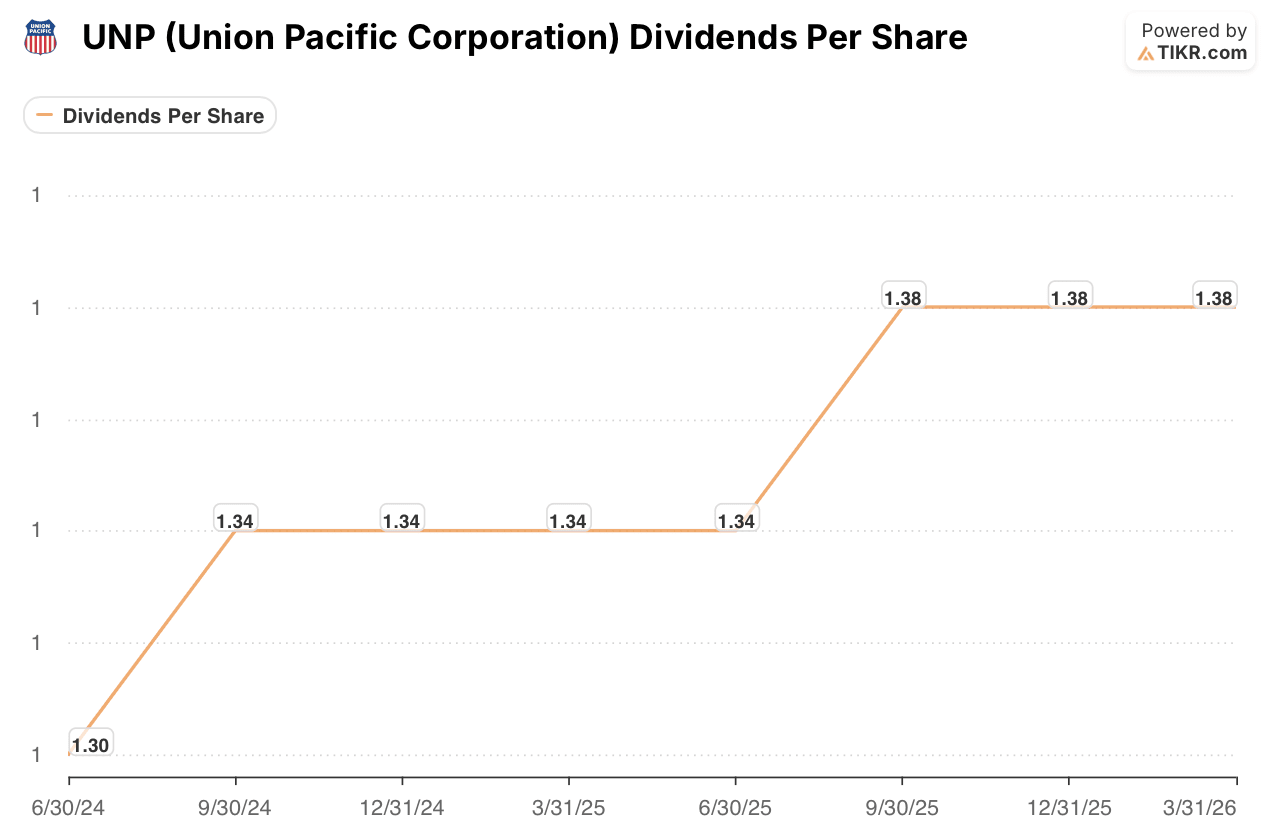
The quarterly payout rose from $1.30 in mid-2024 to $1.34, where it held for four consecutive quarters, then stepped up to $1.38 beginning in Q3 2025. Three straight quarters at $1.38 confirm Union Pacific’s preference for measured, durable raises over splashy one-time bumps.

The payout ratio tells the rest. It peaked at 49% in Q1 2025, dipped to 42% the following quarter as earnings strengthened, and has since oscillated between 44% and 48%. The most recent reading of 48% sits comfortably below the 50% line that would signal any strain on earnings coverage.

Set against that ratio, the 1.9% yield looks stingy on the surface. But yield compression here is a function of price appreciation, not dividend neglect. Union Pacific stock has repriced higher while the dividend grew behind it, which means the low yield reflects confidence in the earnings trajectory rather than a shrinking commitment to shareholders.
The real question is whether the merger, once approved, accelerates the next raise cycle. Hamann noted the company is prioritizing debt paydown while the deal is pending and has paused share repurchases. That capital allocation pause means the dividend is currently the sole direct cash return to shareholders, and management has shown no inclination to slow it.
TIKR’s Model Puts Union Pacific Stock at $477 With 11% Annualized Upside
TIKR’s mid-case model values Union Pacific stock at $477 by December 2030, implying 65% total return and an 11% annualized rate from the current $288 price.

That return prices in a business compounding revenue at 7% annually with net income margins expanding toward 36% in the mid case, according to the model’s forecast assumptions.
Vena’s call gave those assumptions a tangible floor. A railroad that just posted record efficiency across every operating metric, confirmed pricing power above inflation, and guided to high single-digit to low double-digit EPS growth through 2027 has already demonstrated the earnings trajectory the model requires.
The pending Norfolk Southern combination, with its projected $12 billion in combined annual free cash flow, would only widen the gap between what Union Pacific earns and what any reasonable dividend program would cost.
Is Union Pacific stock undervalued? Check UNP’s full valuation breakdown on TIKR for free →
Should You Invest in Union Pacific Corporation?
The only way to really know is to look at the numbers yourself. TIKR gives you free access to the same institutional-quality financial data that professional analysts use to answer exactly that question.
Pull up Union Pacific Corporation stock and you’ll see years of historical financials, what Wall Street analysts expect for revenue and earnings in the quarters ahead, how valuation multiples have moved over time, and whether price targets are trending up or down.
You can build a free watchlist to track Union Pacific Corporation alongside every other stock on your radar. No credit card required. Just the data you need to decide for yourself.
Access Professional Tools to Analyze UNP stock on TIKR for Free →
Looking for New Opportunities?
- See what stocks billionaire investors are buying so you can follow the smart money.
- Analyze stocks in as little as 5 minutes with TIKR’s all-in-one, easy-to-use platform.
- The more rocks you overturn… the more opportunities you’ll uncover. Search 100K+ global stocks, global top investor holdings, and more with TIKR.
Disclaimer:
Please note that the articles on TIKR are not intended to serve as investment or financial advice from TIKR or our content team, nor are they recommendations to buy or sell any stocks. We create our content based on TIKR Terminal’s investment data and analysts’ estimates. Our analysis might not include recent company news or important updates. TIKR has no position in any stocks mentioned. Thank you for reading, and happy investing!