


Key Takeaways for CVS Health Stock as of July 2026
- CVS Health delivered $2.57 in adjusted EPS for Q1 2026 and raised full-year guidance to $7.30-$7.50, confirming the earnings turnaround has traction.
- The quarterly dividend held at $0.67 per share, unchanged for eight straight quarters.
- A 29% payout ratio paired with a 2.47% NTM yield captures the tension: dividend coverage has never been stronger in the visible data, but the stock’s rally compressed the yield to its trailing-year low.
- TIKR’s mid-case model targets $130 for CVS Health stock by December 2030, implying 23% total return at a 5% annualized rate.
CVS Health’s Q1 Earnings Gave the Dividend a Cushion It Hadn’t Had in Years
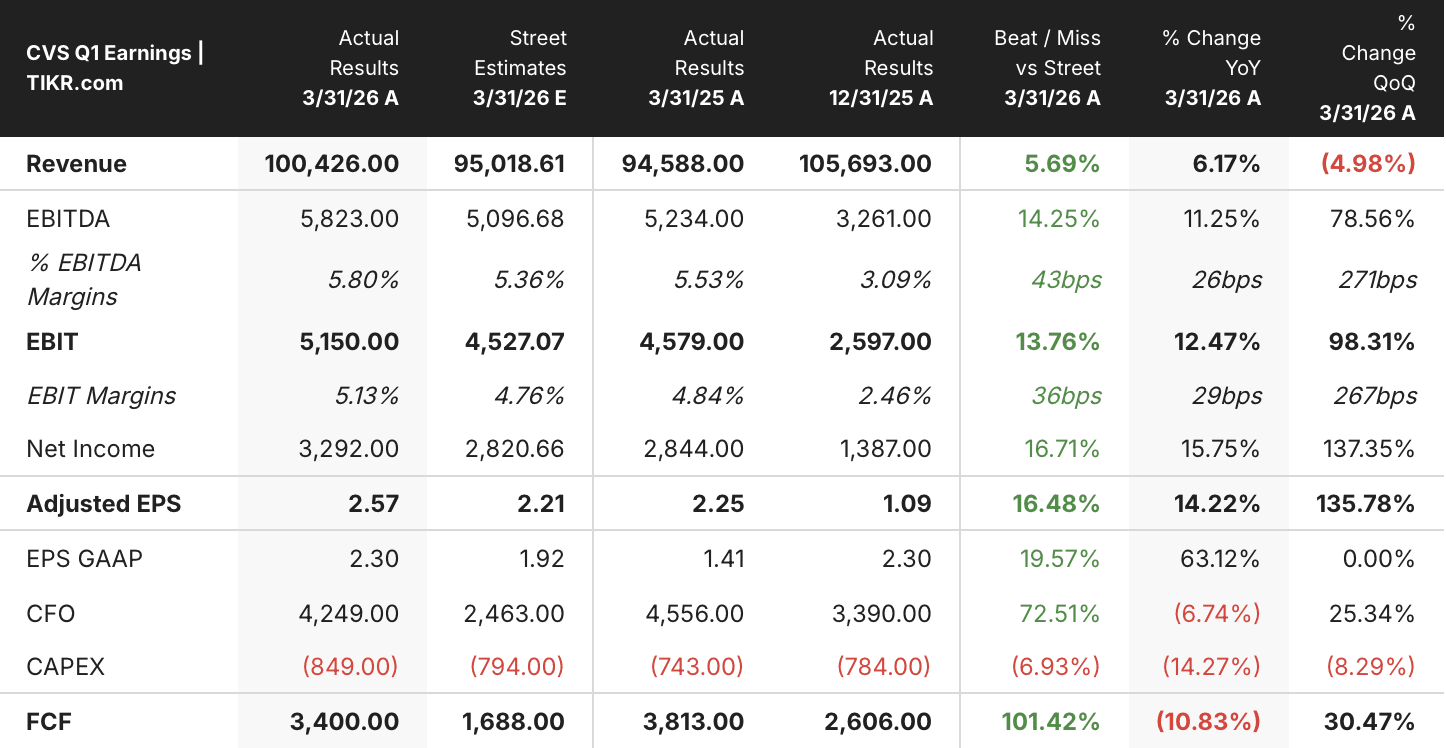
CVS Health (CVS) opened its Q1 2026 earnings call with numbers that reframed the dividend question: $2.57 in adjusted earnings per share, up 14% from the prior year, on revenue that topped $100 billion.
Management raised full-year adjusted EPS guidance to a range of $7.30 to $7.50, up from $7.00 to $7.20. CEO David Joyner called it “another quarter of excellent performance” and pointed to margin recovery at Aetna, where the Health Care Benefits segment posted roughly $3 billion in adjusted operating income against an 84.6% medical benefit ratio.
Cash generation backed the earnings print. CVS Health reported $4.2 billion in operating cash flow and returned nearly $850 million to shareholders through its quarterly dividend.
The leverage ratio improved to 3.84x at quarter-end. CFO Brian Newman guided full-year operating cash flow to at least $9.5 billion and full-year revenue to at least $405 billion.
On buybacks, Newman was direct: not in the 2026 guide. “We remain focused on strengthening our balance sheet,” he told analysts, adding that the company would evaluate the impact of improving financial performance and leverage throughout the year.
Newman also reaffirmed confidence in a mid-teens EPS compound annual growth rate through 2028. For dividend investors, the implication landed without management spelling it out: CVS Health will keep paying $0.67 per quarter, the balance sheet is healing, and the earnings trajectory gives management options it lacked a year ago.
Whether those options surface as a dividend raise or a buyback restart remains the open question heading into the back half of 2026.
CVS Stock’s Dividend Has Its Best Coverage in Years, at Its Lowest Yield

The quarterly dividend has not budged from $0.67 per share. CVS Health paid that figure every quarter across eight consecutive periods in the visible trajectory, from mid-2024 through Q1 2026.
That flatness reads differently depending on when you bought CVS Health stock. When the yield sat near its trailing-year high of 4.89%, the $0.67 payout came with a price that reflected real turnaround doubt. At today’s 2.47%, the same $0.67 arrives on a stock that the market treats as fixed.
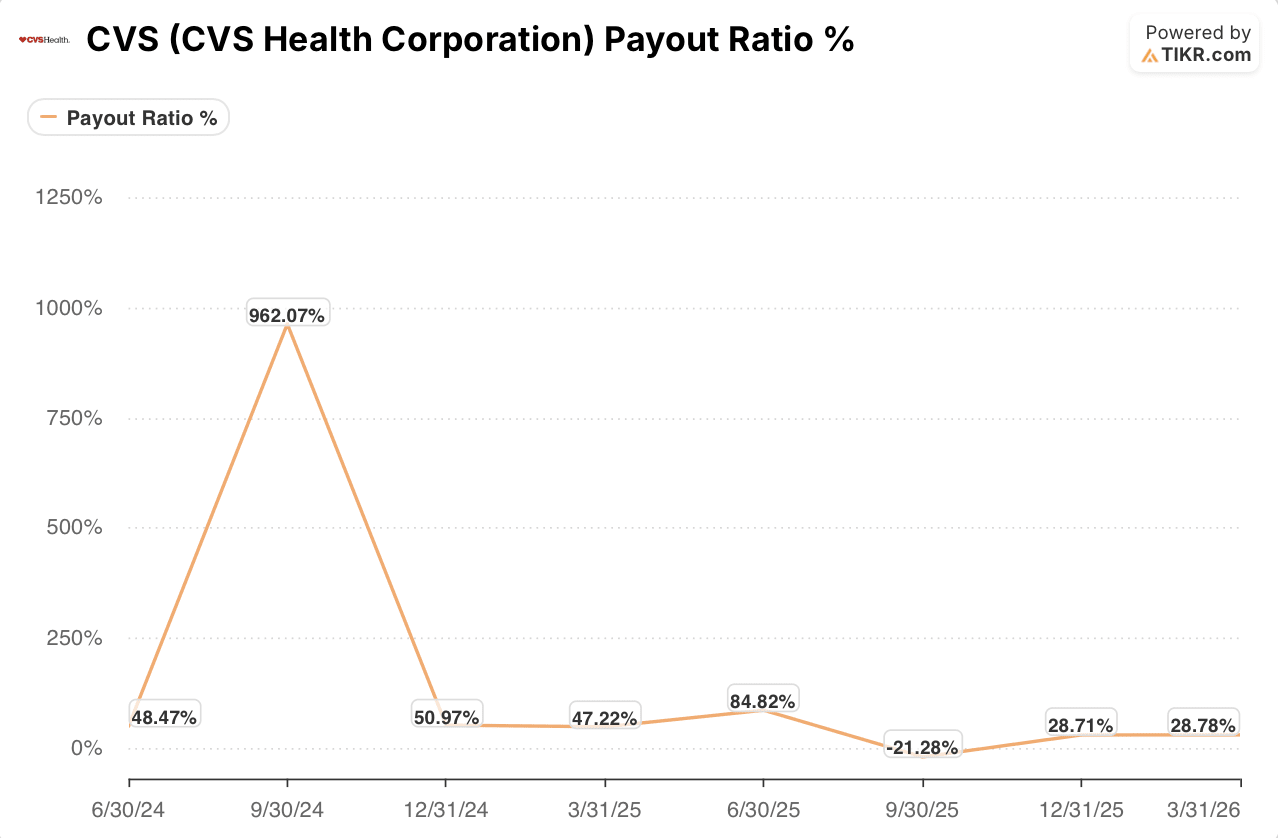
The payout ratio traces the same arc. As recently as Q3 2024, CVS Health’s payout ratio spiked to 962.07% on a quarter of collapsed earnings. By Q1 2026, it had dropped to 29%, the lowest reading in the data set.
A 29% payout ratio on a flat dividend tells one story plainly: earnings recovered faster than the company returned capital. CVS Health chose debt paydown over payout growth, and the leverage ratio Newman cited on the call confirmed that priority.

The yield’s compression from 4.89% to 2.47% is where the bull and bear cases fork. Bulls see a dividend floor with ample room for a raise once deleveraging ends; bears see a stock that already priced in the turnaround, leaving the yield at a level that no longer compensates for the sector’s regulatory exposure.
TIKR’s $130 Target Gives CVS Health Stock Room to Grow Into Its Earnings
TIKR’s mid-case model sets a $130 target on CVS Health stock by December 2030, implying 23% total return and a 5% annualized rate from the current $106 price.

That 5% annualized figure sits below the mid-teens EPS compound annual growth rate management committed to through 2028, which suggests the model prices in execution risk rather than the full guidance trajectory.
The path to $130 runs through the same priorities Joyner and Newman laid out on the call: continued margin recovery at Aetna, stable Caremark execution against rebate guarantees, and a leverage ratio that keeps improving. The dividend feeds into that return without carrying it.
Should You Invest in CVS Health Corporation?
The only way to really know is to look at the numbers yourself. TIKR gives you free access to the same institutional-quality financial data that professional analysts use to answer exactly that question.
Pull up CVS Health Corporation stock and you’ll see years of historical financials, what Wall Street analysts expect for revenue and earnings in the quarters ahead, how valuation multiples have moved over time, and whether price targets are trending up or down.
You can build a free watchlist to track CVS Health Corporation alongside every other stock on your radar. No credit card required. Just the data you need to decide for yourself.
Access Professional Tools to Analyze CVS stock on TIKR for Free →
Looking for New Opportunities?
- See what stocks billionaire investors are buying so you can follow the smart money.
- Analyze stocks in as little as 5 minutes with TIKR’s all-in-one, easy-to-use platform.
- The more rocks you overturn… the more opportunities you’ll uncover. Search 100K+ global stocks, global top investor holdings, and more with TIKR.
Disclaimer:
Please note that the articles on TIKR are not intended to serve as investment or financial advice from TIKR or our content team, nor are they recommendations to buy or sell any stocks. We create our content based on TIKR Terminal’s investment data and analysts’ estimates. Our analysis might not include recent company news or important updates. TIKR has no position in any stocks mentioned. Thank you for reading, and happy investing!


