Key Stats for RTX Stock
- 52-Week Range: $112.3 to $214.5
- Current Price: $196.2
- Street High Target: $242
What Happened?
RTX Corporation (RTX), the aerospace and defense giant powering everything from commercial jet engines to Patriot missile systems, closed April 2 at $196.21 as its record $268 billion backlog and $6.60–$6.80 adjusted EPS guidance for 2026 signal the company’s strongest demand cycle in its post-merger history.
On March 31, Pratt & Whitney, RTX’s commercial and military engine division, secured a $6.6 billion F135 production contract covering lots 18–19 of the F-35 Lightning II fighter jet program, with a $3.8 billion modification already awarded, cementing RTX’s sole-source position on the only fifth-generation fighter engine in Western service.
RTX’s Raytheon defense unit, which manufactures Patriot missile defense systems, AMRAAM air-to-air missiles, and Tomahawk cruise missiles, posted $10.3 billion in Q4 2025 bookings for a 1.35 book-to-bill ratio, leaving Raytheon’s backlog at a record $75 billion with 47% of it tied to international customers whose defense budgets are growing at 3%–4% annually across the Asia Pacific and Middle East.
On March 5, Deutsche Bank raised its price target on RTX to $240 from $235 and reiterated its Buy rating, citing the Hot Section Plus upgrade for the PW1100G engine, which roughly doubles time-on-wing by eliminating two major shop visits over a 20-year engine life and directly expands RTX’s high-margin commercial aftermarket revenue stream.
CEO Christopher Calio stated on the Q4 2025 earnings call that “we understand that our products are critical to maintaining security around the world and we fully support the Department of War’s transformation objectives to significantly increase capacity and accelerate production over a sustained period,” directly anchoring RTX’s 2026 plan to invest $10.5 billion in CapEx and R&D while targeting $8.25–$8.75 billion in free cash flow.
RTX’s competitive position over the next three to five years rests on three compounding drivers: the GTF Advantage engine’s entry into service in 2026 expanding an already 8,000-engine backlog on a program three times its originally projected size, Raytheon’s framework agreements with the Department of War targeting 2x–4x production rate increases across critical munitions programs not yet reflected in the $268 billion backlog, and $3.4 billion in scheduled 2026 debt paydowns freeing capital to fund the $3.1 billion CapEx program already approved for munitions, sensor, and engine capacity expansion.
Wall Street’s Take on RTX Stock
The $6.6 billion F135 contract and the $268 billion backlog together confirm what RTX’s 75.1% FCF surge in 2025 already signaled: this defense and commercial aerospace platform has crossed from a recovery trade into a durable cash compounding story.

RTX’s FCF expanding from $7.9 billion in 2025 to an estimated $8.6 billion in 2026 reflects the direct conversion of Raytheon’s record $75 billion backlog and Pratt’s growing GTF commercial aftermarket into hard cash, with EBIT margins tracking from 12.9% to an estimated 13.1% this year.
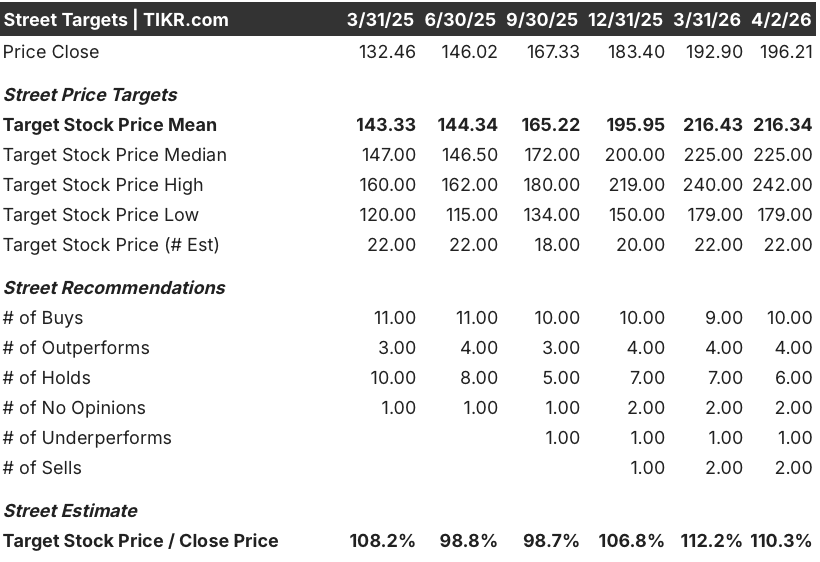
Fourteen analysts carry Buy or Outperform ratings on RTX against six Holds and three Sells, with a mean price target of $216.34 across 22 estimates, implying 10.3% upside from the April 2 close as Wall Street prices in accelerating Raytheon munitions output and Collins Aerospace margin expansion.
The spread between the $179 low target and $242 high target reflects a genuine binary on execution: the bull case assumes Raytheon’s Department of War framework agreements convert to definitive contracts and drive output 2x–4x current rates, while the bear case prices in GTF delivery constraints and continued Airbus engine allocation friction.
What Does the Valuation Model Say?
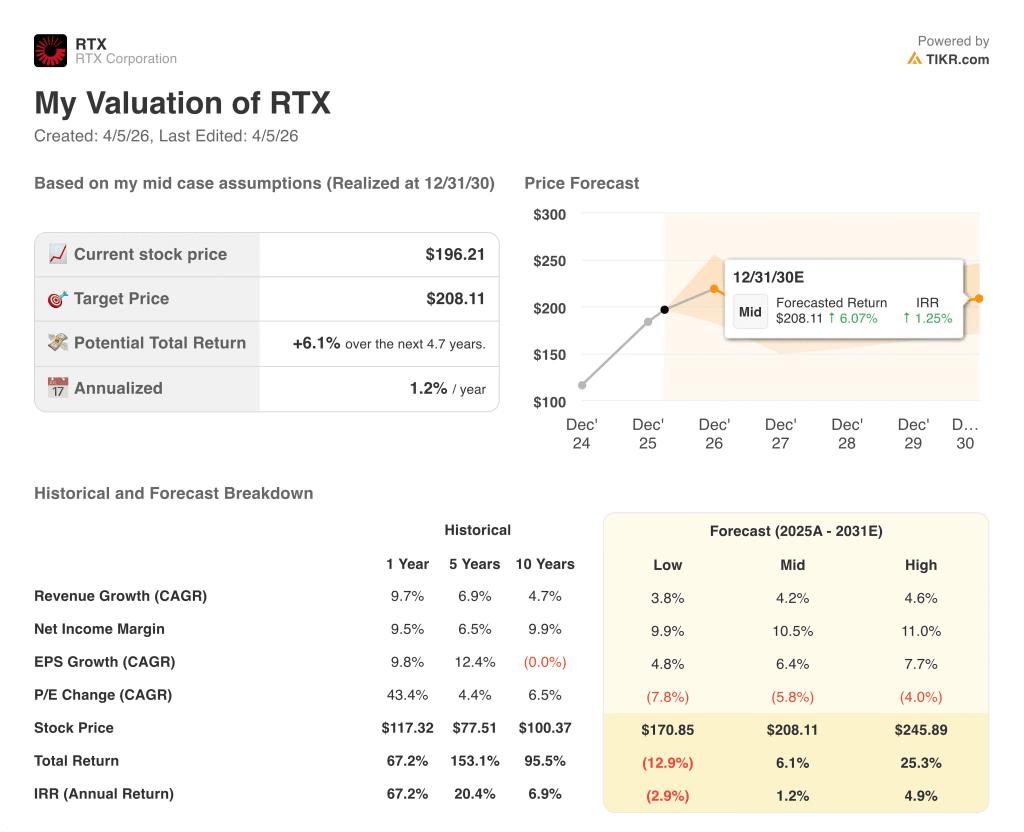
The TIKR mid-case model targets $208.11 by December 2030, assuming a mid-case revenue CAGR of 4.2% and net income margin expanding to 10.5%, driven by the GTF Advantage engine entering service in 2026 and Raytheon’s munitions production ramp flowing into the P&L across the forecast period.
Trading at roughly 30.6x 2026 estimated FCF against a FCF margin that TIKR models expanding from 9.0% in 2025 to 10.0% by 2027, RTX looks fairly valued today relative to its own 5-year average, though the $10 billion FCF milestone approaching in 2027 supported by the F135 lot 18–19 contract and the $8.25–$8.75 billion 2026 FCF guidance argues the current multiple underprices the compounding setup ahead.
Raytheon’s output on GEM-T, AMRAAM, and Coyote already rose 20% in 2025, and the $75 billion defense backlog with 85% of 2026 sales already contracted directly supports TIKR’s $93.5 billion revenue estimate for the year, underpinning the $208.11 mid-case price target.
CEO Christopher Calio’s commitment to $10.5 billion in combined CapEx and R&D in 2026, alongside $3.4 billion in debt maturities being paid down, signals management is simultaneously building capacity for future growth and strengthening the balance sheet rather than choosing between them.
The primary risk is GTF engine delivery constraints: Pratt’s ongoing allocation between commercial OE and MRO shop visits, compounded by Airbus’s active damages pursuit over engine delays, could suppress the commercial aftermarket revenue ramp that underpins TIKR’s FCF expansion trajectory.
RTX reports Q1 2026 earnings on April 21, and the number to watch is Raytheon’s book-to-bill ratio, which needs to sustain above 1.3x to confirm that framework agreement momentum is translating into backlog growth beyond the existing $75 billion.
Should You Invest in RTX Corporation?
The only way to really know is to look at the numbers yourself. TIKR gives you free access to the same institutional-quality financial data that professional analysts use to answer exactly that question.
Pull up RTX stock and you’ll see years of historical financials, what Wall Street analysts expect for revenue and earnings in the quarters ahead, how valuation multiples have moved over time, and whether price targets are trending up or down.
You can build a free watchlist to track RTX Corporation alongside every other stock on your radar. No credit card required. Just the data you need to decide for yourself.
Access Professional Tools to Analyze RTX stock on TIKR for Free →