


Key Stats for General Motors Stock
- 52-Week Range: $41.6 to $87.6
- Current Price: $72.5
- Street High Target: $122
What Happened?
General Motors (GM), the largest U.S. automaker by sales, delivered $12.7 billion in EBIT adjusted for 2025 while trading at $72.54, roughly 17% below its 52-week high, as Wall Street debates whether the company’s structural profit improvement is durable or tariff-exposed, with free cash flow now running at $10 billion annually against a historical baseline of $3 billion.
Barclays cut its price target on March 30 to $105 from $110 while maintaining its “overweight” rating, flagging Q1 cost headwinds from tariffs, chip costs tied to memory semiconductors used in vehicle electronics, and rising aluminum and copper prices, yet the firm’s revised target still implies 43.9% upside from that session’s close.
GM’s OnStar platform, the connected-services subscription business embedded in every new vehicle that generates high-margin recurring revenue well after the initial sale, ended 2025 with 12 million subscribers and $5.4 billion in deferred revenue on the balance sheet, with management targeting $7.5 billion by year-end 2026, a level that already exceeds what 19 of 28 covering brokerages appear to price into their models.
On March 30, GM confirmed it will run the Flint Assembly plant in Michigan, which builds its profitable heavy-duty Silverado and Sierra pickups, six days per week starting in June, a direct response to demand that CFO Paul Jacobson described at the March 18 Bank of America Global Automotive Summit as: “we’re challenged a little bit with low inventory in some key products, particularly like the Cadillac Escalade and some of the full-size trucks as we retool for the next generation of trucks beginning later this year.”
General Motor’s path through 2026 and into 2027 rests on three compounding drivers: a $400 million increase in high-margin OnStar and Super Cruise recognized revenue this year, a $1 billion warranty cost improvement already in guidance, and $5 billion in onshoring investments that management expects to bring U.S. annual production to approximately 2 million units while structurally reducing the $3 billion to $4 billion gross tariff burden that has weighed on the multiple.
Wall Street’s Take on GM Stock
The Barclays price target cut on March 30 to $105 from $110, despite implying 43.9% upside, captures the Street’s central tension: GM’s cost structure is absorbing a second consecutive year of $3 billion to $4 billion in gross tariffs while simultaneously funding $1 billion to $1.5 billion in onshoring and software investments that only begin paying back in 2027.

Yet the forward earnings trajectory remains intact, with normalized EPS estimated at $12.45 for 2026 and $13.87 for 2027, driven by the $1 billion warranty improvement, $500 million to $750 million in regulatory credit savings, and $400 million in incremental OnStar and Super Cruise, the connected-vehicle subscription business, recognized revenue.

Conviction among analysts covering General Motor stock has actually strengthened in recent months, with 13 buys and 7 outperforms among 26 analysts as of April 2, against a mean price target of $94.88 that implies 30.8% upside from the current $72.54, as the Street anticipates the North America margin recovery to the 8% to 10% range.
The spread between the $122 high target and the $57 low target reflects exactly the binary the market is pricing: the bull case assumes the onshoring investments and OnStar deferred revenue ramp materialize on schedule, while the bear case reflects the risk that sustained tariff pressure and weak EV volumes compress margins before the 2027 volume payback arrives.
What Does the Valuation Model Say?
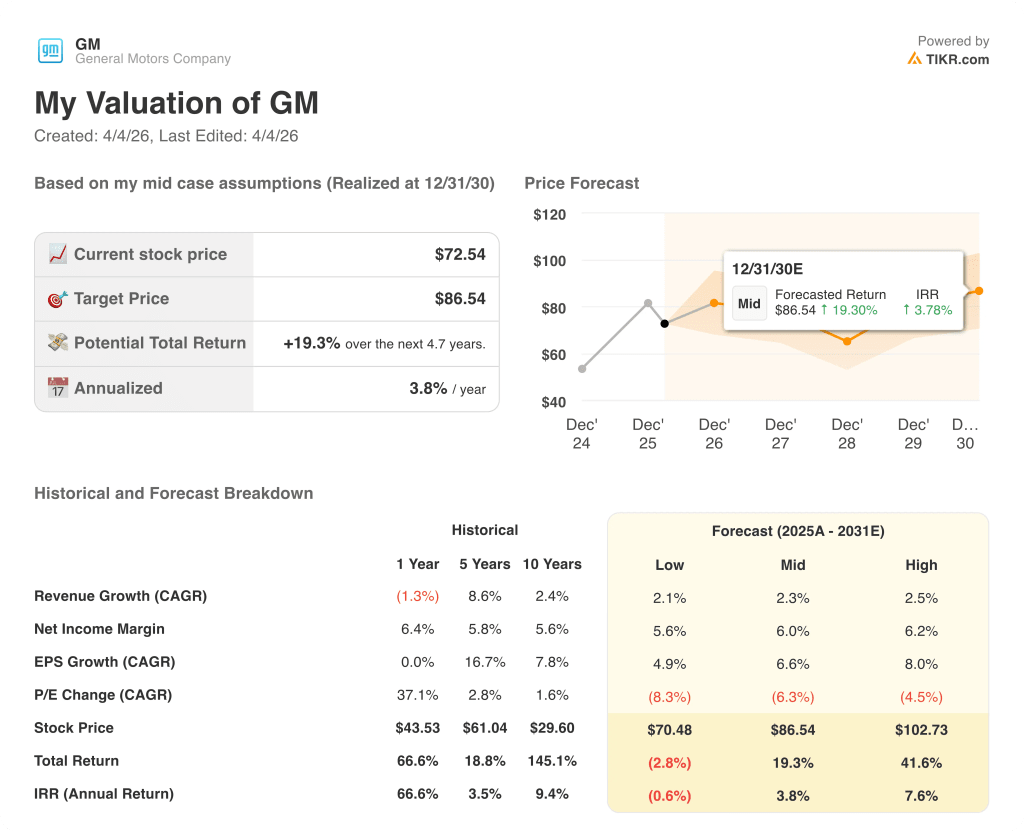
The TIKR mid-case model, assuming a 2.3% revenue CAGR and 6.6% EPS CAGR through 2031, supported by the FCF-accretive shift away from capital-heavy EV buildout toward the high-margin software services layer, prices GM at $86.54 by December 2030 for a 19.3% total return and a 3.8% annualized IRR.
At $72.54, GM trades at roughly 5.8x its 2026 estimated free cash flow of $10.45 billion, a meaningful discount to the 7x to 9x range that consistent free cash flow generators in the industrial and auto space have historically commanded, making GM stock undervalued against its own cash generation capacity, particularly as FCF margins hold at 5.6% through the investment cycle.
The TIKR model’s $86.54 target is grounded in the company’s demonstrated ability to sustain $10 billion or more in annual free cash flow while funding both $10 billion to $12 billion in annual CapEx and a newly authorized $6 billion buyback program, collapsing the share count that has already declined 35% since late 2023.
CFO Paul Jacobson’s stated intent to complete the supplier settlement cash payments, expected to total approximately $4.6 billion in cash charges, by the end of Q2 removes the single largest overhang on 2026 free cash flow conversion and confirms the investment thesis is execution-dependent, not structurally impaired.
The primary risk is a deterioration in U.S. full-size truck pricing: GM’s North America margin recovery to 8% to 10% depends on holding incentives roughly 200 basis points below the industry average, and any inventory-driven price war breaks that assumption directly.
The single most important near-term data point is GM’s Q1 2026 earnings report, where investors should watch North America EBIT margin against the 7.5% full-year estimate and the pace of supplier settlement cash payments against the Q2 completion target management has committed to publicly.
Should You Invest in General Motors Company?
The only way to really know is to look at the numbers yourself. TIKR gives you free access to the same institutional-quality financial data that professional analysts use to answer exactly that question.
Pull up GM stock and you’ll see years of historical financials, what Wall Street analysts expect for revenue and earnings in the quarters ahead, how valuation multiples have moved over time, and whether price targets are trending up or down.
You can build a free watchlist to track General Motors Company alongside every other stock on your radar. No credit card required. Just the data you need to decide for yourself.
Access Professional Tools to Analyze GM stock on TIKR for Free →


