Key Stats for Constellation Energy Stock
- Current Price: $272.82
- Target Price (Mid): $484.41
- Street Target (Mean): $375.82
- Potential Total Return (Mid): +77.6%
- Annualized IRR (Mid): 12.80% / year
Now Live: Discover how much upside your favorite stocks could have using TIKR’s new Valuation Model (It’s free) >>>
What Happened?
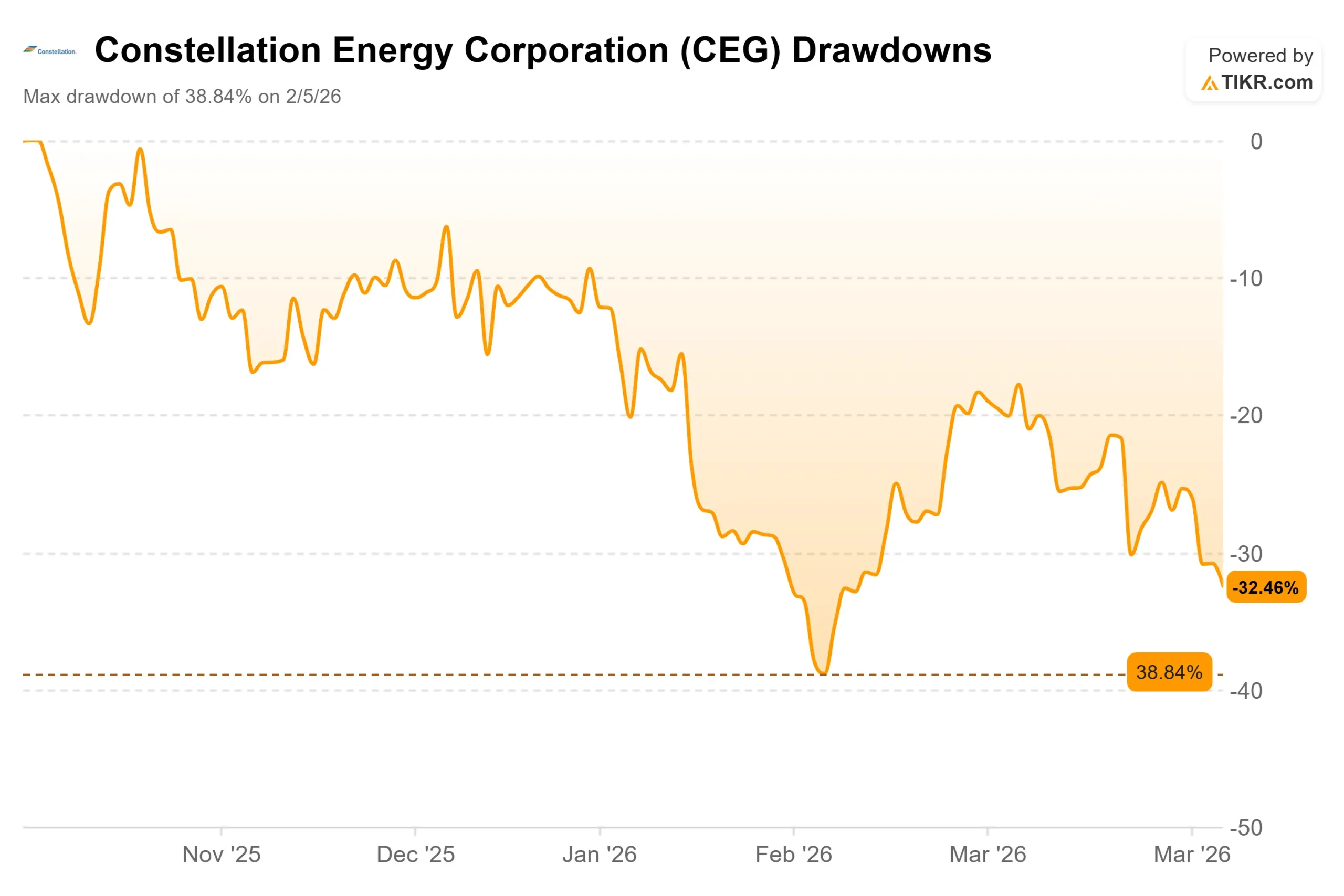
Constellation Energy (CEG) hit a 52-week high of $412.70 in October 2025, then spent the following months giving most of it back. By April 2, 2026, it closed at $272.82, a nearly 34% decline.
This week’s guidance call was supposed to be the reset. Instead, it became another leg down.
On March 31, Constellation hosted its 2026 Business and Earnings Outlook, the first major investor update since closing its $16.4 billion acquisition of Calpine Corporation in January.
Shares fell more than 5% on April 1 as investors digested guidance that, while technically in line with targets, failed to clear the bar set by the market’s AI-utility fever.
The company initiated 2026 adjusted operating earnings guidance of $11.00 to $12.00 per share, missing the average analyst estimate of $11.72. Markets had also been waiting for a new hyperscaler contract. None came.
CEO Joe Dominguez explained the delay directly on the call.
He cited two reasons: a preference to announce data center deals with community stakeholders present rather than on an earnings call, and the need to renegotiate power purchase agreement terms after hyperscalers revised their pledges following President Trump’s executive order on AI infrastructure.
On demand, he was unambiguous: “The growth we’re seeing is like nothing we’ve seen before.” He also noted that combined-cycle gas replacement costs have risen to roughly $3,000 per kilowatt, making Constellation’s existing fleet harder to replicate than ever.
See historical and forward estimates for Constellation Energy stock (It’s free!) >>>
Is Constellation Energy Undervalued Today?
The drawdown has brought CEG’s valuation back to a more defensible range.
At $272.82, it trades at 23.54x forward earnings, above the electric utilities peer mean of 19.33x. NextEra Energy trades at 23.21x, Duke Energy at 19.73x, and Southern Company at 21.34x, per TIKR’s Competitors page.
On NTM EV/EBITDA, however, CEG at 11.66x now trades nearly in line with the peer mean of 11.78x, compressed sharply from 20.52x in mid-2025 when AI-utility enthusiasm was at its peak.
For a company targeting 20% compounded base EPS growth through 2029, that compression is the core of the current setup.
After the Calpine acquisition, Constellation is now the largest private-sector power producer in the world, with approximately 55 gigawatts of capacity, roughly two-thirds of it carbon-free.
More important than the scale is what remains uncontracted: approximately 147 million megawatt hours of clean, firm nuclear generation still available for long-term deals in 2030.
As Dominguez noted on the call, the total available nuclear capacity of all other U.S. competitive market participants combined would be roughly half that amount. That asset sits at the center of AI infrastructure demand, and there is no near-term substitute for it.
CFO Shane Smith outlined $13.6 billion in deployable capital over 2026 and 2027, across $3.9 billion in growth projects delivering at least 10% unlevered returns, $3.4 billion to pay down Calpine debt, a $5 billion share repurchase authorization, and dividends growing at 10% per year.
None of the 20% base EPS CAGR through 2029 assumes any buyback benefit. That is upside-down on top of the organic trajectory.
The nuclear Production Tax Credit (PTC), a government-backed price floor under the Inflation Reduction Act, adds further protection.
Smith noted that a 100 basis point rise above the 2% inflation assumption embedded in guidance would add approximately 100 basis points to base EPS CAGR through 2029, a direct benefit from the same macro environment that pressures most equities.
Integration of $16.4 billion in acquired assets carries execution risk.
The DOJ-mandated divestiture of approximately 4.4 gigawatts of gas generation to LS Power for $5 billion removed two high-efficiency stations that management acknowledged as meaningful earnings contributors.
Purchase accounting depreciation from marking Calpine’s assets to current fair value is creating a non-cash drag. UBS flagged a share lockup overhang, with 50 million shares from the Calpine transaction set to expire in phases in June 2026 and June 2027.
Until FERC delivers clarity on PJM’s large-load rules, with PJM’s filing due April 10 and a ruling expected roughly 60 days after, new hyperscaler contracts will remain in negotiation rather than announced.

See how Constellation Energy performs against its peers in TIKR (It’s free!) >>>
TIKR Advanced Model Analysis
- Current Price: $272.82
- Target Price (Mid): $484.41
- Potential Total Return: +77.6%
- Annualized IRR: 12.80% / year
See analysts’ growth forecasts and price targets for Constellation Energy stock (It’s free!) >>>
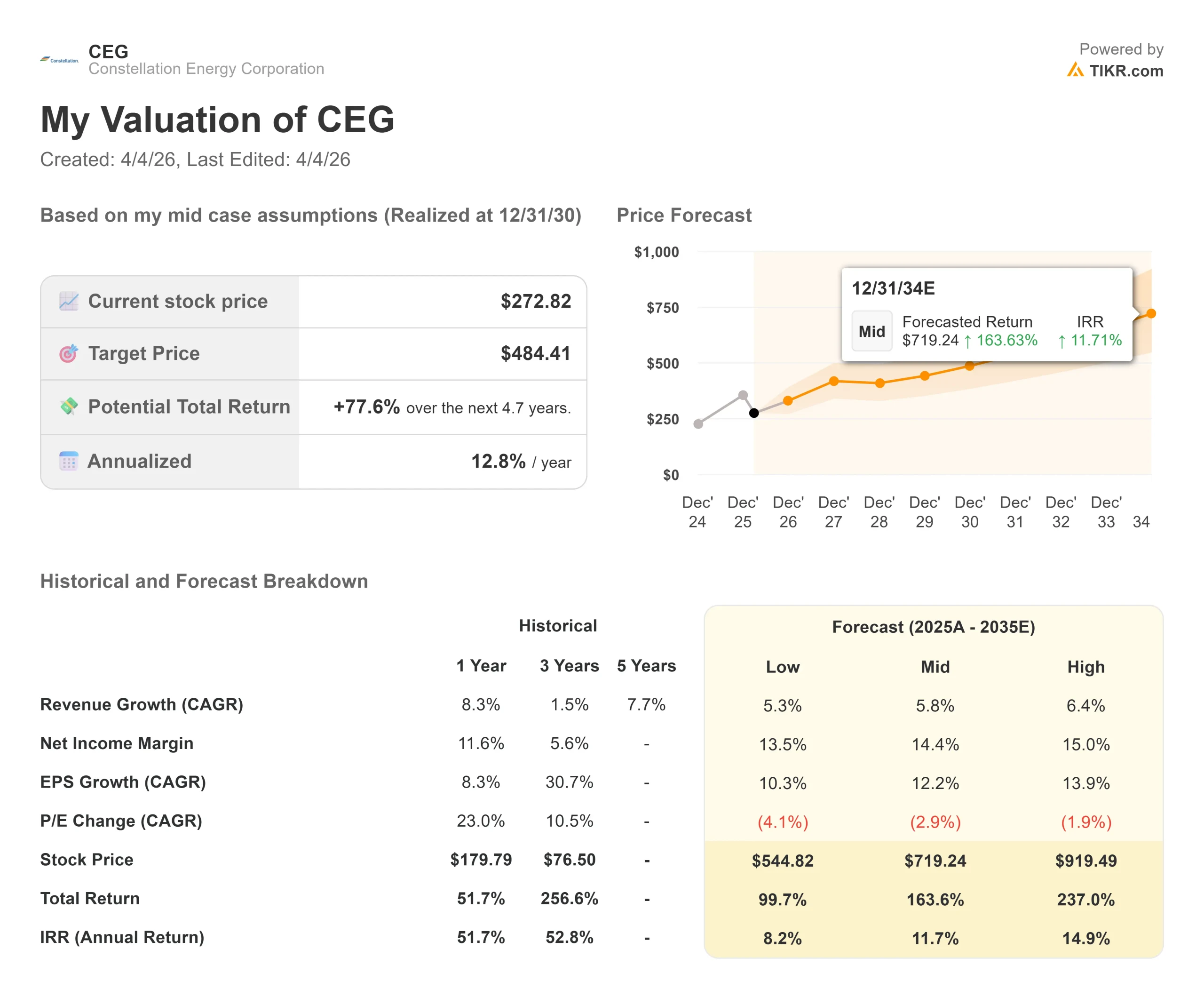
TIKR’s mid-case model prices CEG at $484.41 by 12/31/30, implying a +77.6% total return and 12.80% annualized IRR from today’s price. The model assumes 5.8% revenue CAGR, driven by newly contracted nuclear and gas output flowing into earnings from 2027 through 2029, and the full commercial contribution of Calpine’s platform as it gains access to Constellation’s investment-grade balance sheet. Net income margins reach 14.4% in the mid-case as fixed nuclear costs are spread across a larger contracted revenue base. The primary risk to the model is regulatory delay, pushing premium-priced hyperscaler contracts further into the period.
The high case prices CEG at $919.49, a +237.0% total return, requiring 6.4% revenue growth and 15.0% net income margins. That scenario is plausible if several large hyperscaler contracts lock in above-PTC pricing across a meaningful share of the 147 million MWh open position. The low case at $544.82 still implies a +99.7% return from current levels, reflecting the structural floor the PTC provides. All three scenarios price CEG materially above today, which explains why the Street maintains a Buy consensus with a mean target of $375.82, roughly 38% above the current price, even after this week’s target cuts.
Conclusion: Watch the Q1 2026 earnings report on May 7, 2026. If the quarter comes in on pace and management reaffirms the $11.00 to $12.00 full-year guidance range, the Calpine integration overhang begins to clear. The FERC PJM ruling and a new hyperscaler contract announcement each resolve on their own timelines, but a clean Q1 removes the question investors most directly control right now.
Constellation is not a cheap stock by traditional utility standards, and it was never meant to be. The 34% drawdown from its peak was driven by expectations that outran even a very strong business. The business has not changed.
See what stocks billionaire investors are buying so you can follow the smart money with TIKR.
Should You Invest in Constellation Energy?
The only way to really know is to look at the numbers yourself. TIKR gives you free access to the same institutional-quality financial data that professional analysts use to answer exactly that question.
Pull up Constellation Energy, and you’ll see years of historical financials, what Wall Street analysts expect for revenue and earnings in the quarters ahead, how valuation multiples have moved over time, and whether price targets are trending up or down.
You can build a free watchlist to track Constellation Energy alongside every other stock on your radar. No credit card required. Just the data you need to decide for yourself.
Analyze Constellation Energy on TIKR Free →
Looking for New Opportunities?
- See what stocks billionaire investors are buying so you can follow the smart money.
- Analyze stocks in as little as 5 minutes with TIKR’s all-in-one, easy-to-use platform.
- The more rocks you overturn… the more opportunities you’ll uncover. Search 100K+ global stocks, global top investor holdings, and more with TIKR.
Disclaimer:
Please note that the articles on TIKR are not intended to serve as investment or financial advice from TIKR or our content team, nor are they recommendations to buy or sell any stocks. We create our content based on TIKR Terminal’s investment data and analysts’ estimates. Our analysis might not include recent company news or important updates. TIKR has no position in any stocks mentioned. Thank you for reading, and happy investing!