


Key Stats
- Current Price: ~$27 (May 6, 2026)
- Q1 2026 Revenue: $14.5B, up 5% YoY
- Q1 2026 Adjusted EPS: $0.75, down 18% YoY (from $0.92 in Q1 2025)
- Full-Year 2026 Revenue Guidance: $59.5B to $62.5B (reaffirmed)
- Full-Year 2026 Adjusted EPS Guidance: $2.80 to $3.00 (reaffirmed)
- TIKR Model Price Target: $29 (mid case)
- Implied Upside: ~8% from current price
What Happened?
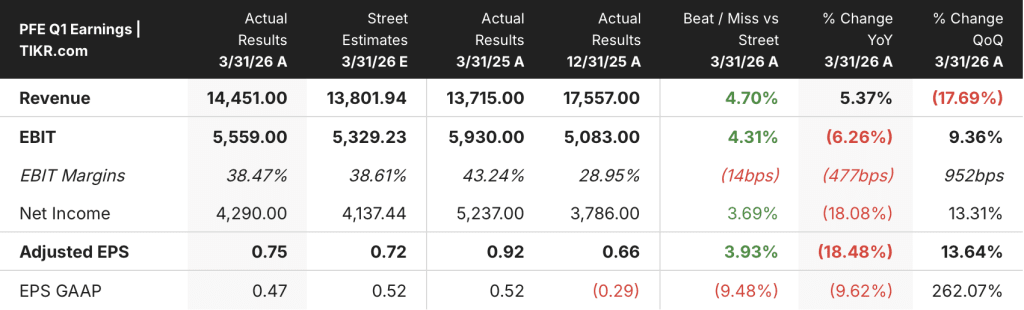
Pfizer stock (PFE) beat on both the top and bottom lines in Q1 2026, with revenue of $14.5B surpassing expectations and adjusted EPS of $0.75 coming in above consensus.
Excluding COVID products, the underlying business grew approximately 7% operationally, according to CFO Dave Denton on the Q1 2026 earnings call.
The launch and acquired product portfolio was the quarter’s clearest momentum driver, generating $3.1B in revenue and growing 22% operationally.
Padcev led oncology gains, with Seagen products collectively posting 20% operational revenue growth year over year.
Nurtec delivered 41% operational revenue growth in the quarter, driven by demand across both acute and preventive migraine treatment, according to CEO Albert Bourla on the Q1 2026 earnings call.
Adjusted operating margin came in at 38%, above pre-pandemic levels, reflecting disciplined cost management even as adjusted R&D expenses rose 11% operationally due to oncology and obesity program spending.
The Vyndamax patent settlement was flagged as a material positive: Bourla stated the agreement creates a clear line of sight to high single-digit revenue CAGR for a five-year period beginning in 2029.
A Belgian court ruling related to EU Comirnaty contracts was also cited as a tailwind, with management noting it improves post-2028 EPS and cash flow visibility.
Pfizer reaffirmed full-year 2026 revenue guidance of $59.5B to $62.5B and adjusted EPS guidance of $2.80 to $3.00.
Denton noted the company would likely have raised guidance absent the back-half weighting of its COVID franchise, and that the guidance as reaffirmed should be viewed as derisked.
Pfizer returned $2.4B to shareholders through its quarterly dividend in Q1 and invested $2.5B in internal R&D.
Pfizer Stock Financials
Pfizer stock’s income statement tells a margin recovery story, with operating leverage rebuilding off a compressed Q4 2024 trough even as year-over-year comparisons remain challenged.

Revenue followed a clear seasonal pattern across the past eight quarters: peaking at $17.8B in Q4 2024, dropping to $13.7B in Q1 2025, recovering to $16.7B by Q3 2025, then pulling back again to $14.5B in Q1 2026.
The Q1 2026 figure represents 5% YoY growth over the $13.7B posted in Q1 2025, confirming the underlying business is growing through the seasonal trough even as the LOE cycle weighs on the annual trajectory.
Gross margin came in at 76% in Q1 2026, consistent with Q2 and Q3 2025 levels of 76%, and recovering from the 71% registered in Q4 2025.
The sequential recovery came despite higher accrued royalty expense in the quarter, which Denton noted dampened gross margin relative to Q1 2025’s 81%.
Operating income reached $4.57B in Q1 2026, rising from $4.20B in Q4 2025, though it remained below the $4.82B posted in Q1 2025.
Operating margin expanded to 32% in Q1 2026 from 24% in Q4 2025, though it contracted from the 35% posted in Q1 2025, reflecting ongoing year-over-year headwinds from the LOE cycle.
Denton attributed operating expense discipline to lower marketing and promotional spend and ongoing productivity improvements, with the company tracking toward $7.2B in total net cost savings by year-end 2026.
What Does the Valuation Model Say?
The TIKR model values Pfizer stock at $28.54 under the mid case, implying approximately 8% upside from the current price of ~$27 over a 4.6-year horizon.
The mid-case assumptions embed a revenue CAGR of negative 1.5% through 2035 and a net income margin of 24%, reflecting the weight of near-term LOE headwinds before the post-2028 pipeline drives recovery.

Q1’s execution reinforces that the bridge strategy is working: launched and acquired products are growing at 22%, providing real offset to the incoming LOE wave.
The Vyndamax settlement materially reduces downside risk to the valuation by extending exclusivity on a product generating over $6B annually, according to Bourla’s remarks on the Q1 2026 earnings call, and the Belgian court outcome improves cash flow clarity past 2028.
At current prices, Pfizer stock does not price in a successful pipeline execution through 2029: the IRR of 3.9% per year in the mid case reflects skepticism about the transition, not optimism.
The real tension this report creates is whether the 2029 recovery thesis is now credible enough to hold the stock through three more years of LOE pressure.
Near-Term (Through 2028)
- Launched and acquired products generated $3.1B in Q1 alone, on pace for over $12B annualized, providing concrete offset to the $14B to $15B LOE impact Bourla quantified on the call
- Adjusted operating margin of 38% in Q1 exceeded pre-pandemic levels, signaling the cost structure can hold even as revenue comes under LOE pressure
- Full-year 2026 adjusted EPS guidance of $2.80 to $3.00 was reaffirmed and effectively derisked by COVID back-half weighting, leaving limited downside to the near-term number
Long-Term (2029 and Beyond)
- The Vyndamax settlement adds approximately 2.5 years of additional exclusivity to a $6B-plus product, shifting the LOE impact from $17B to an estimated $14B to $15B and extending the post-2028 CAGR runway
- The obesity portfolio targets a first approval in 2028, with VESPER-3 data to be presented at ADA and 10 planned Phase III studies this year, seeding a multi-billion dollar growth driver the TIKR model does not yet value
- Bladder cancer and multiple myeloma data readouts in 2026 for Padcev and Elrexfio represent the next near-term catalysts for the oncology franchise, which currently drives the majority of launch product growth.
Should You Invest in Pfizer Inc.?
The only way to really know is to look at the numbers yourself. TIKR gives you free access to the same institutional-quality financial data that professional analysts use to answer exactly that question.
Pull up Pfizer stock and you’ll see years of historical financials, what Wall Street analysts expect for revenue and earnings in the quarters ahead, how valuation multiples have moved over time, and whether price targets are trending up or down.
You can build a free watchlist to track Pfizer Inc. alongside every other stock on your radar. No credit card required. Just the data you need to decide for yourself.
Access Professional Tools to Analyze PFE stock on TIKR for Free →


