


Key Stats for Dominion Stock
- Past week’s performance: Consolidating
- 52-week range: $56 to $73
- Valuation model target price: $79
- Implied upside: 11.4% over 2.4 years
See how the NextEra merger changes Dominion’s fair value (Free with TIKR) >>>
A Stock Frozen by Deal Math
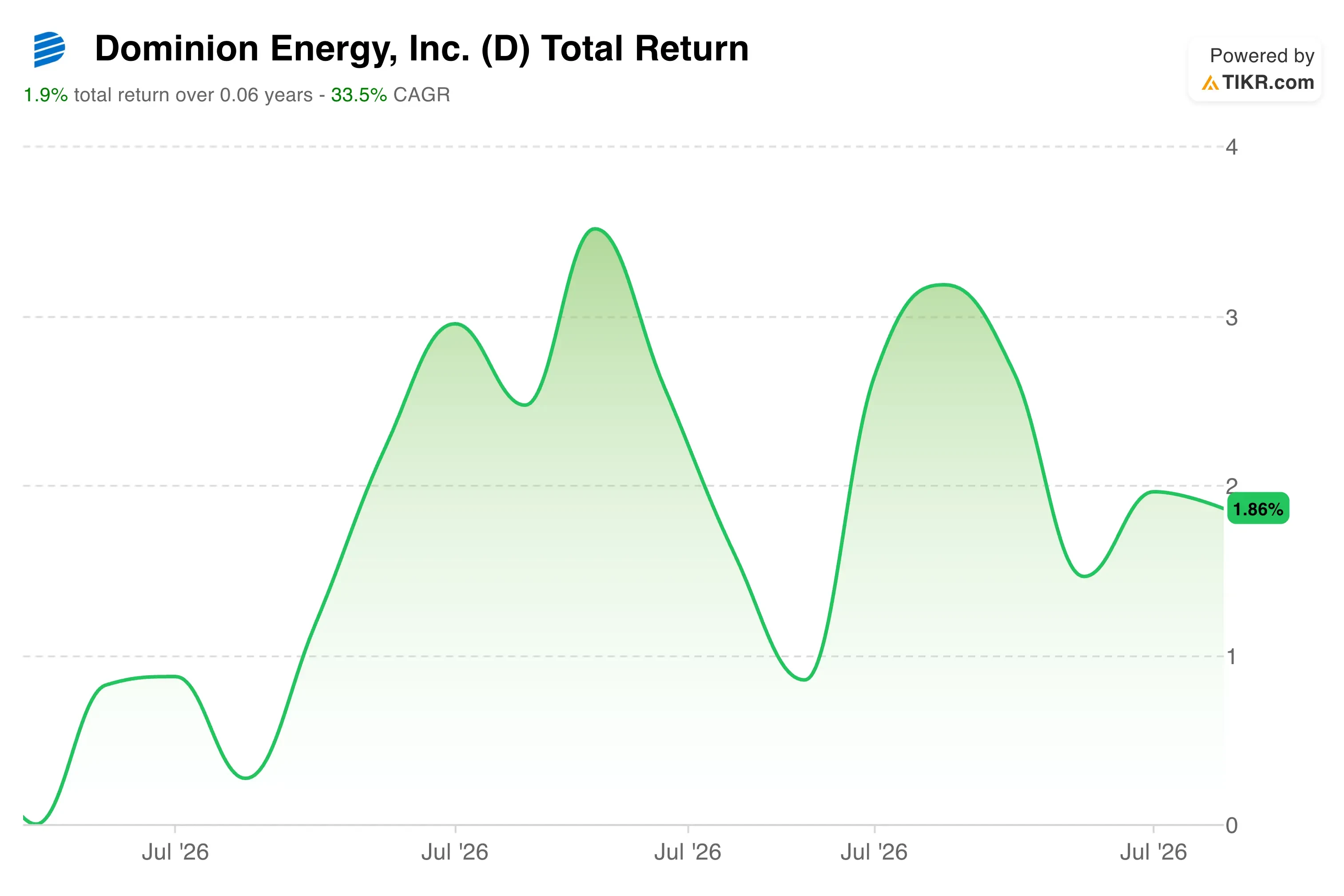
Dominion Energy (D) has barely moved this week, slipping less than 1%, and that stillness is itself the story. Since NextEra Energy agreed in May to buy Dominion in an all-stock deal worth $66.8 billion, the stock has traded largely in line with deal-arbitrage math rather than its own fundamentals. Investors are essentially pricing in the odds of regulatory approval.
Those odds got more complicated this week. Dominion and NextEra formally filed merger applications with regulators in Virginia, North Carolina, and South Carolina, starting a 180-day review clock in Virginia. But U.S. Sen. Angus King of Maine has separately urged the Federal Energy Regulatory Commission to reject the deal, arguing it would concentrate too much power generation and transmission in one company’s hands.
NextEra Chairman and CEO John Ketchum has defended the combination as a way to strengthen Dominion’s ability to meet surging power demand. “This combination is about putting scale and a stronger, more comprehensive platform behind Dominion Energy’s local teams so they can meet growing power demand while keeping bills affordable and service reliable,” he said. As part of the deal, the companies will fund $2.25 billion in bill credits for customers in Dominion’s territory.
Dominion serves the largest concentration of data centers in the world, which is why AI-driven power demand sits at the center of the merger’s rationale. If the deal clears regulatory review, the combined company would become the largest regulated electric utility on the planet. Going forward, the stock’s near-term direction depends far more on FERC and state regulators than on Dominion’s own operating results.
Track how deal risk is affecting Dominion’s price target (It’s free) >>>
Standalone Value Inside a Merger-Arbitrage Trade

Under valuation model assumptions realized through 12/31/28, the stock is modeled using:
- Revenue Growth (CAGR): 7.6%
- Operating Margins: 34.5%
- Exit P/E Multiple: 17.0x
Based on these inputs, the model estimates a target price of $79, implying 11.4% upside and a 4.5% annualized return by the end of 2028.
Dominion’s standalone valuation model points to modest upside, but that framework doesn’t fully capture how the stock will actually trade if the NextEra merger closes. Because the deal is an all-stock transaction, Dominion shares are likely to move in tandem with NextEra’s valuation until the deal closes or fails.
The under 5% annualized return implied by the standalone model reflects a company facing real headwinds of its own, including a net debt-to-EBITDA ratio above 6x and 10-year revenue growth of just 3.5%. That’s part of why Dominion’s board was willing to entertain the merger in the first place, since NextEra’s scale could help fund the capital-intensive buildout data centers require.

This is best understood as a capital-return and deal-risk story rather than a pure growth story. Dominion’s dividend yield near 3.8% offers some downside cushion while the merger review unfolds. However, the stock’s upside is effectively capped near the implied deal value unless NextEra’s shares rally.
Given the binary nature of this situation, the most useful visual is a total-return chart showing Dominion’s stock price against the implied deal value since the May announcement. This illustrates how closely the two have tracked as arbitrage investors price in approval odds.
Model Dominion’s standalone value versus the deal price yourself (It’s free) >>>
Dominion vs. NextEra and Duke: Scale, Margins, and Debt
NextEra Energy (NEE) is the obvious comparison here, given the pending merger, and it already ranks among the largest power companies in the U.S. by market capitalization. NextEra’s forward two-year revenue growth is driven heavily by its renewable energy development arm, a business line Dominion largely lacks on a standalone basis. This helps explain why NextEra typically commands a premium valuation versus Dominion’s own modeled 7.6% revenue CAGR.

Among peers not involved in mega-mergers, Duke Energy (DUK) offers a cleaner read on how regulated utilities with heavy data-center exposure are being valued. Dominion’s operating margin of roughly 31.6% on an LTM basis trails Duke’s, which has typically run in the mid-20% to high-20% range in recent years, not the mid-30% range. This gap reflects Dominion’s higher debt load from funding offshore wind and nuclear projects.
The regulatory scrutiny facing this deal also sets Dominion apart from typical utility M&A. Sen. King’s objection specifically cites NextEra’s past efforts to block a competing transmission project in New England, arguing the combined company could use its scale to suppress competition elsewhere. That history gives the Dominion deal a harder path than a typical utility merger might otherwise face.
See the earnings and regulatory catalysts that could re-rate D shares >>>
What’s Driving Dominion Energy Stock Going Forward?
The single biggest catalyst is the outcome of the regulatory review process now underway in Virginia, North Carolina, and South Carolina, alongside the separate FERC review where Sen. King has requested rejection. Any signal about the likely timeline or outcome could move Dominion shares sharply in either direction.
Dominion’s own quarterly results remain a secondary factor while the deal is pending. The company is scheduled to report second-quarter results shortly, and while operating performance still matters for the standalone valuation model, most investors will focus more on merger commentary than on the underlying numbers themselves.
Longer term, AI-driven data-center demand underpinning the merger won’t fade, regardless of the deal’s outcome. Dominion’s territory remains the U.S. data-center construction hub, preserving its core growth story whether the NextEra deal closes or not.
Estimate a company’s fair value instantly (Free with TIKR) >>>
Should You Invest in Dominion Energy?
The only way to really know is to look at the numbers yourself. TIKR gives you free access to the same institutional-quality financial data that professional analysts use to answer exactly that question.
Pull up D, and you’ll see years of historical financials, what Wall Street analysts expect for revenue and earnings in the quarters ahead, how valuation multiples have moved over time, and whether price targets are trending up or down.
You can build a free watchlist to track D alongside every other stock on your radar. No credit card required. Just the data you need to decide for yourself.
Disclaimer:
Please note that the articles on TIKR are not intended to serve as investment or financial advice from TIKR or our content team, nor are they recommendations to buy or sell any stocks. We create our content based on TIKR Terminal’s investment data and analysts’ estimates. Our analysis might not include recent company news or important updates. TIKR has no position in any stocks mentioned. Thank you for reading, and happy investing!


