Key Stats for Cadence Stock
- Current Price: $322.00
- Target Price (Mid): ~$509
- Street Target (Mean): ~$403
- Potential Total Return: ~58%
- Annualized IRR: ~11% / year
Now Live: Discover how much upside your favorite stocks could have using TIKR’s new Valuation Model (It’s free) >>>
What Happened?
Cadence Design Systems (CDNS) launched an AI agent on September 22 that it says writes better chip code than a general-purpose AI model. In Cadence’s early evaluations, its RTL Generation Agent, which writes the code describing a chip’s logic, produced designs averaging 24% less area and 18% less power than code generated by a foundation model alone.
Shares rose 2.61% to $302.60 on launch day, after gaining 4.24% the session before. They added 4.18% to $322.00 on September 24, a day Synopsys also rose on an analyst upgrade, though no single catalyst was reported for Cadence’s move. The run recovered about a third of a drawdown that hit 34.21% below the June record on September 15, after the July Kimi K3 scare and a September 1 software selloff as bond yields rose.
Cadence’s 24% Claim Lands Six Months After Synopsys Launched Its Own Spec-to-RTL Agent
Synopsys unveiled an AgentEngineer workflow that generates chip code from natural-language specifications in March 2026, reporting 2x productivity gains for customers and up to 5x in select cases. Futurum Research Director Brendan Burke frames the difference as Cadence claiming quantified area and power results, where Synopsys emphasizes productivity.
Those results are Cadence’s own. It ran the evaluations and did not name the foundation models it compared against, and Honda R&D is still evaluating the agent on automotive chips. The test also measures a different threat than July’s: Kimi K3 paired an AI model with open-source design tools, while Cadence scored its agent against a model writing code on its own.
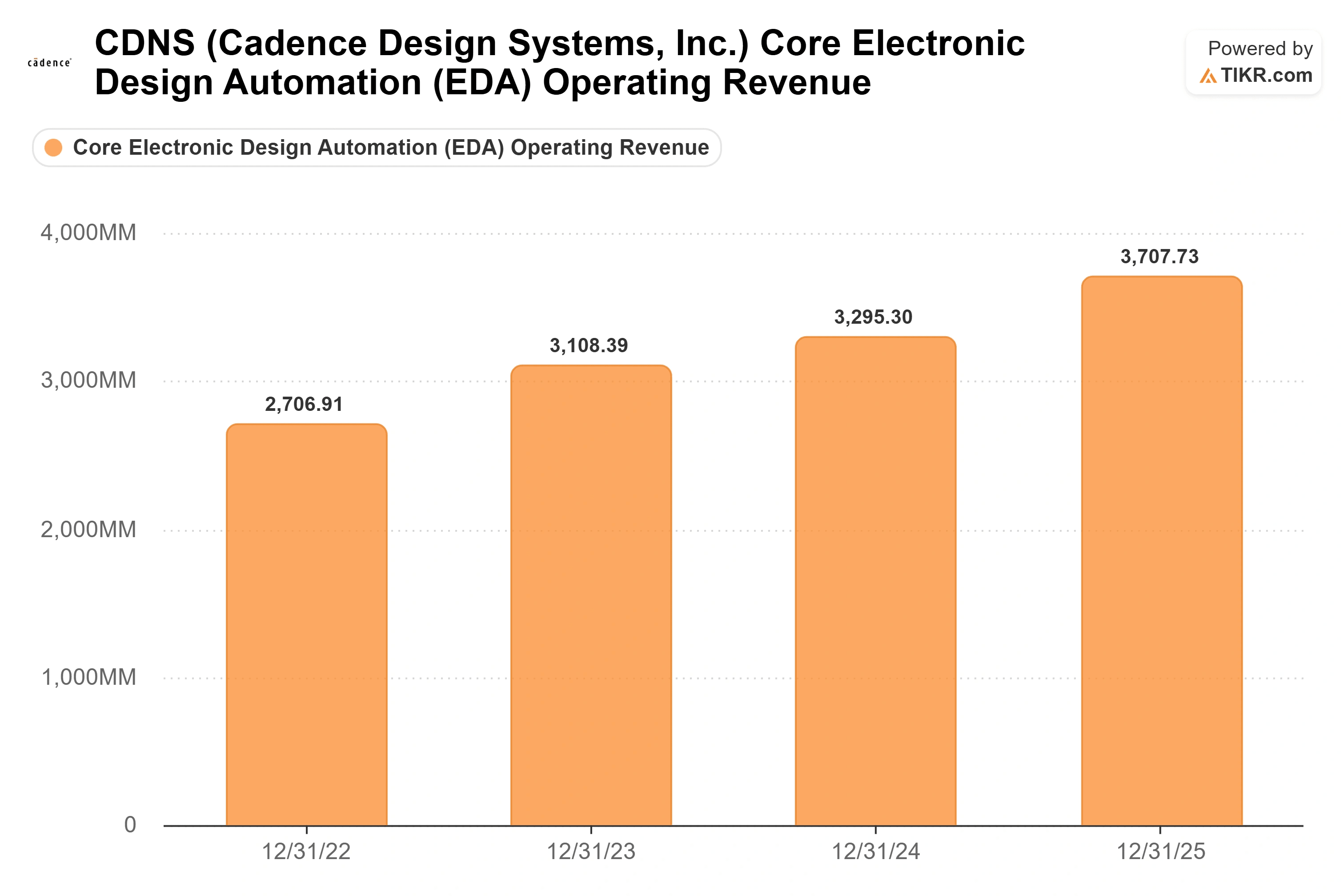
See historical and forward estimates for Cadence stock (It’s free!) >>>
Devgan Conceded Customers Can Write Their Own Agents. Those Agents Still Call Cadence’s Tools
At the Goldman Sachs Communacopia + Technology Conference on September 9, Goldman analyst Jim Schneider asked CEO Anirudh Devgan why customers couldn’t pair another vendor’s AI agents with Cadence’s engines. Devgan said “some customers are writing some agents that call our tools and not use our agents. That could happen,” and added that “we don’t need to get 100% of that market.”
That puts the risk on the new agent revenue more than on the core business. Customer-built agents still call Cadence’s engines, and Devgan said an agent “runs, like, 100 experiments” where a human typically runs three or four at a time. He also pointed to history: a CPU took 5 years and 500 people to design in the late 1990s or early 2000s, while “now you can design a CPU with 30, 40 people within 6 months,” and design activity has kept rising.
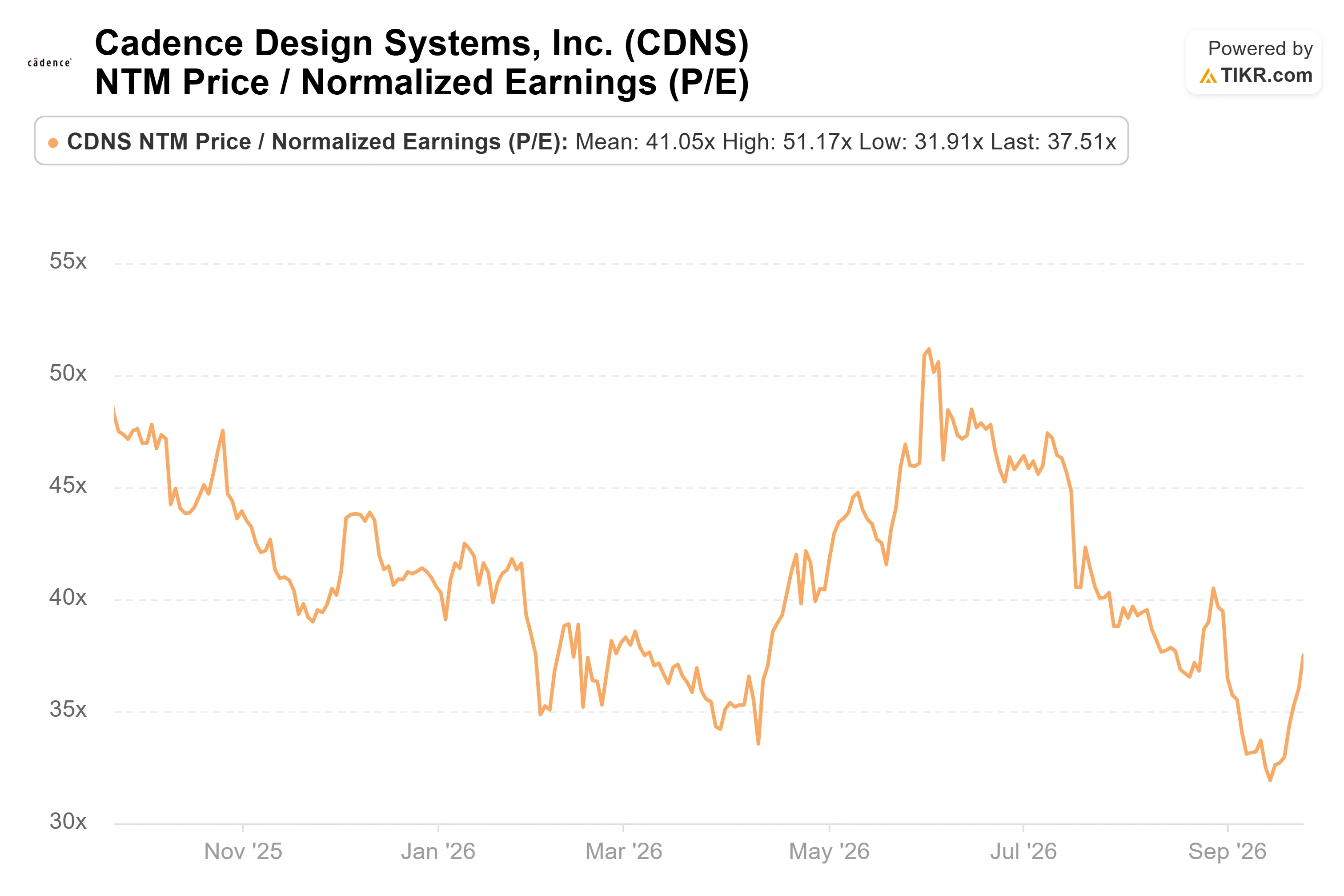
Cadence’s second quarter brought 24.23% revenue growth, a record $8.1 billion backlog, and a raised 19% growth outlook for 2026. Its forward P/E ratio sits at 37.5x, down from about 46x on June 30, against 25.1x for Synopsys and 15.5x for Dassault Systèmes. That premium holds only if agents add revenue on top of a core that customer-built agents also use.
See how Cadence performs against its peers in TIKR (It’s free!) >>>
TIKR Advanced Model Analysis
- Current Price: $322.00
- Target Price (Mid): ~$509
- Potential Total Return: ~58%
- Annualized IRR: ~11% / year

See analysts’ growth forecasts and price targets for Cadence stock (It’s free!) >>>
This uses TIKR’s mid case realized on December 31, 2030. It assumes revenue compounds around 8% a year from 2025 through 2035 with net margins near 38%. Consensus for the shorter 2025 to 2030 span implies about 12% a year, though only two analysts forecast 2030.
Hitting that growth rests on hardware demand, which Devgan said scales with chip size, plus any usage-based revenue Cadence’s agents add. Operating leverage drives margins: consensus normalized net margin rises to around 38% in 2028 before the 2029 and 2030 estimates dip to around 35%. The primary risk is that customer-built agents keep the new revenue layer small while the multiple keep compressing.
If agent revenue lands on top of the core, around 8% growth would prove conservative. Over the model’s full forecast window, the low case reaches about $486 (around 5% a year), compared with about $622 in the mid case.
Conclusion
Synopsys hosts its September 30 investor day first, and any agent pricing or quantified results it shows will set the bar Cadence must clear. Cadence’s third-quarter report follows, expected October 26 after the close, against guidance of $1.595 billion to $1.625 billion and consensus near $1.61 billion.
Revenue above $1.625 billion, backlog above $8.1 billion, and a first disclosed figure for agent revenue or customers would show the benchmark turning into dollars. A print near $1.61 billion with no agent numbers would leave the 37.5x multiple resting on Devgan’s argument.
See what stocks billionaire investors are buying so you can follow the smart money with TIKR.
Should You Invest in Cadence?
The only way to really know is to look at the numbers yourself. TIKR gives you free access to the same institutional-quality financial data that professional analysts use to answer exactly that question.
Pull up Cadence, and you’ll see years of historical financials, what Wall Street analysts expect for revenue and earnings in the quarters ahead, how valuation multiples have moved over time, and whether price targets are trending up or down.
You can build a free watchlist to track Cadence alongside every other stock on your radar. No credit card required. Just the data you need to decide for yourself.
Analyze Cadence on TIKR Free →
Looking for New Opportunities?
- See what stocks billionaire investors are buying so you can follow the smart money.
- Analyze stocks in as little as 5 minutes with TIKR’s all-in-one, easy-to-use platform.
- The more rocks you overturn… the more opportunities you’ll uncover. Search 100K+ global stocks, global top investor holdings, and more with TIKR.
Disclaimer:
Please note that the articles on TIKR are not intended to serve as investment or financial advice from TIKR or our content team, nor are they recommendations to buy or sell any stocks. We create our content based on TIKR Terminal’s investment data and analysts’ estimates. Our analysis might not include recent company news or important updates. TIKR has no position in any stocks mentioned. Thank you for reading, and happy investing!