Key Takeaways
- Target’s Q2 EPS more than doubled to $4.11, but $1.65 of that came from a one-time $994 million tariff refund; stripped out, EPS was still up roughly 20 to 24 percent, a real acceleration off last year’s markdown-heavy base.
- The Street believed the underlying number. In the seven weeks after the print, the mean analyst price target on Target stock jumped from $135.34 to $162.76, a 20 percent increase, and the high estimate moved from $170 to $200.
- The stock did not follow. Shares peaked near $170.73 five days after earnings, then fell 5 percent on a Halloween costume controversy that revived comparisons to 2023’s Pride Collection backlash, closing at $156.26 on September 23.
- For the first time in over a year, Target now trades at a discount to its own freshly raised consensus target, even as buy ratings held at 10 and underperform calls ticked up from 3 to 4.
Target Stock’s Quarter Was Stronger Than the Refund Made It Look
John Hulbert, Vice President of Finance and former Vice President of Investor Relations of Target, opened the Q2 2027 earnings call by announcing his own retirement after 26 years running Target’s investor relations desk, a fitting bookend for a quarter that needed a veteran’s steady hand to explain.
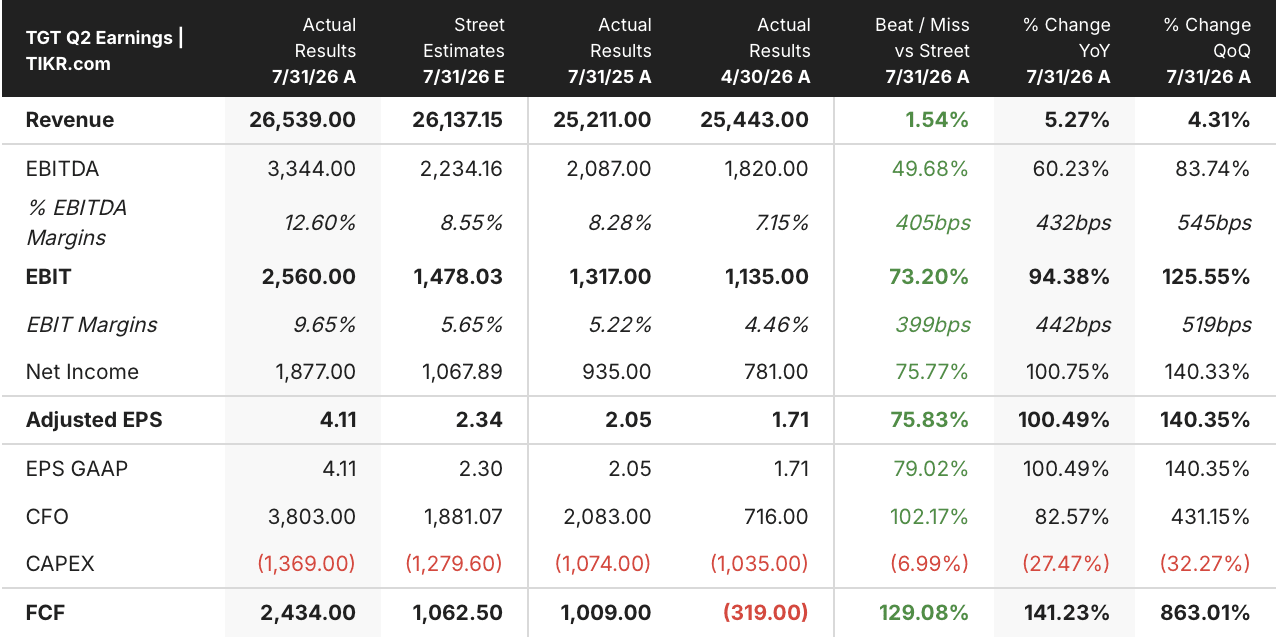
Reported EPS of $4.11 had more than doubled from $2.05 a year earlier, net sales rose 5.3 percent to $26.5 billion, and comparable sales grew 3.8 percent on a 3.6 percent jump in traffic, the best two-year trend the company had shown in over a year. But CFO Jim Lee was careful not to let the headline stand alone. The quarter included a $994 million pretax tariff refund, worth $1.65 of that $4.11 in EPS and 3.7 of the 4.7 percentage points of gross margin expansion. Lee told analysts directly that adjusted EPS excluding the refund, up roughly 20 percent in the quarter and 24 percent year to date, was “the number we probably want everyone to anchor on.”
That distinction mattered because it was the difference between a company that got a one-time check from the government and one whose merchandising reset, the largest volume of in-store transitions in a decade according to CEO Michael Fiddelke, was actually working. The Street seems to have taken Lee at his word.
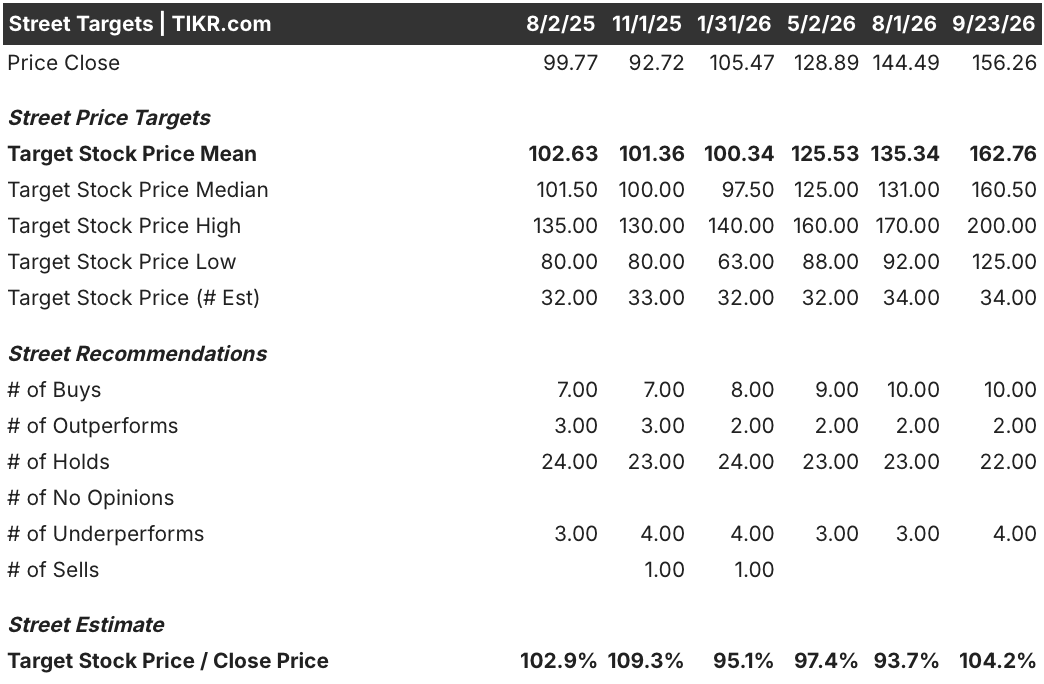
Between August 1, just before the print, and September 23, the mean price target on Target stock climbed from $135.34 to $162.76, a 20 percent jump, and the top estimate on the Street rose from $170 to $200. Buy ratings held steady at 10 through that stretch. Analysts, working with the same tariff caveat management gave them on the call, still chose to get more bullish, not less.
The Gap Between What Target Stock Is Worth and What It Trades At
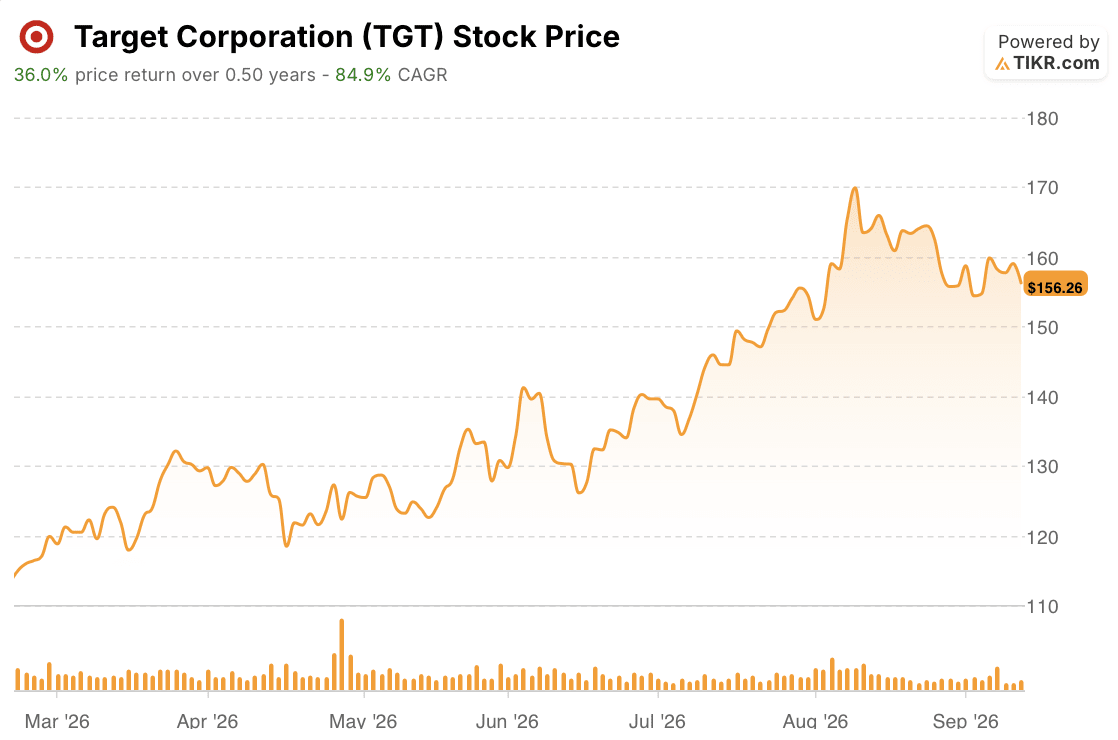
The stock did not keep pace with its own analysts. Shares ran from around $144 in early August to a near two-year high of $170.73 by August 24, riding the earnings momentum. Five days after that peak, Target apologized for and pulled a “Kids’ Glows Under Blacklight Circus Clown” Halloween costume that critics said evoked blackface, and the stock dropped 5 percent in a single session. It was the second time in three years a product controversy had cost Target real trading value, after the 2023 Pride Collection saga, and the market seemed to read it that way. By September 23, shares closed at $156.26, roughly $14 below the post-earnings high, even as the mean Street target kept climbing to $162.76. That gap, the stock trading about 4 percent below where its own newly upgraded consensus says it belongs, is new. As recently as August 1, Target traded above its mean target, not below it.
The most useful read here is that the fundamental story and the brand-trust story are now pulling in opposite directions, and neither has fully won. Home and apparel, by management’s own admission on the call, remain flat and will stay a multi-year fix into 2027. A repeat brand misstep during the holiday quarter, Target’s biggest test of the reworked Fun 101 and food resets, would give the skeptics more ammunition than a single September costume recall.
A clean Q3 print in November, the first call under incoming IR head Justin Madsen, without a fresh controversy attached to it, is what would close that four percent gap and tell whether Wall Street’s target hike or the stock’s own hesitation has the story right.
Should You Invest in Target Corporation?
The only way to really know is to look at the numbers yourself. TIKR gives you free access to the same institutional-quality financial data that professional analysts use to answer exactly that question.
Pull up TGT stock and you’ll see years of historical financials, what Wall Street analysts expect for revenue and earnings in the quarters ahead, how valuation multiples have moved over time, and whether price targets are trending up or down.
You can build a free watchlist to track Target Corporation alongside every other stock on your radar. No credit card required. Just the data you need to decide for yourself.
Access Professional Tools to Analyze TGT stock on TIKR for Free →
Looking for New Opportunities?
- See what stocks billionaire investors are buying so you can follow the smart money.
- Analyze stocks in as little as 5 minutes with TIKR’s all-in-one, easy-to-use platform.
- The more rocks you overturn… the more opportunities you’ll uncover. Search 100K+ global stocks, global top investor holdings, and more with TIKR.
Disclaimer:
Please note that the articles on TIKR are not intended to serve as investment or financial advice from TIKR or our content team, nor are they recommendations to buy or sell any stocks. We create our content based on TIKR Terminal’s investment data and analysts’ estimates. Our analysis might not include recent company news or important updates. TIKR has no position in any stocks mentioned. Thank you for reading, and happy investing!