Key Takeaways
- Chevron will raise exploration spending by roughly 50% in 2027 from a $1.5 billion budget this year, drilling about 20 exploration wells against 10 in 2024.
- Its Venezuela joint ventures plan $7 billion of gross investment to take production from 280,000 barrels per day to 600,000 by 2031, at total costs management puts under $20 a barrel.
- Free cash flow hit $18.10 billion in the second quarter of 2026 after a negative $1.55 billion first quarter, and the buyback still stayed inside its $10 billion to $20 billion range.
- Shares change hands at 5.90x NTM EV/EBITDA against a 6.07x mean, and 9.23x NTM market cap to free cash flow against an 11.27x mean, with the stock near a 52-week high of $214.71.
The Spending Turn Hiding Inside Chevron’s Efficiency Story
On September 8, at the Barclays energy conference in New York, CFO Eimear Bonner summed up Chevron’s year in six words: “bigger, better and stronger than we’ve ever been.” The stock sat within two dollars of its 52-week high of $214.71.
The case behind that line was a harvest case. Three billion dollars of structural cost reductions delivered six months early, 70% of it from efficiency rather than headcount. Hess synergies of $1.5 billion, also early. The Permian plateaued near a million barrels a day on spending heading below $3.5 billion, with full-year organic capex guided to the low end of the $18 billion to $19 billion range.
Eleven days later, the Financial Times reported something that does not fit that case. Kevin McLachlan, Chevron’s vice president of exploration, said exploration spending rises about 50% next year from this year’s $1.5 billion, with roughly 20 exploration wells plus five or six appraisal wells in 2027 against 10 in 2024.
The reason sits in the reserve base. Chevron closed 2025 with about 10.6 billion barrels of oil equivalent of proved reserves while exiting the year producing above 4 million a day, which works out to roughly seven years of output. The 158% reserve replacement ratio that year came from buying Hess, not from the drill bit.
Exploration is only part of it. Venezuela’s new fiscal terms, complete with stability clauses and international arbitration rights, cleared the way for $7 billion of gross joint venture spending aimed at 600,000 barrels a day. Iraq is in exclusive negotiation on West Qurna 2, Nasiriyah and a pipeline. Project Kilby’s 2.67 gigawatt Microsoft contract reaches a final investment decision this year.
Chevron’s $18.10 Billion Quarter Was the Down Payment
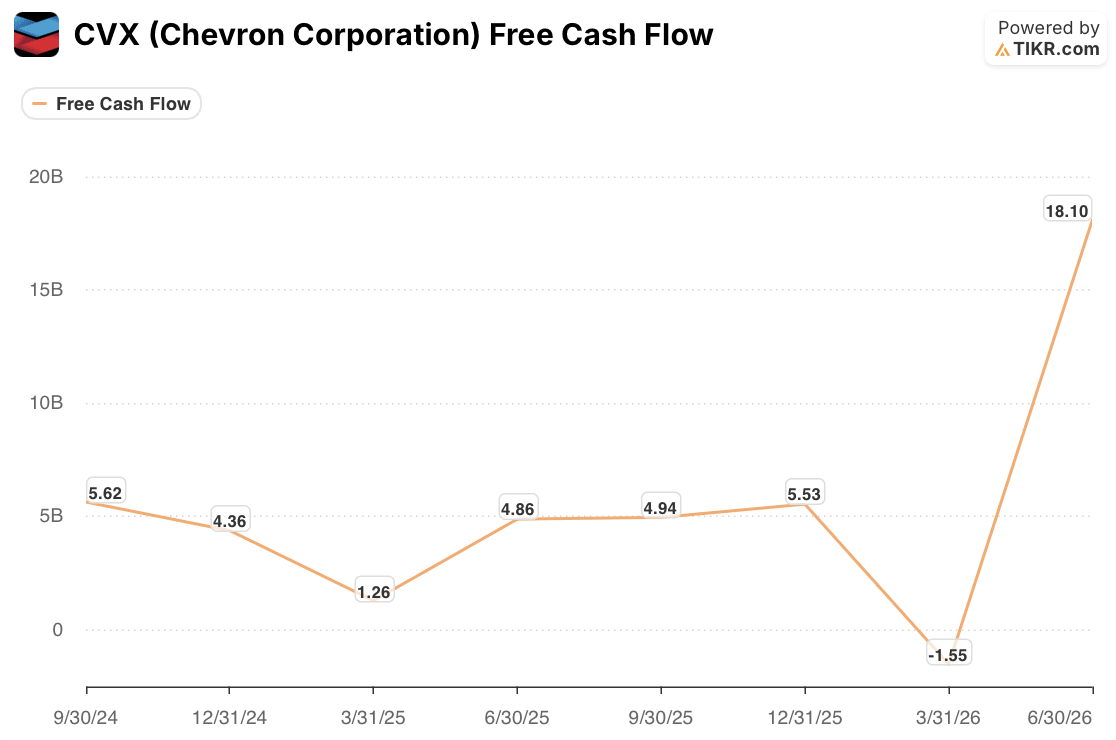
That figure is the largest in the two-year window by a factor of three, and part of it is mechanical. The first quarter carried a working capital build and timing effects the company had flagged ahead of its results, and $2.9 billion of that working capital unwound in the second. Brent above $100 after the war with Iran did the rest.
What happened to the money is the tell. Chevron retired more than $8 billion of debt in the quarter, cutting net debt to cash flow from operations to 0.6x, and left the repurchase rate where it was.
Bonner’s stated reason was price swings: “we generally don’t like to move the buyback rate during times of volatility.” She also said the surplus returns eventually, that “it’s not a matter of if, it’s a matter of when.” Both can be true, and the sequence still reads a particular way. Dividends and buybacks still took their usual share, roughly $6 billion. What was left went to lenders, six weeks before the Venezuela terms landed.
What the Market Is Actually Paying For
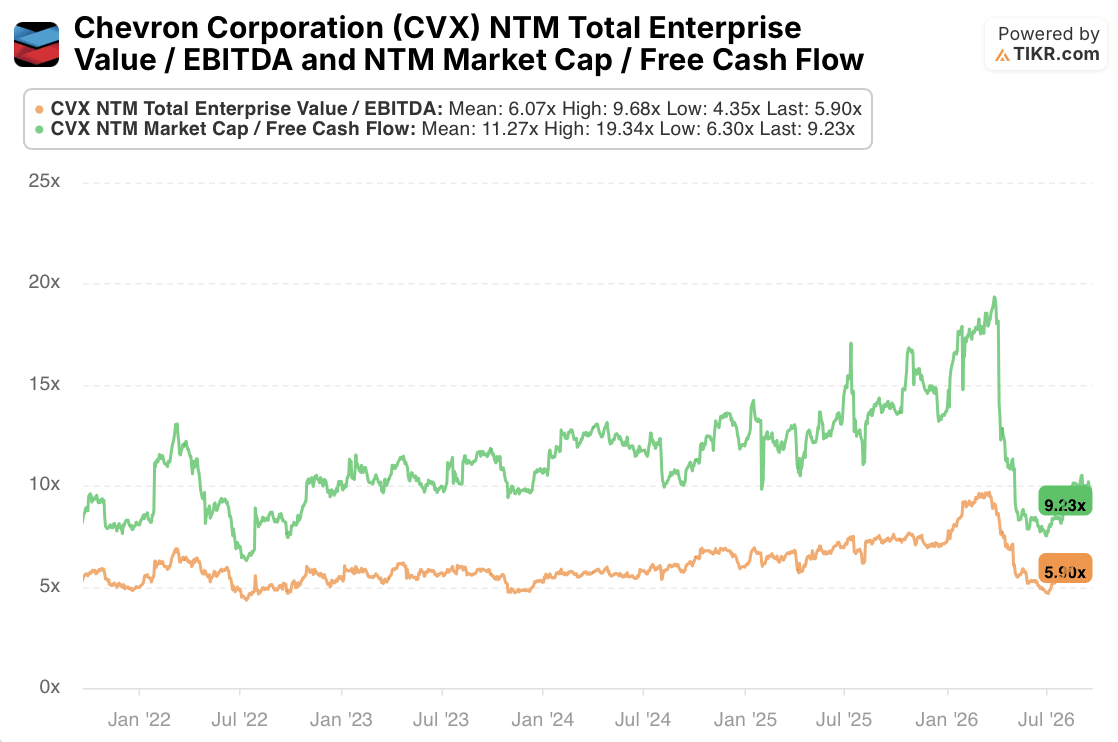
A stock two dollars off its 52-week high does not usually trade under its own averages. Chevron does. Forward denominators explain some of that, since consensus estimates rose with crude and mechanically compressed both multiples from their February peaks. What is left is a market capitalizing the barrels Chevron produces now rather than the ones it is spending to find.
That is the investment question in one line. If Venezuela ramps toward 600,000 barrels a day at sub-$20 costs and the 2027 program replaces reserves through the drill bit rather than the checkbook, today’s multiple pays for none of it. If crude normalizes while capex climbs toward the $21 billion top of the long-term range, the harvest math that earned this re-rating thins out, and those stability clauses get tested by a government that has already rewritten its own rules once this year.
Three disclosures settle more of this than any macro call: the 2027 capital budget and whether exploration lands at the guided step-up, the buyback rate as the cleanest signal of whether management still treats the cash as surplus, and Venezuela’s debt recovery completing in early 2027, which turns a 1% to 2% slice of operating cash flow into an equity-accounted growth asset carrying country risk.
Should You Invest in Chevron Corporation?
The only way to really know is to look at the numbers yourself. TIKR gives you free access to the same institutional-quality financial data that professional analysts use to answer exactly that question.
Pull up CVX stock and you’ll see years of historical financials, what Wall Street analysts expect for revenue and earnings in the quarters ahead, how valuation multiples have moved over time, and whether price targets are trending up or down.
You can build a free watchlist to track Chevron Corporation alongside every other stock on your radar. No credit card required. Just the data you need to decide for yourself.
Access Professional Tools to Analyze CVX stock on TIKR for Free →
Looking for New Opportunities?
- See what stocks billionaire investors are buying so you can follow the smart money.
- Analyze stocks in as little as 5 minutes with TIKR’s all-in-one, easy-to-use platform.
- The more rocks you overturn… the more opportunities you’ll uncover. Search 100K+ global stocks, global top investor holdings, and more with TIKR.
Disclaimer:
Please note that the articles on TIKR are not intended to serve as investment or financial advice from TIKR or our content team, nor are they recommendations to buy or sell any stocks. We create our content based on TIKR Terminal’s investment data and analysts’ estimates. Our analysis might not include recent company news or important updates. TIKR has no position in any stocks mentioned. Thank you for reading, and happy investing!