Key Takeaways
- Kyle Grieve, co-host of the We Study Billionaires podcast, puts Walmart’s intrinsic value at about $50 a share, which he says is less than half its share price.
- Walmart’s forward P/E has more than doubled from its 2017 low, while its normalized EPS rose about 80%.
- Walmart’s operating margin is 4.2%, lower than the 4.7% it earned a decade ago.
- Faster-growing ads and e-commerce are the bull case, and AI shopping agents are the main risk to both.
Walmart (WMT) stock is already about 20% off its high, and one value investor thinks it could fall much further.
On the Sept. 30 episode of We Study Billionaires, co-host Kyle Grieve said Walmart’s stock “is priced like a tech business inside of the Magnificent Seven.” Then he ran his model:
“I actually get an intrinsic value of about $50, which is less than half of the current share price.”
Ouch.
I think $50 is harsher than the facts require. But Grieve’s case against the price holds up, and here’s why…
Weigh Walmart’s premium valuation against 5 years of analyst forecasts with TIKR (It’s free) >>>
The multiple did the heavy lifting
Grieve’s co-host, Shawn O’Malley, summed up the issue by looking back to 2012:
“Basically, the market went from paying 12 times earnings to 38 times earnings for Walmart, while earnings per share growth has actually been very anemic.”
TIKR’s data over the past decade tells a similar story. Walmart’s forward P/E bottomed at 15.4x in early 2017, climbed to 46.8x in February, and now sits around 34.8x.
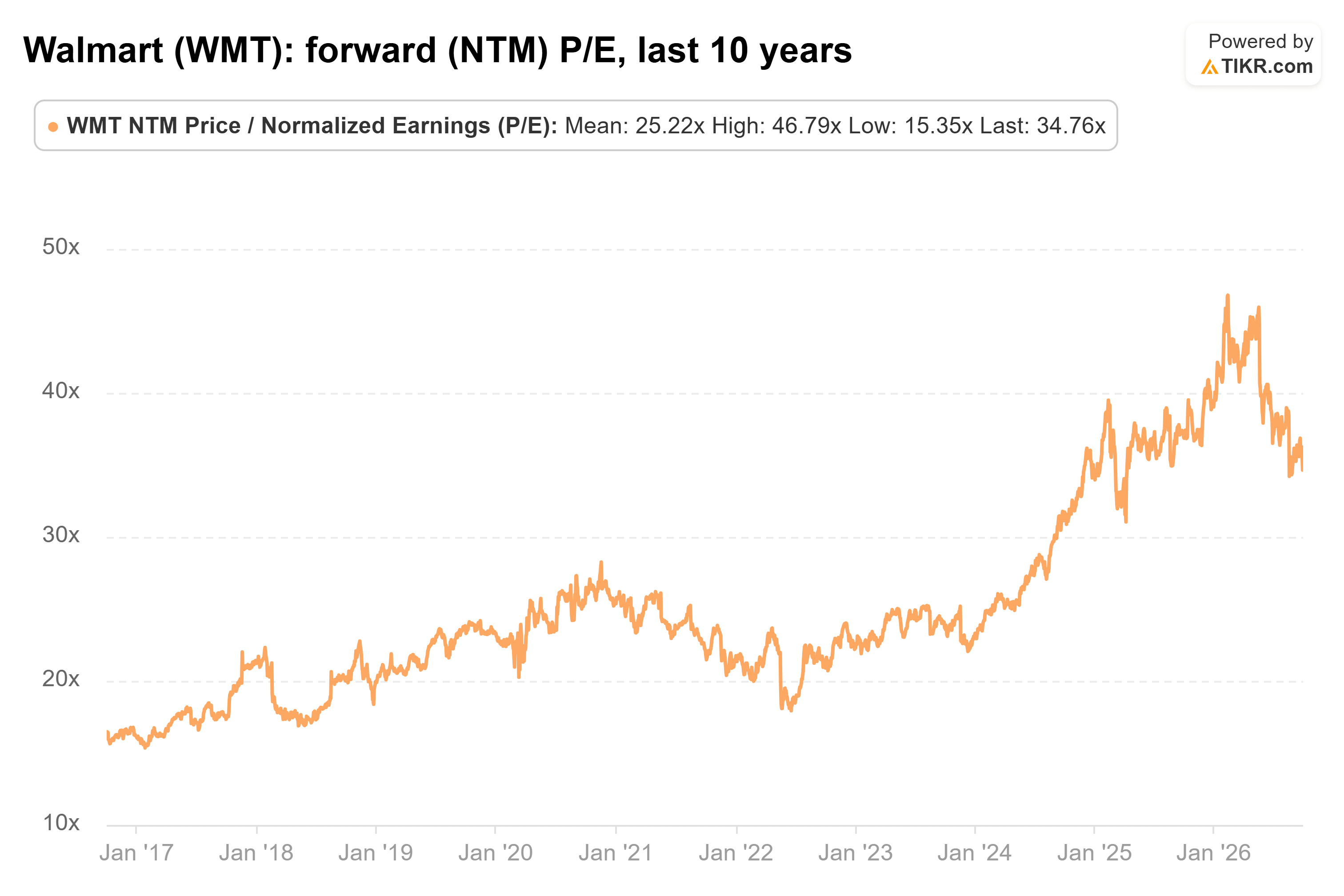
For a big-box retailer, that’s a pretty dramatic change in how the market values the stock.
Earnings didn’t keep up
Earnings have grown too, just at a slower pace. Normalized EPS increased from $1.47 at the start of the decade to $2.64 in the latest full year. Analysts now expect it to reach $2.89 this year, based on estimates from 39 analysts.

That’s steady growth, and it’s a lot kinder than calling earnings “anemic.” But it still doesn’t come close to explaining a valuation multiple that has more than doubled.
There’s another issue with paying such a high multiple: buybacks get more expensive. O’Malley’s point is that Walmart is “basically buying back stock at 30 or 40 times earnings,” which means each dollar spent buys back fewer shares than it would at a lower valuation.
Estimate a company’s fair value instantly (Free with TIKR) >>>
Scale hasn’t shown up in the margins
You’d expect a retailer of Walmart’s size to squeeze more profit out of its scale over time. Grieve points out that it hasn’t: since 2005, “operating margins are actually down from 6% to 4% today.” He suspects that years of competition, mostly from Amazon (AMZN), are part of the reason.
The last decade has been flat at best. TIKR shows an operating margin of 4.7% at the start, between 4.0% and 4.5% every year since, and 4.2% in the latest year…

Nothing on this chart shows a business getting more profitable.
How he gets to $50
Grieve’s base case rests on three inputs:
- Growth of about 5% a year, with “negligible margin expansion”
- A 20 times earnings multiple five years out
- A resulting price of about $78 a share
He then blends in his bear and bull cases and takes 15% off for a margin of safety, which brings him to about $50. Even in his bull case, before that cushion, “you’re making just a 1% return,” he said. Adding the roughly 1% dividend yield still means “you aren’t really even beating inflation.”
So $50 is a margin-of-safety number. I think his $78 is the fairer figure, and even that sits well below where the stock trades.
Here’s the thing: the bull case is exposed
The obvious counterpoint is that Walmart is becoming a different kind of business. For example, its ad business is growing 38%, while e-commerce now accounts for about a quarter of revenue and is growing around 23%. If those higher-margin businesses keep expanding, a model based on today’s 4% margin may miss what they add. TIKR recently laid out a more bullish path to $128 by 2029.
The problem is that both ads and memberships depend on shoppers coming to Walmart. Grieve argues AI could work against that. “The switching costs to switch from, let’s say Walmart to Amazon are basically zero and AI isn’t really helping Walmart’s cause.”
The hosts used laundry detergent to make the point. Ask an AI agent for the cheapest brand with same-day shipping, and the agent doesn’t care which store sells it. As O’Malley put it, “it sort of takes the customer relationship out of their hands if everybody’s shopping through ChatGPT and Claude and AI agents.”
This is the risk Grieve sees, as fewer visits to Walmart’s stores and website mean fewer chances to sell memberships and ads, which are the same businesses driving the bull case.
The upshot
Is Walmart worth “about $50”? You only get there if you accept Grieve’s 15% cushion and his bear case. The bigger issue is the valuation. At 34.8 times forward earnings, with an operating margin that has barely changed in a decade, the stock assumes Walmart becomes much more profitable than the numbers show today.
The question is whether those margins can improve. O’Malley has “my doubts about whether we’ll all be shopping with agents.” If advertising and memberships push margins higher, the current valuation may make more sense. For now, the margin is the number to watch.
So what is Walmart stock actually worth?
TIKR lets you forecast the future price of any stock in less than a minute. Just enter a few assumptions into TIKR’s valuation model and see what Walmart could be worth. Start from Wall Street consensus estimates, or adjust the inputs to reflect your own view of the business. It’s free to use.
Disclaimer:
Please note that the articles on TIKR are not intended to serve as investment or financial advice from TIKR or our content team, nor are they recommendations to buy or sell any stocks. We create our content based on TIKR Terminal’s investment data and analysts’ estimates. Our analysis might not include recent company news or important updates. TIKR has no position in any of the stocks mentioned. Thank you for reading, and happy investing!