
Key Takeaways
- Jim Cramer said on Monday’s Mad Money that NVIDIA can’t make its chips fast enough to meet demand, and on Wednesday Dell said its first Vera Rubin NVL72 racks are shipping in volume.
- Wall Street’s numbers back up the shortage, with consensus revenue nearly doubling this fiscal year to about $412 billion.
- NVIDIA trades at 19.2 times forward earnings, about half its five-year average of 36.6x and close to its five-year low of 17.5x.
- If the multiple moved even halfway back to that average on the same earnings, NVIDIA’s market value would rise by about 45%.
NVIDIA (NVDA) has the kind of problem most companies would love to have.
On Monday’s episode of Mad Money, host Jim Cramer summed it up:
“NVIDIA literally can’t make their own chips fast enough to satisfy the demand.”
The funny part? He said it in a segment praising Advanced Micro Devices (AMD) CEO Lisa Su. The shortage was his explanation for why AMD had room to break into high-end AI chips at all: “Of course, there was room for AMD there.”
(AMD isn’t really in a place to compete with NVIDIA at the high end yet, but for “good enough” models, it’s a real workhorse.)
And on Wednesday, the next generation started heading out the door. Michael Dell, founder and CEO of Dell Technologies (DELL), posted on X:
“The first Vera Rubin NVL72 rack-scale system, fully integrated and shipping in volume.”
He added that “the pace of this partnership is unlike anything I’ve seen in 40+ years.”
Put differently, NVIDIA’s next product cycle is already turning into shipments, with no lull between generations.
The demand shows up in the numbers
Of course, a shortage only matters to shareholders if it turns into pricing power…and sales. Wall Street clearly thinks it will:
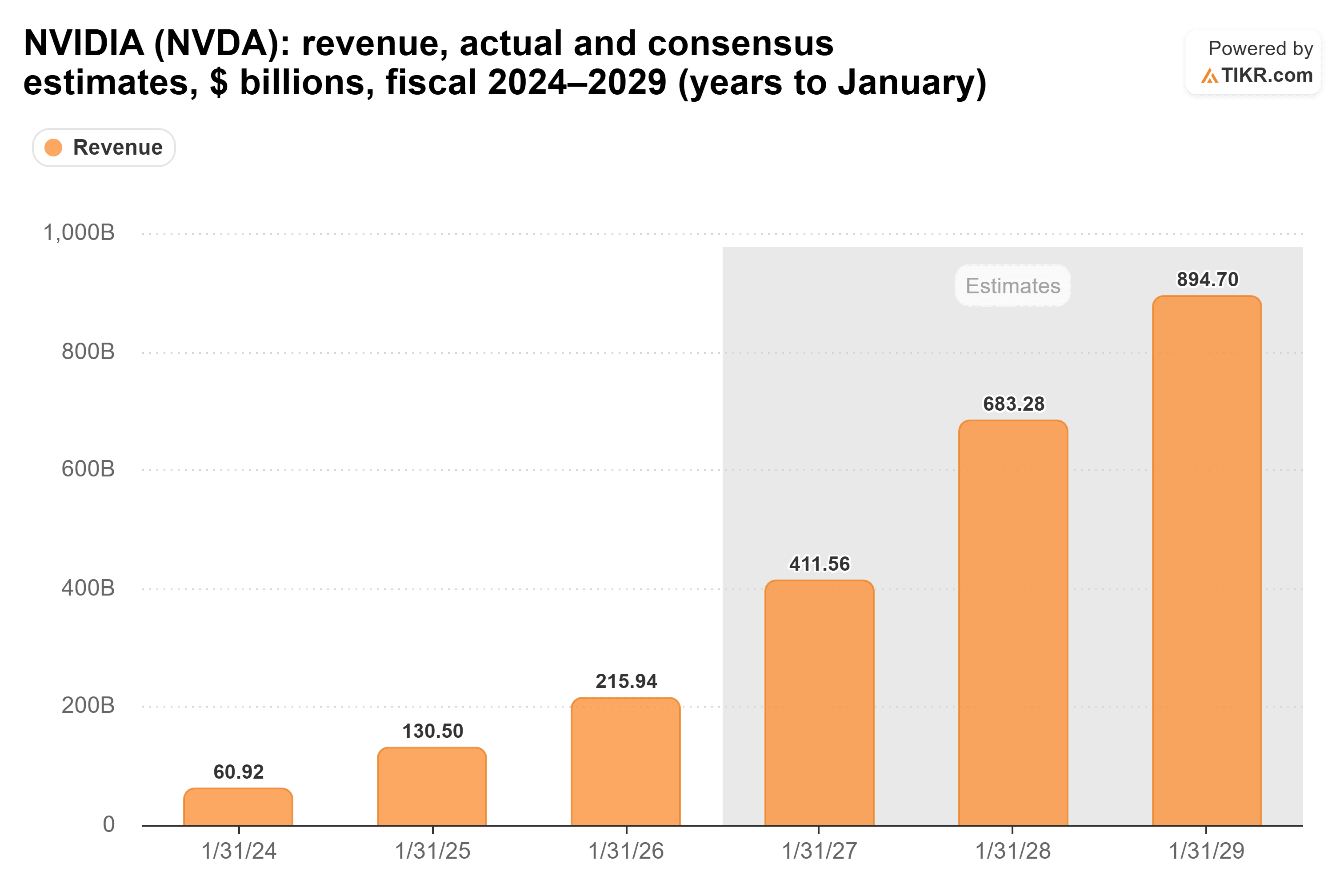
NVIDIA brought in $216 billion last fiscal year, up from $131 billion the year before. Consensus has revenue nearly doubling this year to about $412 billion, reaching $683 billion next year, and almost $900 billion the year after.
I don’t see a gap between generations in there.
So why does the stock look cheap?
Here’s the thing: you’d expect that kind of growth to come with a sky-high multiple. Instead…
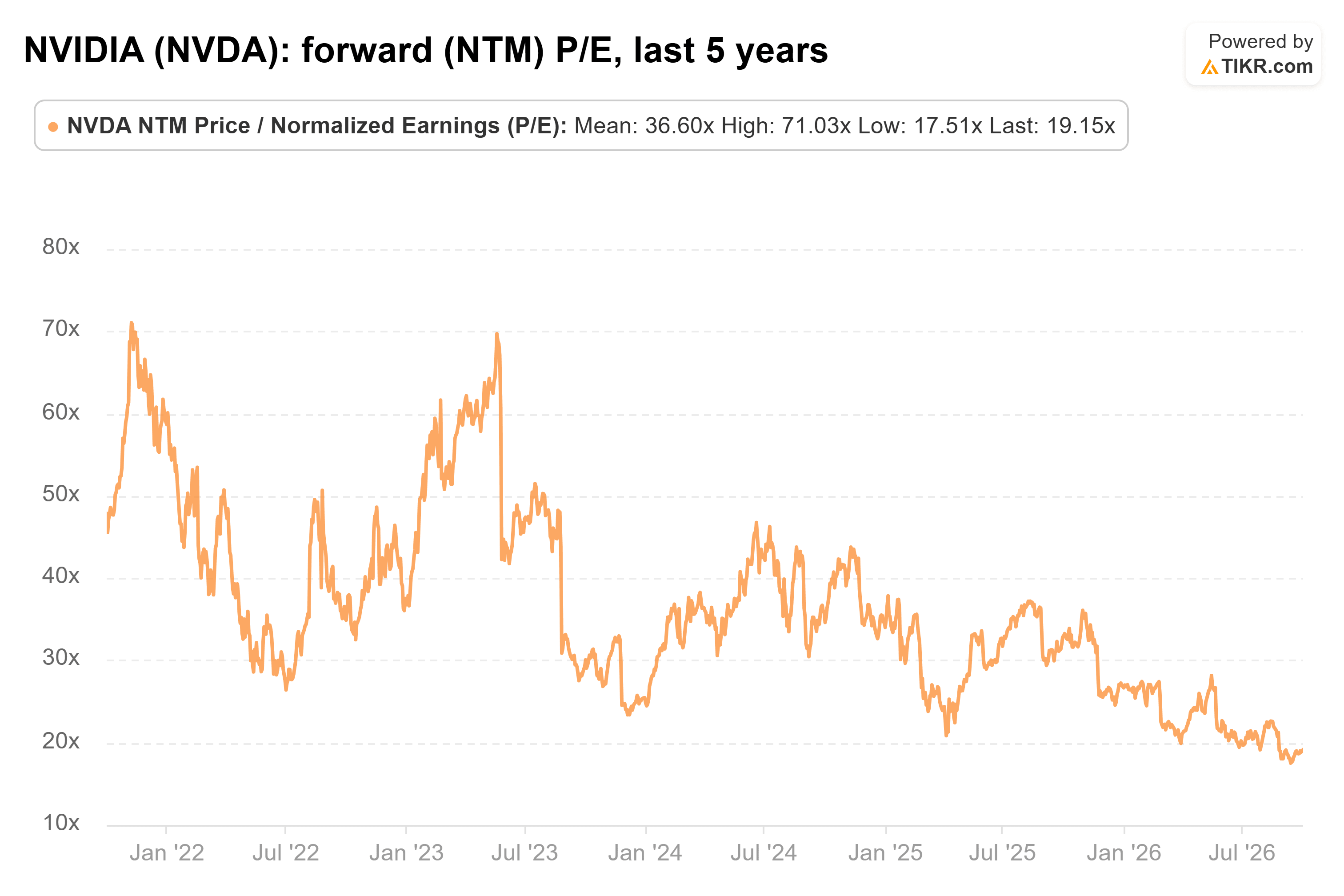
NVIDIA trades at 19.2 times its forward earnings, according to TIKR. Its five-year average is 36.6x, and it hit a five-year low of 17.5x as recently as Sept. 14.
For a company that can’t build enough of its product, that looks awfully cheap to me.
There are two ways to read that multiple. The first is that you’ve got a genuine buying opportunity: The share price hasn’t kept up with how fast earnings estimates are rising, and a multiple falls when that happens. The less charitable reading is that the market doubts those earnings will last. Chip demand runs in cycles (well, or at least historically it has), and Cramer’s own point was that a shortage leaves room for AMD to take share.
The 45% upside scenario
Today, NVIDIA is trading for about 19.2 times forward earnings.
If the market paid its five-year average of 36.6x for those same earnings, the stock would nearly double.
Even meeting halfway, at about 28x, gets you a roughly 45% higher value.
And that’s on the next 12 months of earnings alone. If consensus is right about revenue climbing another 66% next year, those earnings keep growing too.
Of course, all of this assumes the estimates hold. If demand cools, the earnings and the multiple could fall together. And there’s of course the broader macro backdrop – rising rates, an economy that’s starting to look shaky outside of the AI buildout, and increasing political uncertainty around data centers.
Vera Rubin only just started shipping in volume, so the next few quarters will show how much of that demand turns into revenue.
So what is NVIDIA stock actually worth?
TIKR lets you forecast the future price of any stock in less than a minute. Just enter a few assumptions into TIKR’s valuation model and see what NVIDIA could be worth. Start from Wall Street consensus estimates, or adjust the inputs to reflect your own view of the business. It’s free to use.
Disclaimer:
Please note that the articles on TIKR are not intended to serve as investment or financial advice from TIKR or our content team, nor are they recommendations to buy or sell any stocks. We create our content based on TIKR Terminal’s investment data and analysts’ estimates. Our analysis might not include recent company news or important updates. TIKR has no position in any of the stocks mentioned. Thank you for reading, and happy investing!