Key Stats for Uber Stock
- Current Price: $69.42
- Target Price (Mid): ~$220
- Street Target: ~$101
- Potential Total Return: ~217%
- Annualized IRR: ~31% / year
Now Live: Discover how much upside your favorite stocks could have using TIKR’s new Valuation Model (It’s free) >>>
What Happened?
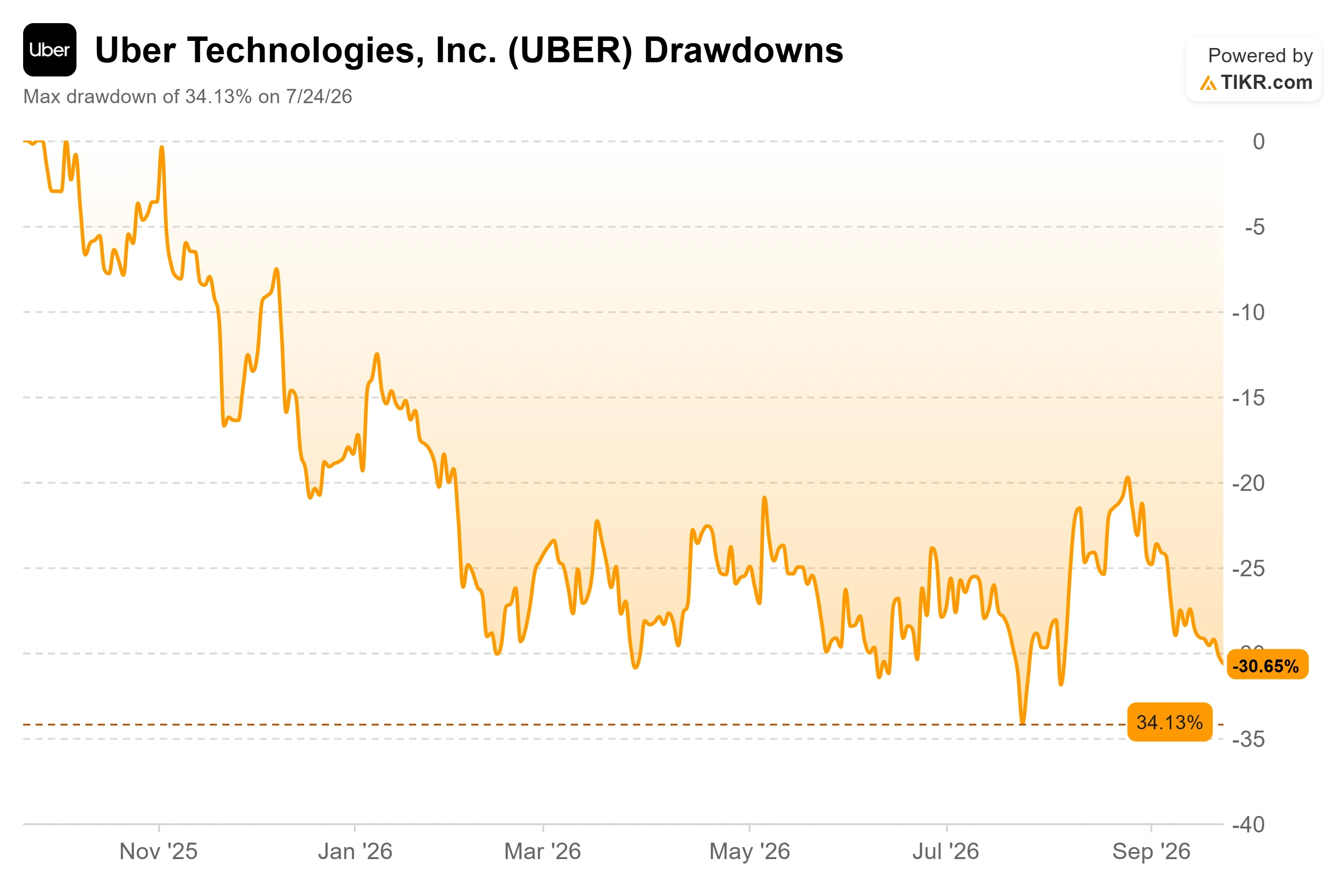
Uber Technologies (UBER) closed at $69.42 on September 23, down about 28% over the past year and just a few dollars above its 52-week low of $65.41. The business keeps compounding, yet the stock keeps sliding, and the reason is not in the financials. This month it got a sharper edge: Bank of America put a calendar on the robotaxi threat, estimating that Uber’s autonomous rivals get an 18-to-24-month head start before Uber’s own fleet scales.
Then, CEO Dara Khosrowshahi bought $10 million of stock in the open market, near the lows. The analyst’s note says the clock is ticking. The CEO’s purchase says buy anyway.
The Bears Just Got a Calendar
For most of 2026, the robotaxi threat was a vibe. Now it has dates attached. In a note published September 22, Bank of America analyst Justin Post estimated that Uber and Lyft expect their AV partnerships to begin scaling in 2028, giving newer autonomous platforms roughly 18 to 24 months to build volumes first. The same note projects more than 100,000 autonomous vehicles from Waymo, Tesla, and Zoox operating in the US by 2029.
That is the bear case in one line: rivals get a clear head start, and by the time Uber’s fleet matters, the market may already be carved up. It gained weight on September 8, when Tesla debuted its Cybercab in Austin and Uber fell 4% in a session. Waymo added to it by planning to launch its own app in Austin and Atlanta in January 2028, ending its exclusive routing through Uber in those cities.
What makes the setup unusual is that the analyst delivering the timeline is bullish. Post kept his Buy rating and a price objective near $101, and he is not alone: of the analysts covering Uber, 33 rate it Buy and 9 Outperform, against 8 Holds and a single Sell. His argument is that Uber’s partnerships with Nvidia, Lucid, Rivian, Volkswagen, Zoox, and WeRide could give it access to about 120,000 autonomous vehicles, and that the marketplace still solves a problem the carmakers cannot. An empty robotaxi burning miles without a passenger loses money. Uber brings the demand that keeps those cars full.
See historical and forward estimates for Uber stock (It’s free!) >>>
Why Utilization Is the Whole Argument
Khosrowshahi made that exact point at the Goldman Sachs Communacopia conference on September 10, and it is the most important thing management said all month. The economics of AVs, he explained, flip the model from variable cost to fixed. “We pay drivers, our drivers or couriers when we use them,” he said of today’s business. With AVs, you own an expensive car and pay for it whether it moves or not, plus the depots and charging behind it.
On Uber’s edge there, he was specific: “We’re able to drive significantly higher utilization than is possible for, let’s say, a 1P player. We estimate that 30%.” A 30% utilization advantage over a first-party operator is the number the bull case rests on. If it holds, Uber does not need to build the winning robotaxi. It needs to be the app riders open first, so whichever partner has a free car nearby gets the trip. That is why membership matters more than it looks: Uber One passed 50 million subscribers, grew 50% year over year, drives about half of gross bookings, and members spend three times more than non-members.
Should a single operator like Waymo reach the scale to keep its own cars full through its own app, it retains the economics and has less reason to route through Uber at all, which is what the Austin and Atlanta move foreshadows. The bull and bear cases are built from the same fact. Utilization decides which one wins.
The Business Under the Falling Chart
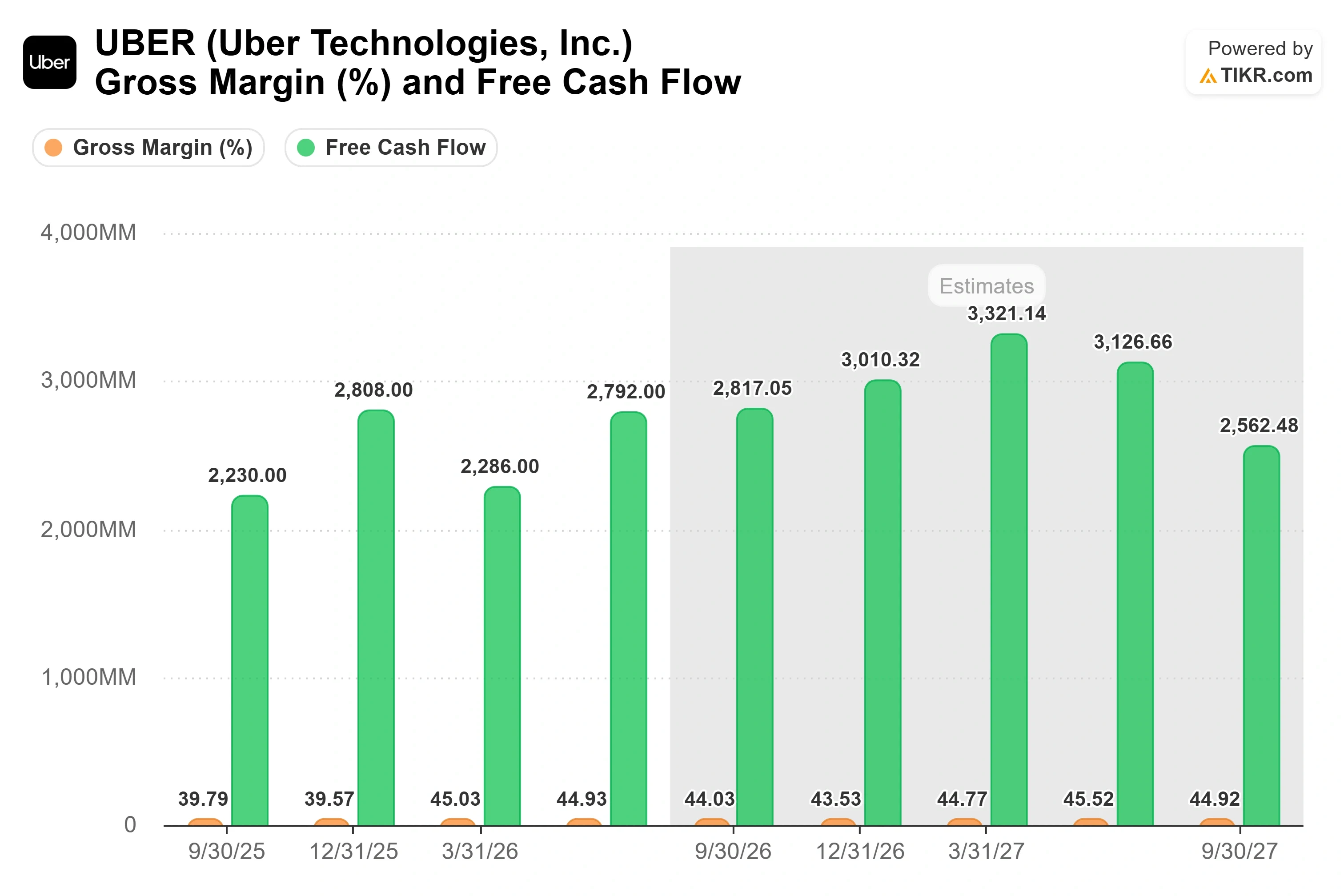
In the second quarter, reported August 5, Uber grew revenue 12% year over year to $14.19 billion, with gross bookings up 24% to $58.02 billion and free cash flow of $2.79 billion. It was the fourth straight quarter of gross bookings growth above 20%, and US mobility has accelerated since late last year, per management.
The valuation is where the disconnect shows. Uber trades near 15 times trailing earnings and about 12 times next-twelve-month free cash flow, multiples you would expect on a business growing high-single digits, not one still compounding bookings above 20%. The market is applying a mature-company P/E to a company still growing like a young one, because it is discounting the robotaxi transition years before it arrives.
Khosrowshahi purchased 141,000 shares on September 10 at a weighted average of $70.96, about $10 million, his first open-market buy since 2022, filed the same day. President and COO Andrew Macdonald had bought $5.3 million a week earlier at $75.83. The stock popped on the CEO’s purchase but has since drifted back below his entry to $69.42, so today’s buyer gets in under both men. Asked at Communacopia why Uber’s acquisition hurdle is so high, Khosrowshahi gave the reason plainly: “we think our stock is really cheap.” Insider purchases are conviction, and executives misjudge timing too, but roughly $15 million of personal cash into the stock near its lows is hard to wave off.
See how Uber performs against its peers in TIKR (It’s free!) >>>
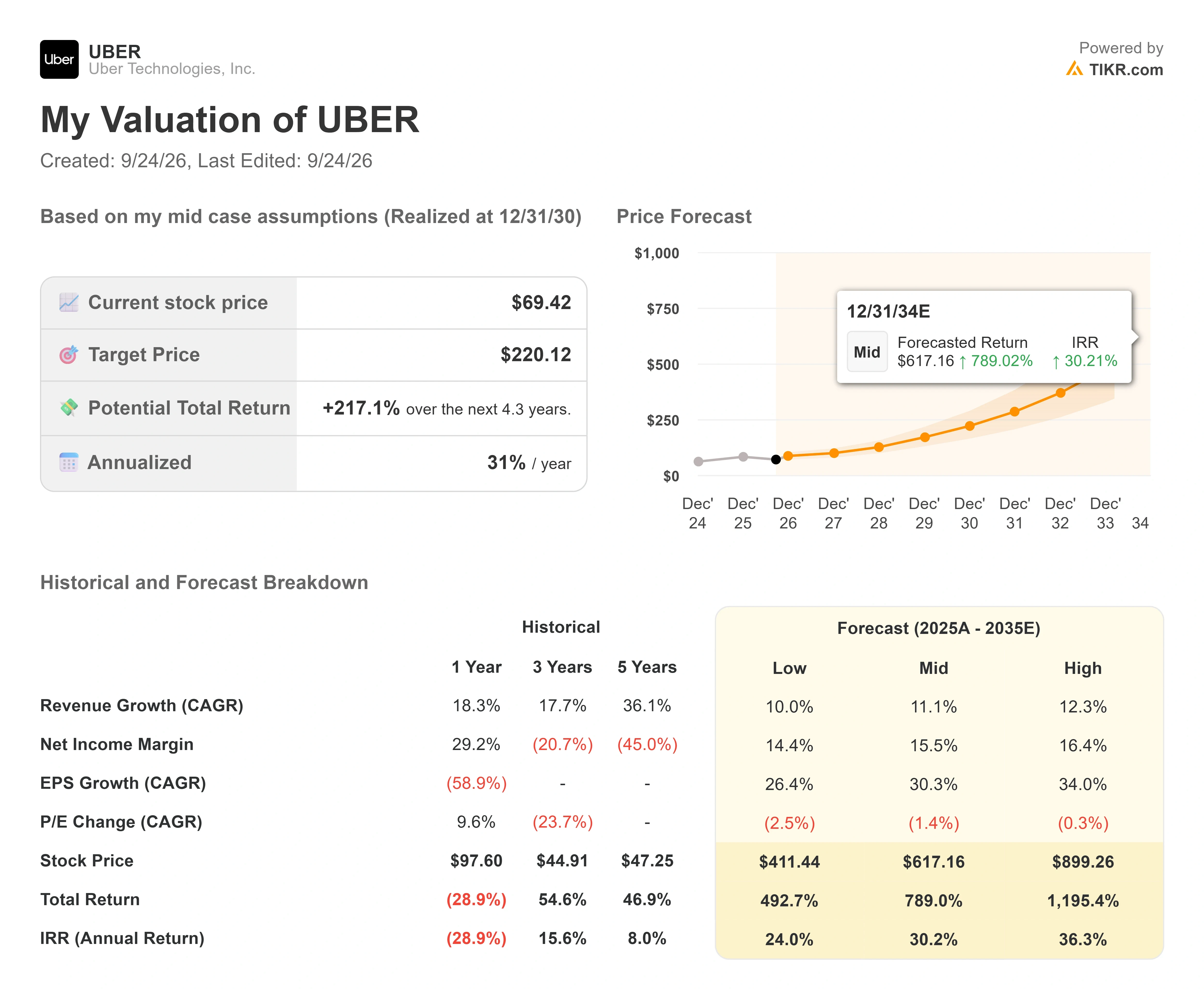
TIKR Advanced Model Analysis
- Current Price: $69.42
- Target Price (Mid): ~$220
- Potential Total Return: ~217%
- Annualized IRR: ~31% / year
See analysts’ growth forecasts and price targets for Uber stock (It’s free!) >>>
The revenue line rests on two drivers: forward revenue growth of around 11% per year in the mid case, and penetration of sparse markets, which Khosrowshahi said grow 1.5 times faster than core markets and where Uber reaches only 10% of the eligible population versus 50% in mature cities. The margin driver is the barbell strategy, using high-margin products like Uber for Business and advertising to fund low-cost products that pull in new users, with net income margin assumed to expand to around 15%. The primary risk is unchanged: a dominant AV operator keeps its own cars full through its own app and take rates compress faster than membership can defend.
The upside is that the platform proves durable, autonomy fragments across many partners who all need Uber’s demand, and the multiple re-rates as the threat turns into a tailwind. The downside is that one operator, like Waymo, keeps its own economics on the exact 2028 timeline the bears now cite.
Conclusion
The next real test is the Q3 print, expected in early November, where management guided gross bookings of roughly $58 billion to $60 billion. Good looks like bookings at or above the high end with US mobility still accelerating. Bad looks like the low end paired with any margin wobble from AV and Delivery Hero spending, which hands the bears their proof that growth is cooling. The Delivery Hero tender offer also closes on November 5, so by mid-November, investors will know both whether the operating story held and whether the CEO buying at $71 was early or right.
See what stocks billionaire investors are buying so you can follow the smart money with TIKR.
Should You Invest in Uber?
The only way to really know is to look at the numbers yourself. TIKR gives you free access to the same institutional-quality financial data that professional analysts use to answer exactly that question.
Pull up Uber, and you’ll see years of historical financials, what Wall Street analysts expect for revenue and earnings in the quarters ahead, how valuation multiples have moved over time, and whether price targets are trending up or down.
You can build a free watchlist to track Uber alongside every other stock on your radar. No credit card required. Just the data you need to decide for yourself.
Looking for New Opportunities?
- See what stocks billionaire investors are buying so you can follow the smart money.
- Analyze stocks in as little as 5 minutes with TIKR’s all-in-one, easy-to-use platform.
- The more rocks you overturn… the more opportunities you’ll uncover. Search 100K+ global stocks, global top investor holdings, and more with TIKR.
Disclaimer:
Please note that the articles on TIKR are not intended to serve as investment or financial advice from TIKR or our content team, nor are they recommendations to buy or sell any stocks. We create our content based on TIKR Terminal’s investment data and analysts’ estimates. Our analysis might not include recent company news or important updates. TIKR has no position in any stocks mentioned. Thank you for reading, and happy investing!