
Key Stats for Airbnb Stock
- Current Price: $149.58
- Target Price (Mid): ~$321
- Street Target: ~$184
- Potential Total Return: ~114%
- Annualized IRR: ~20% / year
Now Live: Discover how much upside your favorite stocks could have using TIKR’s new Valuation Model (It’s free) >>>
What Happened?
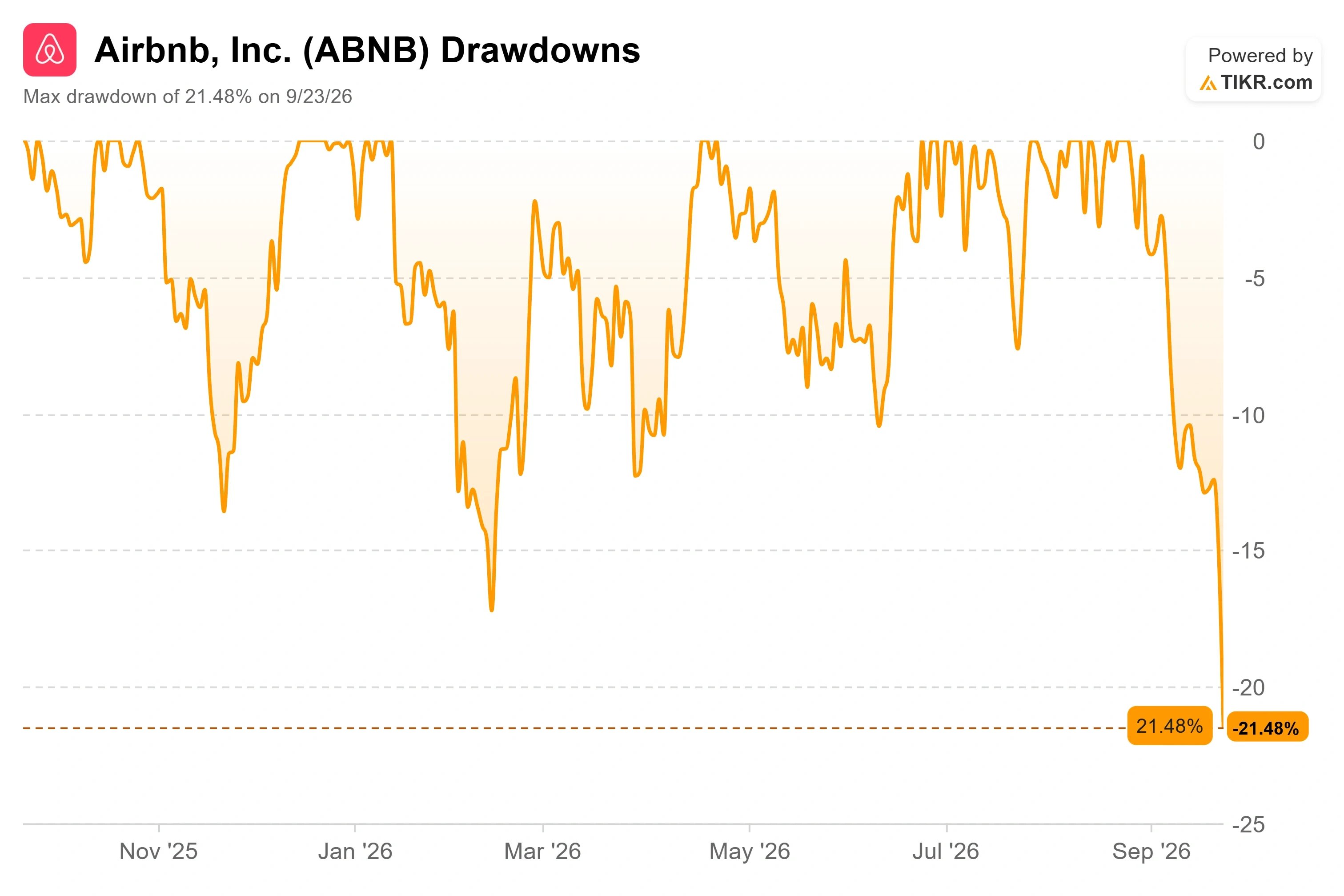
Airbnb (ABNB) lost 7.56% on September 23, closing at $149.58, and no earnings miss or guidance cut caused it. The stock fell because online travel names sold off together and because Wall Street’s newest voice on the stock told investors to expect little from here. That is a strange reason to lose $12 in a day, and it is exactly why the drop is worth a closer look.
The selloff leaves ABNB about 23% below its 52-week high of $193.45, back to where it traded in late July. For a business that beat revenue estimates in each of the last five quarters and still runs a free-cash-flow margin near 37%, a market that suddenly wants to pay less deserves an answer: is this fear rational, or is it an opening?
A $170 Target That Reads Like a Ceiling
On September 16, Morgan Stanley analyst Matthew Cost assumed coverage of the online travel sector, rating Booking Holdings Overweight, Airbnb Equal-Weight at a $170 target, and Expedia Underweight. The Airbnb call was not bearish in isolation. Cost lifted the stock from a prior Underweight stance, citing its roughly 90% direct-booking share and improved product execution as reasons double-digit room-night growth now looks more credible. But Booking was the bank’s preferred name in the group, and once the stock slid under $170, the initiation read as a ceiling rather than a floor.
In the two weeks prior, Rosenblatt and DA Davidson both started Airbnb at Buy with $220 targets, and Raymond James upgraded it to Outperform at $200. When a name known for bullish coverage picks up a high-profile neutral voice, the marginal buyer hesitates. That hesitation, layered on a broad consumer-discretionary selloff driven by rising Treasury yields, did the damage.
A second thread is also at work. Airbnb recently expanded in-app grocery ordering through a partnership with Instacart across the United States, with Canada expected to follow. Investors have not embraced it as a real revenue driver, and the muted reaction fed a broader worry that Airbnb’s services push spreads effort without moving the financial needle. That skepticism collides with what management says these extensions are for.
See historical and forward estimates for Airbnb stock (It’s free!) >>>
What Chesky Told Goldman That the Selloff Ignored
Two weeks before the drop, CEO Brian Chesky spoke at the Goldman Sachs Communacopia + Technology Conference, and his framing of the services push was not about grocery margins. “Every time we add a category, it not only expands our business, but it makes the core stronger,” Chesky said. That reframes the Instacart move: the value is not the grocery fee, it is the reason a hotel-only or service-only customer eventually books a home, a conversion he pegged at one in three hotel bookers returning for a stay.
He was blunt about growth. Airbnb’s revenue grew about 10% last year, yet he described the core as nowhere near mature, with four of its five largest markets accelerating and India growing near 50%. On the AI fear now weighing on the stock, he argued the same models are available to Airbnb, which already handles nearly half of customer-service tickets with AI. The Goldman audience heard a CEO who believes the company went “from the sixth inning back to the second inning.” The selloff priced none of that in.
Airbnb reported $3.61 billion in Q2 2026 revenue, up 16.5% year over year, beating the $3.58 billion consensus. Adjusted EPS reached $1.37 against $1.03 a year earlier, and adjusted EBITDA margin came in near 35%, more than a point above the prior-year quarter. This is not a business cracking. It is one that the market decided to pay less for over eight sessions.
Cheaper Than the Hotels
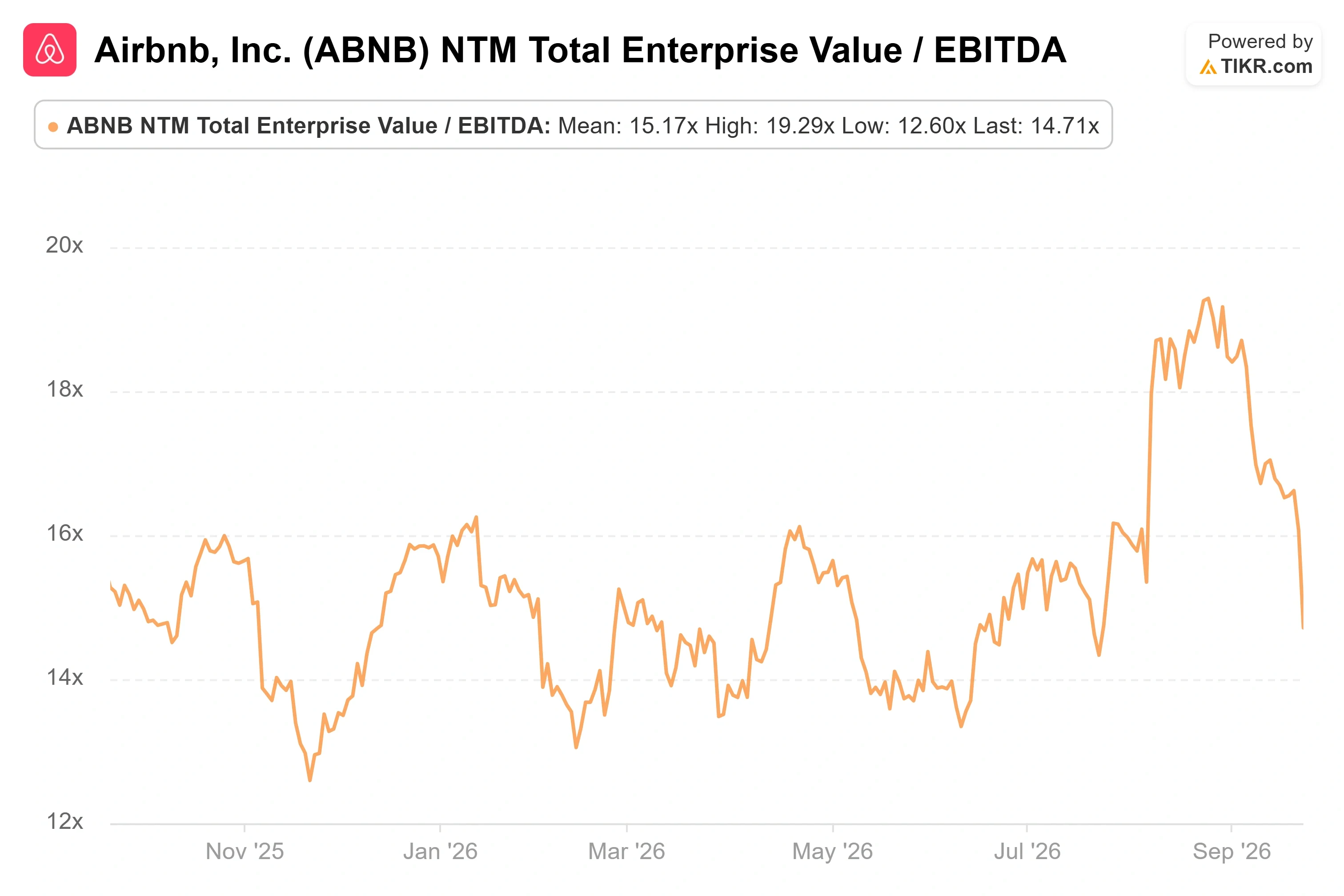
Airbnb trades at about 14.7 times NTM EV/EBITDA and roughly 26.5 times forward earnings. Against the hotel operators it is pulling independent supply from, that looks reasonable: Marriott sits near 17.5 times and Hilton near 19.3 times, both richer despite slower growth and heavier balance sheets.
The catch is the closest pure peer. Booking Holdings trades cheaper at about 10.6 times, so Airbnb is not simply “cheap,” it is priced as the faster grower it has been. Whether that premium to Booking and discount to the chains is justified depends entirely on whether category expansion converts, which is the live disagreement between a $170 target and a $220 one.
Airbnb holds roughly $9.6 billion in net cash, funding buybacks and product investment without external financing. That cushion is why a sentiment-driven drawdown changes the entry price without threatening the thesis.
See how Airbnb performs against its peers in TIKR (It’s free!) >>>
TIKR Advanced Model Analysis
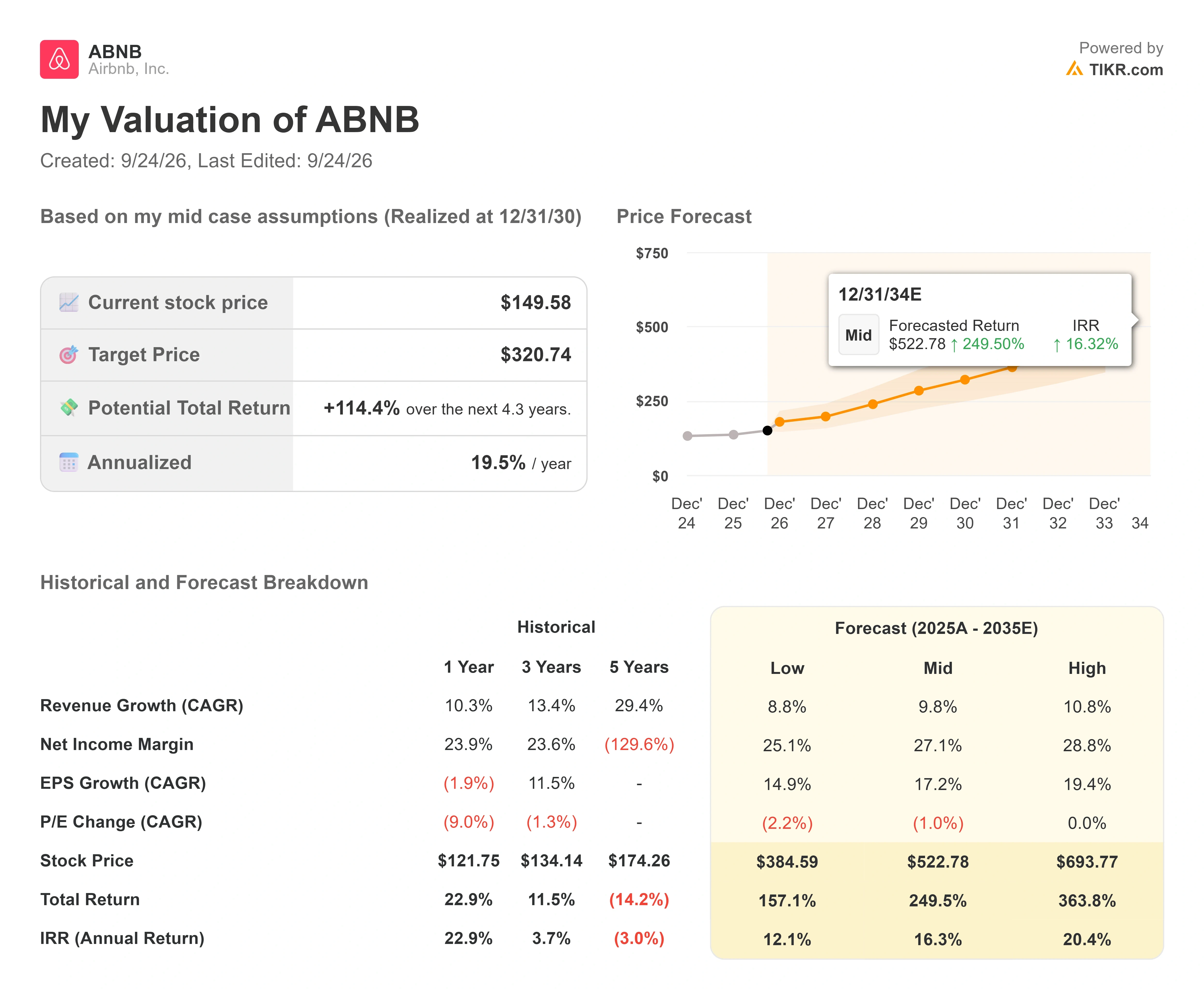
- Current Price: $149.58
- Target Price (Mid): ~$321
- Potential Total Return: ~114%
- Annualized IRR: ~20% / year
See analysts’ growth forecasts and price targets for Airbnb stock (It’s free!) >>>
The TIKR valuation model uses the mid-case scenario, realized at the end of 2030. It puts fair value near $321, implying roughly 114% total return and about 20% annualized from the current price over the next 4.3 years. That sits far above the Street mean near $184 and Morgan Stanley’s $170, so treat it as a scenario built on stated assumptions, not a promise. The gap between the model and the Street is the whole debate in two numbers.
Two drivers carry the revenue line: category expansion across hotels, experiences, services, and car rentals, and international, where the largest markets are still accelerating, and Asian penetration stays low. The mid case assumes around 10% annual revenue growth, roughly what the business delivers, with net income margin widening toward the high-20s as higher-margin seller services scale. The primary risk is the one the selloff named. If services expansion spreads effort without converting to revenue, growth decelerates, and the multiple compresses with it. The upside is a re-rating if the flywheel proves out; the downside is a business that keeps executing while the market keeps paying less.
Conclusion
The next real test comes in early November, when Airbnb reports Q3 2026. The number that matters most is not headline revenue but room-night growth, because that is the metric Morgan Stanley’s neutral call hinges on. Double-digit growth there, held alongside an EBITDA margin near 35%, would tell you the selloff was positioning, and the double-digit thesis is intact. A slip into single digits, or margin softness as services scale, would hand the bears their proof and make the $170 target look prescient. Airbnb walks in cheaper than the hotels it is outgrowing.
See what stocks billionaire investors are buying so you can follow the smart money with TIKR.
Should You Invest in Airbnb?
The only way to really know is to look at the numbers yourself. TIKR gives you free access to the same institutional-quality financial data that professional analysts use to answer exactly that question.
Pull up Airbnb, and you’ll see years of historical financials, what Wall Street analysts expect for revenue and earnings in the quarters ahead, how valuation multiples have moved over time, and whether price targets are trending up or down.
You can build a free watchlist to track Airbnb alongside every other stock on your radar. No credit card required. Just the data you need to decide for yourself.
Looking for New Opportunities?
- See what stocks billionaire investors are buying so you can follow the smart money.
- Analyze stocks in as little as 5 minutes with TIKR’s all-in-one, easy-to-use platform.
- The more rocks you overturn… the more opportunities you’ll uncover. Search 100K+ global stocks, global top investor holdings, and more with TIKR.
Disclaimer:
Please note that the articles on TIKR are not intended to serve as investment or financial advice from TIKR or our content team, nor are they recommendations to buy or sell any stocks. We create our content based on TIKR Terminal’s investment data and analysts’ estimates. Our analysis might not include recent company news or important updates. TIKR has no position in any stocks mentioned. Thank you for reading, and happy investing!