
Key Stats for Palo Alto Networks Stock
- Current Price: $393.30
- Target Price (Mid): ~$545
- Street Target (Mean): ~$396
- Potential Total Return: ~39%
- Annualized IRR: ~7% / year
Now Live: Discover how much upside your favorite stocks could have using TIKR’s new Valuation Model (It’s free) >>>
What Happened?
Palo Alto Networks (PANW) flagged 1,200 possible vulnerabilities across its own technology when Anthropic’s Mythos came out, and CEO Nikesh Arora said sorting real ones from false alarms and fixing them took three to four months. On September 22, the company turned that kind of testing into an always-on subscription built on Anthropic’s Claude Mythos 5, OpenAI’s GPT-5.6-Cyber, and open-weight models. On September 23, shares closed up 5.00% at $393.30, within 1% of their all-time closing high.
Writing mid-session with shares up about 3%, Benzinga attributed the move to investors weighing the new service and favoring select cybersecurity names, noting that Ritholtz Wealth Management’s Josh Brown and Sean Russo named Palo Alto among four they like. The launch, posted with the company’s investor relations materials, came with no pricing or revenue outlook. With shares up 94.5% over the past year, the service lands on a stock that already prices in strong AI security demand.
Palo Alto Tested Itself First, and No Single Model Found Everything
Arora described that process at Goldman Sachs’ Communacopia + Technology Conference on September 10, saying Palo Alto now finds only a few vulnerabilities a month, as it did before Mythos. Of what the company found, he estimated about 60% came through Mythos, 30-odd percent through OpenAI, and 10% through other models.
“So we actually have to use a multi-model harness to find all the vulnerabilities that current AI will help you find as opposed to using any one single model,” said Arora, Palo Alto’s chairman and CEO. The new service runs on that kind of harness, which the company says routes each task to the best-suited model while managing the cost of frontier AI at scale. Palo Alto says it validated the approach over six months of in-house testing and more than 100 customer engagements, backed by $17 million in R&D.
The frontier models at the center of the harness belong to Anthropic and OpenAI, and access to them is gated. In the same release, Anthropic cybersecurity lead Michael Moore described Unit 42’s job as taking what Claude Mythos finds and testing “whether it can actually be exploited.” Palo Alto supplies the harness, threat intelligence, and remediation, while the labs supply the frontier models.
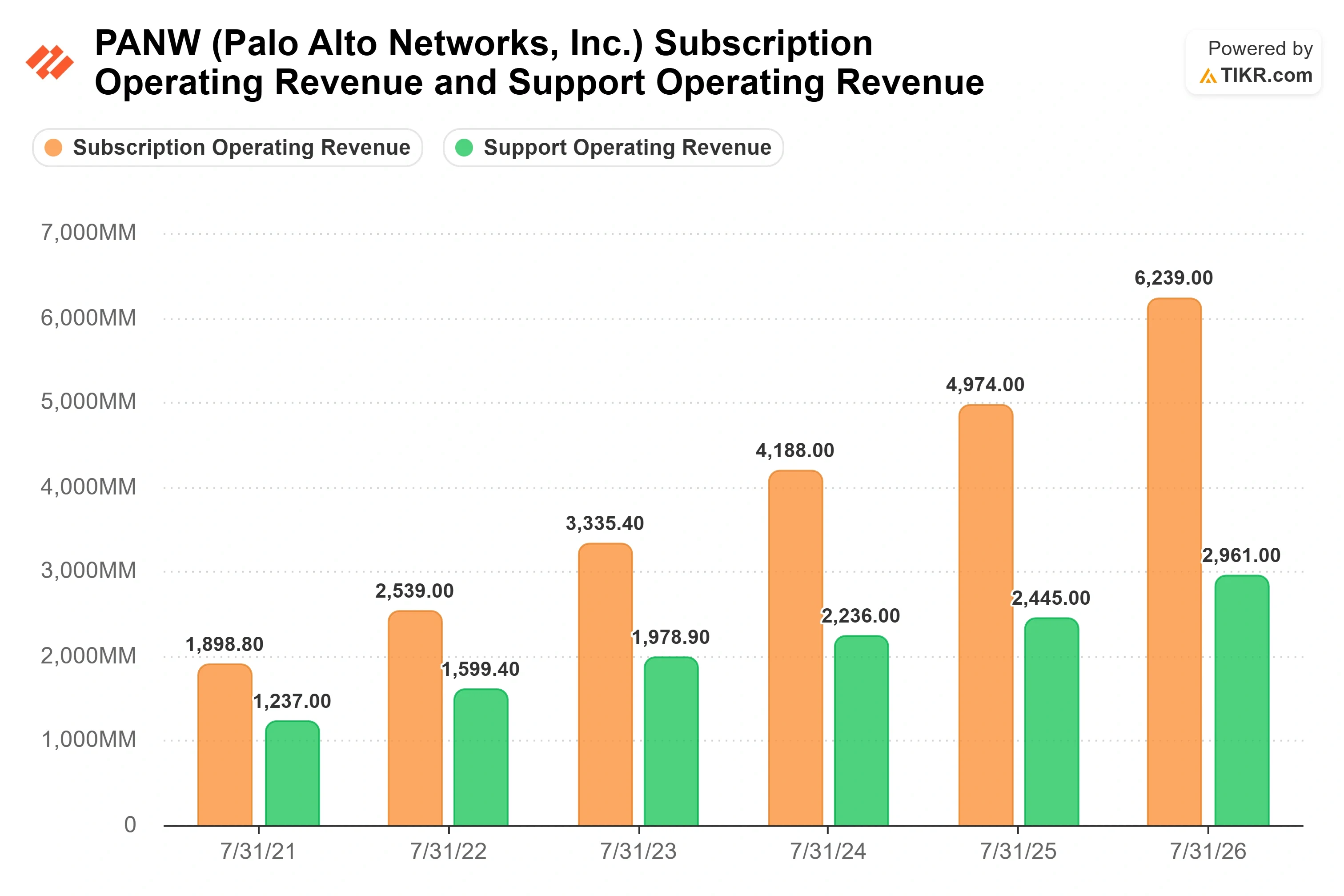
See historical and forward estimates for Palo Alto Networks stock (It’s free!) >>>
Testing Opens the SIEM Sale, but Cloud Costs Rise With It
Arora treats the testing as a door. Since Mythos, he said, Palo Alto has talked with about 2,000 companies’ CEOs, CIOs, and security chiefs, and the conversation quickly turns to catching intruders faster. “That’s usually when the platform conversation begins,” he said. Later in the talk, he said Mythos is now driving change in the SIEM, the system that collects security data for analysis.
Cortex XSIAM, its SIEM replacement, ended fiscal 2026 above $700 million in ARR, up 70%, and Prisma AIRS, its real-time AI security product, passed $100 million in ARR. Arora was frank that the market is unfinished: “If anybody sat here and told you they can solve AI security, there’s a bunch of marketing going on.” As of September 10, he said, agent tools like Claude Code and Codex lacked the hooks vendors need for in-line security.
Arora expects average intelligence to become free, “but you will still have to pay for compute,” and said Palo Alto already spends north of $1 billion buying cloud. On the Q4 call, CFO Dipak Golechha said cloud-hosting costs should grow faster than revenue in fiscal 2027 as the business shifts toward cloud and SaaS.
Gross margin slipped to 75.8% in fiscal 2026 from 76.4%, and the fourth-quarter margin of 74.8% came in below the roughly 76% analysts expected. Model access adds a second dependency: Arora said the labs are building “interim moats” and called long-term routing across models “an economic argument,” which could leave part of this service’s pricing power with Anthropic and OpenAI.
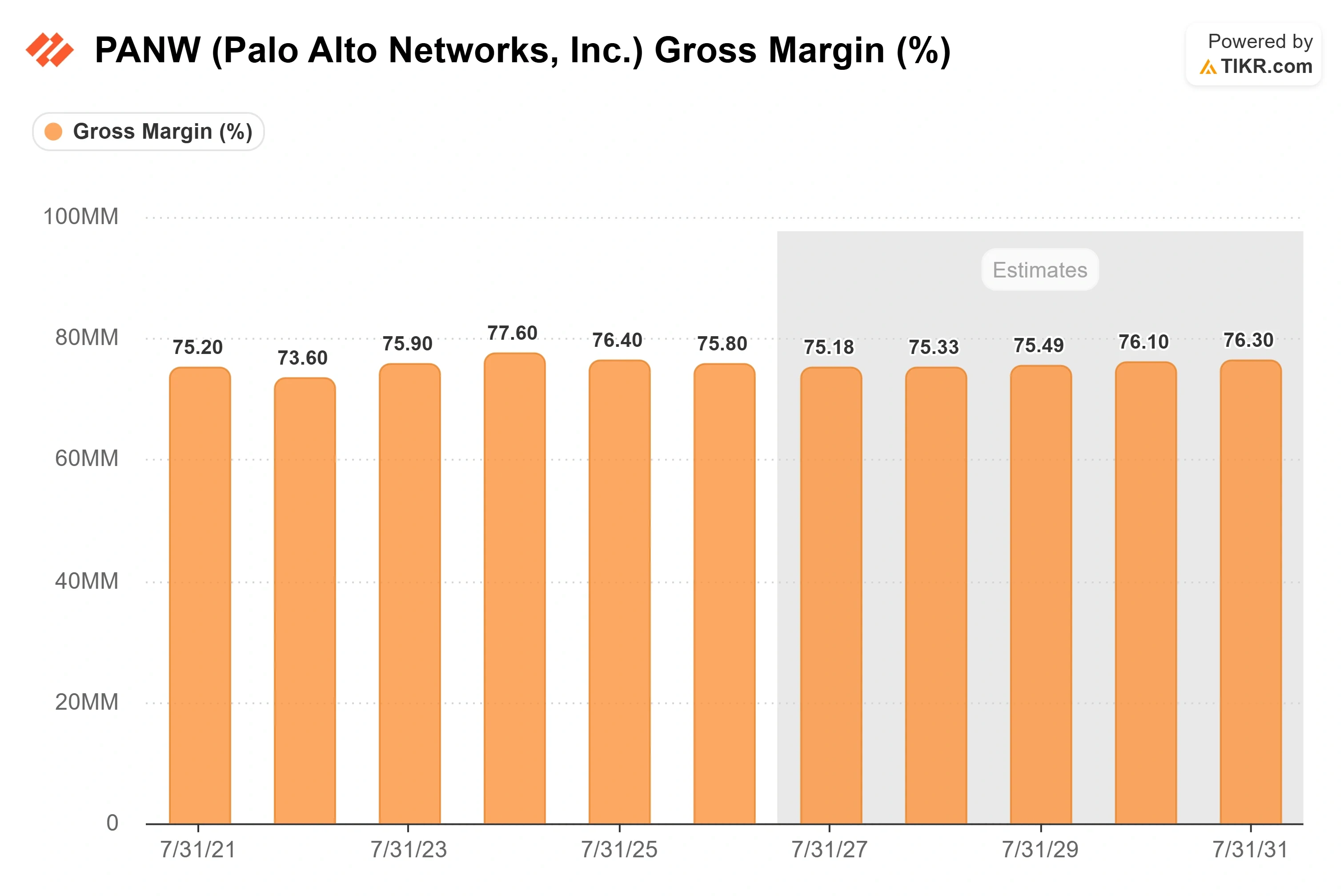
See how Palo Alto Networks performs against its peers in TIKR (It’s free!) >>>
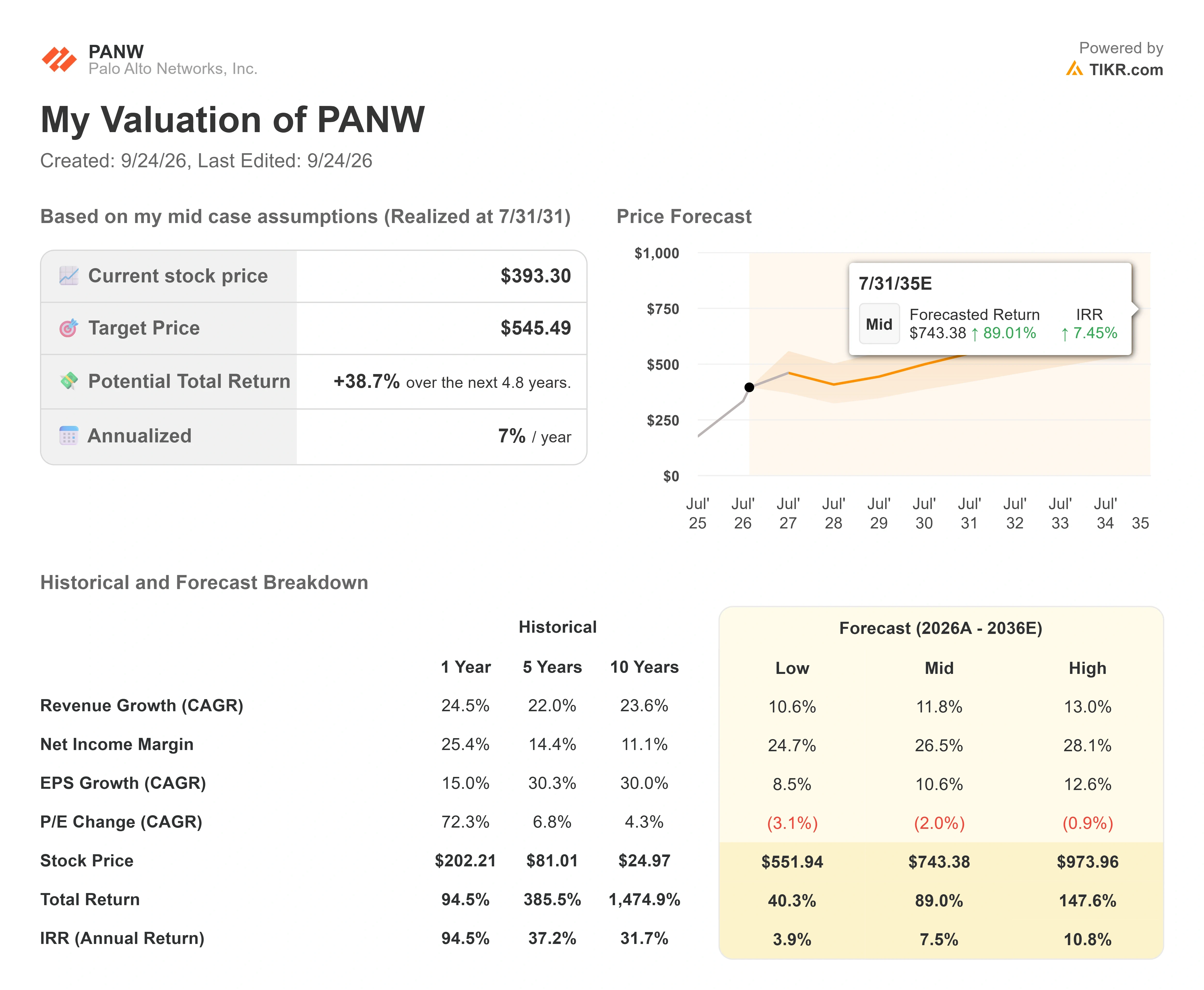
TIKR Advanced Model Analysis
- Current Price: $393.30
- Target Price (Mid): ~$545
- Potential Total Return: ~39%
- Annualized IRR: ~7% / year
See analysts’ growth forecasts and price targets for Palo Alto Networks stock (It’s free!) >>>
On the mid-case assumptions, the model points to around $545 by July 31, 2031. It assumes revenue CAGR of around 12%, net margin of around 27%, and a P/E ratio that contracts about 2% a year.
- Revenue drivers: SIEM replacements that Arora says Mythos is prompting, and AI security subscriptions such as the new Unit 42 service.
- Margin driver: net margin expanding as subscription revenue scales faster than operating costs.
- Primary risk: cloud-hosting and model-access costs rising faster than the revenue the service brings in.
- Upside: the high case compounds near 11% a year through July 2035.
- Downside: the low case compounds near 4% a year through July 2035.
Conclusion
Gross margin is the number that tells investors whether this service pays. When Palo Alto reports the quarter ending October 31, margin holding near Q4’s 74.8% would show AI services scaling without the compute bill getting ahead of them. Another 100-basis-point drop would say the cost side is winning.
Watch ARR with a caveat. Management guided next-generation security ARR to $9.54 billion to $9.56 billion in the Q4 release, but that metric excludes professional services, so it may not capture the new Unit 42 service. Palo Alto usually sets its report date in early November, and last year’s first-quarter results came out on November 19.
See what stocks billionaire investors are buying so you can follow the smart money with TIKR.
Should You Invest in Palo Alto Networks?
The only way to really know is to look at the numbers yourself. TIKR gives you free access to the same institutional-quality financial data that professional analysts use to answer exactly that question.
Pull up Palo Alto Networks, and you’ll see years of historical financials, what Wall Street analysts expect for revenue and earnings in the quarters ahead, how valuation multiples have moved over time, and whether price targets are trending up or down.
You can build a free watchlist to track Palo Alto Networks alongside every other stock on your radar. No credit card required. Just the data you need to decide for yourself.
Analyze Palo Alto Networks on TIKR Free →
Looking for New Opportunities?
- See what stocks billionaire investors are buying so you can follow the smart money.
- Analyze stocks in as little as 5 minutes with TIKR’s all-in-one, easy-to-use platform.
- The more rocks you overturn… the more opportunities you’ll uncover. Search 100K+ global stocks, global top investor holdings, and more with TIKR.
Disclaimer:
Please note that the articles on TIKR are not intended to serve as investment or financial advice from TIKR or our content team, nor are they recommendations to buy or sell any stocks. We create our content based on TIKR Terminal’s investment data and analysts’ estimates. Our analysis might not include recent company news or important updates. TIKR has no position in any stocks mentioned. Thank you for reading, and happy investing!