
Key Stats for Lockheed Martin Stock
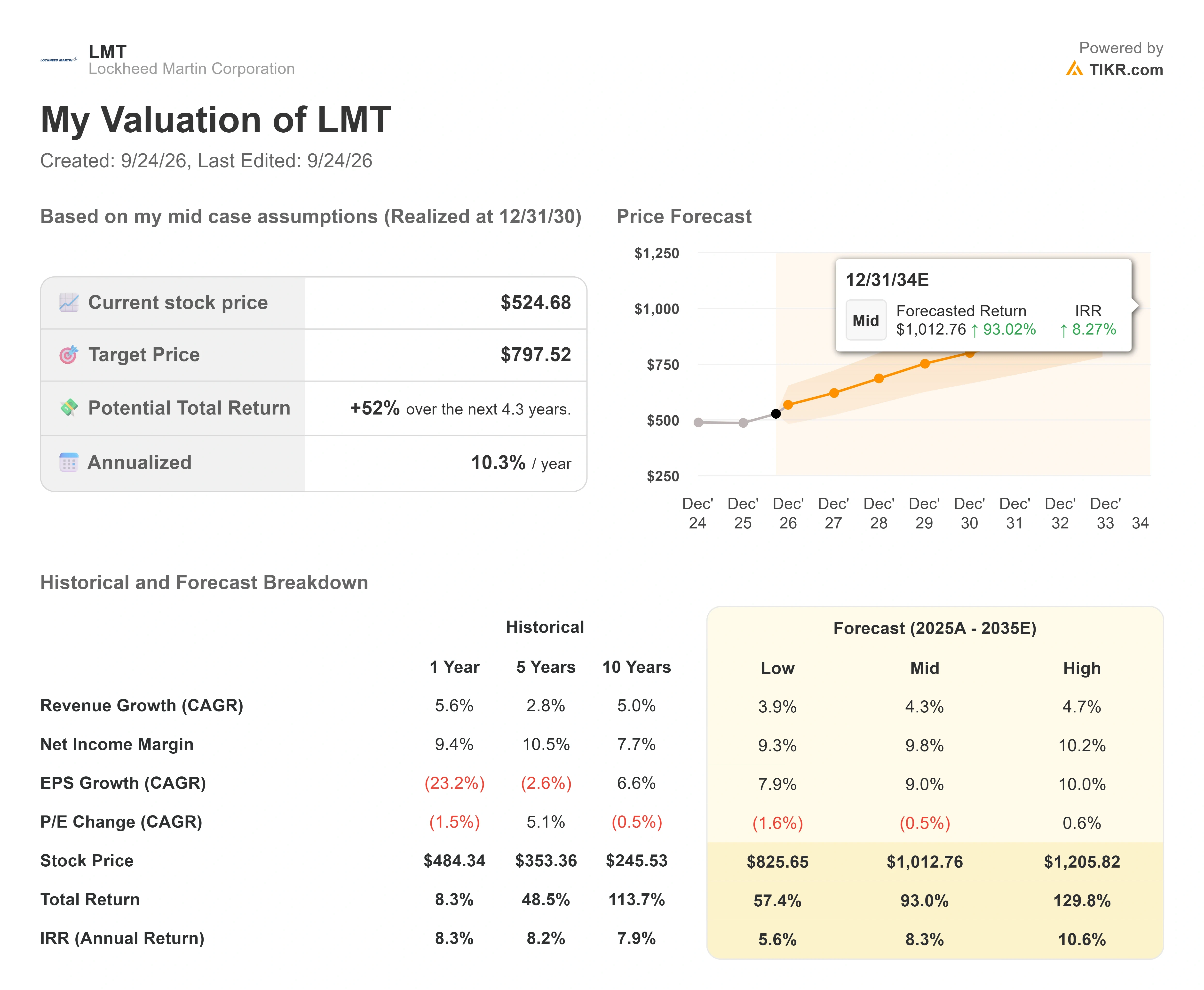
- Current Price: $524.68
- Target Price (Mid): ~$798
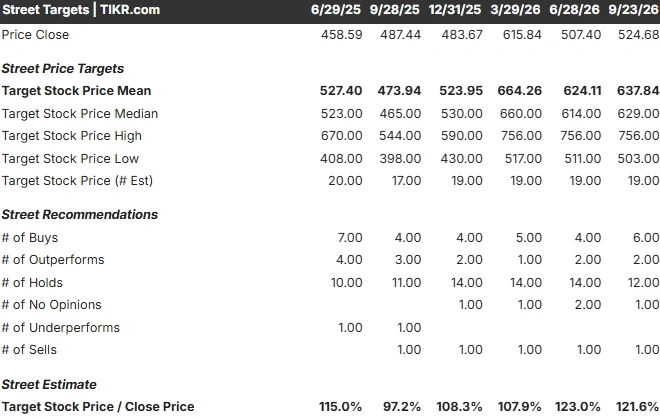
- Street Target: ~$638
- Potential Total Return: ~52%
- Annualized IRR: ~10% / year
Now Live: Discover how much upside your favorite stocks could have using TIKR’s new Valuation Model (It’s free) >>>
What Happened?
Lockheed Martin (LMT) spent most of 2026 out of favor, its stock stuck near $525 while investors worried that fixed-price contracts and program charges would keep eating into profits. On September 8, UBS pushed against that caution. The bank upgraded LMT to Buy from Neutral and raised its price target to $674 from $581, arguing the market is underpricing a missile-driven earnings shift that is already underway.
Within ten days of the call, three catalysts landed that feed the exact business UBS is betting on. The question now is whether the bank is early to a re-rating, or reaching for a stock that still carries real execution risk beneath it.
The Upgrade Rests on One Segment, and the Contracts Back It
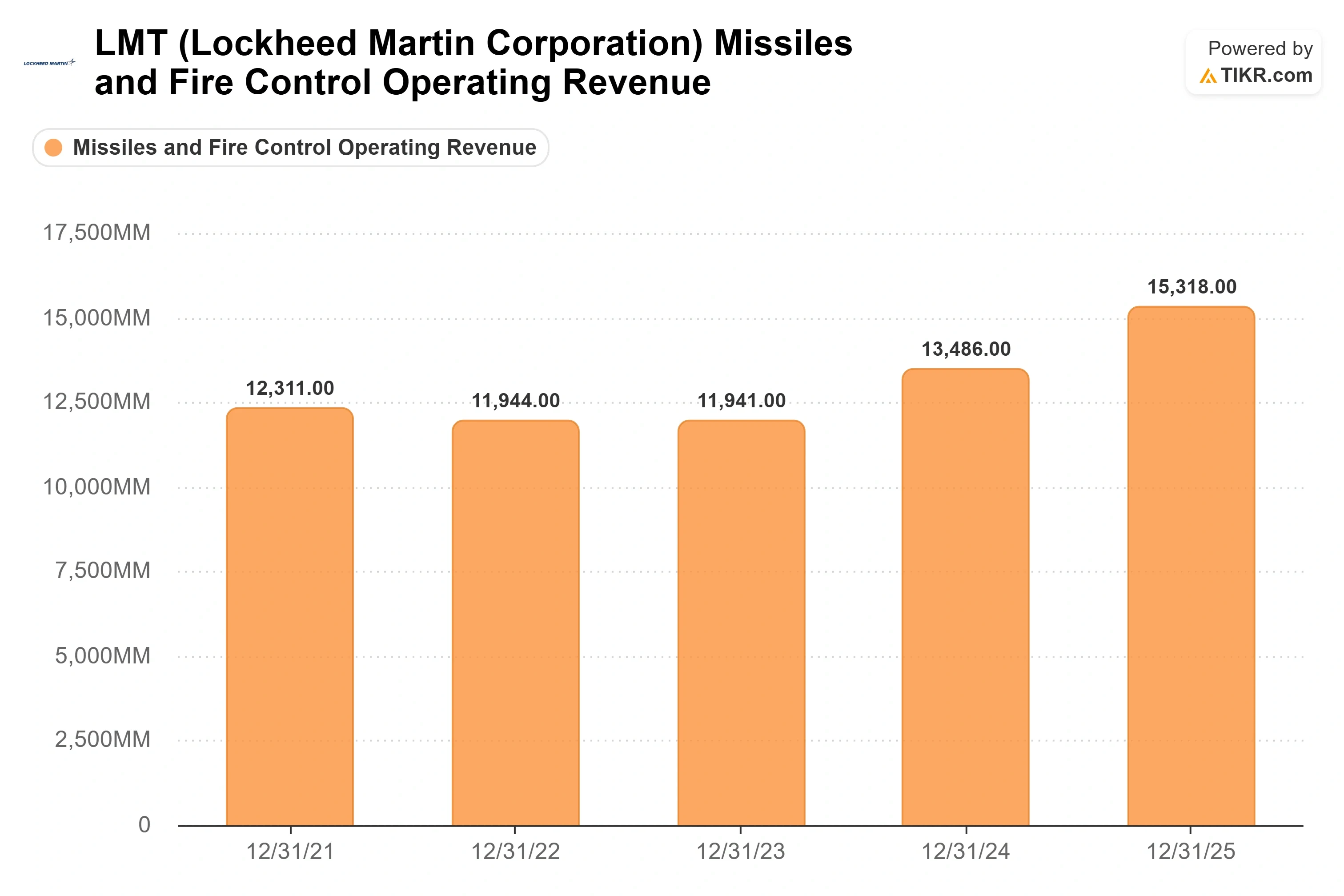
UBS analyst Gavin Parsons built the call around Missiles and Fire Control, the fastest-growing and highest-margin part of the company. He expects roughly 9% annual revenue growth through 2028, above consensus, and sees the missile segment growing about 150% between 2025 and 2030. His 2028 adjusted earnings estimate of around $39 sits about 12% above the Street.
On September 17, Lockheed signed a framework agreement with the Department of War to accelerate production of the classified AIM-260 JATM air-to-air missile. It is a demand signal, and any multiyear buy still needs Congressional approval. The same day, the State Department approved a potential $24.3 billion F-35 sale to Saudi Arabia, which also faces a Congressional review window. Four days later, the Army awarded Lockheed a contract worth up to $1.2 billion for the Precision Strike Missile.
On July 23, Lockheed posted second-quarter revenue of $20.06 billion, up 11% year over year, with adjusted EPS of $7.94 that beat the Street by 10.5%. Backlog hit a record $230 billion, up $64 billion from a year earlier, including a $35 billion multi-year THAAD contract. CEO Jim Taiclet said the company is tripling annual PAC-3 production and quadrupling THAAD output, describing the scale bluntly at Morgan Stanley’s Laguna conference on September 17: “There’s not like 20% more than last year.”
See historical and forward estimates for Lockheed Martin stock (It’s free!) >>>
What Could Still Break the Call
The bear case is not gone, and management named the sharpest version of it directly. Asked about scaling production, Taiclet pointed past his own factories: “Our supply chain is our biggest risk factor in production scaling.” The ramp UBS is counting on runs through mid-tier suppliers deciding to invest, and that is the piece Lockheed controls least.
They compressed in the first half of 2026 as F-16 and C-130 charges weighed on Aeronautics, whose operating margin ran around 10% to 10.5% from 2021 to 2023 based on TIKR segment data before slipping. CFO Evan Scott warned third-quarter margins may show some “lumpiness” with fewer risk retirements than the second quarter carried, and full-year free cash flow guidance of over $7 billion is heavily back-end weighted.
One genuinely new element cuts the other way. Lockheed took its Sanctum counter-drone system from concept to live-fire testing in 45 days, pairing a repurposed Hellfire missile with a startup radar and an in-house high-power microwave. Taiclet’s reaction after seeing it work was to order scale: “Build 1,000 of each of them right now.” At tens of thousands of dollars per unit rather than the billions a platform costs, these systems address the drone threat without straining cash flow.
On valuation, the discount is why the debate exists at all. Lockheed trades at about 11.9x NTM EV/EBITDA and 17x NTM P/E. Northrop Grumman sits at 13.5x EV/EBITDA and 17.6x P/E on the same TIKR data, and Airbus trades near 13.3x EBITDA. Lockheed is the cheapest large Western prime just as it is handed a multi-year production ramp. Whether that gap closes depends on the margin recovery, because the backlog is already full.
See how Lockheed Martin performs against its peers in TIKR (It’s free!) >>>
TIKR Advanced Model Analysis
- Current Price: $524.68
- Target Price (Mid): ~$798
- Potential Total Return: ~52%
- Annualized IRR: ~10% / year
See analysts’ growth forecasts and price targets for Lockheed Martin stock (It’s free!) >>>
TIKR’s mid-case model values Lockheed at around $798 by the end of 2030, roughly 52% total return from today’s price, or about 10% a year. Two drivers carry it: the missile production ramp across PAC-3, THAAD, and JATM, and F-35 sustainment plus international demand feeding Aeronautics. The margin driver is the framework-agreement structure that lets Lockheed keep its efficiency gains, lifting net income margin toward the high-9% range by 2030. The primary risk is the one management named itself: supplier capacity, plus the fixed-price charges that reset earnings before the ramp fully lands.
The whole target hinges on that margin recovery landing, which is already full. UBS maps the same tension through its own scenarios: a bull case near $870 if the ramp compounds, and a bear at $452 if execution charges keep resetting the base.
Conclusion
The next test is the third-quarter report on October 20. Watch free cash flow: management guided to over $7 billion for the year, and after a soft first half, the back half has to carry it. A print that keeps the company on that track, with Aeronautics margins recovering toward their historical 10% range, says the earnings shift UBS is betting on is real. Another charge that resets the base says the market’s caution was right. At around $525, the stock is still priced for the second outcome.
See what stocks billionaire investors are buying so you can follow the smart money with TIKR.
Should You Invest in Lockheed Martin?
The only way to really know is to look at the numbers yourself. TIKR gives you free access to the same institutional-quality financial data that professional analysts use to answer exactly that question.
Pull up Lockheed Martin, and you’ll see years of historical financials, what Wall Street analysts expect for revenue and earnings in the quarters ahead, how valuation multiples have moved over time, and whether price targets are trending up or down.
You can build a free watchlist to track Lockheed Martin alongside every other stock on your radar. No credit card required. Just the data you need to decide for yourself.
Analyze Lockheed Martin on TIKR Free →
Looking for New Opportunities?
- See what stocks billionaire investors are buying so you can follow the smart money.
- Analyze stocks in as little as 5 minutes with TIKR’s all-in-one, easy-to-use platform.
- The more rocks you overturn… the more opportunities you’ll uncover. Search 100K+ global stocks, global top investor holdings, and more with TIKR.
Disclaimer:
Please note that the articles on TIKR are not intended to serve as investment or financial advice from TIKR or our content team, nor are they recommendations to buy or sell any stocks. We create our content based on TIKR Terminal’s investment data and analysts’ estimates. Our analysis might not include recent company news or important updates. TIKR has no position in any stocks mentioned. Thank you for reading, and happy investing!