Key Stats for NVIDIA Stock
- Current Price: $225.51
- Target Price (Mid): ~$660
- Street Target: ~$328
- Potential Total Return: ~193%
- Annualized IRR: ~28% / year
Now Live: Discover how much upside your favorite stocks could have using TIKR’s new Valuation Model (It’s free) >>>
What Happened?
NVIDIA (NVDA) is paying nearly $13 billion for a company with about $150 million in revenue. On September 2, it signed a definitive agreement to acquire Hugging Face, the hub where millions of developers find, test, and deploy open-source AI models. Shares rose roughly 1.8% to $228.45 when the deal went public the next session, outpacing the S&P 500 by less than a point.
The price tag looks absurd against Hugging Face’s sales. It looks small against the point of the deal. NVIDIA is the most valuable company on Earth because it sells the chips the AI boom runs on, and its biggest long-term threat is that its largest customers (Meta, Alphabet, Amazon) are designing their own silicon to escape it. Buying the place where developers choose their tools is how NVIDIA answers that threat without building a faster chip.
Why NVIDIA Paid a Fortune for a Small Company
Hugging Face is a distribution story. Public model repositories on the platform grew from 2.43 million to 2.96 million in the first seven months of 2026, and hardware makers increasingly use open models to showcase their chips and drive adoption. Owning that layer puts NVIDIA at the exact moment a developer decides what to build on.
The parallel analysts keep drawing is Microsoft buying GitHub in 2018. Microsoft took control of the leading place where developers gathered, then used it to feed its paid cloud business. NVIDIA is running the same play: own the discovery and distribution layer, then point the demand it generates back at CUDA and the hardware underneath. CFRA analyst Angelo Zino framed it directly, telling Yahoo Finance the deal is “less about the financials” and more about “building that AI ecosystem,” which “ultimately translates to greater adoption” for what NVIDIA sells.
Management has been open that the strategy is the whole company now. On the fiscal second-quarter call, CEO Jensen Huang described NVIDIA as “one platform, fungible for every model and workload, durable for the entire life cycle of AI.” Hugging Face is that sentence turned into an acquisition. The risk NVIDIA named in its own filing is the mirror image: open models could reduce demand for its products if they run mostly on competing hardware. Buying the hub is how it guards against that.
See historical and forward estimates for NVIDIA stock (It’s free!) >>>
The Threat the Deal Is Really Answering
A distribution move matters now because of the competition NVIDIA has never faced at this scale. On September 22, David Russell of TradeStation warned that customers, including Meta and Alphabet, are building their own chips to cut reliance on NVIDIA, a shift he expects to pressure both share and margins over time. That is the bear case in one sentence: the hyperscalers who drive most of the demand are also NVIDIA’s most motivated would-be replacements.
The financials show why the market has not panicked:
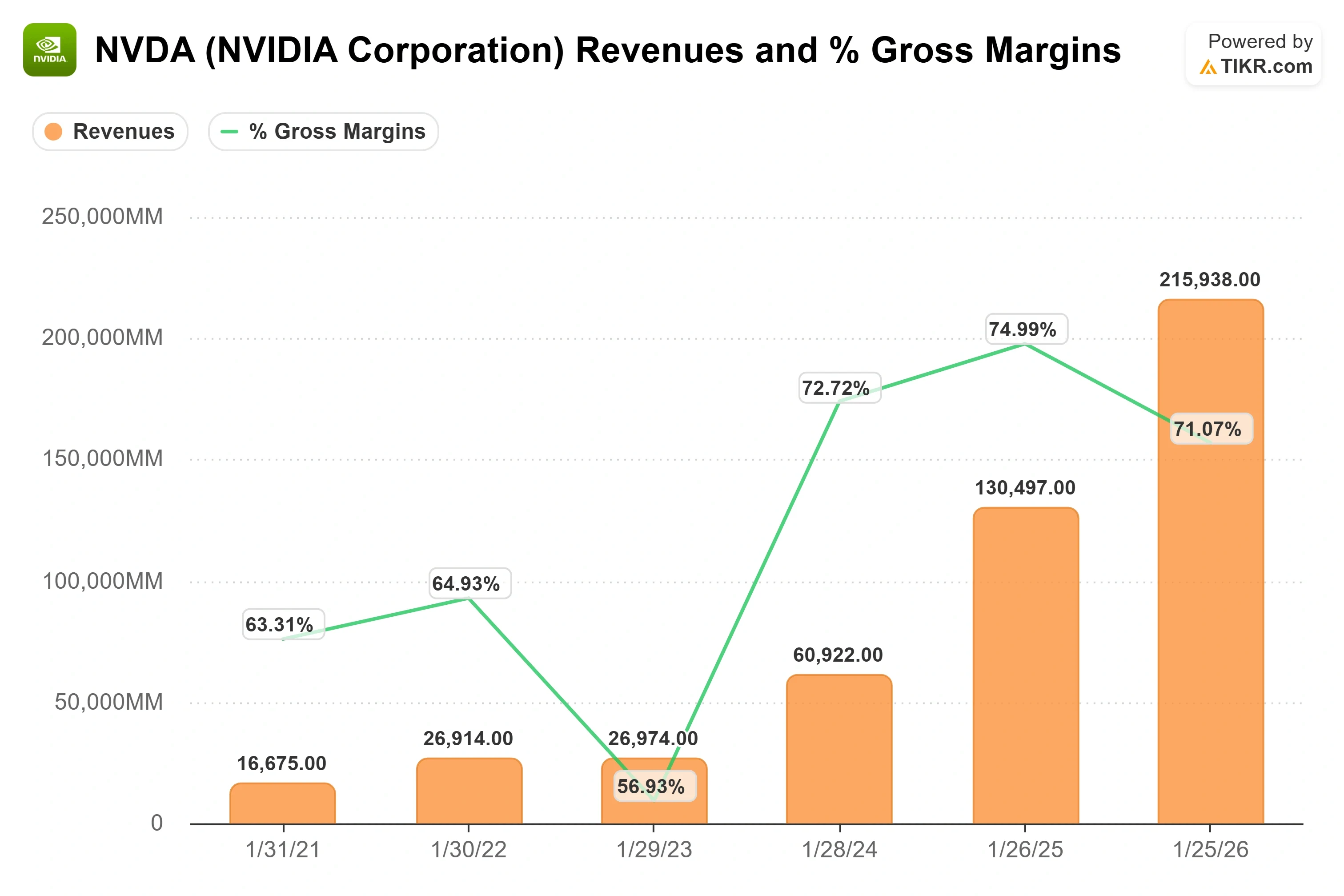
- Revenue: $96.2 billion in fiscal Q2 2027, up 106% year over year
- Data Center: $89.0 billion in revenue
- Reported gross margin: 75.0% for the quarter (GAAP and non-GAAP)
- Adjusted EPS: $2.22, and shares rose 8.74% the session after the report
Demand is not the constraint. CFO Colette Kress told investors the roughly 70% growth guided for the next fiscal year is a supply-constrained outlook, though she also flagged a near-term dip in gross margin to the low-70s in the fiscal fourth quarter on rising memory costs.
Owning Hugging Face does not stop a hyperscaler from taping out its own accelerator. It does make the developers at those companies reach for NVIDIA-optimized tooling by default, the softer and stickier version of a moat. NVIDIA has said the platform will stay open to all chips and clouds. Whether open in principle means neutral in practice is what analysts are watching.
See how NVIDIA performs against its peers in TIKR (It’s free!) >>>
What the Model Says at This Price
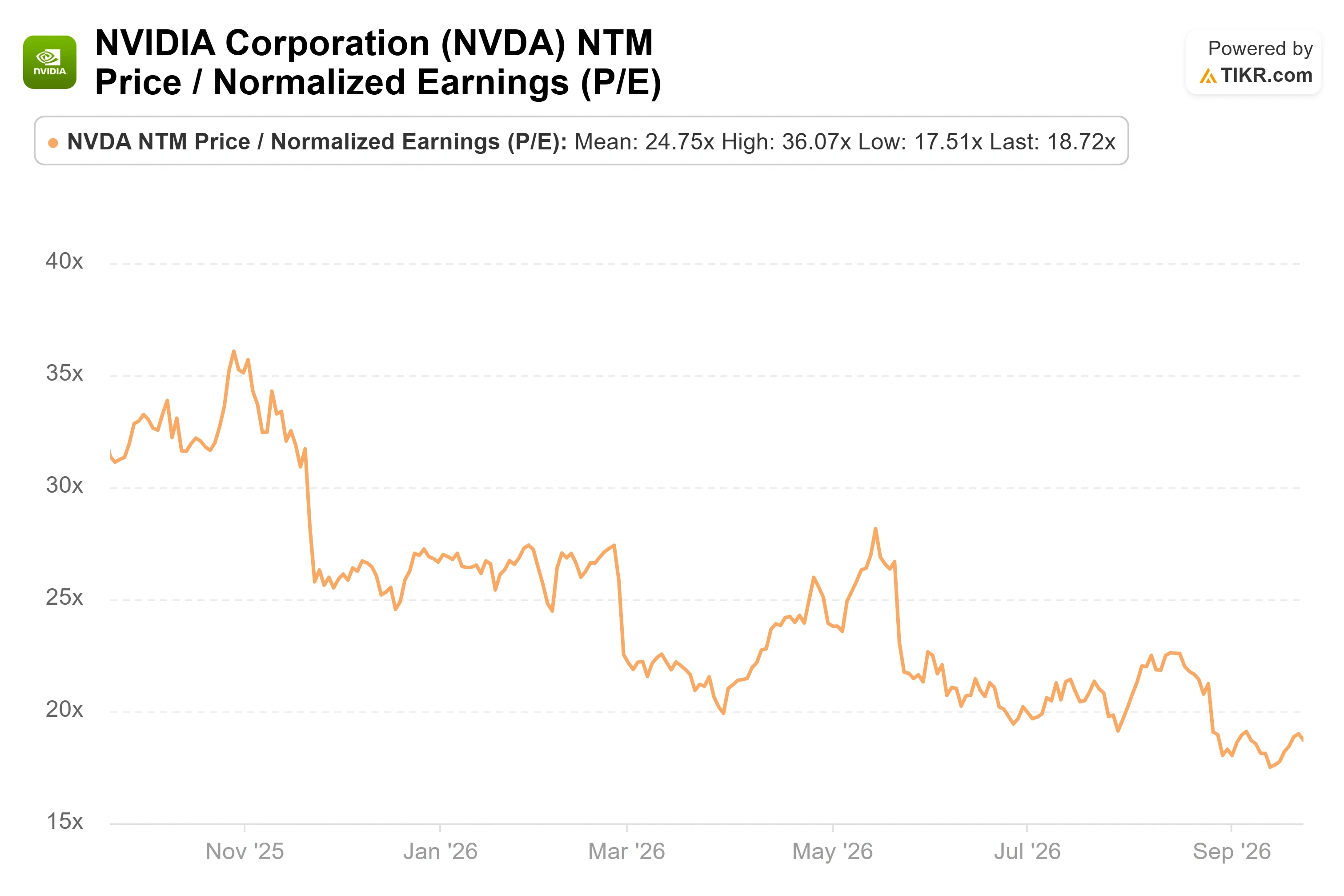
Against its own sector, NVIDIA does not stand out as the expensive name. On next-twelve-month price-to-earnings, the stock trades at 18.7 times, versus 55.6 times for Advanced Micro Devices and 20.5 times for Broadcom, per TIKR’s competitor data. It carries the highest growth profile of the three and the lowest forward multiple among the group’s fast growers. David O’Connor of Piper Sandler made the same point, launching coverage on September 10 with an Overweight rating and a $300 target, calling NVIDIA the outright leader in AI compute. That optimism is not new: even as NVIDIA’s rally kept outrunning the Street’s own targets, analysts have struggled to keep their price targets ahead of the stock.
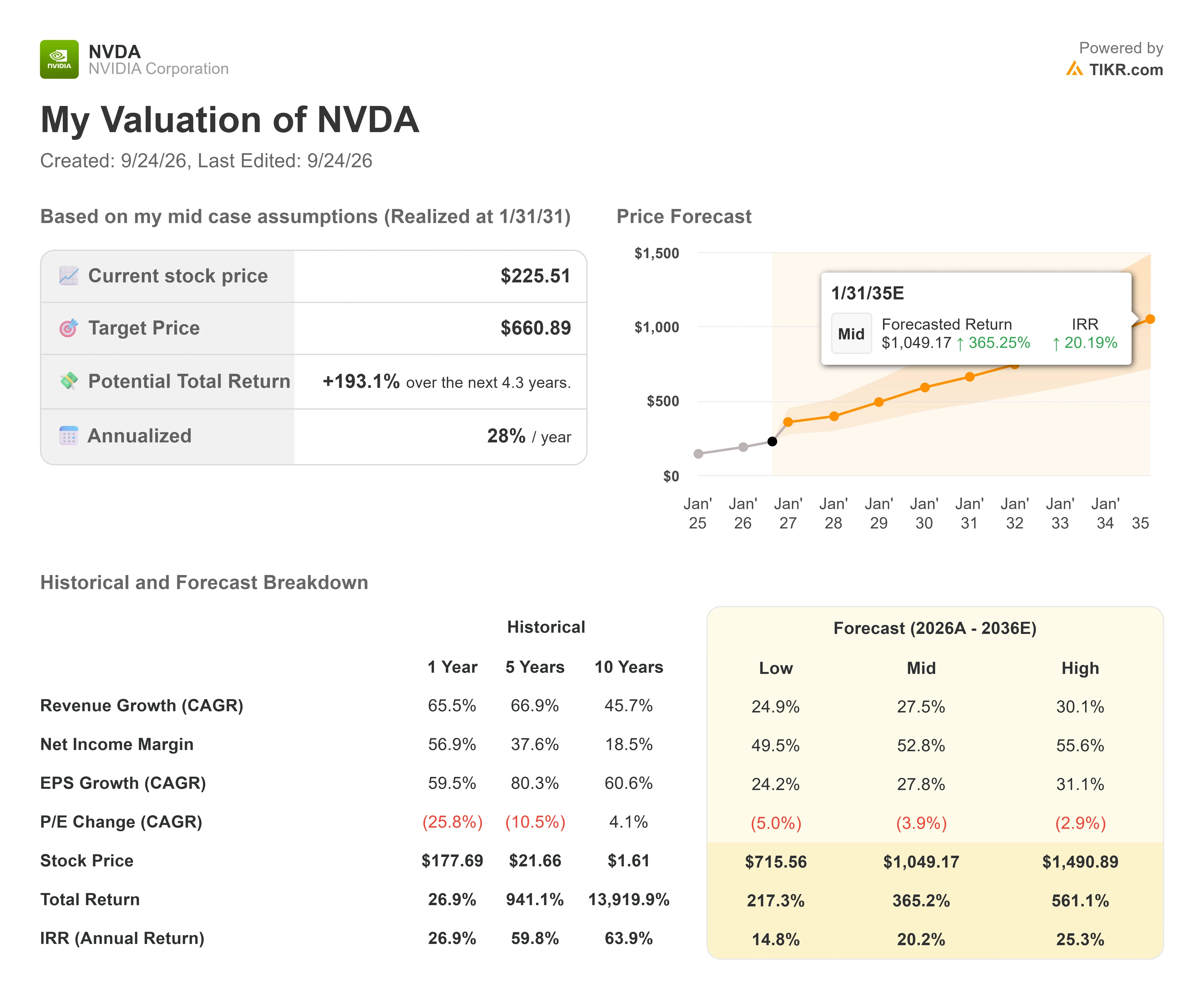
TIKR Advanced Model Analysis
- Current Price: $225.51
- Target Price (Mid): ~$660
- Potential Total Return: ~193%
- Annualized IRR: ~28% / year
See analysts’ growth forecasts and price targets for NVIDIA stock (It’s free!) >>>
The two revenue growth drivers are continued hyperscaler capital spending and the ramp of Vera Rubin, NVIDIA’s next-generation platform, reaching enterprise, sovereign, and AI-cloud customers, supporting mid-case revenue growth of around 28%. The margin driver is data center operating leverage holding a net income margin of around 53%. The primary risk is the exact one the Hugging Face deal is meant to blunt: custom silicon taking share faster than expected, which would compress both growth and the multiple. The case gets better if AI demand stays vertical and Vera Rubin ramps on schedule, and worse if hyperscaler spending normalizes.
Conclusion
Two clocks are running. The near-term one is the fiscal third-quarter report in November: revenue is almost a formality at the guided $108 billion, so the number that matters is gross margin. Management flagged a low-70s trough in the fourth quarter, so a third-quarter print holding near the guided 74% would tell investors the memory squeeze is contained. The slower clock is the deal itself, which needs regulatory clearance and is not expected to close until the first half of 2027. Until then, this is a signed agreement, and the strategy behind it is a wager that owning the road still pays when your biggest customers are trying to build their own cars.
See what stocks billionaire investors are buying so you can follow the smart money with TIKR.
Should You Invest in NVIDIA?
The only way to really know is to look at the numbers yourself. TIKR gives you free access to the same institutional-quality financial data that professional analysts use to answer exactly that question.
Pull up NVIDIA, and you’ll see years of historical financials, what Wall Street analysts expect for revenue and earnings in the quarters ahead, how valuation multiples have moved over time, and whether price targets are trending up or down.
You can build a free watchlist to track NVIDIA alongside every other stock on your radar. No credit card required. Just the data you need to decide for yourself.
Looking for New Opportunities?
- See what stocks billionaire investors are buying so you can follow the smart money.
- Analyze stocks in as little as 5 minutes with TIKR’s all-in-one, easy-to-use platform.
- The more rocks you overturn… the more opportunities you’ll uncover. Search 100K+ global stocks, global top investor holdings, and more with TIKR.
Disclaimer:
Please note that the articles on TIKR are not intended to serve as investment or financial advice from TIKR or our content team, nor are they recommendations to buy or sell any stocks. We create our content based on TIKR Terminal’s investment data and analysts’ estimates. Our analysis might not include recent company news or important updates. TIKR has no position in any stocks mentioned. Thank you for reading, and happy investing!