Key Stats for Spotify Stock
- Current Price: $499.94
- Target Price (Mid): ~$1,170
- Potential Total Return: ~134%
- Annualized IRR: ~21% / year
- Street Target: ~$607
Now Live: Discover how much upside your favorite stocks could have using TIKR’s new Valuation Model (It’s free) >>>
What Happened?
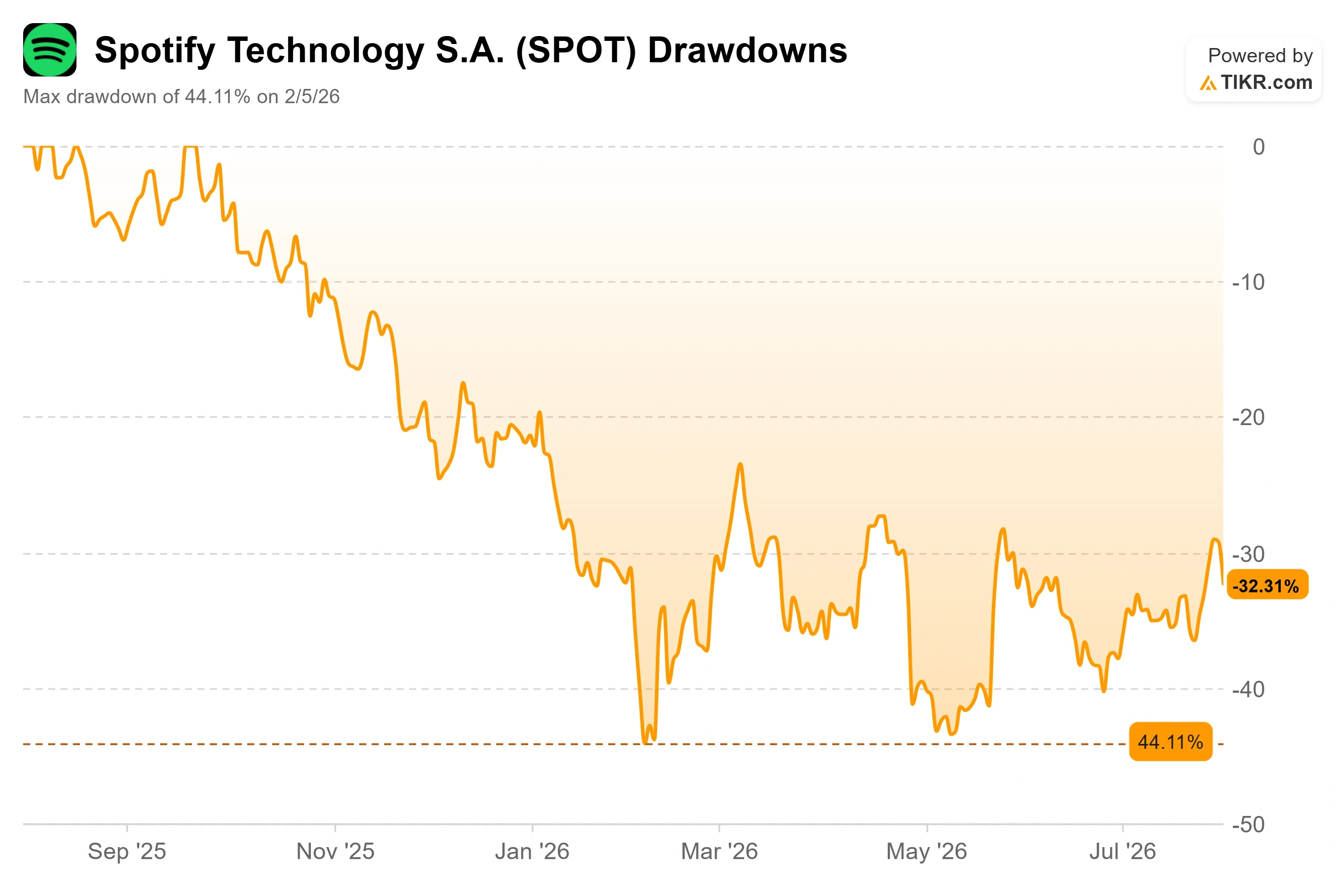
Spotify Technology (SPOT) reports second-quarter results on Tuesday, August 4, before the market opens, and the stock walks in 33% below its 52-week high of $748.30. The market has spent 2026 fixated on decelerating subscriber growth. But in May, management put a concrete new revenue lever on the table that the price barely reflects: a landmark licensing deal with Universal Music Group that will let fans create AI-generated covers and remixes as a paid Premium add-on, with participating artists sharing the revenue.
That deal is an announced agreement, not a shipped product: Spotify disclosed no price and no launch date. So it will not show up in Tuesday’s numbers. What Tuesday does test is whether the add-on strategy the UMG deal extends is already working, and the single metric that answers it is average revenue per user.
Why the UMG Deal Matters More Than One Quarter
The add-on model is the part of the story that the market is not paying for. Spotify already proved the mechanic with audiobooks: management said on May 21 that Audiobooks+ was on track to reach $100 million in annualized recurring revenue this July, and that those add-on buyers carry lifetime values several times higher than premium-only listeners. The UMG deal points the same mechanic at music itself, the largest and most engaged part of the base.
The strategic logic is sharp. Unlicensed AI music apps like Suno and Udio are being sued by the major labels, and Spotify is building the licensed alternative instead, on a consent, credit, and compensation framework. UMG CEO Lucian Grainge called it an “artist-centric” initiative designed to “drive growth for the entire ecosystem.” It gives Spotify a new way to monetize its heaviest music fans without raising the base subscription price, which is exactly the “no such thing as an average user” thesis turned into a product. The catch for now is timing: with no disclosed price or launch window, this is optionality, not modeled revenue.
See historical and forward estimates for Spotify stock (It’s free!) >>>
ARPU Is the Number That Proves It on Tuesday
If the add-on flywheel is real, it shows up first in average revenue per user, and that is the metric to grade on August 4. Management guided premium ARPU to rise 7% to 7.5% year over year in Q2, helped by the U.S. price increase that took individual plans to $12.99 in February. Spotify has raised U.S. prices three times in four years and kept churn roughly in line each time, the rare feat of adding scale while charging more for it. ARPU landing at the top of that range would say the pricing-and-add-on engine is intact heading into the UMG launch.
The rest of the guidance bar is the context. Management guided Q2 to 778 million monthly active users, 299 million premium subscribers (about 6 million net adds), revenue near €4.8 billion, and operating income of €630 million, the last figure below the roughly €684 million the Street wanted and the reason the stock fell more than 12% on the April print. Wall Street looks for adjusted EPS near $3.27 to $3.29. Headline EPS is noisy here anyway: Q1 net income tripled to €721 million, but leaned on €222 million in finance income and a €216 million tax benefit, neither of which recurs. Against a multiple of roughly 34 times trailing earnings and 26 times forward EV/EBITDA, versus Netflix near 17 times and Disney near 9 times on the same basis, the operating margin and ARPU trend matter more than any one-quarter EPS beat.

See how Spotify performs against its peers in TIKR (It’s free!) >>>
TIKR Advanced Model Analysis
- Current Price: $499.94
- Target Price (Mid): ~$1,170
- Potential Total Return: ~134%
- Annualized IRR: ~21% / year

See analysts’ growth forecasts and price targets for Spotify stock (It’s free!) >>>
TIKR’s mid case points to a price of around $1,170, a total return near 134%, and an annualized IRR of about 21% a year over roughly 4.4 years. Revenue growth rests on add-on monetization, the engine that the UMG deal and Audiobooks+ both feed, and on free-to-paid conversion in developing markets like India and Brazil, where paid penetration still sits in the single digits to low teens. The margin driver is operating leverage as the 2026 marketing and AI spend rolls off. The primary risk is advertising, which grew only about 3% in constant currency in Q1 and remains mid-rebuild. On the upside, ARPU beating guidance ahead of the UMG launch would support a re-rating from an already compressed multiple. On the downside, a soft ARPU number tells investors the price hikes are finally costing growth, and a stock near 34 times earnings has little room to forgive that.
Conclusion
The UMG add-on is the reason to hold a beaten-down stock through the noise, but it will not move Tuesday’s numbers, because no price or launch date exists yet. What moves Tuesday is ARPU against the 7% to 7.5% guide. Clear it with subscribers at or above 299 million, and the add-on thesis the UMG deal extends looks fundable. Come in soft, and the market reads it as price hikes denting growth before the new lever even ships. Watch ARPU first, operating income against €630 million second. The report lands before Tuesday’s open, and with the stock down 33% from its high, the reaction will say as much about expectations as about the quarter.
See what stocks billionaire investors are buying so you can follow the smart money with TIKR.
Should You Invest in Spotify?
The only way to really know is to look at the numbers yourself. TIKR gives you free access to the same institutional-quality financial data that professional analysts use to answer exactly that question.
Pull up Spotify, and you’ll see years of historical financials, what Wall Street analysts expect for revenue and earnings in the quarters ahead, how valuation multiples have moved over time, and whether price targets are trending up or down.
You can build a free watchlist to track Spotify alongside every other stock on your radar. No credit card required. Just the data you need to decide for yourself.
Analyze Spotify on TIKR Free →
Looking for New Opportunities?
- See what stocks billionaire investors are buying so you can follow the smart money.
- Analyze stocks in as little as 5 minutes with TIKR’s all-in-one, easy-to-use platform.
- The more rocks you overturn… the more opportunities you’ll uncover. Search 100K+ global stocks, global top investor holdings, and more with TIKR.
Disclaimer:
Please note that the articles on TIKR are not intended to serve as investment or financial advice from TIKR or our content team, nor are they recommendations to buy or sell any stocks. We create our content based on TIKR Terminal’s investment data and analysts’ estimates. Our analysis might not include recent company news or important updates. TIKR has no position in any stocks mentioned. Thank you for reading, and happy investing!