
Key Stats for Seagate Stock
- Current Price: $771.81
- Target Price (Mid): ~$3,200
- Street Target: ~$1,125
- Potential Total Return: ~315%
- Annualized IRR: ~35% / year
Now Live: Discover how much upside your favorite stocks could have using TIKR’s new Valuation Model (It’s free) >>>
What Happened?
Seagate Technology Holdings (STX) has done something the market spent a decade assuming a hard-drive maker could never do: raise prices, quarter after quarter, and make it stick. Price per exabyte climbed at a double-digit annual rate last quarter, and non-GAAP gross margin reached 52.7% in the June quarter, up roughly 570 basis points sequentially, and the thirteenth straight quarter of expansion. At $771.81 after a September 15 slide, one question now decides the stock. Is that pricing power durable, or is it a one-cycle spike that reverses the moment supply catches up?
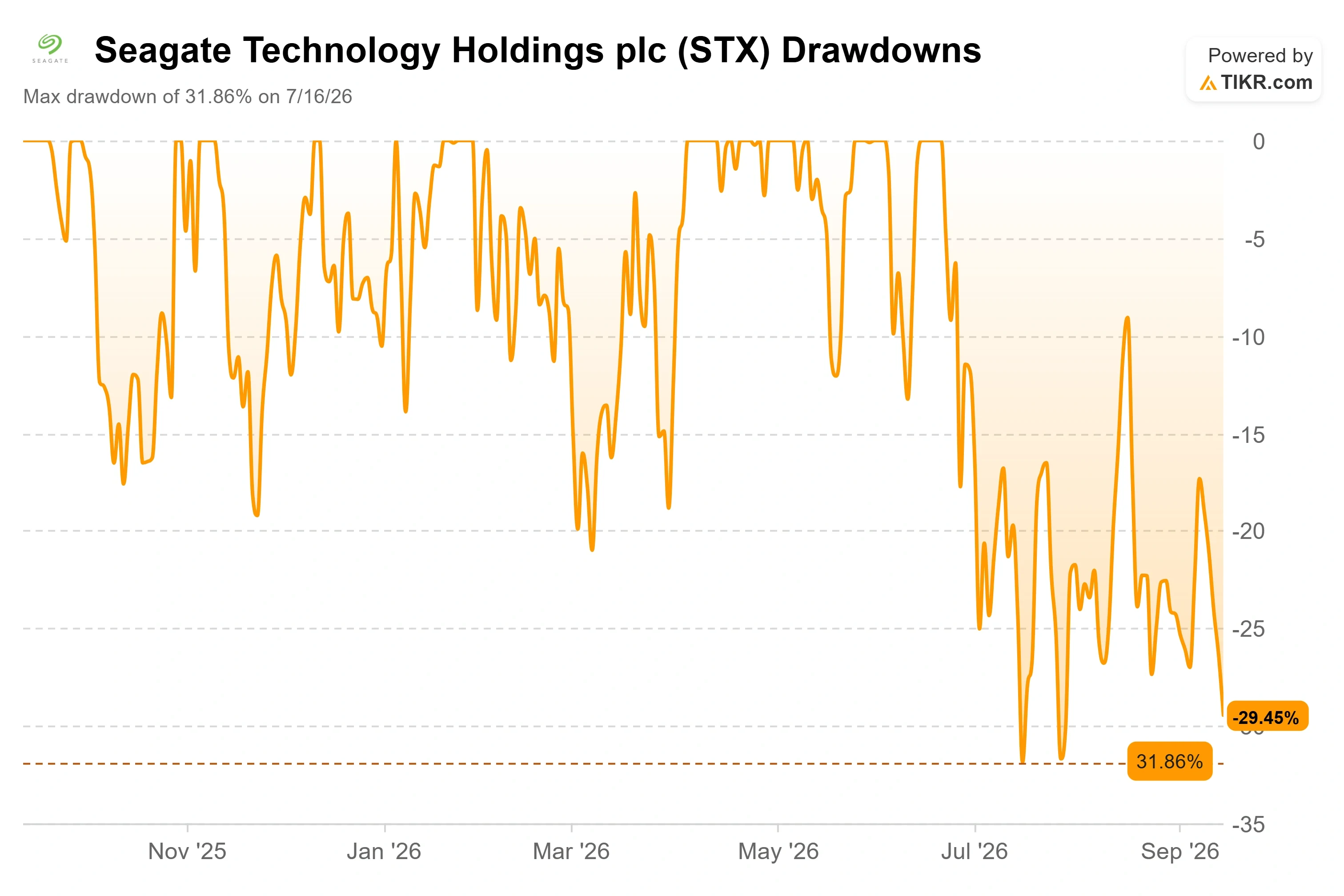
The stock fell 4.19% on September 15 and sits about 30% below its June record near $1,093, dragged down with the storage group on fears that gains in AI compute efficiency could soften future infrastructure demand. At the Goldman Sachs Communacopia conference five days earlier, CFO Gianluca Romano gave the most concrete defense yet of why the pricing holds, and it turns on how small Seagate’s bill is on a customer’s invoice.
Why the Pricing Sticks: Seagate Is a Rounding Error on a Cloud Budget
Romano’s key disclosure was a number he had not stressed before. Seagate’s drives now cost its cloud customers only “low to middle single digit” of their total capital spending. That is the crux of the pricing thesis. When storage is a few percent of a hyperscaler’s budget, and the alternative to keeping data is the far higher cost of recomputing it, a double-digit price increase per exabyte barely registers against the value delivered.
“We changed the pricing strategy about 3 years ago,” said Romano, EVP and CFO, tying the shift to a tighter supply-demand balance and the rising value of stored data. On the conference call, the analyst noted price per exabyte rose 11% year over year last quarter, a figure Romano did not dispute as he described a strategy that has “almost triple[d] our gross margin without really impacting our customers too much.” Because the price hikes are small relative to customer budgets, he argued Seagate can keep applying the approach “for a very, very long period of time.” That reframes the bear case: the risk is not that customers balk at higher prices, but that industry discipline on supply eventually breaks.
The engine underneath is the shift to HAMR, the heat-assisted recording technology that packs more terabytes onto each disk. The top cloud customers have qualified Seagate’s 30-terabyte drive, the two largest are buying 40-terabyte units, and a 50-terabyte drive arrives late in calendar 2027. Each step lifts capacity per drive against a roughly flat cost base, so incremental gross margins have been running “70-plus percent,” well above the 50% the Street modeled a year ago. Seagate’s investor relations materials show the payoff: fiscal 2026 revenue up 34% to $12.2 billion, and a June quarter up 48% year over year to $3,629 million with adjusted EPS of $5.71, a 12% beat.

See historical and forward estimates for Seagate stock (It’s free!) >>>
What Could Break It, and What Management Already Conceded
The durability case is not airtight, and Romano was unusually candid about the one thing that could dent it. Asked about a downside scenario, he did not claim demand was bulletproof. He conceded customers could slow data-center construction because of power constraints, permitting delays, or missing components, which would push orders out in time. His argument was that the demand does not disappear, it defers, and that Seagate’s discipline on capacity, adding exabytes through technology rather than new factories, lets it manage a slowdown better than a unit-driven builder could.
That candor matters more than a polished answer would. It tells you the risk is timing, and Seagate has already contracted much of its near-term demand: purchase orders cover the next four to five quarters at a fixed mix, volume, and price, with nearline capacity allocated into calendar 2028. The recent insider selling sits against that backdrop. CFO Gianluca Romano’s own filings show the largest sale, about $38 million on September 15, was an issuer-mandated sell-to-cover to satisfy tax withholding on performance shares that vested the day before, not a discretionary call on the stock. Executives, including the CFO, have trimmed stakes through pre-scheduled 10b5-1 plans, each running on a fixed calendar rather than a view on the quarter.
Even after a 30% drawdown, shares trade near 22x next-twelve-months earnings and about 17x NTM EV/EBITDA, a full multiple for a business long treated as cyclical. The premium over peers is thinner than it looks: Western Digital sits near 20.5x forward earnings and 15x NTM EV/EBITDA, with Dell and NetApp around 19x. Against Western Digital, its closest comparison, Seagate is qualified deeper on high-capacity drives and carries fatter incremental margins, so the premium looks earned, though it leaves little room for error if supply discipline slips.
See how Seagate performs against its peers in TIKR (It’s free!) >>>
TIKR Advanced Model Analysis
- Current Price: $771.81
- Target Price (Mid): ~$3,200
- Potential Total Return: ~315%
- Annualized IRR: ~35% / year

See analysts’ growth forecasts and price targets for Seagate stock (It’s free!) >>>
The mid-case scenario points to a fair value near $3,200 by mid-2031, an annualized return of around 35%. Two revenue drivers carry it: continued exabyte growth through the HAMR capacity transitions, and the double-digit price-per-exabyte gains the pricing strategy has delivered for three years. Together, they support a mid-case revenue CAGR near 21%. The margin driver is the same mix shift, with net income margin modeled toward the low 50s, in line with the 70%-plus incremental gross margins already posting. The primary risk is a break in industry supply discipline that ends the pricing run, or a demand deferral if hyperscalers hit power and permitting limits.
That ~$3,200 mid-case figure is a scenario built on those assumptions holding, not a forecast. Wall Street’s 12-month mean target sits far lower, near $1,125, which still implies roughly 46% upside. Sentiment is heavily positive: of the 25 firms rating the stock, 18 rate it Buy, 4 Outperform, 2 Hold, 1 Underperform, and none rate it Sell.
Conclusion
The pricing thesis gets its next test in late October, when Seagate reports fiscal Q1 2027 after the close. Management guided to $4.1 billion in revenue and non-GAAP EPS of $7.30. The number that matters is not the headline beat but the price-per-exabyte trend and whether gross margin holds its climb. If margins expand again and the language around the four-to-five-quarter order book stays firm, Romano’s low-single-digit-of-capex argument holds, and the pullback looks like sentiment. If pricing flattens, the market’s fear that this was a cyclical peak gets its first real evidence.
See what stocks billionaire investors are buying so you can follow the smart money with TIKR.
Should You Invest in Seagate?
The only way to really know is to look at the numbers yourself. TIKR gives you free access to the same institutional-quality financial data that professional analysts use to answer exactly that question.
Pull up Seagate, and you’ll see years of historical financials, what Wall Street analysts expect for revenue and earnings in the quarters ahead, how valuation multiples have moved over time, and whether price targets are trending up or down.
You can build a free watchlist to track Seagate alongside every other stock on your radar. No credit card required. Just the data you need to decide for yourself.
Analyze Seagate on TIKR Free →
Looking for New Opportunities?
- See what stocks billionaire investors are buying so you can follow the smart money.
- Analyze stocks in as little as 5 minutes with TIKR’s all-in-one, easy-to-use platform.
- The more rocks you overturn… the more opportunities you’ll uncover. Search 100K+ global stocks, global top investor holdings, and more with TIKR.
Disclaimer:
Please note that the articles on TIKR are not intended to serve as investment or financial advice from TIKR or our content team, nor are they recommendations to buy or sell any stocks. We create our content based on TIKR Terminal’s investment data and analysts’ estimates. Our analysis might not include recent company news or important updates. TIKR has no position in any stocks mentioned. Thank you for reading, and happy investing!