Key Stats for Alibaba Stock
- Current Price: $109.34
- Target Price (Mid): ~$221
- Street Target: ~$186
- Potential Total Return: ~102%
- Annualized IRR: ~17% / year
Now Live: Discover how much upside your favorite stocks could have using TIKR’s new Valuation Model (It’s free) >>>
What Happened?
Alibaba (BABA) gave analysts one event to react to, and they walked away pointing in opposite directions. On September 7, Bernstein’s Robin Zhu cut his price target to $165 from $180 while keeping an Outperform rating. The same morning, BofA’s Joyce Ju raised her target to $175 from $172 and kept her Buy. Both were staring at the identical fact: Alibaba had just sold $10.2 billion of new stock to fund AI infrastructure, three days after telling investors it held $30.7 billion in net cash.
The argument is narrower: whether raising equity at a discount, while free cash flow bleeds, is disciplined capital allocation or a warning about returns on all this spending. The stock has round-tripped back to about $109 after falling roughly 10% on the placement, so the market has not settled it either.
Why a Buy-Rated Bank Still Cut Its Number
Zhu wrote that with Alibaba holding $30.7 billion of net cash, the deal “diluted the credibility of management’s ROI claims,” yet his own analysis “mostly supports management’s claims on payback on capex.” He built a data center model around Alibaba’s Zhenwu 810E chip, showing a roughly three-year payback, tightening toward 2.5 years on the newer M890. His problem was the timing and optics of funding the buildout through dilution, not the strategy.
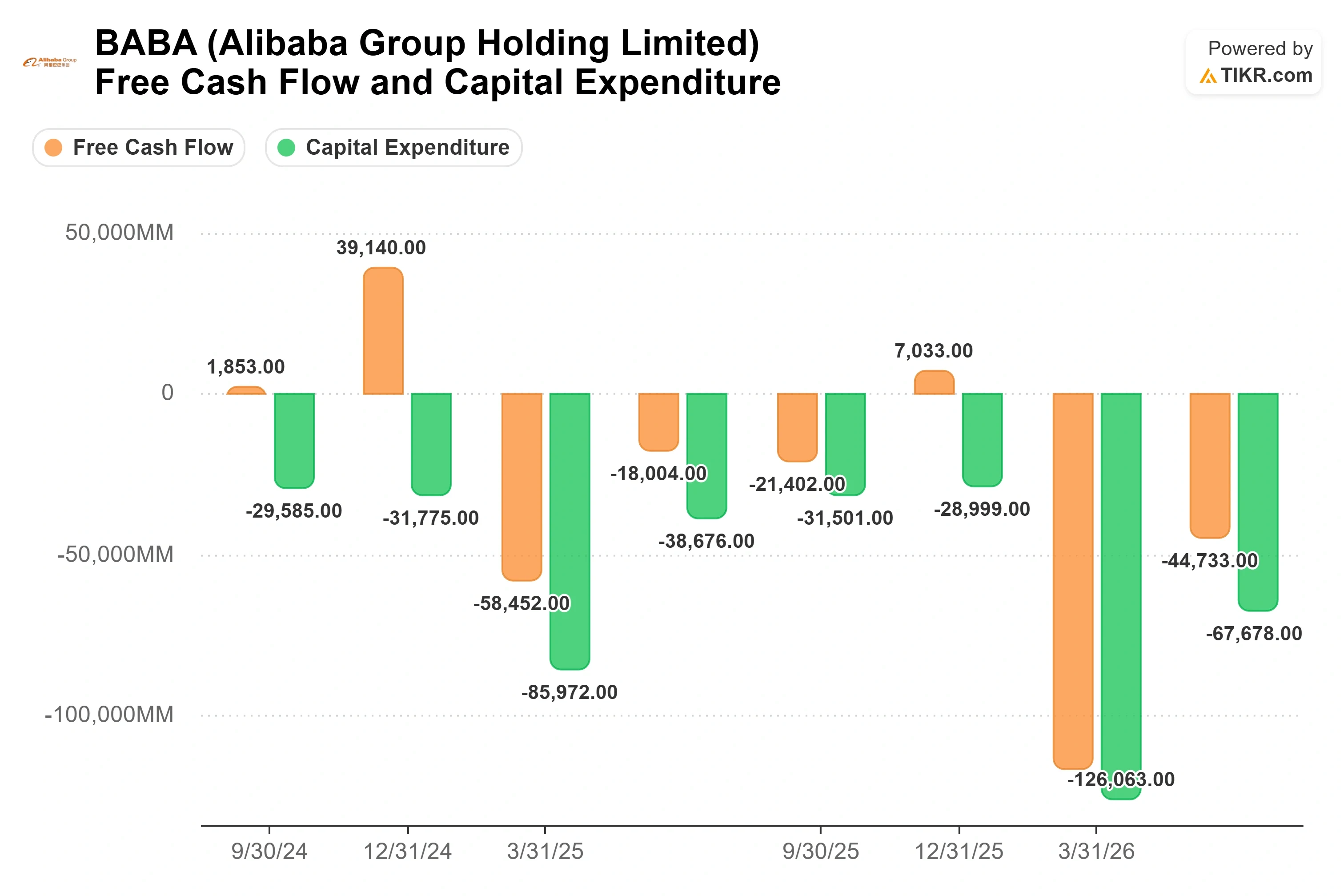
For the June period (fiscal Q1 2027), reported August 20, revenue rose 8.6% to RMB 268.95 billion, a slight beat, while everything below the top line went the other way. Adjusted EBITDA fell 30%, GAAP net income dropped 75%, and free cash flow swung to an RMB 44.7 billion outflow as capex hit RMB 67.7 billion in a single quarter. Adjusted EPS of RMB 8.52 missed the RMB 10.82 that the Street expected. TIKR logs an 8.57% single-day drop on the August 20 earnings date, though the print-day reaction was volatile and the larger, cleaner selloff came days later on the placement.
Management is not hiding the tradeoff. CFO Toby Xu described capital allocation as running across “investments for AI + Cloud business growth, share buybacks and dividends,” with priorities that shift as conditions evolve. The same balance sheet is funding a buildout, returning cash, and absorbing an earnings hit at once, and the two banks are pricing which wins.
See historical and forward estimates for Alibaba stock (It’s free!) >>>
The Number Management Wants You to Anchor On
Behind the earnings damage sits the framework Alibaba spent most of its August call defending, and it is the strongest answer the bulls have. On the call, management laid out the math: at current gross margins and a three-year capex payback, keeping revenue growth below 33% would already produce positive cash flow.
One executive put it plainly: “keeping our growth rate below 33% would already enable positive cash flow. However, that is not our strategic choice at this time.” That reframes the negative free cash flow. In management’s telling, the outflow is a decision to outspend the breakeven line while AI demand is scarce and pricing power is high, not the business failing to fund itself. Bernstein believes the payback but questioned the optics of funding it with dilution; BofA read the same call and nudged its number up.
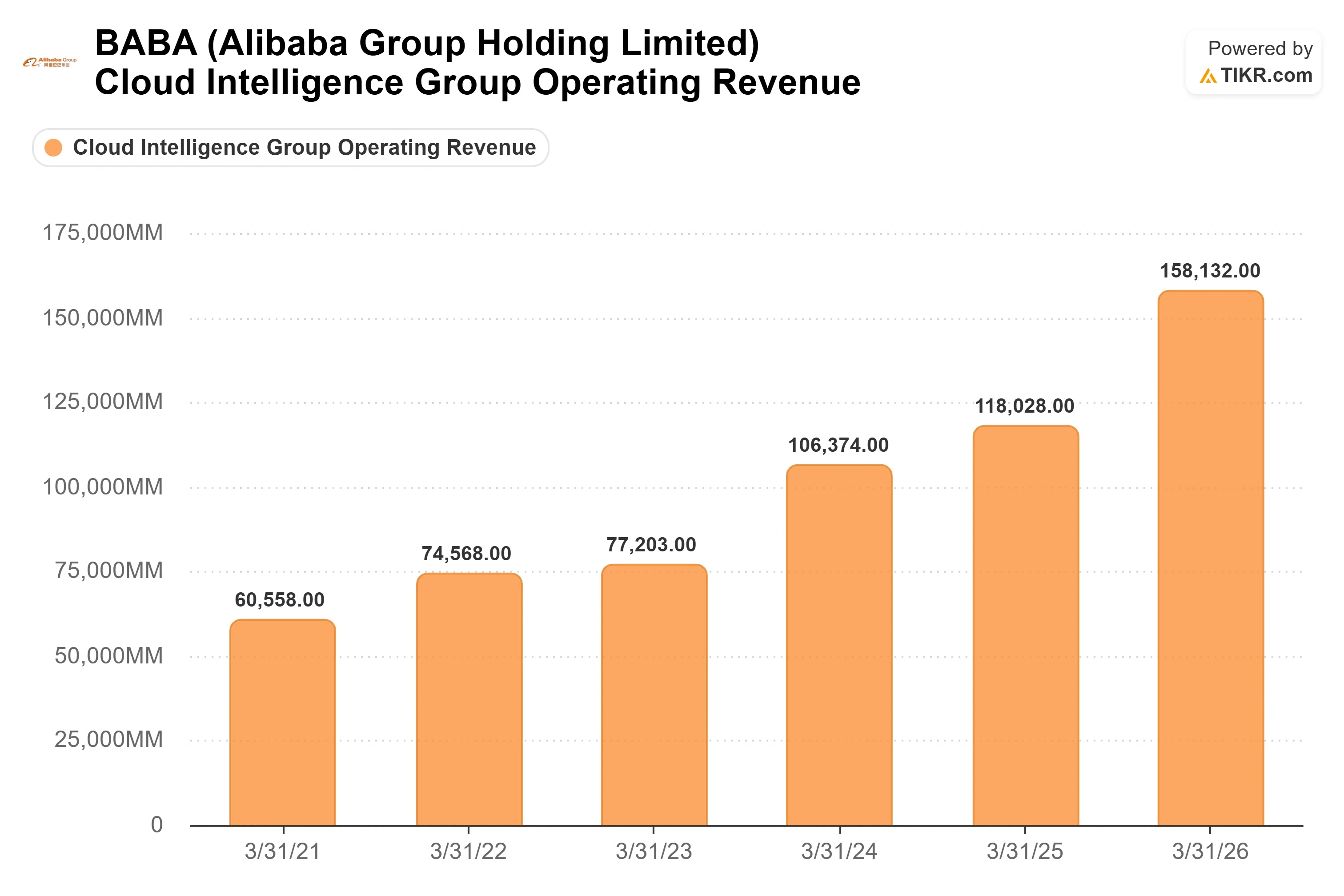
External cloud revenue grew 45%, the fastest in 22 quarters, and AI-related product revenue hit RMB 12.4 billion, a 12th straight quarter of triple-digit growth, now 35% of external cloud revenue. Management guided the annualized AI run rate, about $7.3 billion this quarter, to approach $10 billion next quarter, with segment EBITDA margin already at 12%. What the placement then complicated was trust: having just pointed to a strong cash position, the company turned around and asked shareholders to fund still more. Two signals pushed back on the dilution fear. Chairman Joe Tsai and CEO Eddie Wu bought a combined HK$120 million of stock in the open market, per Hong Kong exchange filings, and the placement drew institutional demand of close to three times the shares on offer. The reported $300 million Alibaba is leading into AI benchmarking startup UniPat AI, a deal Bloomberg says is not yet closed, cuts the other way: capital keeps flowing outward while cash generation runs backward.
See how Alibaba performs against its peers in TIKR (It’s free!) >>>
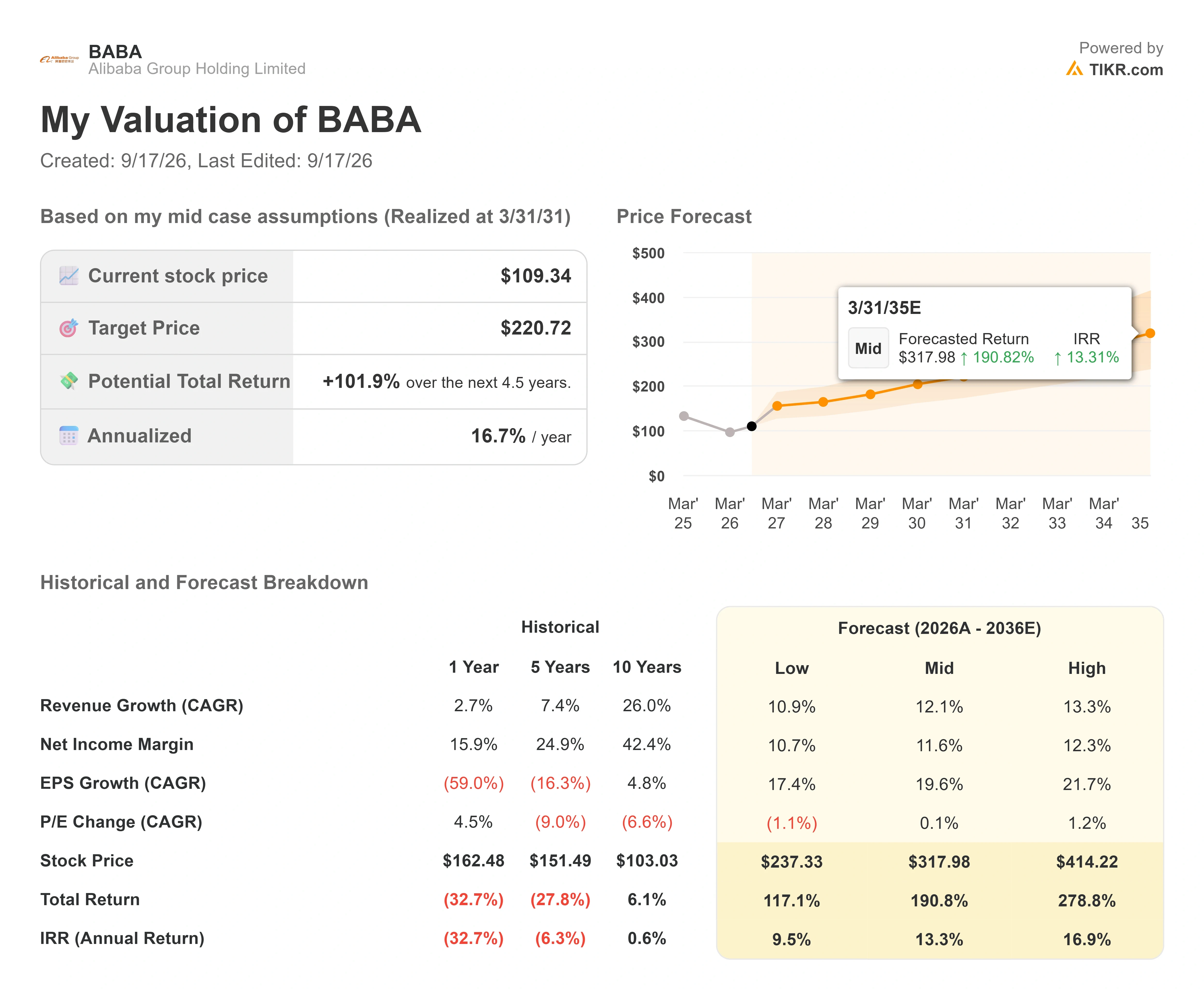
TIKR Advanced Model Analysis
- Current Price: $109.34
- Target Price (Mid): ~$221
- Potential Total Return: ~102%
- Annualized IRR: ~17% / year
See analysts’ growth forecasts and price targets for Alibaba stock (It’s free!) >>>
The TIKR Valuation Model uses the mid-case scenario, which sits above both the highest and lowest bank targets because it runs a longer horizon than a 12-month Street call. It points to a fair value near $221 by early 2031, a total return around 102%, and an IRR near 17% per year from today’s price.
Two drivers carry the revenue line: Alibaba Cloud, growing external revenue at 45% and targeted by management to reach RMB 100 billion by 2030 at a 20% gross margin, and recovering core commerce monetization as quick commerce losses narrow. The model assumes forward revenue growth of around 12% annually, below the historical peak but well above last year’s 2.7%. The margin driver is the cloud mix shift that lifted segment EBITDA margin to 12%, with proprietary T-Head chips replacing bought-in silicon over time. The primary risk is the one the September cuts named: capex outrunning cloud profit, which keeps free cash flow negative longer if chip substitution runs slow. On the upside, hitting the $10 billion AI run rate with expanding margins re-rates a stock trading under 14 times forward earnings; on the downside, another raise or a wider cash outflow validates the bears, and a pending securities class action, with an October 5 lead-plaintiff deadline and allegations Alibaba disputes, keeps a legal overhang on the multiple.
Conclusion
The next print, expected around December 1, is where this resolves. Watch one number above the headlines: the gap between capex growth and cloud revenue growth. If cloud external revenue holds near 45% while capex flattens or the AI run rate clears the $10 billion mark, management guided, the bulls who kept their Buy ratings get their proof, and the September cuts read as noise. If capex keeps climbing and free cash flow widens its outflow again, the bears get theirs, and the discount that looks like an opportunity today starts to look like a value trap.
See what stocks billionaire investors are buying so you can follow the smart money with TIKR.
Should You Invest in Alibaba?
The only way to really know is to look at the numbers yourself. TIKR gives you free access to the same institutional-quality financial data that professional analysts use to answer exactly that question.
Pull up Alibaba, and you’ll see years of historical financials, what Wall Street analysts expect for revenue and earnings in the quarters ahead, how valuation multiples have moved over time, and whether price targets are trending up or down.
You can build a free watchlist to track Alibaba alongside every other stock on your radar. No credit card required. Just the data you need to decide for yourself.
Analyze Alibaba on TIKR Free →
Looking for New Opportunities?
- See what stocks billionaire investors are buying so you can follow the smart money.
- Analyze stocks in as little as 5 minutes with TIKR’s all-in-one, easy-to-use platform.
- The more rocks you overturn… the more opportunities you’ll uncover. Search 100K+ global stocks, global top investor holdings, and more with TIKR.
Disclaimer:
Please note that the articles on TIKR are not intended to serve as investment or financial advice from TIKR or our content team, nor are they recommendations to buy or sell any stocks. We create our content based on TIKR Terminal’s investment data and analysts’ estimates. Our analysis might not include recent company news or important updates. TIKR has no position in any stocks mentioned. Thank you for reading, and happy investing!