Key Takeaways
- Procter & Gamble raised its dividend 3% in fiscal 2026 and guided to pay over $10 billion in dividends again in fiscal 2027, part of a $15 billion total shareholder return plan.
- The quarterly dividend reached $1.09 in the most recent quarter, up from $1.06 across four straight quarters and $1.01 the year before that.
- Payout ratio jumped to 85.71% last quarter, and yield sits at 3.00%.
- TIKR’s mid-case model targets $204 for Procter & Gamble stock by mid-2031, a 39% total return worth 7% annualized from today’s $147 share price.
Procter & Gamble Commits to a $15 Billion Payout Despite Fiscal 2027 Cost Hit
Procter & Gamble (NYSE: PG) closed fiscal 2026 by raising its dividend 3%, part of a plan that returned more than $15 billion to shareholders over the year.
CFO Andre Schulten broke that figure down on the company’s fiscal fourth-quarter call held July 29, 2026: over $10 billion in dividends and $5 billion in share buybacks, matching the guidance P&G gave investors at the start of the year.
Procter & Gamble stock investors got the same commitment for fiscal 2027. Schulten told analysts the company plans to pay over $10 billion in dividends again and repurchase roughly $5 billion in stock, a combined $15 billion return to shareowners.
That promise comes against a tougher backdrop. Schulten set core earnings per share growth guidance at just 0% to 3% for fiscal 2027, off a fiscal 2026 base of $6.89, with $7 at the center of the range.
The company is absorbing a $1.4 billion after-tax hit, worth $0.56 per share and 8% of fiscal 2026 core EPS, from higher costs, foreign exchange and items below the operating line.
Schulten pinned roughly $1 billion of that after-tax hit on higher raw materials, energy and transportation costs tied to the conflict in the Middle East, assuming an effective Brent crude price of $90 a barrel.
Most of that cost pressure lands early. Schulten flagged that these costs will likely cut first-quarter earnings per share by 5% or more versus the prior year.
Cash generation is also set to loosen. Adjusted free cash flow productivity ran at 100% for fiscal 2026 and 133% in the fourth quarter alone, but Schulten guided fiscal 2027 productivity down to a range of 85% to 90%.
CEO Shailesh Jejurikar framed the capital plan as unwavering despite the pressure. “We will maintain strong investment in the business, balanced by a strong productivity program with an intent to improve results semester-by-semester and year-by-year,” he said.
Procter & Gamble Stock’s Payout Ratio Spike Complicates a Dividend Still Growing

The trajectory backs up what Schulten told analysts. Procter & Gamble stock’s quarterly dividend held at $1.01 through three straight quarters, stepped up to $1.06 for four more, and now sits at $1.09 in the most recent quarter, consistent with the 3% increase management referenced for fiscal 2026. That progression shows a board still willing to raise the payout on a predictable schedule, not one pausing to conserve cash.
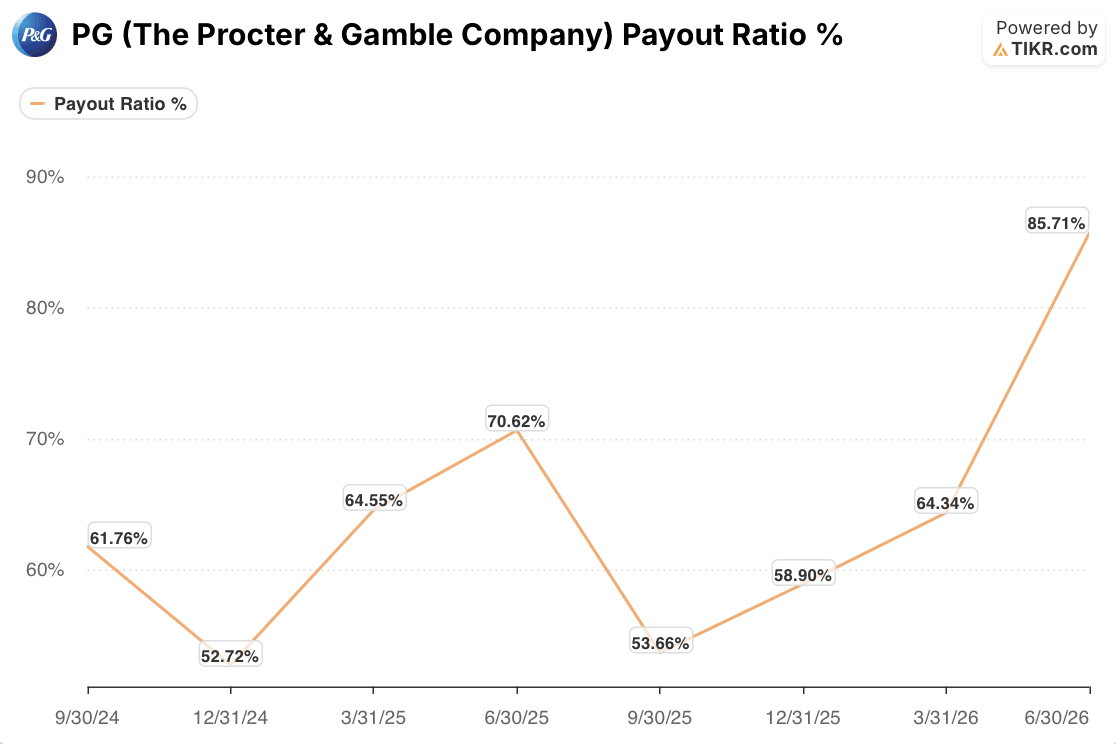
The payout ratio tells a less comfortable story. It moved in a band between 52.72% and 70.62% across the prior seven quarters, then jumped to 85.71% in the latest one. A payout ratio that high leaves far less earnings cushion than Procter & Gamble stock has carried through most of this stretch, and it lines up with the fiscal 2027 guidance for compressed core EPS growth and a first-quarter earnings hit of 5% or more. If earnings stay pressured while the dividend keeps climbing, that ratio has little room left to move before the payout starts looking stretched rather than merely generous.

Yield adds the market’s own verdict. The forward dividend yield last printed at 3.00%, close to its 3.14% high over the period and well above the 2.65% mean and 2.25% low. A yield sitting near the top of its own range usually means one of two things: the stock has gotten cheaper, or investors are demanding more income to compensate for slower growth ahead. Either reading makes Procter & Gamble stock more interesting to income buyers right now than it has been for most of the stretch covered here.
Put together, the three data points do not fully agree. The trajectory says the dividend keeps growing on schedule. The payout ratio says that growth is now eating a bigger share of earnings than at any point in this data. The yield says the market has already priced in some of that caution. None of that points to a cut, but it does mean the cushion behind the next raise is thinner than it was even two quarters ago.
TIKR’s Model Sees Procter & Gamble Stock Reaching $204 by Mid-2031
TIKR’s mid-case valuation model puts Procter & Gamble stock at a $204 target price by mid-2031, a 39% total return worth 7% annualized from today’s $147 share price.

That return profile reads as a steady compounder rather than a turnaround story, with price appreciation doing most of the work and dividends contributing the rest.
The case for reaching that target rests on the business Schulten and Jejurikar described on the call: mid-single-digit growth in categories like Hair Care and Skin and Personal Care, a return to share growth in Greater China after 15 quarters of decline, and a $2.8 billion pretax productivity program funding continued investment straight through the fiscal 2027 cost headwind.
Should You Invest in The Procter & Gamble Company?
The only way to really know is to look at the numbers yourself. TIKR gives you free access to the same institutional-quality financial data that professional analysts use to answer exactly that question.
Pull up The Procter & Gamble Company stock and you’ll see years of historical financials, what Wall Street analysts expect for revenue and earnings in the quarters ahead, how valuation multiples have moved over time, and whether price targets are trending up or down.
You can build a free watchlist to track The Procter & Gamble Company alongside every other stock on your radar. No credit card required. Just the data you need to decide for yourself.
Access Professional Tools to Analyze PG stock on TIKR for Free →
Looking for New Opportunities?
- See what stocks billionaire investors are buying so you can follow the smart money.
- Analyze stocks in as little as 5 minutes with TIKR’s all-in-one, easy-to-use platform.
- The more rocks you overturn… the more opportunities you’ll uncover. Search 100K+ global stocks, global top investor holdings, and more with TIKR.
Disclaimer:
Please note that the articles on TIKR are not intended to serve as investment or financial advice from TIKR or our content team, nor are they recommendations to buy or sell any stocks. We create our content based on TIKR Terminal’s investment data and analysts’ estimates. Our analysis might not include recent company news or important updates. TIKR has no position in any stocks mentioned. Thank you for reading, and happy investing!